What does a seismic engineer do?
Seismic engineer responsibilities
Here are examples of responsibilities from real seismic engineer resumes:
- Authore substantiation documents in compliance with FAA regulations and customer requirements to achieve type certifications and supplemental type certifications.
- Cover all aspects of QC and in-file processing.
- Company's algorithms have been develop for streamer data and are not appropriate for an OBC project.
- Supervise a team which design and construct the first 1 11/16"3 axis VSP tool for Schlumberger.
- Determine loads as per ASCE 7 and perform engineering calculations for beams, columns, foundations and connections.
- Streamline the process of FEA model building, solving and post processing by writing custom ANSYS APDL macros.
- Perform dynamic analysis & seismic design of under- & above-ground structures base on IBC standards and local building codes.
- Perform the finite element models/ report check by using PATRAN model with NASTRAN solution on wing structure for A320NEO airplane.
- Create IronPython scripts to intelligently determine ANSYS license availability and efficiently use all licenses.
- Work in bridge inspection and analysis to complete preliminary and final plans and specifications for rehabilitation projects.
- Design repair procedures for structures under distress or to correct improper construction, and provide structural design associate with rehabilitation.
- Conduct geotechnical and environmental subsurface investigations.
- Conduct geotechnical and environmental subsurface investigations.
Seismic engineer skills and personality traits
We calculated that 27% of Seismic Engineers are proficient in Technical Support, Stress Analysis, and Retrofit. They’re also known for soft skills such as Analytical skills, Writing skills, and Math skills.
We break down the percentage of Seismic Engineers that have these skills listed on their resume here:
- Technical Support, 27%
Provide technical support to the sales team.
- Stress Analysis, 25%
Executed site investigation, collected historical & field technical data for structures distress analysis.
- Retrofit, 18%
Cost Engineer/Estimator Performed quantity take-offs and prepared estimates for new and retrofit proposals using parametric and conventional estimating techniques.
- Nuclear Power, 11%
Created and presented slide presentations to engineering colleagues about nuclear power plant functions.
- R, 7%
Employed MCMC expertise to uncover problems within the C# code and issues in the original R code.
- Data Processing, 5%
Developed training materials for land data processing.
"technical support," "stress analysis," and "retrofit" are among the most common skills that seismic engineers use at work. You can find even more seismic engineer responsibilities below, including:
Analytical skills. One of the key soft skills for a seismic engineer to have is analytical skills. You can see how this relates to what seismic engineers do because "mining and geological engineers must take many factors into account when evaluating new mine locations and designing facilities." Additionally, a seismic engineer resume shows how seismic engineers use analytical skills: "modeled support components per stress analysis for standard and engineered supports. "
Writing skills. Another soft skill that's essential for fulfilling seismic engineer duties is writing skills. The role rewards competence in this skill because "mining and geological engineers must prepare reports and instructions for other workers." According to a seismic engineer resume, here's how seismic engineers can utilize writing skills in their job responsibilities: "assisted bombardier senior engineers in developing and debugging the program, as well as writing and translating technical documents. "
Math skills. seismic engineers are also known for math skills, which are critical to their duties. You can see how this skill relates to seismic engineer responsibilities, because "mining and geological engineers use the principles of calculus, trigonometry, and other advanced topics in math for analysis, design, and troubleshooting in their work." A seismic engineer resume example shows how math skills is used in the workplace: "perform finite element simulations to validate equipment designs and suggest design changes using ansys software and computational mathematical tools. "
Problem-solving skills. For certain seismic engineer responsibilities to be completed, the job requires competence in "problem-solving skills." The day-to-day duties of a seismic engineer rely on this skill, as "mining and geological engineers must explore for potential mines, plan their operations and mineral processing, and design environmental reclamation projects." For example, this snippet was taken directly from a resume about how this skill applies to what seismic engineers do: "participated in the development of solution 360 debugger tool with java, javascript and angular.js in vise team verizon. "
The three companies that hire the most seismic engineers are:
- Planate Management Group1 seismic engineers jobs
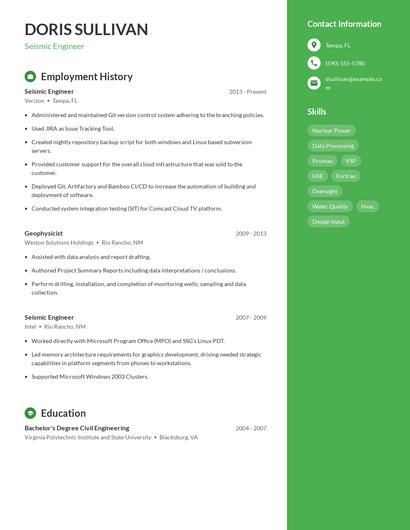
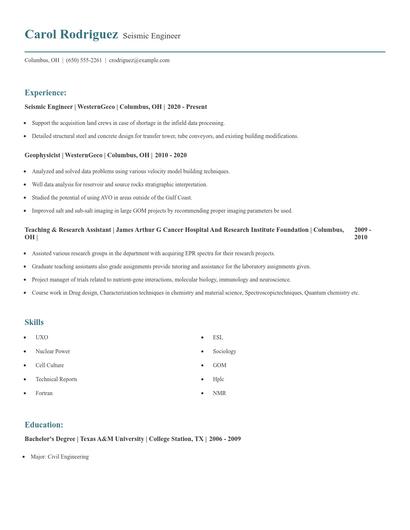
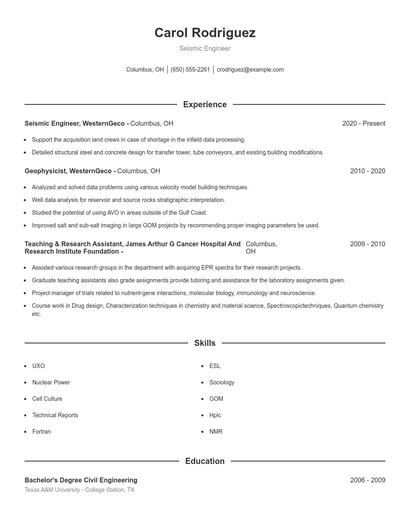
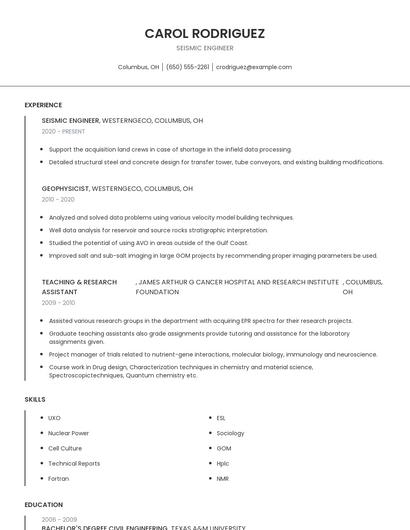
Choose from 10+ customizable seismic engineer resume templates
Build a professional seismic engineer resume in minutes. Our AI resume writing assistant will guide you through every step of the process, and you can choose from 10+ resume templates to create your seismic engineer resume.





Compare different seismic engineers
Seismic engineer vs. Mine safety director
There are some key differences in the responsibilities of each position. For example, seismic engineer responsibilities require skills like "technical support," "stress analysis," "retrofit," and "nuclear power." Meanwhile a typical mine safety director has skills in areas such as "msha," "breakthrough strategies," "safety program," and "mine site." This difference in skills reveals the differences in what each career does.
On average, mine safety directors reach similar levels of education than seismic engineers. Mine safety directors are 0.3% less likely to earn a Master's Degree and 6.5% less likely to graduate with a Doctoral Degree.Seismic engineer vs. Mine safety manager
In addition to the difference in salary, there are some other key differences worth noting. For example, seismic engineer responsibilities are more likely to require skills like "technical support," "stress analysis," "retrofit," and "nuclear power." Meanwhile, a mine safety manager has duties that require skills in areas such as "safety audits," "msha," "safety program," and "accident investigation." These differences highlight just how different the day-to-day in each role looks.
Mine safety managers earn lower levels of education than seismic engineers in general. They're 21.0% less likely to graduate with a Master's Degree and 6.5% more likely to earn a Doctoral Degree.Seismic engineer vs. Mining consultant
Some important key differences between the two careers include a few of the skills necessary to fulfill the responsibilities of each. Some examples from seismic engineer resumes include skills like "technical support," "stress analysis," "retrofit," and "nuclear power," whereas a mining consultant is more likely to list skills in "geotechnical," "extraction," "sas," and "financial models. "
Most mining consultants achieve a similar degree level compared to seismic engineers. For example, they're 2.1% less likely to graduate with a Master's Degree, and 1.7% less likely to earn a Doctoral Degree.Seismic engineer vs. Mine inspector
Types of seismic engineer
Updated January 8, 2025
