What does a senior implementation engineer do?
Senior implementation engineer responsibilities
Here are examples of responsibilities from real senior implementation engineer resumes:
- Manage the roll-out of all hardware and CareFusion mobile suite of products from QA to deployment.
- Lead engineering for medical products, FDA 510k submissions and NIOSH approvals to international companies, primarily in Asia.
- Coordinate with manage service delivery teams to ensure the accurate deployment of organizational Cisco router and switches.
- Handle the queries regarding XML and troubleshoot the complex technical XML problems.
- Provision and maintain Unix servers for web hosting customers.
- Ensure that all QA steps are taken before handover to customers.
- Certify and document OS and 3rd party software patching, firmware and driver installation.
- Work with cross functional teams to troubleshoot and resolve system issues relate to product implementations.
- Develop ETL processes using AbInitio and SQL to obtain require performance results for large data transformations.
- Implement file transfer application in JAVA, which transfers files across different operating systems using SMB andSFTP protocols.
- Develop and promote AIX, Solaris, HPUX, and Linux standard engineering and operating procedures and disaster recovery procedures.
- Position require extensive knowledge of the Unix operating system, web hosting, DNS, IP addressing, and hardware configuration.
- Develop and implement disaster recovery model and network infrastructure security measures.
- Configure distributed devices and setup policies on VPLEX for VMWARE active/active cluster environment.
- Create network designs and configurations for customer's largest most complex sites by analyzing customers existing network infrastructure.
Senior implementation engineer skills and personality traits
We calculated that 13% of Senior Implementation Engineers are proficient in Java, Linux, and API. They’re also known for soft skills such as Self-confidence, Technological skills, and Listening skills.
We break down the percentage of Senior Implementation Engineers that have these skills listed on their resume here:
- Java, 13%
Migrated statement parsing to a Java and XML platform to improve processing speed by 50% for a large telecommunications customer.
- Linux, 8%
Improved team readiness by participating in the creation of the internal training/certification programs for LINUX and ORACLE.
- API, 7%
Trained team members on processes, procedures, API functionality, and development specifications.
- Infrastructure, 7%
Created network designs and configurations for customer's largest most complex sites by analyzing customers existing network infrastructure.
- Customer Satisfaction, 7%
Created add-in applications for customized solutions that fit business needs and left customer satisfaction high.
- HTML, 5%
Created HTML mock-ups for new Web application interfaces; recommended and implemented design and usability improvements for existing interfaces.
Most senior implementation engineers use their skills in "java," "linux," and "api" to do their jobs. You can find more detail on essential senior implementation engineer responsibilities here:
Listening skills. senior implementation engineers are also known for listening skills, which are critical to their duties. You can see how this skill relates to senior implementation engineer responsibilities, because "mechanical engineers often work on projects with others, such as architects and computer scientists." A senior implementation engineer resume example shows how listening skills is used in the workplace: "developed and implemented product development strategies, communicated with clients on product improvements, and led software training courses. "
Math skills. For certain senior implementation engineer responsibilities to be completed, the job requires competence in "math skills." The day-to-day duties of a senior implementation engineer rely on this skill, as "mechanical engineers use the principles of calculus, statistics, and other advanced subjects in math for analysis, design, and troubleshooting in their work." For example, this snippet was taken directly from a resume about how this skill applies to what senior implementation engineers do: "ported legacy linux agent source to the cross platform agent, primarily x11 input capture and agent health and statistics. "
Mechanical skills. A commonly-found skill in senior implementation engineer job descriptions, "mechanical skills" is essential to what senior implementation engineers do. Senior implementation engineer responsibilities rely on this skill because "mechanical skills allow engineers to apply basic engineering concepts and mechanical processes to the design of new devices and systems." You can also see how senior implementation engineer duties rely on mechanical skills in this resume example: "engineer mechanical and acoustical product development, manufacture validation. "
Problem-solving skills. Another skill commonly found on senior implementation engineer job descriptions is "problem-solving skills." It can come up quite often in senior implementation engineer duties, since "mechanical engineers need good problem-solving skills to take scientific principles and discoveries and use them to design and build useful products." Here's an example from a resume of how this skill fits into day-to-day senior implementation engineer responsibilities: "provided support to the teamcenter users with technical problem resolution in the production environment and maintaining the classification data export/import scripts. "
The three companies that hire the most senior implementation engineers are:
Choose from 10+ customizable senior implementation engineer resume templates
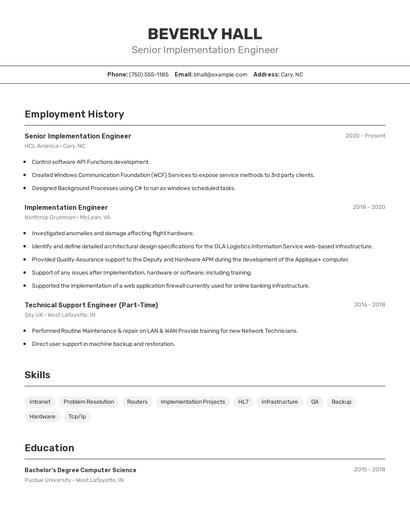
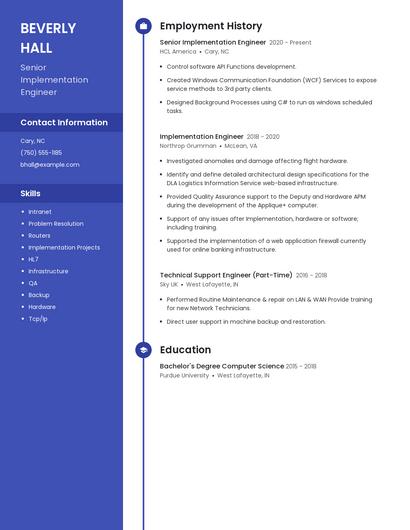
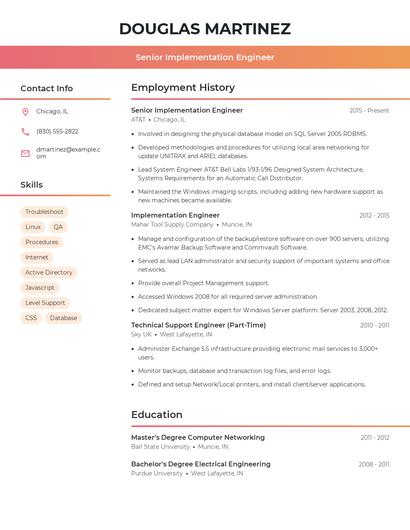
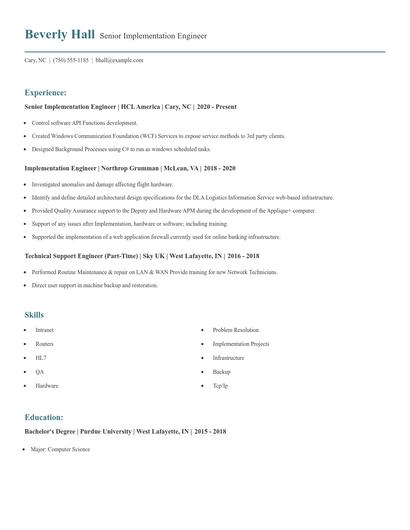
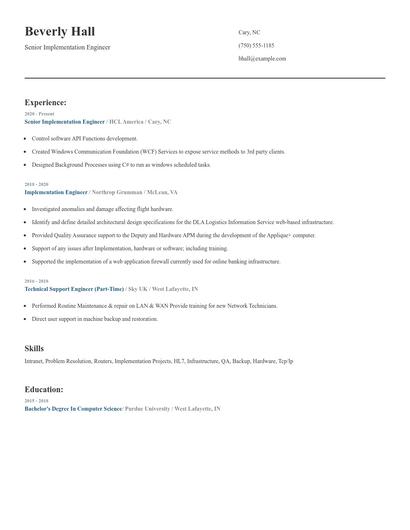
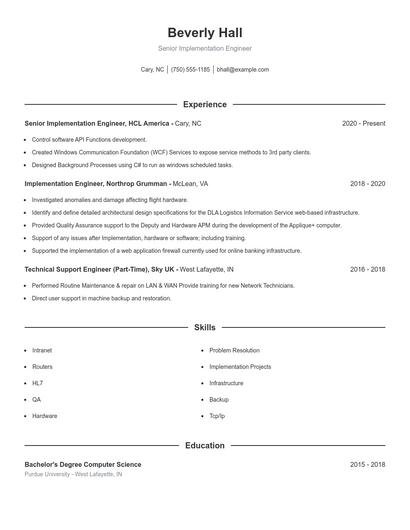
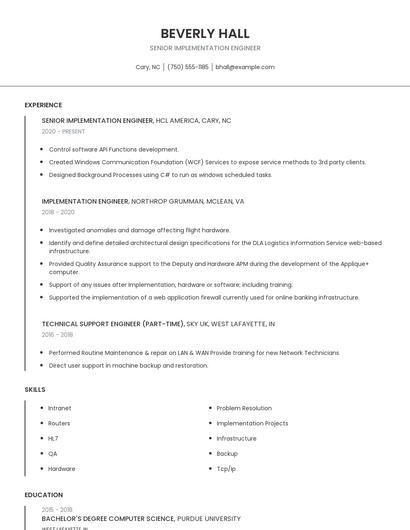
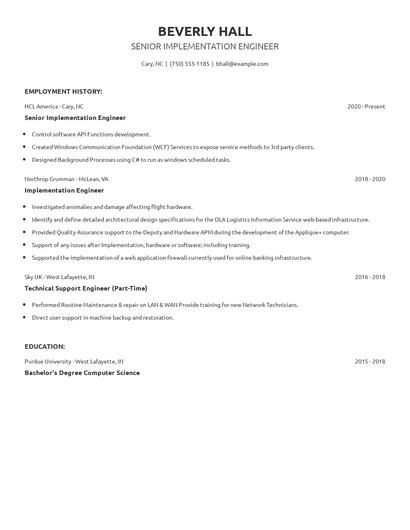
Build a professional senior implementation engineer resume in minutes. Our AI resume writing assistant will guide you through every step of the process, and you can choose from 10+ resume templates to create your senior implementation engineer resume.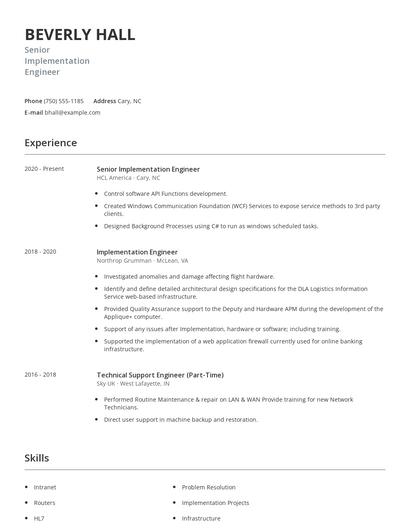



Compare different senior implementation engineers
Senior implementation engineer vs. Engineer
Engineers are highly trained professionals who determine the feasibility of various projects, usually related to the construction industry. They are considered experts in mathematics and science, two disciplines that they need to use in designing and coming up with plans for projects. They should also be well-versed in different construction or industrial materials, and they ensure that appropriate materials are used for the project. They also ensure that the projects meet the requirements of the groups that hired them. They create spaces that would both address the needs of the end-users and the industry standards. They also ensure that the projects they make would stand the test of time.
There are some key differences in the responsibilities of each position. For example, senior implementation engineer responsibilities require skills like "infrastructure," "customer satisfaction," "client facing," and "pre sales." Meanwhile a typical engineer has skills in areas such as "python," "cloud," "aws," and "windows." This difference in skills reveals the differences in what each career does.
Engineers really shine in the automotive industry with an average salary of $97,672. Comparatively, senior implementation engineers tend to make the most money in the media industry with an average salary of $133,795.engineers tend to reach similar levels of education than senior implementation engineers. In fact, engineers are 1.3% less likely to graduate with a Master's Degree and 1.3% more likely to have a Doctoral Degree.Senior implementation engineer vs. Technical support senior engineer
A technical support senior engineer is primarily in charge of resolving complicated issues and concerns through calls and correspondence, ensuring efficiency and client satisfaction. Their responsibilities include coordinating with customer support staff to gather data, studying records of initial assessments, liaising with clients to identify their needs, utilizing their expertise to develop solutions, and maintaining records of all transactions. Furthermore, as a technical support senior engineer, it is essential to lead and serve as a mentor to others, all while implementing the company's policies and regulations.
While some skills are similar in these professions, other skills aren't so similar. For example, resumes show us that senior implementation engineer responsibilities requires skills like "api," "infrastructure," "client facing," and "html." But a technical support senior engineer might use other skills in their typical duties, such as, "customer service," "azure," "customer issues," and "ruby."
Technical support senior engineers earn a lower average salary than senior implementation engineers. But technical support senior engineers earn the highest pay in the telecommunication industry, with an average salary of $104,548. Additionally, senior implementation engineers earn the highest salaries in the media with average pay of $133,795 annually.Average education levels between the two professions vary. Technical support senior engineers tend to reach similar levels of education than senior implementation engineers. In fact, they're 4.0% less likely to graduate with a Master's Degree and 1.3% more likely to earn a Doctoral Degree.What technology do you think will become more important and prevalent for senior implementation engineers in the next 3-5 years?
Andrea Welker Ph.D.
Associate Dean for Academic Affairs, College of Engineering Professor, Civil and Environmental Engineering, Villanova University
Senior implementation engineer vs. Lead engineer
A lead engineer's duties vary on their line of work or industry of employment. Typically, their responsibilities will revolve around overseeing the progress of operations and performance of the workforce, ensuring that everything is running smoothly. They are also responsible for addressing issues and concerns, assessing risks, monitoring the budget, coordinating with clients and architects, and even training workers. Furthermore, as a lead engineer, it is crucial to conduct regular inspections to ensure the quality of work and maintain a safe environment for all workers.
There are many key differences between these two careers, including some of the skills required to perform responsibilities within each role. For example, a senior implementation engineer is likely to be skilled in "infrastructure," "customer satisfaction," "pre sales," and "post implementation," while a typical lead engineer is skilled in "python," "architecture," "git," and "database."
Lead engineers earn the highest salary when working in the automotive industry, where they receive an average salary of $110,872. Comparatively, senior implementation engineers have the highest earning potential in the media industry, with an average salary of $133,795.When it comes to education, lead engineers tend to earn similar degree levels compared to senior implementation engineers. In fact, they're 3.9% more likely to earn a Master's Degree, and 1.8% more likely to graduate with a Doctoral Degree.Senior implementation engineer vs. Systems engineer
Systems engineers are responsible for creating and overseeing systems related to the overall operations of the organization. They are in charge of assessing the organization's needs in terms of systems and creating plans to address these needs. These systems are usually related to the production or manufacturing of company products. Systems engineers create end-to-end processes that ensure efficiency and effectiveness. They make sure that the processes they put in place adhere to safety and security policies and guidelines. They also do routine checks and continuously find ways to further improve production and other systems.
Types of senior implementation engineer
Updated January 8, 2025
