What does a senior network technician do?
Senior network technician responsibilities
Here are examples of responsibilities from real senior network technician resumes:
- Manage 10 servers , 2 UNIX , 6 Win2k3 and 2 Win2k.
- Set up and manage firewall and content base web filtering.
- Recommend, engineer and manage office systems, including centralize productivity and communication systems such as e-mail and centralize desktop environments.
- Connect and configure LAN and WLAN networks and perform security updates on network devices and routers.
- Train customer s employees on network protocols such as TCP/IP EGIRP, BGP, SNA, OSPF.
- Implement wide area network solution using VPN and MPLS technologies to interconnect remote offices.
- Complete install, setup and programming of all switches, routers and access points via laptop both on and off site.
- Monitor and troubleshoot all campus Cisco network devices within the university infrastructure.
- Assist in VMware troubleshooting and account management.
- Administer e-safe firewall software and SMTP virus watch software.
- Create, reassign and modify RSA token for VPN access.
- Configure VPN tunnel for remote monitoring and control of wireless network.
- Used Citrix apps to connect to different cell sites for status.
- Install, operate and maintain RF mobile and stationary radios with antenna equipment.
- Learned Linux, Java, and SQL through on-the-job experience and training at Northrop Grumman.
Senior network technician skills and personality traits
We calculated that 9% of Senior Network Technicians are proficient in Switches, Troubleshoot, and Routers. They’re also known for soft skills such as Analytical skills, Communication skills, and Multitasking skills.
We break down the percentage of Senior Network Technicians that have these skills listed on their resume here:
- Switches, 9%
Performed password recovery and stacking catalyst switches.
- Troubleshoot, 8%
Demonstrated ability to troubleshoot down to the component level on specialized collection systems.
- Routers, 5%
Managed over 1,400 continuously operating routers, circuits and sites providing connectivity for critical government agencies.
- Network Hardware, 4%
Install network hardware and software by following provided documentation and tools.
- Windows Server, 4%
Performed Windows Server Administration - create and manage profile shares, file and print server and workstations.
- Network Security, 3%
Implemented network security policy's for users to follow and ensured overall network security.
Most senior network technicians use their skills in "switches," "troubleshoot," and "routers" to do their jobs. You can find more detail on essential senior network technician responsibilities here:
Analytical skills. One of the key soft skills for a senior network technician to have is analytical skills. You can see how this relates to what senior network technicians do because "administrators need to evaluate networks and systems to make sure that they perform reliably and to anticipate new requirements as customers’ needs change." Additionally, a senior network technician resume shows how senior network technicians use analytical skills: "configured and analyzed at&t; code activated switches and digital decoders. "
Communication skills. Another soft skill that's essential for fulfilling senior network technician duties is communication skills. The role rewards competence in this skill because "administrators must describe problems and their solutions to non-it workers." According to a senior network technician resume, here's how senior network technicians can utilize communication skills in their job responsibilities: "traveled to nationwide and installed computer terminals, printers and communications equipment in senators state offices. "
Multitasking skills. senior network technicians are also known for multitasking skills, which are critical to their duties. You can see how this skill relates to senior network technician responsibilities, because "administrators may have to work on many problems and tasks at the same time." A senior network technician resume example shows how multitasking skills is used in the workplace: "exhibit strong communication, critical thinking, multitasking, troubleshooting, and customer service skills"
Problem-solving skills. senior network technician responsibilities often require "problem-solving skills." The duties that rely on this skill are shown by the fact that "administrators must quickly resolve problems that arise with computer networks." This resume example shows what senior network technicians do with problem-solving skills on a typical day: "supported network operation daily operations by maintaining and troubleshooting network problems, providing the appropriate solutions in a timely matter. "
The three companies that hire the most senior network technicians are:
- Microsoft16 senior network technicians jobs
- NETSYNC4 senior network technicians jobs
- Johns Hopkins Medicine3 senior network technicians jobs
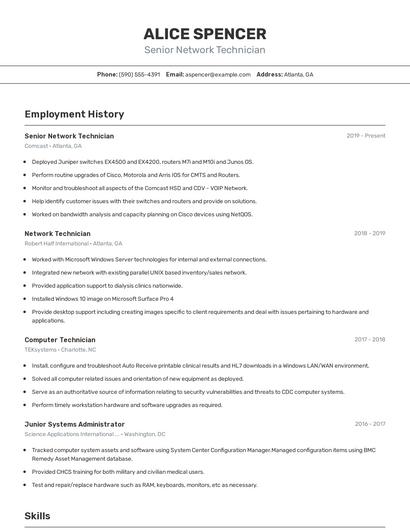
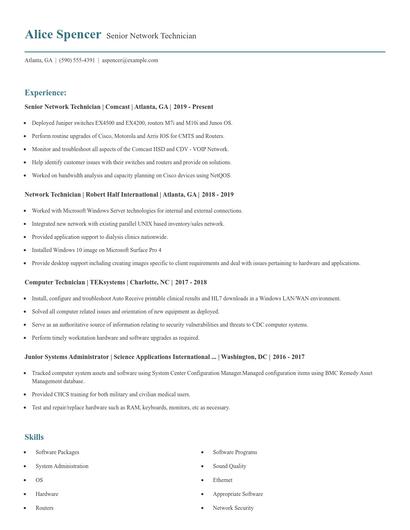
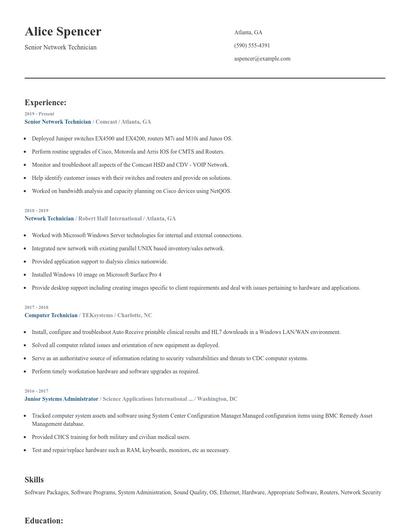
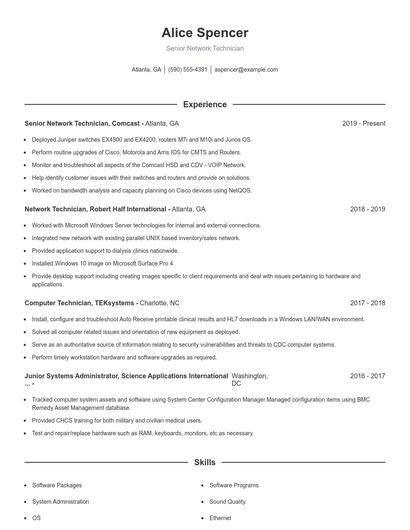
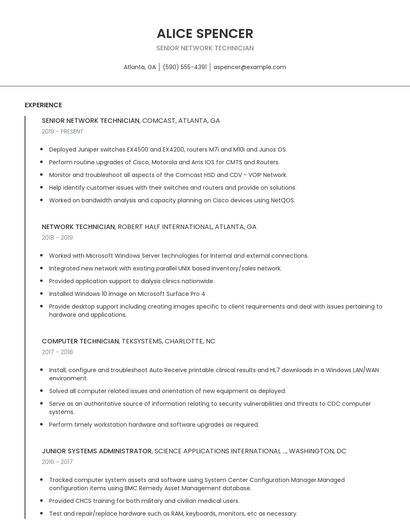
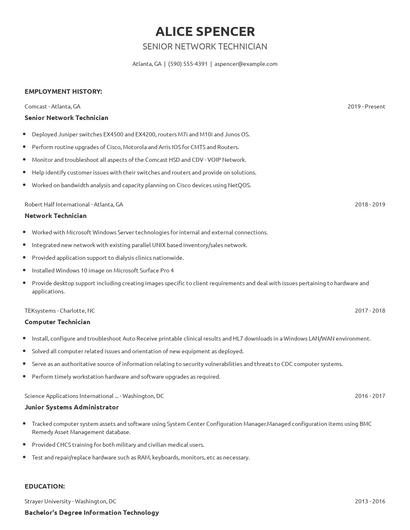
Choose from 10+ customizable senior network technician resume templates
Build a professional senior network technician resume in minutes. Our AI resume writing assistant will guide you through every step of the process, and you can choose from 10+ resume templates to create your senior network technician resume.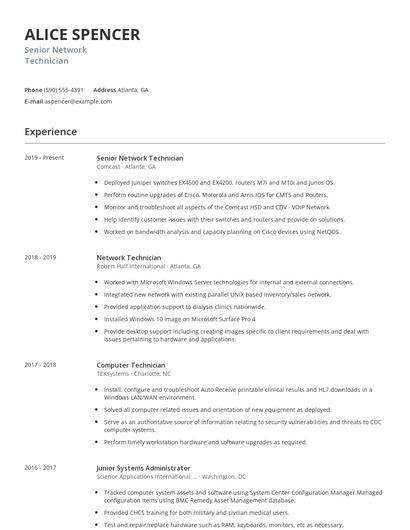


Compare different senior network technicians
Senior network technician vs. Technician support team leader
The Technician Support Team Leader is tasked with leading and training the technical support team. As a team leader, you will be required to organize scheduled staff reviews and communicate new procedures and policies with them. Your key role is to ensure that all goals are met. For all that you'll do, you'll have to ensure that the staff under you are highly productive, and you'd have to come up with ways to increase their productivity.
These skill sets are where the common ground ends though. The responsibilities of a senior network technician are more likely to require skills like "switches," "troubleshoot," "routers," and "network hardware." On the other hand, a job as a technician support team leader requires skills like "customer service," "customer issues," "sla," and "lan." As you can see, what employees do in each career varies considerably.
Technician support team leaders earn the highest salaries when working in the technology industry, with an average yearly salary of $91,502. On the other hand, senior network technicians are paid more in the technology industry with an average salary of $49,313.On average, technician support team leaders reach similar levels of education than senior network technicians. Technician support team leaders are 1.1% more likely to earn a Master's Degree and 0.4% less likely to graduate with a Doctoral Degree.Senior network technician vs. Technician support tier
A technician support tier focuses on providing technical support to clients or employees within a company. Typically working in a team setting, a technician support tier addresses technical problems and troubleshoots to identify the root of the issues and perform necessary corrective measures or repairs. Their responsibilities also revolve around responding to inquiries, answering calls and correspondence, conducting regular maintenance of systems and networks, maintaining records of all transactions, and supporting software and networks. Furthermore, it is essential to coordinate with all team members while adhering to the company's policies and regulations.
In addition to the difference in salary, there are some other key differences worth noting. For example, senior network technician responsibilities are more likely to require skills like "switches," "troubleshoot," "routers," and "network hardware." Meanwhile, a technician support tier has duties that require skills in areas such as "customer service," "phone calls," "tier ii," and "lan." These differences highlight just how different the day-to-day in each role looks.
Technician support tiers may earn a higher salary than senior network technicians, but technician support tiers earn the most pay in the technology industry with an average salary of $62,098. On the other hand, senior network technicians receive higher pay in the technology industry, where they earn an average salary of $49,313.In general, technician support tiers achieve similar levels of education than senior network technicians. They're 2.8% less likely to obtain a Master's Degree while being 0.4% less likely to earn a Doctoral Degree.Senior network technician vs. Network engineer
A network engineer is responsible for managing a network system, monitoring its performance, and upgrading its features to optimize performance and boost efficiency. Network engineers also create new systems, designing them based on clients' specifications and business needs. They also check network defects, perform troubleshooting, improve data security systems, and install security updates. A network engineer must have excellent knowledge of the technology industry, as well as a broad understanding of system codes, programming languages, and network configurations.
There are many key differences between these two careers, including some of the skills required to perform responsibilities within each role. For example, a senior network technician is likely to be skilled in "routers," "network hardware," "network security," and "printers," while a typical network engineer is skilled in "firewall," "eigrp," "network design," and "ios."
Network engineers make a very good living in the technology industry with an average annual salary of $90,927. On the other hand, senior network technicians are paid the highest salary in the technology industry, with average annual pay of $49,313.Most network engineers achieve a similar degree level compared to senior network technicians. For example, they're 4.3% more likely to graduate with a Master's Degree, and 0.2% more likely to earn a Doctoral Degree.Senior network technician vs. Network manager
A network manager is responsible for monitoring the efficient network connection of the company's technology systems, analyzing system designs, and overseeing installation processes and programs. Network managers inspect the efficiency of existing network management systems, upgrading network data to boost optimal performance and communication transportation. A network manager must have excellent knowledge of technology disciplines and should always be updated with the recent technology trends, guiding the network staff on their tasks and immediately resolving system defects and discrepancies.
Types of senior network technician
Updated January 8, 2025
