Explore jobs
Find specific jobs
Explore careers
Explore professions
Best companies
Explore companies
Job outlook for senior program analysts in the United States
Senior program analyst job growth summary. After extensive research, interviews, and analysis, Zippia's data science team found that:
The projected senior program analyst job growth rate is 9% from 2018-2028.
About 56,000 new jobs for senior program analysts are projected over the next decade.
Senior program analyst salaries have increased 8% for senior program analysts in the last 5 years.
There are over 39,720 senior program analysts currently employed in the United States.
There are 132,578 active senior program analyst job openings in the US.
The average senior program analyst salary is $93,415.
Are senior program analyst jobs in demand?
Senior program analyst job and salary trends over time
Senior program analyst jobs over time
Senior program analyst job growth rate over time
| Year | # of jobs | % of population |
|---|---|---|
| 2021 | 39,720 | 0.01% |
| 2020 | 37,939 | 0.01% |
| 2019 | 36,685 | 0.01% |
| 2018 | 37,837 | 0.01% |
| 2017 | 36,663 | 0.01% |
Average senior program analyst salary over time
Senior program analyst salary by year
| Year | Avg. salary | Hourly rate | % Change |
|---|---|---|---|
| 2026 | $93,415 | $44.91 | +3.4% |
| 2025 | $90,337 | $43.43 | +2.3% |
| 2024 | $88,292 | $42.45 | +0.5% |
| 2023 | $87,824 | $42.22 | +1.2% |
| 2022 | $86,779 | $41.72 | +1.7% |
Senior program analyst jobs by state
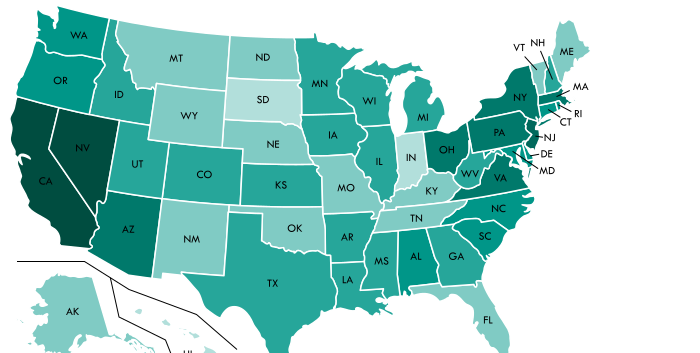
Most common states for senior program analysts
| Rank | State | Population | # of jobs | Employment/ 1000ppl |
|---|---|---|---|---|
| 1 | District of Columbia | 693,972 | 775 | 112% |
| 2 | Delaware | 961,939 | 309 | 32% |
| 3 | North Dakota | 755,393 | 222 | 29% |
| 4 | Virginia | 8,470,020 | 2,294 | 27% |
| 5 | New Hampshire | 1,342,795 | 344 | 26% |
| 6 | Rhode Island | 1,059,639 | 262 | 25% |
| 7 | Colorado | 5,607,154 | 1,358 | 24% |
| 8 | Maryland | 6,052,177 | 1,334 | 22% |
| 9 | Minnesota | 5,576,606 | 1,250 | 22% |
| 10 | Oregon | 4,142,776 | 907 | 22% |
| 11 | Nebraska | 1,920,076 | 415 | 22% |
| 12 | Montana | 1,050,493 | 231 | 22% |
| 13 | Connecticut | 3,588,184 | 713 | 20% |
| 14 | Utah | 3,101,833 | 633 | 20% |
| 15 | South Dakota | 869,666 | 170 | 20% |
| 16 | Arizona | 7,016,270 | 1,306 | 19% |
| 17 | Massachusetts | 6,859,819 | 1,284 | 19% |
| 18 | Illinois | 12,802,023 | 2,352 | 18% |
| 19 | Georgia | 10,429,379 | 1,830 | 18% |
| 20 | New Mexico | 2,088,070 | 371 | 18% |
Most common cities for senior program analysts
| Rank | City | # of jobs | Employment/ 1000ppl | Avg. salary |
|---|---|---|---|---|
| 1 | Suitland | 2 | 8% | $88,883 |
| 2 | Annapolis | 2 | 5% | $89,068 |
| 3 | Alexandria | 6 | 4% | $94,715 |
| 4 | Washington | 18 | 3% | $107,064 |
| 5 | Rockville | 2 | 3% | $88,821 |
| 6 | Huntsville | 4 | 2% | $92,238 |
| 7 | Germantown | 2 | 2% | $88,784 |
| 8 | Bedford | 1 | 2% | $86,697 |
| 9 | Arlington | 2 | 1% | $94,726 |
| 10 | Aurora | 2 | 1% | $83,215 |
| 11 | Orlando | 2 | 1% | $79,137 |
| 12 | San Diego | 5 | 0% | $104,583 |
| 13 | Atlanta | 1 | 0% | $84,666 |
| 14 | Baltimore | 1 | 0% | $89,064 |
| 15 | Colorado Springs | 1 | 0% | $84,023 |
Senior Program Analyst job outlook: Expert opinions
Our panel of senior program analyst experts

UMass Lowell
Merrimack College
University of Cincinnati Clermont College
University of Washington
University of Southern Maine
Western Kentucky University
John Jay College of Criminal Justice of the City University of New York
University of California, Santa Cruz
Drexel University
New Jersey Institute of Technology
University of Iowa
Wake Forest University
Saint Cloud State University
University of Delaware
DePauw University

Coastal Carolina University
Michael Ciuchta Ph.D.
Associate Professor, Program Coordinator, Masters of Science in EntrepreneurshipUMass Lowell
Department of Marketing, Entrepreneurship & Innovation
What will help Senior Program Analysts increase their earning potential?
Michael Ciuchta Ph.D.: If all you want is the highest potential starting salary, then you should aim for careers that offer them. But that is a shortsighted way to view things. For example, many careers that have tournament-like pay structures (think entertainment) often have very low starting salaries but the so-called winners enjoy outsized financial gains. If you are thinking about a more traditional career, I think it's important to make sure you are more valuable to your employer than they are to you. This means you have to market yourself, both to your current employer as well as to potential ones. Of course, this approach may not be for everyone and maximizing your salary potential is only one thing you should be considering when assessing job and career opportunities.
What Senior Program Analyst skills would you recommend for someone trying to advance their career?
Reshad Osmani PhD: To maximize your salary potential when starting your career, consider the following strategies: negotiate your starting salary based on market research, demonstrate your value through accomplishments, seek out opportunities for advancement and growth, continuously improve your skills, consider additional certifications or degrees, and be willing to explore job opportunities that offer competitive compensation packages.
What will help Senior Program Analysts increase their earning potential?
Dr. David Powell Ph.D.: MPA (Master's of Public Administration) graduates typically work in local, state, and national government. Some of the positions they typically hold are management analyst, program analyst, policy analyst, budget analyst, finance manager, and human resources manager/specialist among others. We also have graduates who work in local nonprofit organizations in a variety of policy areas such as housing, senior services, etc.
What will help Senior Program Analysts increase their earning potential?
Melissa Zimdars: Recognize that your first career opportunity won't be your last. If the job you land after college does not have opportunities for growth or advancement, it's imperative that you keep an eye out for them elsewhere as you continue to gain experience in your field.
Fawen Zhang PhD
Professor of AudiologyUniversity of Cincinnati Clermont College
Communication Disorders Sciences And Services
What Senior Program Analyst skills would you recommend for someone trying to advance their career?
Fawen Zhang PhD: This is perfect! Thank you so much. We will be sure to feature your response in the article and send a draft over for your review before we promote it.
What general advice would you give to a Senior Program Analyst?
Victor Menaldo: Learn, learn and learn some more. Adopt a growth mindset where you never stop learning. Gain economic literacy and financial literacy and historical literacy and statistical literacy. This will allow you to complement AI: ask it good questions, contextualize and evaluate its answers, and ask good follow up questions.
What will help Senior Program Analysts increase their earning potential?
Victor Menaldo: Develop oral communication skills that allow you to speak in an articulate manner and organize your thoughts to signal your competence, knowledge, work ethic, and willingness to keep learning and improving.
Tove Rasmussen
LecturerUniversity of Southern Maine
Specialized Sales, Merchandising And Marketing Operations
What Senior Program Analyst skills would you recommend for someone trying to advance their career?
Tove Rasmussen: Tove Rasmussen believes that the skills that will become more important and prevalent in the field in the next 3-5 years are...
What Senior Program Analyst skills would you recommend for someone trying to advance their career?
Timothy Rich PhD: Think about the types of jobs that interest you and the skills necessary for those jobs early. So many students start thinking about post-graduation life spring their senior year, when it should be an incremental process much earlier. Another pieces of advice would be to talk to faculty and alum about your interests, find internship or research opportunities when possible, and try to figure out early your strengths and weaknesses. It's easy for students, especially high performing ones, to not fully consider what their weaknesses are. I encourage students to jot down what they see as their skills too and to share them with others. It helps them to identify what's a common skill versus something that might make them stick out.
What will help Senior Program Analysts increase their earning potential?
Timothy Rich PhD: In social science fields, many of the highest paid jobs straight out are government related or data analysis related. Without developing research, writing, and in some cases foreign language skills, this will be a limitation. Depending on the desired job, a graduate degree may be required and students should be maximizing their exposure to graduate-style experiences as undergrads to not only get into prestigious law schools, master's programs, etc., but to take advantage of the internship and research opportunities that first year entrants are rarely equipped to handle.
Professor Shonna Trinch Ph.D.
ProfessorJohn Jay College of Criminal Justice of the City University of New York
Ethnic, Cultural Minority, Gender, And Group Studies
What general advice would you give to a Senior Program Analyst?
Professor Shonna Trinch Ph.D.: Being able to negotiate a salary is also a skill that students need to learn and one that is rarely taught in college. Students need to be able to ask for more than they are offered, but also take jobs at entry levels, prove themselves and then ask for an increase in pay six months into the job after they have shown that they are doing the work and achieving their goals.
What Senior Program Analyst skills would you recommend for someone trying to advance their career?
Stephanie Lain Ph.D.: I would advise graduates to be open to considering jobs in lots of different fields. The skills acquired through their major- such as problem-solving, critical thinking, and writing- are ones that transfer well to a variety of situations.
What Senior Program Analyst skills would you recommend for someone trying to advance their career?
Mark Stehr PhD: At the start of your career, it's very important to land a role where you learn a lot and find good mentors. The additional skills will pay dividends as your career progresses.
What will help Senior Program Analysts increase their earning potential?
Mark Stehr PhD: The ability to use AI to augment your productivity. We're all still working out what this will look like, but it's certain to be important.
What general advice would you give to a Senior Program Analyst?
Michael Smullen: Make yourself uncomfortable. Early graduates find success later on by seeking out numerous challenges: how to respectfully ask questions in a business setting, how to cultivate personal and professional confidence, how to create or expand their professional network, how to chart a course for their career and personal aspirations, and how to maintain a healthy work-life balance. Each of these demands stepping beyond one's comfort zone and engaging in unfamiliar actions. It's not merely about setting intentions; it entails embracing novel experiences solely for the sake of growth. Whether it's attending a seminar on home-buying or participating in a networking event, reaching out to a manager for guidance on enhancing value, or reflecting deeply on personal fulfillment, pushing oneself through discomfort will foster mental agility and resilience. Recent graduates should pay close attention to the danger complacency may signify overlooking crucial opportunities that could lead to future regret.
What Senior Program Analyst skills would you recommend for someone trying to advance their career?
Dr. Kathryn Young Ph.D.: Listen more than you speak. Concentrate and take notes about everything in your new position. Your boss will ask for a particular task to be completed, and they will only ask once. True understanding is lost with the inability to actually listen, decipher, and understand.
What general advice would you give to a Senior Program Analyst?
Kayla Jackson PhD: The future is always bringing new advancements in technology. Learning how to use these new technologies to enhance your work will improve your work quality and collaboration with others in the field. For example, familiarizing yourself with AI tools, information visualization tools, and team management tools can all help you maximize productivity in your work, improve your services, and communicate more effectively with your evaluation team and program stakeholders. As these advancements emerge, however, it is important to adhere to the integrity of your own intelligence and products; while AI can be an incredible tool, it should enhance your work, not replace it.
What will help Senior Program Analysts increase their earning potential?
Kayla Jackson PhD: Supplemental opportunities that allow you to continue or grow your own skills in program evaluation can help you maximize your earning potential. For example, taking on extra teaching or consulting opportunities is wonderful for continuing your professional growth and can be a stepping stone to job advancement.
What Senior Program Analyst skills would you recommend for someone trying to advance their career?
Dr. Mark Evans: Don't stop learning. Treat your first job like more graduate school. Learn everything you can.
What general advice would you give to a Senior Program Analyst?
Emily Munson: One of the most important steps you can take to maximize your earnings potential is to negotiate your salary before accepting a job. People who negotiate and start with a higher salary, even if only slightly higher, will earn more throughout their careers. Negotiation may be tricky, so do some homework before you accept a position. Learn about typical salaries for your position. Examine your skills and talents and relate them to the position. Show how you can help the company, so your value is evident. If base salary is not negotiable, consider benefits. You may be able to negotiate for time off, work location (remote vs in person), benefits (health, retirement); some companies will include moving expenses, clothing allowances, cell phone plans and more in their compensation packages. If negotiation makes you nervous, so some research about how to go about the process. Negotiation shows the company you know your worth and can help you get the best compensation package possible.
What will help Senior Program Analysts increase their earning potential?
Emily Munson: The skills graduates need always include communication skills. Verbal communication skills are essential to career success. Being able to speak to your supervisor and co-workers, being able to ask questions and learn quickly, being able to speak up in meetings, speak to clients, or deliver presentations will help you move up in your career. Written communication skills are also important. Emails demonstrate your clarity of thought, responsiveness to requests, and attention to detail. Emails portray an image of who you are and want to be as an employee. Written reports demonstrate your work product, including your creativity, thoroughness, ability to follow directions and ability to meet deadlines. Communication skills are always important in the workplace. The ability to use generative AI will become more important in the coming years. Some companies are already using generative AI, such as Chat-GPT or Gemini, but others are not yet entering the arena. Either way, often new graduates are looked to as experts in innovative technologies, whether AI or social media. Graduates should understand the benefits and drawbacks of AI and how to use it effectively and ethically. Understanding how generative AI works and how best to use it in the workplace will be increasingly important for new graduates entering the workforce.
What Senior Program Analyst skills would you recommend for someone trying to advance their career?
Bryan Crissinger: Think of your degree more like a learner’s permit than as a credential. You will need to acquire new technical skills and learn much about the particular field you work in. Be prepared to find a balance between asking questions when you get stuck and working to solve the problem yourself. Employers value employees with initiative.
What Senior Program Analyst skills would you recommend for someone trying to advance their career?
Corey Moss-Pech: It’s hard to predict the future, but the general categories of skills that employers look for actually don’t change that much over time. College degrees uniquely bestow the most desirable skills including critical thinking, communication, and data analysis. Most college graduates will be equipped with these skills, and they are what job ads often say employers value.
What will help Senior Program Analysts increase their earning potential?
Corey Moss-Pech: You have plenty of time and plenty of options. Most degrees are flexible, and many people change jobs frequently early in their careers. Whether you prioritize salary, interests, geography, or anything else in your job search, know your first job doesn’t have to be forever. It’s never too late to switch, so you don’t need to be concerned with what your career will look like in five or ten years. Just go based on your current priorities and chances are you’ll be ok in the long run.
What Senior Program Analyst skills would you recommend for someone trying to advance their career?
Dr. Amy Eremionkhale PhD: Looking ahead, the ability to ask the right questions will become increasingly crucial, especially as we navigate a world that's becoming more intertwined with generative AI. This skill is key to peeling back layers of complex information to uncover what decisions truly need to be made. As data grows in both size and complexity, the capacity to ask pertinent and timely questions will be a game-changer.
Sourav Batabyal Ph.D.
Assistant Professor, Finance and EconomicsCoastal Carolina University
Finance and Economics Department
Will there be an enduring impact of the coronavirus pandemic on Senior Program Analysts?
Sourav Batabyal Ph.D.: In the U.S., the first confirmed COVID-19 case was reported on January 22, 2020. Since then, this pandemic has forced us to shut down many businesses and paused many economic activities. Social distancing requirements imposed to fight the epidemic have crushed many industries including airlines, leisure & hospitality, bars & restaurants, Broadway & entertainment, etc. Unemployment peaked at 14.7% in April and then eventually fell to 7.9% in September. The colleges and universities across the country have canceled in-person classes and switched to online instruction to control coronavirus spread. On June 8, NBER announced that the U.S. economy was in recession since February. This recession is different than any other recent economic downturn. It's pegged to the global health crisis caused by the coronavirus pandemic.
The Coronavirus Aid, Relief, and Economic Security (CARES) Act was passed by Congress with bipartisan support and signed into law by President Trump on March 27, 2020. It was an over $2 trillion economic relief package that provided direct financial assistance to American workers, families, and small businesses, and preserved jobs for American industries. The Federal Reserve lowered the target range for the federal funds rate from 0 to 1/4 percent. Interest rates near zero will likely stay in place for years, as the Federal Reserve seeks to restructure the economy characterized by low inflation and a lockdown-affected labor market. The major economies are experiencing sharp economic contractions, as evidenced by falling real GDP, real income, employment, industrial production, and wholesale, retail sales.
In Fall 2020, many colleges and universities announced their plans for a phased return to face-to-face (F2F) instruction. At Coastal Carolina University (CCU), we are in Phase 1 of the Coastal Comeback plan. Every one of us needs to follow the standards and guidelines for the soft comeback to F2F instruction. These standards are: wearing masks, physical and social distancing, avoid public gathering, sanitation and disinfection, personal protective equipment, health screening and monitoring, and COVID-19 testing and infection containment.
Recent graduates may find it more challenging than standard times to find their first job in a recession-hit economy. Those students who already finished an internship or have prior job experience may find it easier to be absorbed in this labor market. If they don't find the suitable jobs they are looking for, we can see a rise in graduate school enrollments in the coming semesters. The recovery process will be slower if Congress and the White House delay the second round of fiscal stimulus. It will take a long time for output to go back to the full employment level, but hiring will take momentum, once we have the vaccine and therapeutics available for everyone. The coronavirus pandemic will remain in our memories and represent not just a global health crisis, but also a cautionary tale of how society is ready to overcome such adversity in the future. Students need to be resilient, stay informed, keep faith in what they are doing; then a whole new world of opportunities will open up for them, once the pandemic is over.