Explore jobs
Find specific jobs
Explore careers
Explore professions
Best companies
Explore companies
Job outlook for service administrators in the United States
Service administrator job growth summary. After extensive research, interviews, and analysis, Zippia's data science team found that:
The projected service administrator job growth rate is 5% from 2018-2028.
About 18,200 new jobs for service administrators are projected over the next decade.
Service administrator salaries have increased 9% for service administrators in the last 5 years.
There are over 109,875 service administrators currently employed in the United States.
There are 57,561 active service administrator job openings in the US.
The average service administrator salary is $54,573.
Are service administrator jobs in demand?
Service administrator job and salary trends over time
Service administrator jobs over time
Service administrator job growth rate over time
| Year | # of jobs | % of population |
|---|---|---|
| 2021 | 109,875 | 0.03% |
| 2020 | 64,990 | 0.02% |
| 2019 | 63,397 | 0.02% |
| 2018 | 59,714 | 0.02% |
| 2017 | 61,147 | 0.02% |
Average service administrator salary over time
Service administrator salary by year
| Year | Avg. salary | Hourly rate | % Change |
|---|---|---|---|
| 2026 | $54,573 | $26.24 | +3.4% |
| 2025 | $52,774 | $25.37 | +2.3% |
| 2024 | $51,580 | $24.80 | +1.2% |
| 2023 | $50,982 | $24.51 | +1.8% |
| 2022 | $50,102 | $24.09 | +2.4% |
Service administrator jobs by state
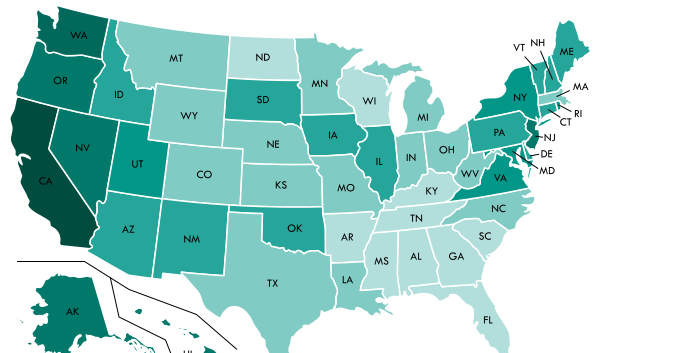
Most common states for service administrators
| Rank | State | Population | # of jobs | Employment/ 1000ppl |
|---|---|---|---|---|
| 1 | District of Columbia | 693,972 | 201 | 29% |
| 2 | Virginia | 8,470,020 | 1,137 | 13% |
| 3 | Maryland | 6,052,177 | 773 | 13% |
| 4 | Colorado | 5,607,154 | 751 | 13% |
| 5 | Alaska | 739,795 | 99 | 13% |
| 6 | Massachusetts | 6,859,819 | 821 | 12% |
| 7 | Utah | 3,101,833 | 346 | 11% |
| 8 | Vermont | 623,657 | 71 | 11% |
| 9 | Arizona | 7,016,270 | 690 | 10% |
| 10 | New Hampshire | 1,342,795 | 138 | 10% |
| 11 | Rhode Island | 1,059,639 | 103 | 10% |
| 12 | North Dakota | 755,393 | 79 | 10% |
| 13 | Washington | 7,405,743 | 676 | 9% |
| 14 | Oregon | 4,142,776 | 376 | 9% |
| 15 | Delaware | 961,939 | 83 | 9% |
| 16 | Alabama | 4,874,747 | 400 | 8% |
| 17 | New Mexico | 2,088,070 | 176 | 8% |
| 18 | Nebraska | 1,920,076 | 150 | 8% |
| 19 | Montana | 1,050,493 | 84 | 8% |
| 20 | Wyoming | 579,315 | 48 | 8% |
Most common cities for service administrators
| Rank | City | # of jobs | Employment/ 1000ppl | Avg. salary |
|---|---|---|---|---|
| 1 | Milpitas | 2 | 3% | $88,029 |
| 2 | Benton | 1 | 3% | $41,891 |
| 3 | Anchorage | 4 | 1% | $66,547 |
| 4 | Atlanta | 3 | 1% | $42,111 |
| 5 | Orlando | 2 | 1% | $40,419 |
| 6 | Saint Paul | 2 | 1% | $44,309 |
| 7 | Avondale | 1 | 1% | $55,584 |
| 8 | Indianapolis | 3 | 0% | $46,013 |
| 9 | Phoenix | 3 | 0% | $55,471 |
| 10 | Chicago | 2 | 0% | $56,564 |
| 11 | Jacksonville | 2 | 0% | $39,797 |
| 12 | Miami | 2 | 0% | $40,795 |
| 13 | Philadelphia | 2 | 0% | $54,936 |
| 14 | Seattle | 2 | 0% | $74,627 |
| 15 | Albuquerque | 1 | 0% | $54,462 |
| 16 | Aurora | 1 | 0% | $48,391 |
| 17 | Bakersfield | 1 | 0% | $83,351 |
| 18 | Baltimore | 1 | 0% | $60,410 |
Service Administrator job outlook: Expert opinions
Our panel of service administrator experts
University of Nebraska - Omaha

Ohio University

Wesleyan College

Tarleton State University

University of Illinois at Chicago
Springfield College

University of Hawai'i West O'ahu
DePaul University

Virginia Commonwealth University
American Jewish University
International Association of Administrative Professionals
Walsh University

American College of Health Care Administrators

Louisiana Tech University
Davenport University

California Baptist University
Aquinas College
Fairleigh Dickinson University

The University of Texas Permian Basin
What general advice would you give to a Service Administrator?
Dr. Joseph Oluwole: The ability to build and sustain relationships with staff for climate and culture and with parents for family and community relations, all to support the holistic success of students.
What Service Administrator skills would you recommend for someone trying to advance their career?
Dr. Joseph Oluwole: Gain as much leadership experience as possible before taking your first job by volunteering for various roles, opportunities, and committees at your school. Additionally, pursuing a doctorate (whether an Ed.D. or Ph.D.) could be very helpful in maximizing your salary potential.
What will help Service Administrators increase their earning potential?
Dr. Joseph Oluwole: My general advice is to seek out administrator and professor mentors who can provide a sounding board and encouragement through the emotional roller coaster that administration can be. I cannot overstate the importance of supportive mentors to the success of a new graduate beginning as an administrator. Even the State of New Jersey, for instance, recognizes the importance of mentoring and created a formal program for new assistant principals and principals to seek support from experienced mentors under the state's New Jersey Leaders to Leaders (NJL2L) program.
What general advice would you give to a Service Administrator?
Janice Garnett Ed.D.: Negotiate based on research, develop a career development plan, focus on enhancing performance, professional growth, and continuous learning.
What Service Administrator skills would you recommend for someone trying to advance their career?
Janice Garnett Ed.D.: New leaders must balance their vision with the realities and priorities of the school and/or school district. In other words, begin by developing an entry plan to learn and understand existing budget(s), staffing, community, and other priority needs of the school and/or district. Include in the plan how you will focus on relationships to build trust and rapport with all stakeholders. A communication plan with transparent messages and ample active listening will be key. The educational landscape constantly evolves, calling for continuous learning through professional development, networking, and mentorship.
What will help Service Administrators increase their earning potential?
Janice Garnett Ed.D.: Being a future-ready leader, Utilizing data-driven decision-making, Leading culturally responsive schools, Leading learning through instructional leadership, Championing Social-Emotional Learning (SEL).
What skills stand out on Service Administrator resumes?
Greg Kessler Ph.D.: I am not sure that there are any particular skills that stand out on resumes, but familiarity with instructional design principles should be considered to be very valuable. I also think that knowledge of multimedia principles, social media, and various forms of virtual and immersive experiences. Also, knowledge of AI and the other things I referred to in the trends above.
Are there any particularly good places in the United States for Service Administrators to find work opportunities?
Greg Kessler Ph.D.: There is no single location with more opportunities. In fact, there is a need for these skills everywhere in the country and world for that matter. There is a huge demand for graduates from programs like ours.
What are the biggest trends we'll see in the Service Administrator job market given the pandemic?
Greg Kessler Ph.D.: I think the biggest trends we are likely to see include an increased acceptance and reliance upon online and virtual immersive technologies. Previously, only a handful of faculty felt comfortable using technologies beyond the simplest tools. Now that we are forced to interact with one another online more and more, people will want to be able to feel more like they are sharing a space with others. This would be supported by simulated immersive technologies such as virtual reality. While VR is somewhat familiar to people now, it will likely take on more diverse forms. These will also incorporate a variety of artificial intelligence that can help by performing automated assessments and providing automated feedback to students as they interact with content. If you think of movies like Ready Player One, you can imagine the kind of thing I am referring to.
What are the biggest trends we'll see in the Service Administrator job market given the pandemic?
Virginia Wilcox: I believe in regard to Education we'll see a higher need for candidates who can fluidly and confidently teach in both a virtual as well as a face-to-face platform.
This will go FAR beyond simply knowing HOW to run a virtual class, set up assignments, create and grade assignments, and communicate that with families.
There will be an even stronger need for these new hires to be:
-confident in building trusting communities of learners,
-strong in planning, presenting, and teaching lessons that engage learners who are screen/virtual platform weary,
-consistent in holding high expectations and establishing levels of accountability that hold students responsible for their own choices, actions, and decisions remotely,
-respectful of the diverse and varied households they will be virtually 'entering' each day by valuing the privacy of families and honoring parenting choices rather than judging.
I believe most Educational Preparation Programs are already shifting to ensure these areas are embedded in the flow of the current courses.
It will not be enough to simply convey your content virtually any longer.
What general advice would you give to a Service Administrator?
Virginia Wilcox: Go into this knowing every single person you encounter was once in your shoes...new, confused, anxious, worried, etc.
The quickest way to make a friend is to ask for help. Everyone (even the most hardened) likes feeling needed and/or appreciated.
So...even if it's as minor as asking for advice on what color to use on the bulletin board or as major as asking for ideas on how to engage an unruly student...
ASK someone not only will you get the assistance you need, you will make their day...AND...you may find that you've made an invaluable step toward a new friendship.
What Service Administrator skills would you recommend for someone trying to advance their career?
Virginia Wilcox: If someone needs to take a gap year, I would suggest they volunteer in an area where children are present and not venture too far away from the REAL WORLD experiences of dealing with diverse and various ages of children consistently. It is very easy to 'forget' the daily ups and downs teachers (well anyone in the field of Education really) experience and to recall only the good or the bad...so you either can't wait to get back and then get blindsided by a bad day or you only recall the bad and have no desire to ever return. Neither of those is realistic experiences as they pertain to what educators experience daily, so take the gap year but go read at a library to kids frequently, coach a rec team, work at summer camp, anything that gets you in front of children (either face to face or virtually) on a regular basis.
Dr. Jacqueline Abernathy
Assistant ProfessorTarleton State University
Public Administration
What are the biggest trends we'll see in the Service Administrator job market given the pandemic?
Dr. Jacqueline Abernathy: I think one of the most significant changes to the job market is how the pandemic forced employers to do business virtually if they wanted to do business at all. For non-essential businesses, they had to find a way for employees to work at home if they wanted employees to keep working. This means that jobs that were originally considered location-bound were found to be done remotely, some with little to no modifications.
What this means is that some employers have reconsidered the costs of maintaining physical office space for workers that could telecommute and would rather work at home. Instead of paying rent and utilities for all employees to work in cubicles, they could export those costs to the employee using the spare bedroom they pay for, and home internet, phone, power, the water they pay for themselves. This cost-saving epiphany could affect employers and jobseekers alike in several ways. If a job can be done from anywhere, it means that those who are interested in a job can apply regardless of where they live.
This means a wider pool of talent for employers to choose from instead of just those willing to live within commuting distance. It also means more potential opportunities for jobseekers that might not be willing or able to relocate. But there is a downside, and that is that it increases competition for available jobs. The labor pool is no longer limited to those with skills and experience in a metro area, so those seeking a job are no longer just up against other locals anymore. This means those on the job market might have a more difficult job finding ways to set themselves apart. I think it means more opportunities, potentially, but greater challenges getting hired and a need to find ways to make themselves more marketable than they may have needed to be when labor pools were shallower.
What general advice would you give to a Service Administrator?
Dr. Jacqueline Abernathy: My advice to graduates would be this: do not sell yourself short by taking a job at a lower level than you have to or a job that does not fully utilize your education. Otherwise, why did you spend the time and money, and effort to get your degree? I think many graduates assume that having a degree in a job where it is not required (but preferred) makes them more valuable as employees. I think the opposite is true. I think it devalues their worth to an organization and just makes them cheaper and more replaceable, especially when employers know that they can pay someone less to do the same job if they run into a budget crunch.
If having a degree is considered a plus for a job rather than a necessity, it actually makes their degree less valuable as a perk than if it were a requirement. If a degree is necessary to do a job, then the time, effort, and expense obtaining it was worthwhile because it was necessary to do that job, and also, the employer knows that they have to compensate employees for those costs. There is nothing wrong with working your way up, paying your dues, etc. but starting at a lower rung just makes a longer, harder climb to the top. They may have upward mobility more than somebody without a degree, but they will be compensated less than they are worthwhile waiting for something better to manifest. I would exhort graduates to start as high as they can and not settle for underemployment. Find a job where your knowledge, skills, and abilities are put to complete use, and the degree you earned to get those assets is not wasted or unfairly compensated.
What Service Administrator skills would you recommend for someone trying to advance their career?
Dr. Jacqueline Abernathy: I think this piggybacks a little bit on what I said above on finding a way to distinguish oneself from the competition. Anything done during a gap year would hopefully yield some knowledge, skill, or ability that can be listed as a bullet point on their resume that others may not have. Suppose a student just wants to travel to China for a while and see the Great Wall. "Back-packed in the Orient" would not be a resume bullet but "conversational in Mandarin" would be. To a lesser extent, "Cultural competency with Chinese colleagues and associates" would be, and if asked, the student could explain their familiarity with Chinese customs and etiquette came from extensive time abroad. That might give the students an advantage in certain jobs, but just being able to speak another language could be a job in itself, like as a translator. Whatever a student does during a gap year, ideally, they should walk away with a skill that someone will pay for.
Unfortunately, because of economic realities, a lot of students just take the year off to work and they work in a job where a year of experience won't necessarily count for much (if anything) when they graduate with their expected degree. This goes for both high school graduates and college graduates taking a break before their next degree. I've read the arguments about the benefits of taking a gap year, but aside from students that are on a waiting list for a prestigious program who just have time to kill, I personally find the concept of a gap year to be ill-advised as a general rule, more so between an undergraduate degree and masters or masters and doctorate. Often times the pitfalls outweigh the benefits at any stage. It just presents an opportunity for life to get in the way of something a student knows they want to do, or it delays it. Someone fresh out of high school taking a gap year to get a skill that they think will benefit them in their career after graduation might find themselves in a completely different career by the time they graduate. And university graduates who plan to further their education- taking a break or just working for a while before graduate school can put them at a disadvantage. Taking a break makes graduate school potentially harder once they have gotten used to living without that stress, the transition back to a student can be unnecessarily difficult than if they went straight through.
Those who start their career with a bachelor's degree when they know they need more than can make life choices and financial commitments that are very difficult to keep in grad school. Perhaps they financed a car or became invested in a project they don't want to abandon but would have easier with a master's degree. Or they start a family and now have to juggle caring for and providing for their family with getting the next degree they need when caring for family would have likely been easier if they had an advanced degree. My bachelor's degree was in social work and many of my classmates decided that they just wanted to work for a while before attending grad school, only to find their return to school delayed and all of the experience they gain with that license not translating into an advantage after they graduated and were looking for a job with the higher license. Essentially many of them just had to play catch-up to those that went straight through and started their career at a higher level. Starting at one level when you know that you need the next level can just be lost time, especially since starting with a bang would only put off working for two years to get the next degree.
I had classmates that intended to go back after a year or two, but by the time they intended to return, they fell in love, got married, had beautiful babies, and all of these blessings meant that they couldn't walk away from a job and health insurance to study full-time. This meant it was harder and took far longer and increased their time working for lower pay, whereas if they hadn't taken a break, they would be working full-time at a higher pay with no classes to juggle. I'm not suggesting that people put off life until school is done or delay marriage, children, or buying a home in favor of going back to school if that is their next step in life, only that they can't assume that it'll be easy to just pick up where they left off if they choose to wait.
Less fortunate things can happen as well, like health crises and caregiving, developing an illness, or having to care for aging parents. These things would have been easier if they have chosen to go straight through. These are some reasons why I think taking a gap year is risky. But if anybody wants to take a gap year, I would be conscientious not to commit to anything that would delay returning to school or not make up for that time by giving them a competitive edge. Otherwise, a year off can easily turn into a decade and it can just add up to lost time.
Will there be an enduring impact of the coronavirus pandemic on Service Administrators?
James R. Thompson Ph.D.: The coronavirus pandemic has made apparent the vital role the government plays in addressing society's larger problems. It will attract new people to the field of public administration and strengthen the commitment of those already in the field to their careers.
What type of skills will young Service Administrators need?
James R. Thompson Ph.D.: Graduates with communication and data analysis skills will be able to command a premium in the public administration job market. Communication skills include written and oral communication and mastery of new technologies that facilitate the creation of relationships across sectors and between governments and citizens. Data analysis includes, in particular, a facility in the interpretation of large data sets.
What experience really stands out on Service Administrator resumes?
James R. Thompson Ph.D.: Employers in the public and nonprofit sectors look for an ongoing commitment to public service on prospective employees. This can take different forms, such as previous employment with a public or nonprofit organization, volunteer activities, or a higher degree in public administration or public policy. Such activities signal to the employer that the prospect understands and is committed to public service as a calling.
What Service Administrator skills would you recommend for someone trying to advance their career?
Eileen Cyr Ed.D.: The pandemic, the polarization of the election, and the Black Lives Matter movement have reinforced today's educators' need to understand how to create a safe learning environment and build a school community. I would encourage students in a gap year to educate themselves on Social Emotional Learning (SEL) and Family and Community Engagement (FACE). This can be accomplished via independent research, participation in MOOCs, and service projects.
What general advice would you give to a Service Administrator?
Eileen Cyr Ed.D.: Use every resource at their disposal to increase their understanding of SEL and FACE. Build a resume that provides evidence of their ability to thrive in both a virtual and face to face classroom. Be prepared to engage with online platforms like Zoom, Nearpod, Jamboard, Padlet, and google slides.
Breathe - the airline advice of putting on your oxygen mask before assisting others is 100% applicable to today's teachers.
What are the biggest trends we'll see in the Service Administrator job market given the pandemic?
Eileen Cyr Ed.D.: The pandemic's financial ramifications will impact state and district budgets, and schools will likely be required to do more with fewer resources. This could potentially trickle down to personnel cuts. Even with this possibility, I believe that there will be an abundance of job opportunities related to early retirement and the predicted exodus from the profession.
In one form or another, virtual teaching is here to stay. I live in New England and believe that we will never have another "snow day." Teachers will need to provide lesson plans that can be carried out both in person and virtually. I believe that it is likely that students who are out sick due to minor illness will be required to attend virtually.
What experience really stands out on Service Administrator resumes?
Dr. Mary F. Heller: Items that stand out on resumes of graduates coming into the profession include but are not limited to. . .
-an earned baccalaureate degree from a state-accredited teacher preparation program housed in a regionally approved university.
-in addition to a general education teaching license, additional licenses in a high need area such as Special Education, English --Language Learners, and STEM (Math, Science, Technology)
-experience teaching in several grade levels or in multiple disciplines
-documented community service
-leadership skills as evidence in community service or undergraduate student government
-membership in professional organizations, such as the National Education Association (NEA)
Will there be an enduring impact of the coronavirus pandemic on Service Administrators?
Dr. Mary F. Heller: Based on recent conversations with undergraduate teacher candidates and alumni, follow are examples of the impact they have felt teaching and learning during the Pandemic:
The Pandemic has ...
-Heightened their awareness of the inequities (e.g., access to technology, hardware, software, the Internet, etc.) among students and their families of all cultures in Hawaii.
Reminded them daily of the importance of being flexible in meeting our diverse student populations' needs, Pre-K-12.
-Instilled a sense of gratitude for the positive, caring attitudes and support of peers, mentors, and university professors, as everyone strives to succeed under these difficult circumstances.
What type of skills will young Service Administrators need?
Dr. Mary F. Heller: Young graduates will need to emerge into the profession as. . .
-Caring and flexible individuals who understand how to design and deliver developmentally appropriate and culturally relevant pedagogy to our diverse student populations.
-Technologically savvy teachers can use a state of the art computer software and Internet platforms to support teaching and learning.
-Life-long learners who are not hesitant to reach out to others through professional development or graduate work keep current in their respective fields.
What are the biggest trends we'll see in the Service Administrator job market given the pandemic?
Dr. Anna Frank: Health care! Not just once the individual is sick, but prevention. No one wants to be at a "higher" risk for catching viruses. The public realizes that health is in their control. In response to the pandemic, more and more individuals go outside for physical activity or use their extra time to get healthy. Walking trails are packed, bikes for children were out of stock this summer, and purchasing home fitness equipment is rising. Professionals are needed to guide the public to new programming, access to facilities, and knowledge in the broad wellness area. Specifically, I think there is a better appreciation for the value of leisure time, recreation, and taking care of ourselves. Our health care systems know this and are supporting efforts to engage in activities that make their clients healthier.
What skills stand out on Service Administrator resumes?
Dr. Anna Frank: First, a degree from a highly respected university. Our graduates have been highly sought after. Experience working with a variety of individuals in a variety of settings is significant. Future professionals must then be committed to social justice, how are explicit in supporting the health and recreational needs of ALL individuals, not just those who can purchase a Peloton.
Are there any particularly good places in the United States for Service Administrators to find work opportunities?
Dr. Anna Frank: This was on ZipRecruiter-outdoor jobs.
Try the Top Five
If location isn't a factor in your outdoor job search, then consider heading to one of the top five states who offer the most employment opportunities to be had under the sun (and stars). Those are:
1. California
2. Florida
3. Texas
4. New York
5. North Carolina
What technology do you think will become more important and prevalent for Service Administrators in the next 3-5 years?
Dr. Richard Huff Ph.D.: The emphasis on data-driven public policy, management, and decision making will continue to require a creative and ethical approach to data analytics. Public agencies will have a need for technical expertise tempered with the recognition of the increasing demands for high levels of trust among stakeholders for how data is safeguarded and managed.
As custodians of sensitive data, in many cases, there is a demand for a high level of trustworthiness to be earned by public officials. I would expect agencies will need to set a high bar for ethical standards and communicate them consistently. This will be particularly true for developing and using artificial intelligence (AI). While the future public servant will need a grounding in understanding, interpreting, and using data in meaningful ways, there will continue to be a critical need for ethical sensitivity and reasoning to ensure public policies and programs heed increasing demands for social equity and justice. Technology advancements are unavoidable for the foreseeable future and need to be harnessed and applied appropriately by professional, principled, and ethical public servants.
What general advice would you give to a Service Administrator?
Dr. Richard Huff Ph.D.: I believe opportunities for employment will begin to open up with a transition in the federal government over the next year or two. While local government and nonprofits will continue to offer opportunities for MPA graduates, I believe the federal government will have urgent needs for talent, given its aging workforce, retirements, and its neglect over the past four years.
I advise graduates to begin considering federal careers, but for whatever sector they choose to shift from micro concerns about management, behavior and work outcomes, and organization structure and operations, and begin to look toward the macro or "big picture." A macro view concerns changes brought on by external environmental forces, which shape our institutions over time. With so many external forces at work today, such as a global pandemic, technological change, ongoing climate change, political trends, and social upheavals, the involvement of public administrators is critical to maintaining our institutions and steadying government response. I encourage students to think critically but also to think big and pursue their passions. Public service is a noble calling. Set your sights high and pursue opportunities that match them.
How would you rate the starting salaries for Service Administrators, as well as the prospects for salary advancement?
Dr. Richard Huff Ph.D.: While MPA students are not drawn to public service by high salaries, it is reasonable to expect remuneration, which respects their credentials and experience. Many students are mid-level careerists and are likely to remain in their jobs where an advanced degree may improve their opportunities for advancement, and others may be looking for a career change. Also, a cohort of students moving from undergraduate to graduate degrees with internships is common.
These groups likely present varying degrees of salary requirements and qualifications. In the federal service, an MPA qualifies as one at the GS-9 entry-level. The Office of Personnel Management (OPM) publishes salary tables at Link The beginning salary varies by location from $53K to $61K, with the higher amount near large metropolitan areas. Higher salaries are common in overseas areas. Progression is based on performance with opportunities to achieve salaries of $150K and over at the executive levels. Overall, beginning salaries for the MPA considering nonprofits and government agencies is estimated at $53K.
What are the biggest trends we'll see in the Service Administrator job market given the pandemic?
David Groshoff: Depending on the industry, of course, one of the biggest trends in the job market will be a smaller reliance on geographic location, whether from an employer's or employee's standpoint. COVID-19 has confirmed many long-held suspicions that productivity doesn't decline despite a remote workforce. This flexibility may also spill into the time of day employees' work, beyond the traditional workday.
However, since many employers have materially cut compensation as a result of COVID-19, recent graduates who are entering the workforce will likely face depressed starting salaries that may trail them for years or careers, similar to what many of the newly hired MBA grads from 2009 experienced.
What technology do you think will become more important and prevalent for Service Administrators in the next 3-5 years?
David Groshoff: Robust virtual meeting technology, such as Zoom, will become increasingly crucial for workforce productivity. While Zoom, Microsoft Teams, and other platforms have provided much-needed capabilities during this time, they-and WiFi providers-could not fully keep up with the demands. Over the coming years, the technology will likely develop to engage in virtual meetings just as fully via mobile technology via desktop, including screen share functionality.
Will there be an increase or decrease in demand for Service Administrators in the next 5 years?
David Groshoff: I firmly believe we will experience an increase in demand for MBA graduates over the next five years. Although our most recent recession this year was uniquely short by formal definitions, we're still experiencing economic shock during this challenging time. Depending on how Congress and the Federal Reserve choose to act, we may experience a double-dip recession or worse. Either way, MBA enrollments tend to increase materially at the front-end of economic recessions, with hiring demand for MBA graduates increasing following the subsequent economic recoveries.
Are there any particularly good places in the United States for Service Administrators to find work opportunities?
Veronica Cochran: I would urge graduates to not simply focus on locations or organizations with the highest salary or most job or promotion opportunities. The key to remaining engaged and creating value is finding an organization that supports your core beliefs and values.
Second to that, I believe a support network is vital to one's professional development and success. That being said, I have had the opportunity to engage administrative professionals throughout the United States and across the globe. In particular, I came across larger networks in New York, D.C., Alabama, California, and Texas.
If they are looking for a place to start, I believe Zippia's list of Best States for an Administrative Assistant is a great starting point.
How do you envision technology impacting Service Administrators in the next 5 years?
Veronica Cochran: Technology will continue to change the nature of work and how work actually gets done for every profession and professional. In particular, it will enable administrative professionals to increase organization and prioritization, optimize performance, and improve efficiency and effectiveness. Technology will support our connectivity - further empowering collaboration, inclusion and teamwork. It will help administrative professionals better manage projects through shared accountability, allowing us to track and evaluate our progress to optimize desired outcomes in real-time.
What type of skills will young Service Administrators need?
Veronica Cochran: Those entering the administrative profession in the upcoming years will find it beneficial to understand what it means to be a strategic partner to their direct manager/supervisor, department, and organization at-large. As strategic partners, their role will extend beyond being a support person. It will involve strategically aligning oneself to fulfilling the organization's mission and vision while achieving business outcomes and success. The following skills will optimize both professional and organizational effectiveness:
1. Time management and organization
2. High EQ and interpersonal communication
3. Leadership effectiveness and accountability
4. Relationship management - (high inclusion capacity and high collaboration)
5. Problem-solving and innovation
6. Strategic planning and adaptability
Are there any particularly good places in the United States for Service Administrators to find work opportunities?
Dr. Julie Szendrey: The industries that will have more demand for marketing graduates provide products/services that have increased demand because of the pandemic.
It would help if you looked at those organizations that have done well over the past few months. The "place" to find work as a marketer is now less of a physical location and more of a virtual location/website as the workforce has gone virtual at an accelerated pace.
How do you envision technology impacting Service Administrators in the next 5 years?
Dr. Julie Szendrey: Those in marketing can pretty much work anywhere, if they have good online connectivity.
Marketing tools (analytics, SEO, email, blogs, content development) rely on technology. These tools will continue to evolve in the years to come.
The discipline of marketing is based on building relationships with customers. Marketers will need to continue to develop creative ways of building those relationships in a virtual space. It will be exciting to see what new platforms evolve.
What type of skills will young Service Administrators need?
Dr. Julie Szendrey: Hard skills: Those graduates skilled in digital marketing and analytics will have an advantage in the workforce. Using analytics tools such as Google Analytics, Tableau, and marketing automation will be a differentiator. And of course, being savvy in Excel is a big plus.
Soft skills: Emotional Intelligence (EQ), or the ability to manage your own emotions and the emotions of others, is essential. It's good to know how your role fits into the function of the overall organization.
Additionally, handling and navigating ambiguity is beneficial - knowing how to figure things out and when to ask questions.
What general advice would you give to a Service Administrator?
Bill McGinley: LTC administrators should have at least a bachelor's degree in business or a healthcare-related field. A well-rounded internship that exposes the future administrator to all aspects of the operation is essential. Needed skills include business, marketing, finance, operations, management and leadership.
Post pandemic opportunities will be nationwide in this field with a greater need in rural areas.
Technology will continue to play a big role in the field. Computerized medical records, census management, and all clinical areas will continue to dominate. Online meetings are liable to continue as well, as employers realize that there is a savings to be gained by not having people travel to meetings and conferences.
Patrick Scott Ph.D.
Assistant Professor of EconomicsLouisiana Tech University
Economics and Finance Department
Are there any particularly good places in the United States for Service Administrators to find work opportunities?
Patrick Scott Ph.D.: We have had success in placing our candidates from the College of Business at Louisiana Tech University in all portions of the country. Small towns, to large cities, to graduate programs, and beyond are all able to benefit from the skills learned by these majors.
What type of skills will young Service Administrators need?
Patrick Scott Ph.D.: I think the importance of critical thinking and reasoning skills cannot be overstated enough. In this area, economics shines. Additionally, analytical and quantitative skills are more important than ever. Businesses continue to make the shift towards data-driven decision making. The ability to quickly analyze data and correctly assign an interpretation or meaning to that data is an important job market skill. With just a little bit of economic intuition, combined data science skills, business economics majors are uniquely positioned for success in the job market of tomorrow.
How do you envision technology impacting Service Administrators in the next 5 years?
Patrick Scott Ph.D.: I'm so glad you asked this question. COVID-19 has structurally changed the economy we knew. Technology will continue to drive these changes at a faster rate than we have seen in previous generations. While the cost of analyzing data and making fast business decisions will likely drop in the coming years, due to increased efficiency, the need to have someone interpret what the numbers mean to business leaders and policymakers will continue to remain strong. Business economics majors are poised to be able to capitalize on these opportunities for the foreseeable future.
How do you envision technology impacting Service Administrators in the next 5 years?
Marjolijn Van der Velde Ph.D.: Strange as it sounds, the one constant we can count on changes. While we may not know exactly what tech skills will be necessary, knowing that we need to be continuous learners will help us keep up with the rapid rate of change we can expect over the next five years.
What type of skills will young Service Administrators need?
Marjolijn Van der Velde Ph.D.: While technical skills will always be necessary, "soft skills" such as critical thinking, problem-solving, and strong communication abilities are playing an increasingly important role, and depending on the position, having experience working and managing teams can be a requirement. Many employers are taking the approach where they "hire for attitude and train for skill," knowing that fit in the workgroup and the organization are key to retention and performance.
Are there any particularly good places in the United States for Service Administrators to find work opportunities?
Marjolijn Van der Velde Ph.D.: Most state's product information on their job outlook over a 5-10 year period. The State of Michigan's "Hot 50" features the 50 most high demand, high wage careers through 2028. The report identifies the highest need jobs requiring a bachelor's degree as general and operations managers with 5,460 expected openings every year. The highest growth rates over the ten year period 2018-2028 are for speech-language pathologists and physician assistants. Both positions require a master's degree and are expected to grow 18% over the ten year period. I have attached a copy of Michigan's Hot 50 report.
Are there any particularly good places in the United States for Service Administrators to find work opportunities?
Wayne Fletcher: As a mid-sized university operating in the Southern California market, my answer incorporates a geographic bias. Although the pandemic has certainly dampened immediate opportunities for some students, aggregately, the Southern California market provides a multitude of new graduate opportunities. California has the largest economy within the U.S., and if it was a sovereign nation, it would be ranked the fifth largest economy in the world. Therefore, opportunities are ample. That said, one constant in securing the best opportunities relates back to networking. People like to hire people they know. To that end, the Jabs School of Business, working with our Career Center, intentionally creates opportunities for students to network in our community through events, job fairs, and internships. However, it still is incumbent on students to engage those opportunities.
What type of skills will young Service Administrators need?
Wayne Fletcher: Interestingly, as you speak to employers, this has not changed over the last 20+ years. I had a conversation with my advisory board last week and discussed this question. Employers, generally speaking, are seeking students with good soft skills. By soft skills, I am referring to the ability to effectively communicate across different mediums, the ability to critically think through situations, and the ability to demonstrate self and situational awareness (emotional intelligence).
However, additional elements our advisory board identifies are personal integrity and decision making from an ethical perspective. Employers expect that an accounting major, or a finance major, or (fill in the blank) will possess the knowledge and technical competencies to perform entry-level professional work. And, if a graduate is smart, they can be trained to work in a specific business. However, soft skills take a long time to develop - and employers often don't believe they have the time or capability to focus on that specific aspect of new employee development.
How do you envision technology impacting Service Administrators in the next 5 years?
Wayne Fletcher: Business is ubiquitous and touches every sector of our economy. As such, technological developments will impact all business graduates as they pursue their respective careers. The guidance I would give students is two-fold. First, never stop learning. Read a variety of publications from different perspectives and on different subjects. By becoming an intelligent consumer of information, young professionals can intentionally seek to develop themselves in order to maintain currency within their areas of interest. Second, expect change.
Life, business, and professions are not linear. We cannot plan for tomorrow simply by observing what occurred yesterday. Those professionals that hunker into one area of their profession, anticipating that they can cruise through until retirement, are the least prepared to engage new norms - which are often driven by new technology. Most businesses and professions are not on the cutting edge of change and technology, which may lead to employee complacency. Those that thrive as things change are the professionals that anticipate and embrace directed and intelligent change. Those that resist change become obsolete.
Are there any particularly good places in the United States for Service Administrators to find work opportunities?
Dana Hebreard: Connections count. Many of the graduates found their positions through networking and through previous experiences. Here are two examples: One student accepted a Business Consultant position with the West Michigan Hispanic Chamber of Commerce, which was where she completed an internship. Another student was offered a position as Staff Accountant at Schmidt, Koning, Villarreal & Associates, LLC, where he completed an internship.
Will there be an enduring impact of the coronavirus pandemic on Service Administrators?
Dana Hebreard: Given the scope of the pandemic and its effect on everyday life, students who graduated this year and head to the job market should expect to get questions in a job interview about how they adjusted. I have been telling everyone to think strategically. How did you use your time effectively? Did you volunteer in the local community? Take a part-time position? Learn a new skill? Responses have a strong indicator of character and how a student stayed motivated during challenging circumstances.
Domenick Celentano
LecturerFairleigh Dickinson University
Department of Management and Entrepreneurship
Will there be an enduring impact of the coronavirus pandemic on Service Administrators?
Domenick Celentano: The Coronavirus Pandemic was a shock to everyone's life, and students were no exception. Students have been impacted in many ways.
Students pivoted over spring break 2020 from traditional on-campus face to face courses to courses delivered 100% to the remote learning modality. In my discussions with students, remote learning online was new to most students, along with a substantial learning curve in transitioning to self-directed study; for many, it was a difficult transition given the short notice over spring break. Many faced difficulties in their home lives, with parents also dealing with interruptions in their careers and incomes. Many students took advantage of the technology offered by the university to support on-campus classes, but the same technology was not immediately available to them at home; fast Internet access and reliable WiFi are but two examples.
The enduring impacts for the future:
-Students are recognizing that "adapting" will become part of their life and profession.
-Resiliency goes hand-in-hand with adaptation because there will not be a straight-line path to ways to deal with future life and work scenarios.
-The ability to learn methods and techniques to successfully work remotely, as many corporations realize employees find an appeal to remote work and the reduction/elimination of their commute. Corporations will have a segment of their workforce working remotely, either full or part-time.
-Collaborating with colleagues remotely will be a necessary skill set to succeed in a future career.
How do you envision technology impacting Service Administrators in the next 5 years?
Domenick Celentano: Remote work will become the norm for most organizations. Currently, we are relying on synchronous video (Zoom, for example) for team collaboration, which is limited in replicating in-person collaboration. Advances in both Artificial/Augmented Reality will lessen the need for in-person collaboration of all sorts because the technology will provide the look and, most importantly, the feel of face-to-face contact. Additionally, 5G technology will allow broad access to high-speed video and data that far exceeds what remote workers currently have via cable and telecom providers.
What general advice would you give to a Service Administrator?
Wayne Counts: I think there will be an impact, both visible and invisible, for years to come. One of the big changes will be in how we do things. The change to remote and virtual business will probably never be fully reversed.
What Service Administrator skills would you recommend for someone trying to advance their career?
Wayne Counts: Accounting is a field where there is almost always a demand. Regardless of whether a business is booming or in decline, someone has to keep track of it and report it. With the steady increase in the public sector, there is always an increased demand to make sure the taxpayers are getting what they are paying for, so assurance services seem to keep rising in demand.
Will there be an enduring impact of the coronavirus pandemic on Service Administrators?
Wayne Counts: Accounting has always been one of the earliest adopters of technology. This makes sense, if you think about it, as the accounting function for everyone, but public accounting firms, are an expense that doesn't directly generate revenue. Accounting adds value by finding ways to cut costs and identify high-profit margin opportunities. As machine learning, artificial intelligence, and other technologies mature, the role of the accountant will change. It is pretty safe to say, the job a graduate starts with, won't be the job they are doing in 10 years.