Explore jobs
Find specific jobs
Explore careers
Explore professions
Best companies
Explore companies
What is a simulation engineer and how to become one
Simulation engineers use various technological tools to figure out how something would behave, or a process would work without actually testing the real thing. You will create a virtual environment that tests the performance, safety, and durability of both software and hardware systems to ensure compliance with quality standards and ascertain their usability in real life.
It is your responsibility to use a virtual environment to test for things that will be too expensive or unsafe to test in real life. You may create computer models to mirror the experience of using a system or build actual prototypes that can be tested for performance in different scenarios.
A bachelor's degree in engineering or any comparable STEM (science, technology, engineering, and mathematics) field is a basic requirement for this role. A master's degree may be an added advantage but is not always a requirement. Good knowledge of software development and the design and use of simulation systems is also needed for this role. A simulation engineer makes about $85,903 yearly.
What general advice would you give to a simulation engineer?
Saeed Khan
Professor of Engineering Technology, Website
Avg. Salary $97,266
Avg. Salary $59,228
Growth rate 6%
Growth rate 0.3%
American Indian and Alaska Native 0.30%
Asian 16.37%
Black or African American 4.00%
Hispanic or Latino 10.00%
Unknown 4.36%
White 64.96%
Genderfemale 15.41%
male 84.59%
Age - 43American Indian and Alaska Native 3.00%
Asian 7.00%
Black or African American 14.00%
Hispanic or Latino 19.00%
White 57.00%
Genderfemale 47.00%
male 53.00%
Age - 43Stress level is manageable
7.1 - high
Complexity level is challenging
7 - challenging
Work life balance is fair
6.4 - fair
Simulation engineer career paths
Key steps to become a simulation engineer
Explore simulation engineer education requirements
Start to develop specific simulation engineer skills
Skills Percentages Python 14.07% MATLAB 5.91% Simulink 5.91% Java 5.13% Systems Engineering 4.35% Complete relevant simulation engineer training and internships
Accountants spend an average of 6-12 months on post-employment, on-the-job training. New simulation engineers learn the skills and techniques required for their job and employer during this time. The chart below shows how long it takes to gain competency as a simulation engineer based on U.S. Bureau of Labor Statistics data and data from real simulation engineer resumes.Research simulation engineer duties and responsibilities
- Manage hardware and software development, integration, and support of the HIL simulation laboratory.
- Manage Jenkins security by providing specific access to authorize developers/testers using project base matrix authorization strategy.
- Create numerous SBIR/STTR proposals for NASA and DOD.
- Train clients in the usage of engineering software such as AutoCAD and MATLAB.
Prepare your simulation engineer resume
When your background is strong enough, you can start writing your simulation engineer resume.
You can use Zippia's AI resume builder to make the resume writing process easier while also making sure that you include key information that hiring managers expect to see on a simulation engineer resume. You'll find resume tips and examples of skills, responsibilities, and summaries, all provided by Zippi, your career sidekick.
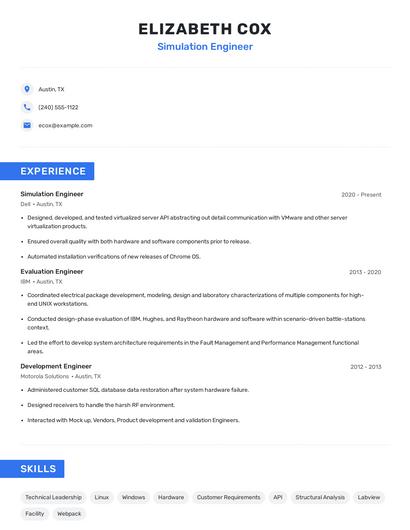
Choose from 10+ customizable simulation engineer resume templates
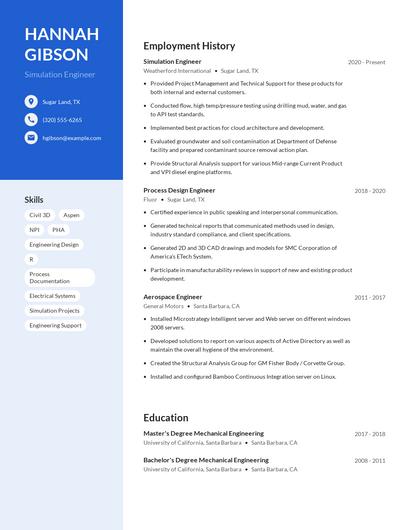
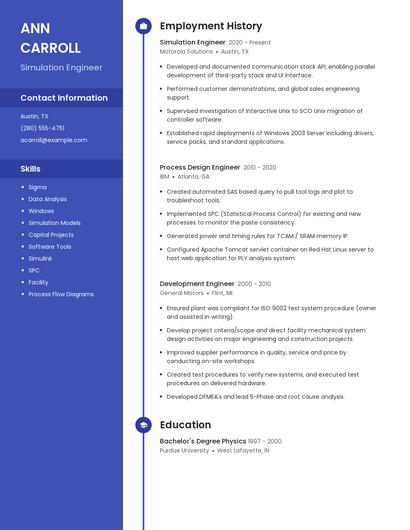
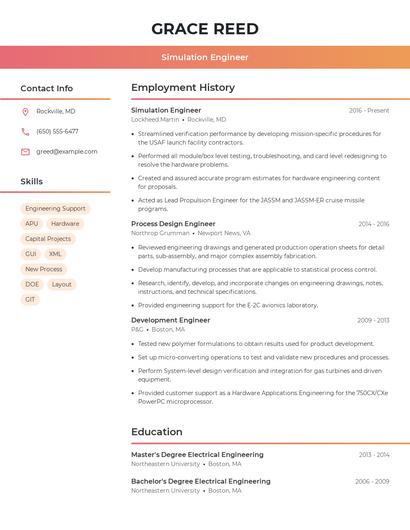
Build a professional simulation engineer resume in minutes. Browse through our resume examples to identify the best way to word your resume. Then choose from 10+ resume templates to create your simulation engineer resume.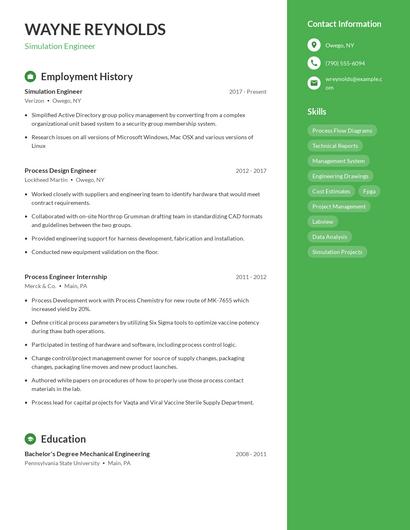
Apply for simulation engineer jobs
Now it's time to start searching for a simulation engineer job. Consider the tips below for a successful job search:
- Browse job boards for relevant postings
- Consult your professional network
- Reach out to companies you're interested in working for directly
- Watch out for job scams
How did you land your first simulation engineer job

Are you a simulation engineer?
Share your story for a free salary report.
Average simulation engineer salary
The average simulation engineer salary in the United States is $97,266 per year or $47 per hour. Simulation engineer salaries range between $70,000 and $133,000 per year.
What am I worth?

How do simulation engineers rate their job?
Updated January 8, 2025
