What does a small parts assembler do?
Small parts assembler responsibilities
Here are examples of responsibilities from real small parts assembler resumes:
- Excel in interpreting detail aligning units using jigs and fixtures, and inspecting complete components to ensure conformance to specifications.
- Excel in interpreting detail aligning units using jigs and fixtures, and inspecting complete components to ensure conformance to specifications.
Small parts assembler skills and personality traits
We calculated that 41% of Small Parts Assemblers are proficient in Hand Tools, Assembly Tasks, and Dexterity.
We break down the percentage of Small Parts Assemblers that have these skills listed on their resume here:
- Hand Tools, 41%
Assembled commercial band saws using various hand tools.
- Assembly Tasks, 19%
Perform circuit board testing Rotated through all assembly tasks required within the cell, according to work instructions
- Dexterity, 18%
Assembled voting systems mouth pieces for individuals with motor disabilities and limited dexterity
- Circuit Boards, 4%
Assembled an array of digital and analog components and circuit boards for a variety of applications, primarily professional medical equipment.
- Quality Checks, 4%
Operate sewing machine to make uniform pants Achieve daily production rate Quality check product
- Assembly Problems, 4%
Resolved assembly problems by altering dimensions to meet specifications; notified supervisor when additional resources or tools were required.
Most small parts assemblers use their skills in "hand tools," "assembly tasks," and "dexterity" to do their jobs. You can find more detail on essential small parts assembler responsibilities here:
The three companies that hire the most small parts assemblers are:
- Aerotek4 small parts assemblers jobs
- TERRA Staffing Group
3 small parts assemblers jobs
- Astronics2 small parts assemblers jobs
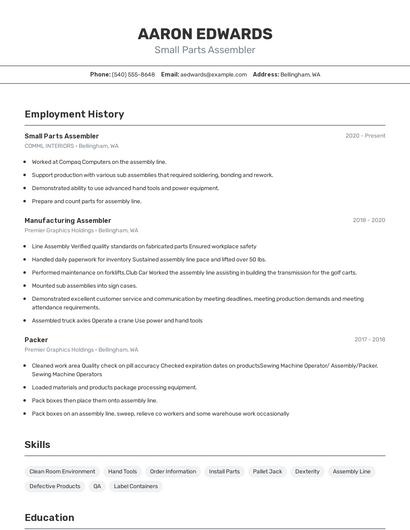
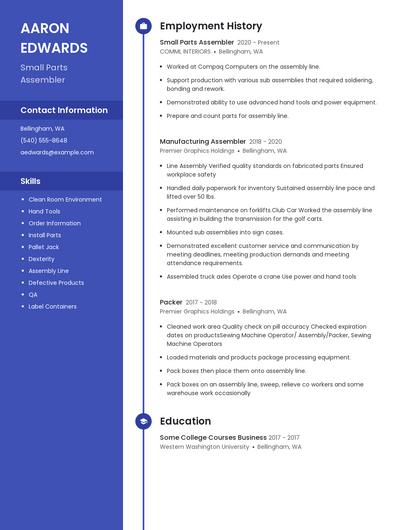
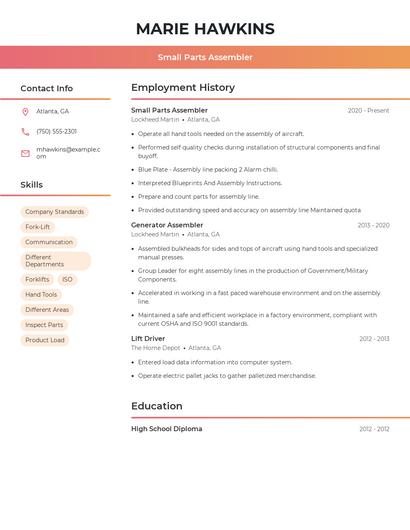
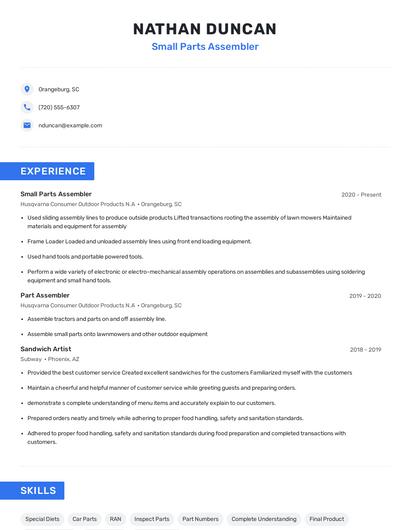
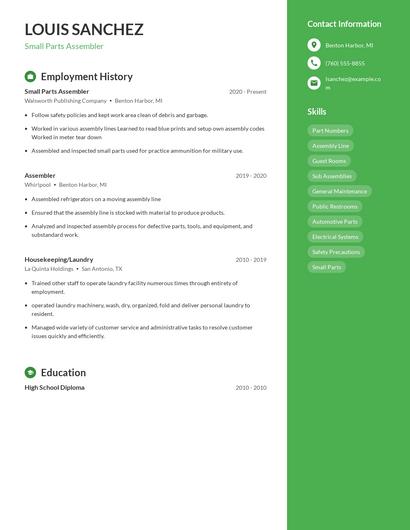
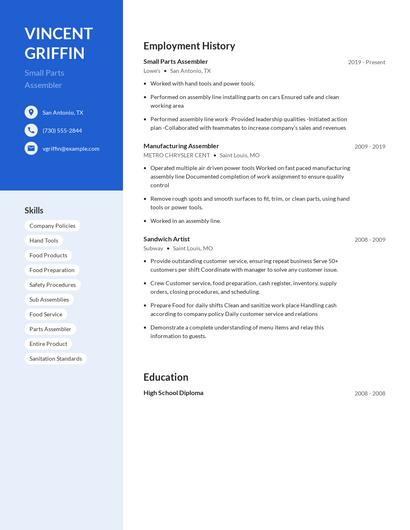
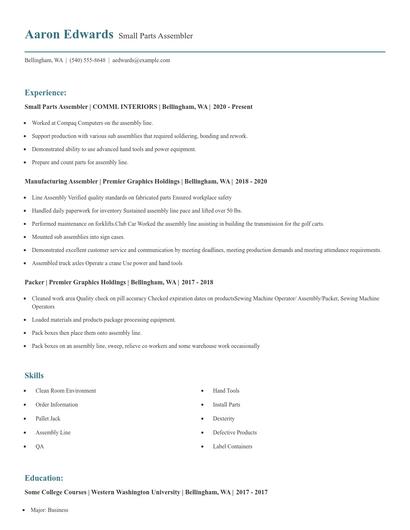
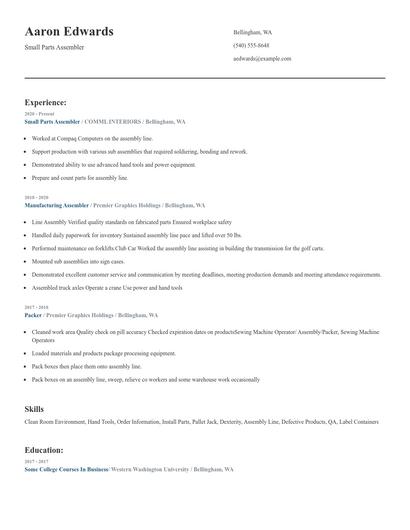
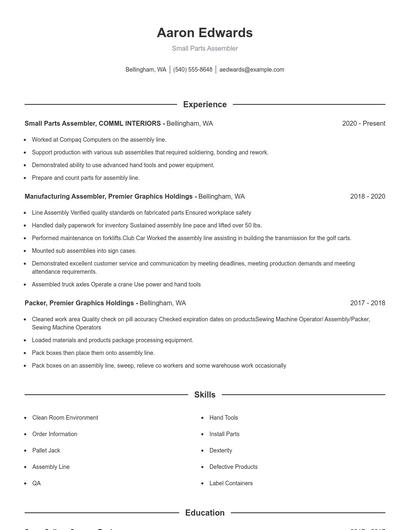
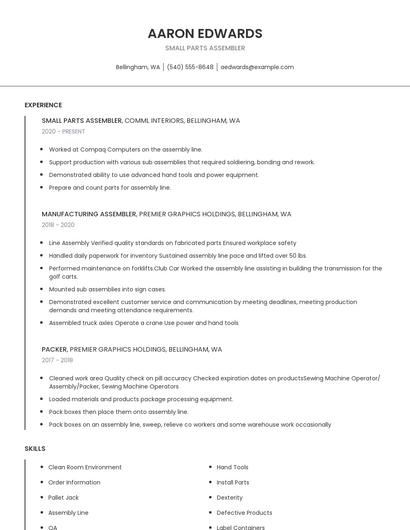
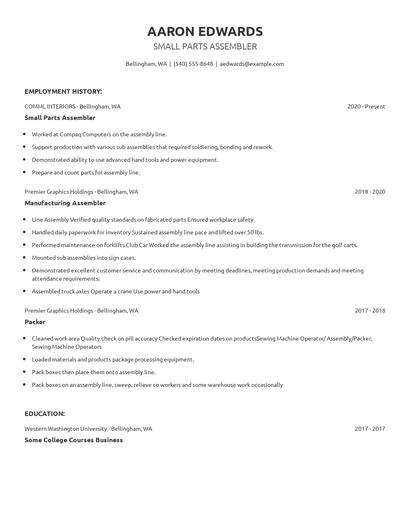
Choose from 10+ customizable small parts assembler resume templates
Build a professional small parts assembler resume in minutes. Our AI resume writing assistant will guide you through every step of the process, and you can choose from 10+ resume templates to create your small parts assembler resume.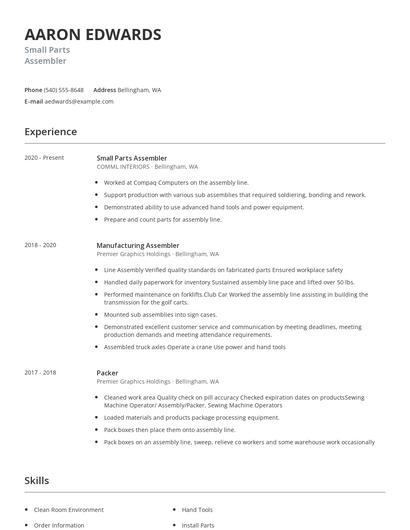
Compare different small parts assemblers
Small parts assembler vs. Solder technician
Assembly technicians are responsible for constructing small parts and components to create a new product according to the specifications of a client or a supervisor. An assembly technician performs diagnostic tests on the assembled product to ensure efficiency and conduct adjustments as needed. An assembly technician also provides manual instructional guides for product use and troubleshooting procedures. Assembly technicians must be knowledgeable about the technology and mechanical industry, as well as have the ability to analyze designs as a guide for creating high-quality products.
There are some key differences in the responsibilities of each position. For example, small parts assembler responsibilities require skills like "assembly tasks," "circuit boards," "quality checks," and "assembly problems." Meanwhile a typical solder technician has skills in areas such as "through-hole," "pcb," "ipc-a-610," and "circuit board assembly." This difference in skills reveals the differences in what each career does.
The education levels that solder technicians earn slightly differ from small parts assemblers. In particular, solder technicians are 1.8% more likely to graduate with a Master's Degree than a small parts assembler. Additionally, they're 0.4% more likely to earn a Doctoral Degree.Small parts assembler vs. Assembler & quality control
In addition to the difference in salary, there are some other key differences worth noting. For example, small parts assembler responsibilities are more likely to require skills like "hand tools," "assembly tasks," "dexterity," and "assembly problems." Meanwhile, an assembler & quality control has duties that require skills in areas such as "part numbers," "assembly line," "control panels," and "r." These differences highlight just how different the day-to-day in each role looks.
On average, assemblers & quality control earn a lower salary than small parts assemblers. Some industries support higher salaries in each profession. Interestingly enough, assemblers & quality control earn the most pay in the automotive industry with an average salary of $34,668. Whereas small parts assemblers have higher pay in the energy industry, with an average salary of $37,243.In general, assemblers & quality control achieve similar levels of education than small parts assemblers. They're 1.7% more likely to obtain a Master's Degree while being 0.4% less likely to earn a Doctoral Degree.Small parts assembler vs. Assembler musical equipment
The required skills of the two careers differ considerably. For example, small parts assemblers are more likely to have skills like "assembly tasks," "dexterity," "quality checks," and "line assembly." But a assembler musical equipment is more likely to have skills like "extreme temperature changes," "fitness equipment," "forks," and "assembly diagrams."
Assembler musical equipment earn the highest salary when working in the manufacturing industry, where they receive an average salary of $35,148. Comparatively, small parts assemblers have the highest earning potential in the energy industry, with an average salary of $37,243.When it comes to education, assembler musical equipment tend to earn similar degree levels compared to small parts assemblers. In fact, they're 2.0% more likely to earn a Master's Degree, and 0.7% more likely to graduate with a Doctoral Degree.Small parts assembler vs. Assembly technician
Even though a few skill sets overlap between small parts assemblers and assembly technicians, there are some differences that are important to note. For one, a small parts assembler might have more use for skills like "assembly tasks," "assembly problems," "line assembly," and "clean environment." Meanwhile, some responsibilities of assembly technicians require skills like "customer service," "lean manufacturing," "safety procedures," and "basic math. "
The finance industry tends to pay the highest salaries for assembly technicians, with average annual pay of $37,725. Comparatively, the highest small parts assembler annual salary comes from the energy industry.assembly technicians reach similar levels of education compared to small parts assemblers, in general. The difference is that they're 1.4% more likely to earn a Master's Degree, and 0.2% more likely to graduate with a Doctoral Degree.Types of small parts assembler
Updated January 8, 2025
