What does a software applications engineer do?
A software application engineer specializes in designing and developing software, ensuring quality and efficiency. Their responsibilities typically revolve around meeting with clients to discuss their needs and preferences, coordinating with different engineers and specialists, installing and repairing systems, devising tests and execution structures, and conducting maintenance checks to ensure optimal performance. They may also improve existing software and provide customers with regular technical support. Furthermore, in a company setting, a software application engineer may have the task of producing progress reports, maintaining databases, and devising training programs for employees.
Software applications engineer responsibilities
Here are examples of responsibilities from real software applications engineer resumes:
- Developed/Maintain software to fully automate businesses onto PC's.
- Manage and complete multiple concurrent ERP software implementation projects.
- Contribute to implementing microservices used to manage entities and maintain a synchronize state between supplier and distributor.
- Develop web applications to retrieve data for team assessments using technologies like JSP, Java, HTML and JavaScript.
- Design databases and write web services that can communicate with PageFlex API.
- Involve in detail analysis, estimates, development, bug fixing and enhancement following SDLC and scrum patterns.
- Generate and document test reports for maintain JIRA issues.
- Participate in daily scrum, bi-weekly sprint cycles, paired-programming methodologies.
- Create class diagrams, flowcharts, prototypes, JIRA use cases.
- Develop stored procedures / triggers to retrieve and report data using PL/SQL.
- Develop and modify Perl programming to retrieve, parse and process XML data.
- Design and develop dynamic reporting system using jQuery, HighCharts, and Ruport.
- Create API web service call from patient unit giving device health information to monitoring server.
- Develop program using Unix shell script to provide automate process in running other shell scripts.
- Prepare system design documents with exposure to all phases of SDLC from requirements to deployment.
Software applications engineer skills and personality traits
We calculated that 14% of Software Applications Engineers are proficient in Java, Python, and Software Development. They’re also known for soft skills such as Analytical skills, Communication skills, and Creativity.
We break down the percentage of Software Applications Engineers that have these skills listed on their resume here:
- Java, 14%
Enhanced Java based certification tool for Motorola based Android Application certification and signing process in order to provide automated server-to-server authentication.
- Python, 10%
Developed python scripts to help the team attain LEAN goals by automating tedious manual processes.
- Software Development, 7%
Embedded software development, GUI development, and software/hardware integration for digital communication equipment.
- JavaScript, 6%
Developed presentation tier for the portfolio system using Spring MVC, JSP, JavaScript and JSTL.
- Architecture, 6%
Contributed to additions and maintenance of software architecture of various diagnostic components providing easy reference and guidelines for the future development.
- HTML, 4%
Created metric reports with Oracle APEX and inserted HTML where needed to make the reports look better.
"java," "python," and "software development" are among the most common skills that software applications engineers use at work. You can find even more software applications engineer responsibilities below, including:
Analytical skills. The most essential soft skill for a software applications engineer to carry out their responsibilities is analytical skills. This skill is important for the role because "developers must analyze users’ needs and then design software to meet those needs." Additionally, a software applications engineer resume shows how their duties depend on analytical skills: "developed rfid analysis platform for rfid data visualization and analysis. "
Communication skills. Another soft skill that's essential for fulfilling software applications engineer duties is communication skills. The role rewards competence in this skill because "developers must be able to give clear instructions to others working on a project." According to a software applications engineer resume, here's how software applications engineers can utilize communication skills in their job responsibilities: "integrated control systems of various different communication protocols using tridium's java based framework. "
Creativity. Another skill that relates to the job responsibilities of software applications engineers is creativity. This skill is critical to many everyday software applications engineer duties, as "developers are the creative minds behind new computer software." This example from a resume shows how this skill is used: "project lead for modules within easisuite for cad design, order entry and inventory / part tracking. "
Detail oriented. A big part of what software applications engineers do relies on "detail oriented." You can see how essential it is to software applications engineer responsibilities because "developers often work on many parts of an application or system at the same time and must therefore be able to concentrate and pay attention to detail." Here's an example of how this skill is used from a resume that represents typical software applications engineer tasks: "developed applications using object-oriented practices, applying design patterns and mvc architectural pattern within an iterative software development process. "
Interpersonal skills. A commonly-found skill in software applications engineer job descriptions, "interpersonal skills" is essential to what software applications engineers do. Software applications engineer responsibilities rely on this skill because "software developers must be able to work well with others who contribute to designing, developing, and programming successful software." You can also see how software applications engineer duties rely on interpersonal skills in this resume example: "generated a map of interpersonal relationships from an xml file. "
Problem-solving skills. Lastly, "problem-solving skills" is an important element of what a software applications engineer does. Software applications engineer responsibilities require this skill because "because developers are in charge of software from beginning to end, they must be able to solve problems that arise throughout the design process." This resume example highlights how software applications engineer duties rely on this skill: "developed java graphical user interface (gui) software solutions for united states marine corps. "
The three companies that hire the most software applications engineers are:
- ZOOM+Care56 software applications engineers jobs
- Change Healthcare47 software applications engineers jobs
- Intel37 software applications engineers jobs
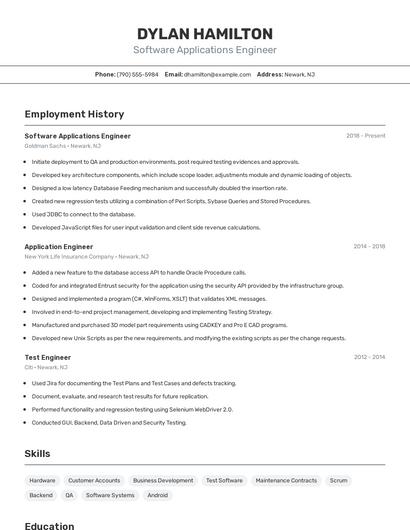
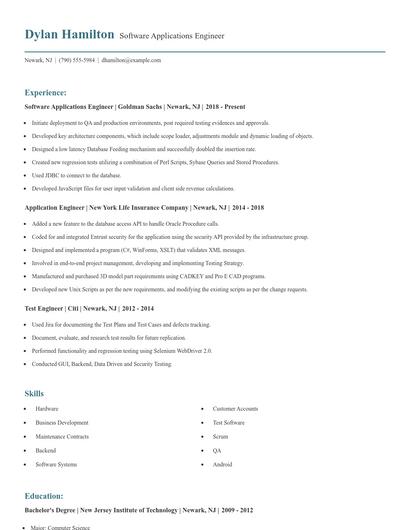
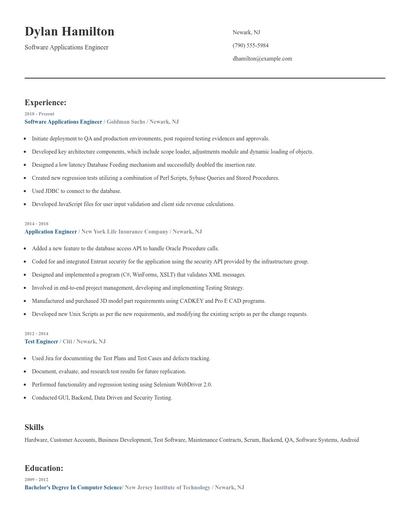
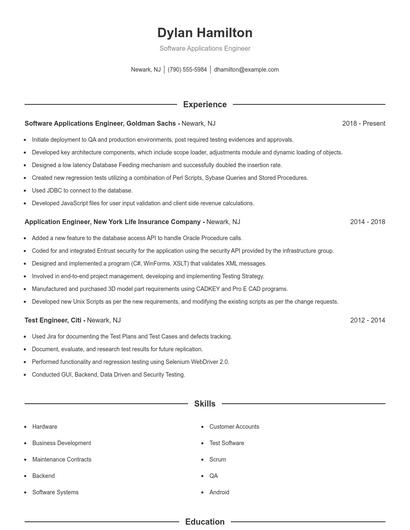
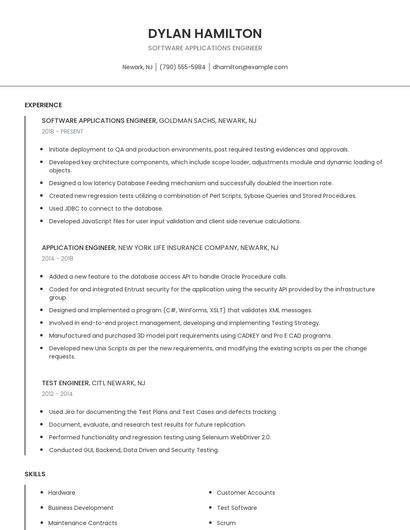
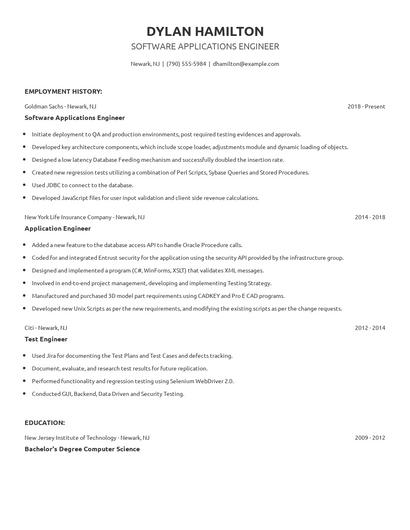
Choose from 10+ customizable software applications engineer resume templates
Build a professional software applications engineer resume in minutes. Our AI resume writing assistant will guide you through every step of the process, and you can choose from 10+ resume templates to create your software applications engineer resume.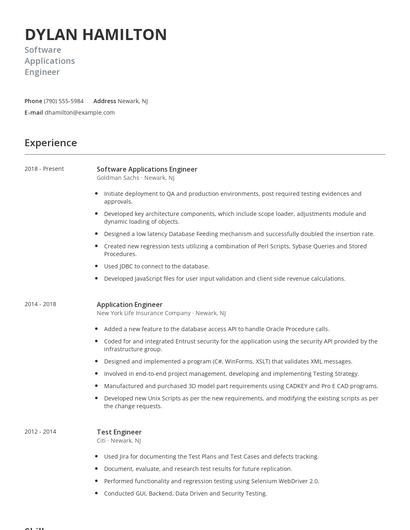


Compare different software applications engineers
Software applications engineer vs. Lead engineer
A lead engineer's duties vary on their line of work or industry of employment. Typically, their responsibilities will revolve around overseeing the progress of operations and performance of the workforce, ensuring that everything is running smoothly. They are also responsible for addressing issues and concerns, assessing risks, monitoring the budget, coordinating with clients and architects, and even training workers. Furthermore, as a lead engineer, it is crucial to conduct regular inspections to ensure the quality of work and maintain a safe environment for all workers.
These skill sets are where the common ground ends though. The responsibilities of a software applications engineer are more likely to require skills like "software development," "c," "application development," and "scrum." On the other hand, a job as a lead engineer requires skills like "git," "database," "project management," and "troubleshoot." As you can see, what employees do in each career varies considerably.
Lead engineers tend to make the most money working in the automotive industry, where they earn an average salary of $110,872. In contrast, software applications engineers make the biggest average salary, $120,071, in the technology industry.lead engineers tend to reach similar levels of education than software applications engineers. In fact, lead engineers are 1.1% more likely to graduate with a Master's Degree and 1.3% more likely to have a Doctoral Degree.Software applications engineer vs. Software developer
A software developer is responsible for designing application systems to support the user and business' needs. Duties of a software developer include testing software codes, performing diagnostic programs and troubleshooting, interpreting system data and establishing efficient parameters, and ensuring the compatibility of the systems. A software developer must have an excellent knowledge of computer programs and programming languages to understand its complexities, especially on detecting system defects and malfunctions. A software developer must have strong attention to detail, communication, and decision-making skills to coordinate with the team and also work independently under minimal supervision.
Each career also uses different skills, according to real software applications engineer resumes. While software applications engineer responsibilities can utilize skills like "c #," "architecture," "c," and "sql server," software developers use skills like "database," "git," "jira," and "c # .net."
On average, software developers earn a lower salary than software applications engineers. Some industries support higher salaries in each profession. Interestingly enough, software developers earn the most pay in the finance industry with an average salary of $96,138. Whereas software applications engineers have higher pay in the technology industry, with an average salary of $120,071.software developers earn similar levels of education than software applications engineers in general. They're 2.8% more likely to graduate with a Master's Degree and 1.3% more likely to earn a Doctoral Degree.What technology do you think will become more important and prevalent for software applications engineers in the next 3-5 years?
Frank McCown Ph.D.
Associate Professor, Harding University
Software applications engineer vs. Software analyst
A software analyst is responsible for creating and designing software programs and applications, as well as modifying existing ones for optimization according to business requirements. Software analysts work with the technical team to draw system codes, analyze programming languages, and ensure the stability and efficiency of software navigation by running multiple quality checks to the system. They inspect the application's performance, configure servers, and improve software infrastructure according to quality findings. A software analyst records resolution reports and provides progress updates, ensuring that the project adheres to budget limitations and set timetables.
Some important key differences between the two careers include a few of the skills necessary to fulfill the responsibilities of each. Some examples from software applications engineer resumes include skills like "c #," "python," "javascript," and "architecture," whereas a software analyst is more likely to list skills in "troubleshoot," "test data," "business process," and "jira. "
Software analysts earn the highest salary when working in the manufacturing industry, where they receive an average salary of $86,986. Comparatively, software applications engineers have the highest earning potential in the technology industry, with an average salary of $120,071.software analysts typically earn similar educational levels compared to software applications engineers. Specifically, they're 3.4% less likely to graduate with a Master's Degree, and 0.1% less likely to earn a Doctoral Degree.Software applications engineer vs. Senior systems software engineer
A senior systems software engineer is an individual responsible for managing a firm's computer network systems. The professional's roles include resolving complex application and network issues through the development of new solutions, overseeing systems developers and other information technology (IT) personnel, and integrating new technology. The job requires proficiency in the MySQL, Python, and Linux programming languages and excellent skills in organizational and time management and communication. The education requirements for the job include a bachelor's degree in electrical engineering, computer science, or a related field.
Types of software applications engineer
Updated January 8, 2025
