What does a special education paraeducator do?
A paraeducator supports teachers by performing administrative tasks and helping give assignments. They prepare lesson plans, track progress, and prepare teaching aids.
Special education paraeducator responsibilities
Here are examples of responsibilities from real special education paraeducator resumes:
- Perform responsible human support and paraprofessional work assisting classroom teacher or other professionals, achieve institution objectives.
- Tutor students with academic subjects such as reading, writing, mathematics, social studies, language arts, and science.
- Participate in transfer, graduation, and annual ARD's.
- Attend CPSE meetings and create annual reports for the individual child.
- Tutor students with math, English, computer, and science assignments.
- Handle high risk behaviors as they arise in the classroom using CPI techniques.
- Teach a developmentally delay first grade student mathematics, reading, and sound phonics.
- Provide instruction in accordance with the student ` s IEP and in conjunction with the instructional team.
- Target and obtain data for children's IEP goals via one-on-one instruction and in- class support.
- Create and implement reading, writing, and math programs for learning disable elementary school children.
- Participate in CPSE meetings and plan instructional activities to meet the individualized needs of each student.
- Participate in CPI training and receive certification.
- Collaborate with speech therapists, occupational therapists, physical therapists and other professionals to develop and implement IFSP goals.
- Work with children and families with special needs as well as ESL.
- Run individualize program with students base upon IEP goals.differentiat Instruction and ESL teaching methods.
Special education paraeducator skills and personality traits
We calculated that 13% of Special Education Paraeducators are proficient in CPR, Instructional Support, and Autism. They’re also known for soft skills such as Communication skills, Interpersonal skills, and Patience.
We break down the percentage of Special Education Paraeducators that have these skills listed on their resume here:
- CPR, 13%
Utilize Crisis Prevention Intervention skills and CPR certification to maintain a safe and positive environment.
- Instructional Support, 7%
Provide instructional support and assistance to teachers and students assigned to a designated special education instructional program.
- Autism, 6%
Provided one-to-one educational and behavioral health services to children with Autism Spectrum Disorders, severe problem behavior, and psychiatric disorders.
- Data Collection, 6%
Supervised incoming staff members, including Education students, in Applied Behavior Analysis and Verbal Behavior methodology and data collection.
- Instructional Materials, 5%
Assist in the preparation of instructional materials and implementation of lesson plans.
- IEP, 5%
Targeted and obtained data for children's IEP goals via one-on-one instruction and in- class support.
Common skills that a special education paraeducator uses to do their job include "cpr," "instructional support," and "autism." You can find details on the most important special education paraeducator responsibilities below.
Communication skills. To carry out their duties, the most important skill for a special education paraeducator to have is communication skills. Their role and responsibilities require that "special education teachers need to explain concepts in terms that students with learning disabilities can understand." Special education paraeducators often use communication skills in their day-to-day job, as shown by this real resume: "reinforced instruction to high school students with learning disabilities and language, communication and behavioral problems. "
Interpersonal skills. Many special education paraeducator duties rely on interpersonal skills. "special education teachers work regularly with a team of educators and the student’s parents to develop ieps," so a special education paraeducator will need this skill often in their role. This resume example is just one of many ways special education paraeducator responsibilities rely on interpersonal skills: "assist students with autism in developing social, interpersonal, problem solving-skills and positive behavior. "
Patience. Another skill that relates to the job responsibilities of special education paraeducators is patience. This skill is critical to many everyday special education paraeducator duties, as "special education teachers must be able to stay calm instructing students with disabilities, who may lack basic skills, present behavioral or other challenges, or require repeated efforts to understand material." This example from a resume shows how this skill is used: "displayed enthusiasm and patience with children to demonstrate a fun learning environment. "
Resourcefulness. For certain special education paraeducator responsibilities to be completed, the job requires competence in "resourcefulness." The day-to-day duties of a special education paraeducator rely on this skill, as "special education teachers must develop different ways to present information that meet their students’ needs." For example, this snippet was taken directly from a resume about how this skill applies to what special education paraeducators do: "showed resourcefulness and teaching effectiveness in meeting the needs of students with limited english language proficiency as well as learning disabilities. "
The three companies that hire the most special education paraeducators are:
- Grandville Public Schools9 special education paraeducators jobs
- KIPP Northern California Public Schools9 special education paraeducators jobs
- Clovis Unified School District8 special education paraeducators jobs
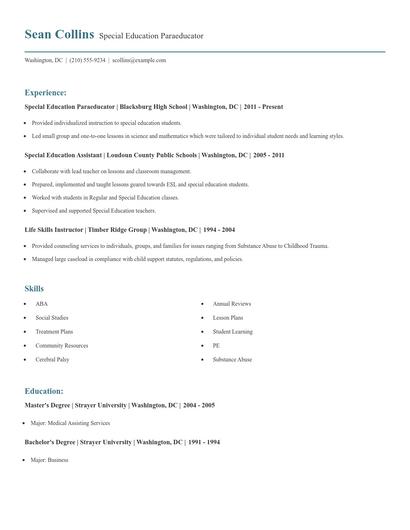
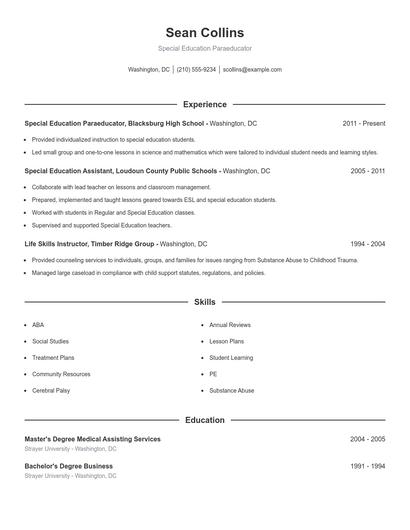
Choose from 10+ customizable special education paraeducator resume templates
Build a professional special education paraeducator resume in minutes. Our AI resume writing assistant will guide you through every step of the process, and you can choose from 10+ resume templates to create your special education paraeducator resume.





Compare different special education paraeducators
Special education paraeducator vs. Learning support teacher
Learning support teachers focus on offering out-of-school education to pupils who need additional help. Their duties include planning and implementing constructive teaching policies as well as collaborating with parents, other relevant professionals, and personnel. They assist pupils in adapting and overcoming problems that emerge due to learning difficulties. Also, the design and foster suitable skills and social abilities as well as motivate students to develop independence, self-confidence, and to achieve their full potential. Additionally, they develop and deliver lessons as well as record and assess children's progress.
While similarities exist, there are also some differences between special education paraeducators and learning support teacher. For instance, special education paraeducator responsibilities require skills such as "cpr," "autism," "applied behavior analysis," and "cpi." Whereas a learning support teacher is skilled in "general education curriculum," "classroom environment," "language arts," and "study." This is part of what separates the two careers.
Learning support teachers really shine in the education industry with an average salary of $35,976. Comparatively, special education paraeducators tend to make the most money in the education industry with an average salary of $32,060.The education levels that learning support teachers earn slightly differ from special education paraeducators. In particular, learning support teachers are 15.6% more likely to graduate with a Master's Degree than a special education paraeducator. Additionally, they're 0.9% more likely to earn a Doctoral Degree.Special education paraeducator vs. Teacher associate
A teacher associate is responsible for assisting the teacher in classroom operations and providing teaching support for the students. Teacher associates develop learning materials according to the instructions of the headteachers, helping them to track students' progress and observing class behaviors. They also take class responsibility if the teacher is away, ensuring to keep activity records and attendance for reference. A teacher associate must have excellent communication and organizational skills, especially in handling students' difficulties and working with the teacher to develop techniques to address those challenges.
In addition to the difference in salary, there are some other key differences worth noting. For example, special education paraeducator responsibilities are more likely to require skills like "instructional support," "autism," "data collection," and "applied behavior analysis." Meanwhile, a teacher associate has duties that require skills in areas such as "child care," "child development," "cleanliness," and "classroom environment." These differences highlight just how different the day-to-day in each role looks.
On average, teacher associates earn a higher salary than special education paraeducators. Some industries support higher salaries in each profession. Interestingly enough, teacher associates earn the most pay in the health care industry with an average salary of $32,745. Whereas special education paraeducators have higher pay in the education industry, with an average salary of $32,060.teacher associates earn similar levels of education than special education paraeducators in general. They're 3.1% more likely to graduate with a Master's Degree and 0.9% less likely to earn a Doctoral Degree.What technology do you think will become more important and prevalent for special education paraeducators in the next 3-5 years?
Chris Craig
Deputy Provost, Missouri State University
Special education paraeducator vs. Learning disabilities teacher
A Learning Disability Teacher plays a vital role in ensuring that every child with special needs can be able to learn even though they are physically and mentally struggling because of their disability. This career does a lot of intervention and production of outcomes for the individual to understand the importance of studying. They use different guides and materials like diagrams, pictures, and other graphics to improve their cognitive, psychological, and analytical thinking of an individual who has disability issues.
There are many key differences between these two careers, including some of the skills required to perform responsibilities within each role. For example, a special education paraeducator is likely to be skilled in "cpr," "instructional support," "data collection," and "instructional materials," while a typical learning disabilities teacher is skilled in "professional development," "learning disabilities," "public schools," and "ieps."
Learning disabilities teachers earn the highest salary when working in the education industry, where they receive an average salary of $39,190. Comparatively, special education paraeducators have the highest earning potential in the education industry, with an average salary of $32,060.When it comes to education, learning disabilities teachers tend to earn higher degree levels compared to special education paraeducators. In fact, they're 21.1% more likely to earn a Master's Degree, and 0.6% more likely to graduate with a Doctoral Degree.Special education paraeducator vs. Instructional aide
An instructional aide focuses on performing support-related tasks for a teacher or faculty member. They are primarily responsible for helping teachers maintain a safe and healthy learning environment, recording attendance, creating visual aids or presentations, participating in the preparation of lesson plans and tests, and assisting students who are having difficulties in a particular task or lesson. An instructional aide may also take part in counseling and supervising students' behavior during class activities, all while adhering to the school's policies and regulations.
Types of special education paraeducator
Updated January 8, 2025
