What does a staff programmer do?
Staff programmer responsibilities
Here are examples of responsibilities from real staff programmer resumes:
- Achieve improved efficiency and cost reduction goals through efforts and expertise provide in multiple LPAR eliminations and data center consolidations.
- Provide technical support to team members on CICS, DB2, and design relate issues.
- Develop UNIX shell script which calls the application.
- Develop subsequent functionality using HTML, JavaScript, CSS, and AJAX.
- Fast-Pace environment of office and production users of PC software and hardware.
- Develop and support batch SAS reports, in support of ECAT routing system.
- Create the department's reusable software component libraries (SAS macros, perl modules, utility scripts).
- Create AS3 graphics drawing interface for map-base web navigation site that function as an overlie over javaScript web page.
- Perform security management as RACF administrator.
- Maintain and advise security administration for RACF.
- Acquire extensive experience installing and maintaining software utilizing SMP/E.
- Develop application framework used to convert free-form relational database extracts to well-form XML.
- Diagnose software installation problems, collect debugging information, and fix problems when necessary.
- Develop unit testing, debugging, documenting, and installation support for client/server software applications.
- Develop a windows application for the automatic downloading of transactional files that insure file integrity and accuracy.
Staff programmer skills and personality traits
We calculated that 9% of Staff Programmers are proficient in Database, COBOL, and DB2. They’re also known for soft skills such as Detail oriented, Troubleshooting skills, and Analytical skills.
We break down the percentage of Staff Programmers that have these skills listed on their resume here:
- Database, 9%
Participated in developing new relational database design and maintaining existing system.
- COBOL, 6%
Served as Customer Service Representative meeting with customers to better understand their requirements, then documenting and coding requirements using COBOL.
- DB2, 4%
Assigned to contract with IBM Corp supporting in-house Parts Planning system PL/1, DB2, CIC, JCL, SQL
- PL/SQL, 4%
Modified PL/SQL code so the SIU Application could call a PL/SQL method that handles email notifications.
- Mainframe, 4%
Maintained existing mainframe system and participated in development many new applications.
- HTML, 3%
Support customers via SharePoint portal troubleshooting, configuring WebParts, and developing HTML based solutions within the SharePoint environment.
Common skills that a staff programmer uses to do their job include "database," "cobol," and "db2." You can find details on the most important staff programmer responsibilities below.
Detail oriented. One of the key soft skills for a staff programmer to have is detail oriented. You can see how this relates to what staff programmers do because "computer programmers must closely examine the code they write because a small mistake can affect the entire computer program." Additionally, a staff programmer resume shows how staff programmers use detail oriented: "converted software from a previous platform from the c and assembly languages to c++ and object oriented based design. "
Troubleshooting skills. Many staff programmer duties rely on troubleshooting skills. "an important part of a programmer’s job is to check the code for errors and fix any they find.," so a staff programmer will need this skill often in their role. This resume example is just one of many ways staff programmer responsibilities rely on troubleshooting skills: "help with the implementation, troubleshooting, enhancement, and maintenance of the star laboratory information management systems database. "
Analytical skills. Another skill that relates to the job responsibilities of staff programmers is analytical skills. This skill is critical to many everyday staff programmer duties, as "computer programmers must understand complex instructions in order to create computer code." This example from a resume shows how this skill is used: "spring beans and transfer objects were used to store data and share data between the front end and back end. "
The three companies that hire the most staff programmers are:
- Lucid Motors2 staff programmers jobs
- Peoria Park District1 staff programmers jobs
- Eastern Kentucky University
1 staff programmers jobs
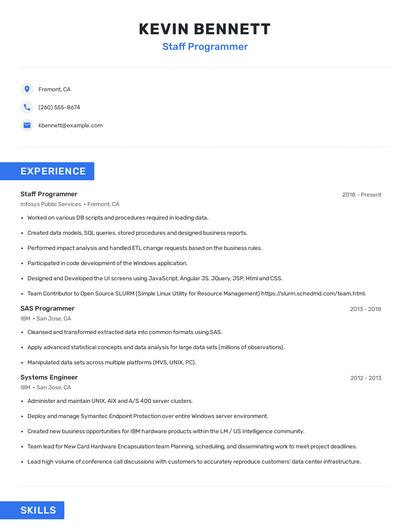
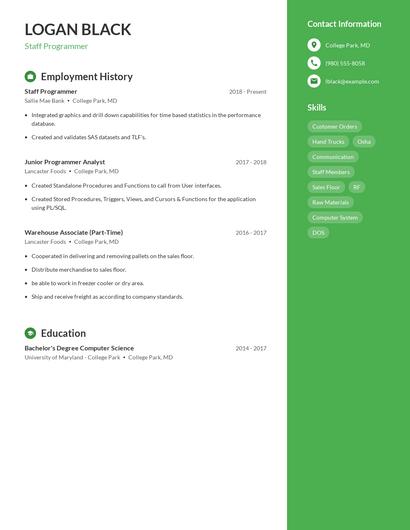
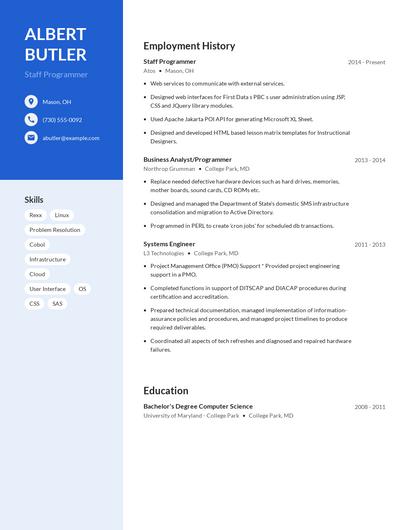
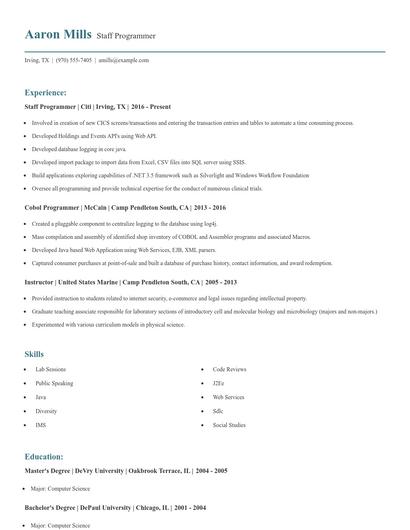
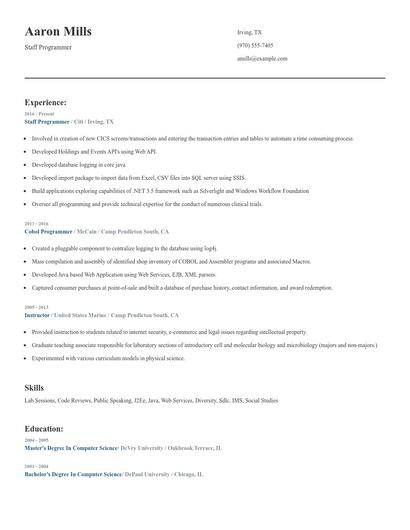
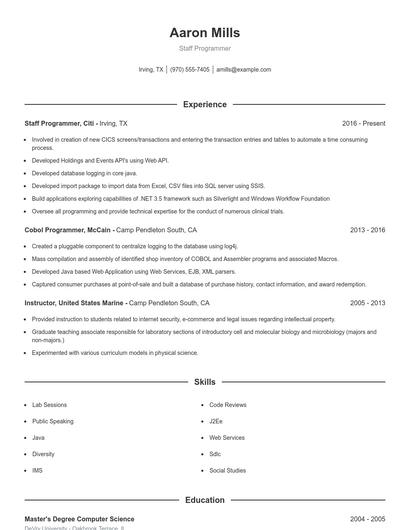
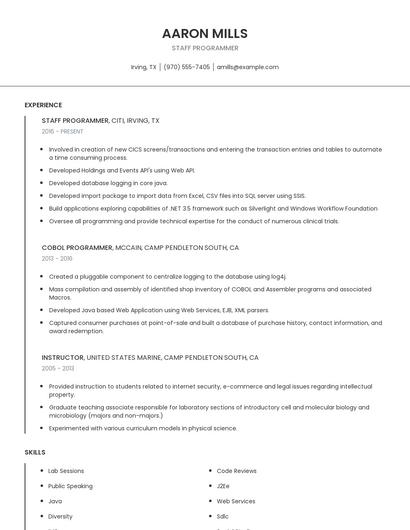
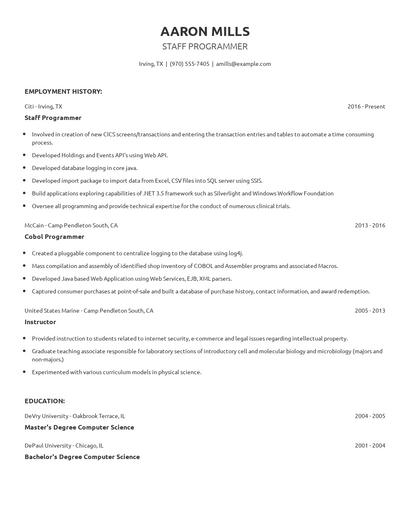
Choose from 10+ customizable staff programmer resume templates
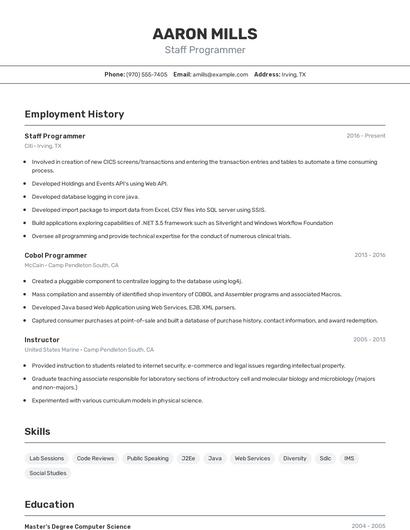
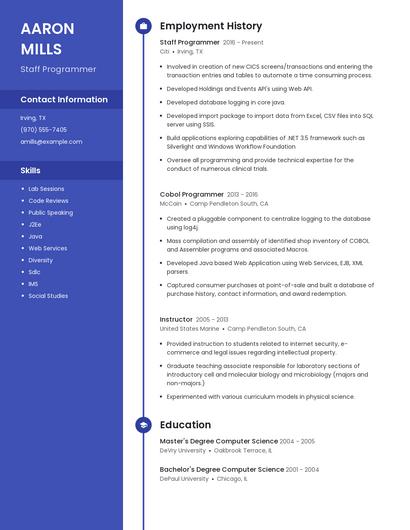
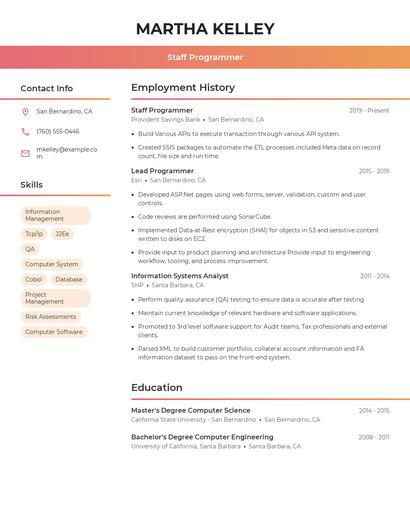
Build a professional staff programmer resume in minutes. Our AI resume writing assistant will guide you through every step of the process, and you can choose from 10+ resume templates to create your staff programmer resume.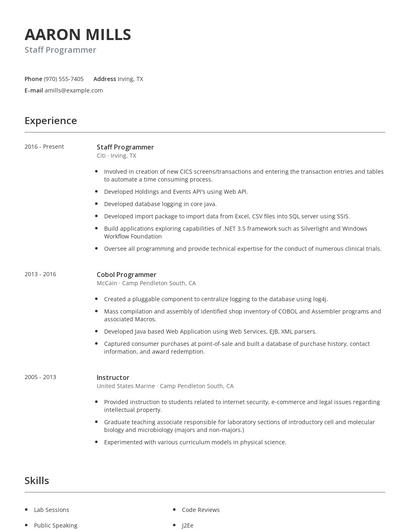
Compare different staff programmers
Staff programmer vs. Senior systems software engineer
A senior systems software engineer is an individual responsible for managing a firm's computer network systems. The professional's roles include resolving complex application and network issues through the development of new solutions, overseeing systems developers and other information technology (IT) personnel, and integrating new technology. The job requires proficiency in the MySQL, Python, and Linux programming languages and excellent skills in organizational and time management and communication. The education requirements for the job include a bachelor's degree in electrical engineering, computer science, or a related field.
These skill sets are where the common ground ends though. The responsibilities of a staff programmer are more likely to require skills like "c #," "mainframe," "jcl," and "life cycle." On the other hand, a job as a senior systems software engineer requires skills like "python," "java," "architecture," and "scrum." As you can see, what employees do in each career varies considerably.
Senior systems software engineers earn the highest salaries when working in the technology industry, with an average yearly salary of $125,048. On the other hand, staff programmers are paid more in the telecommunication industry with an average salary of $110,805.On average, senior systems software engineers reach similar levels of education than staff programmers. Senior systems software engineers are 4.6% more likely to earn a Master's Degree and 0.3% less likely to graduate with a Doctoral Degree.Staff programmer vs. Sap/abap developer
An SAP/ABAP developer is responsible for designing and creating software programs and applications through the SAP and ABAP programming codes. They conduct multiple diagnostic tests for newly-created and existing applications to ensure adherence to quality standards and requirements. They also provide technical resolution to end-users for their system issues and upgrade infrastructure to prevent the reoccurrence of downtimes and system failures. An SAP/ABAP developer must have excellent communication and technical skills, especially in evaluating features for smooth navigation and operations.
While some skills are similar in these professions, other skills aren't so similar. For example, resumes show us that staff programmer responsibilities requires skills like "c #," "database," "cobol," and "db2." But a sap/abap developer might use other skills in their typical duties, such as, "java," "sap abap," "sap hana," and "sql."
On average, sap/abap developers earn a lower salary than staff programmers. Some industries support higher salaries in each profession. Interestingly enough, sap/abap developers earn the most pay in the manufacturing industry with an average salary of $110,167. Whereas staff programmers have higher pay in the telecommunication industry, with an average salary of $110,805.Average education levels between the two professions vary. Sap/abap developers tend to reach higher levels of education than staff programmers. In fact, they're 7.5% more likely to graduate with a Master's Degree and 0.3% less likely to earn a Doctoral Degree.Staff programmer vs. Mainframe developer
A mainframe developer specializes in designing and developing information technology systems. Their responsibilities include performing system installations and modifications, creating test structures, gathering and analyzing data, conducting risk assessments, providing support for project requirements, and implementing plans such as disaster recovery and interface layout. They may also investigate client feedback, troubleshoot issues, and perform systems repairs as needed. Furthermore, as a mainframe developer, it is essential to maintain regular maintenance checks, providing technical support and guidelines to company employees.
Some important key differences between the two careers include a few of the skills necessary to fulfill the responsibilities of each. Some examples from staff programmer resumes include skills like "c #," "database," "cobol," and "pl/sql," whereas a mainframe developer is more likely to list skills in "sql," "java," "mq," and "cobol ii. "
Mainframe developers make a very good living in the insurance industry with an average annual salary of $96,137. On the other hand, staff programmers are paid the highest salary in the telecommunication industry, with average annual pay of $110,805.mainframe developers typically earn similar educational levels compared to staff programmers. Specifically, they're 0.3% more likely to graduate with a Master's Degree, and 1.4% more likely to earn a Doctoral Degree.Staff programmer vs. Program development internship
A Program Development Intern helps to improve the quality of education in schools and other academic institutions. They work in order to gain work experience and satisfy the requirements for a qualification.
Types of staff programmer
Updated January 8, 2025
