What does a standards engineer do?
As a standards engineer, one focuses on the standards and specifications to which people work, how engineering products are developed, and where their quality is based. Standards engineers create technical and engineering applications and limitations for designs, materials, methods, and engineering practices. The engineers work with industrial organization management to maintain a harmonious relationship. They share their knowledge and expertise in engineering technicalities with the field staff. They are effective in carrying out their duties if they have skills in communication, teamwork, innovation, and attention to detail.
Standards engineer responsibilities
Here are examples of responsibilities from real standards engineer resumes:
- Provide mechanical design and sustaining engineering expertise to troubleshoot manufacturing defect trends and achieve a more robust and producible product.
- Ensure technical meetings and proceedings are align with ANSI accredit procedures.
- Expedite company regulatory compliance by writing ISO test methods and policies for test laboratory.
- Obtain skill in ArtiosCAD and training in use of a CNC cutting table for sample production.
- Design changes including - part and assembly locating scheme change, attachment scheme change, material change.
- Conduct analysis to determine form, fit and function alternates for electronic, electrical and electromechanical (EEE) parts.
- Lead engineer on supplier re-tooling of injection mold IML part, applying Cpk and sigma level theory to dimensional tolerance compliance.
- Proofread and approve technical specifications, artwork and cad drawings associate with rebranding.
- Perform internal audits of manufacturing facilities worldwide and report on compliance according to ISO standards.
- Present new product proposals for adoption, fully understanding standards requirements, IP positioning, technology road mapping and market forecasts ..
- Conduct geotechnical and environmental subsurface investigations.
- Focuse on resolving numerous cross browser compatibility relate to CSS and JavaScript.
Standards engineer skills and personality traits
We calculated that 19% of Standards Engineers are proficient in CAD, ISO, and IP. They’re also known for soft skills such as Speaking skills, Writing skills, and Creativity.
We break down the percentage of Standards Engineers that have these skills listed on their resume here:
- CAD, 19%
Created and released complete engineering documentation, including 3D CAD models and 2D drawings, for general-use parts.
- ISO, 12%
Performed internal audits of manufacturing facilities worldwide and reported on compliance according to ISO standards.
- IP, 9%
Prepared and presented technical contributions on All-IP network, IP mobility, IP Security and QoS.
- Engineering Standards, 8%
Initiated a training program for process engineers consisting of manufacturing process flow charts, engineering standards and man-hour estimating data.
- Product Development, 8%
Directed contact with the customers who supported standards, new platforms and new product developments.
- Product Line, 7%
Evaluate change requests/change orders for compliance of hardware and software changes to domestic and international safety standards for existing product lines.
Most standards engineers use their skills in "cad," "iso," and "ip" to do their jobs. You can find more detail on essential standards engineer responsibilities here:
Speaking skills. The most essential soft skill for a standards engineer to carry out their responsibilities is speaking skills. This skill is important for the role because "industrial engineers sometimes have to explain their instructions to production staff or technicians before they can make written instructions available." Additionally, a standards engineer resume shows how their duties depend on speaking skills: "conducted experiments and presented data analysis to solve manufacturing problems. "
Writing skills. Many standards engineer duties rely on writing skills. "industrial engineers must prepare documentation for other engineers or scientists, or for future reference," so a standards engineer will need this skill often in their role. This resume example is just one of many ways standards engineer responsibilities rely on writing skills: "expedited company regulatory compliance by writing iso test methods and policies for test laboratory. "
Creativity. standards engineers are also known for creativity, which are critical to their duties. You can see how this skill relates to standards engineer responsibilities, because "industrial engineers use creativity and ingenuity to design new production processes in many kinds of settings in order to reduce the use of material resources, time, or labor while accomplishing the same goal." A standards engineer resume example shows how creativity is used in the workplace: "assist engineers with multiple inventory component issues. "
Listening skills. A big part of what standards engineers do relies on "listening skills." You can see how essential it is to standards engineer responsibilities because "these engineers often operate in teams, but they also must solicit feedback from customers, vendors, and production staff." Here's an example of how this skill is used from a resume that represents typical standards engineer tasks: "communicated effectively with customers to ensure a shared understanding of the test results. "
Math skills. Another common skill required for standards engineer responsibilities is "math skills." This skill comes up in the duties of standards engineers all the time, as "industrial engineers use the principles of calculus, trigonometry, and other advanced topics in mathematics for analysis, design, and troubleshooting in their work." An excerpt from a real standards engineer resume shows how this skill is central to what a standards engineer does: "experienced in design engineering computer software, including protoflo, hysys, matlab, and mathcad. "
Problem-solving skills. Lastly, "problem-solving skills" is an important element of what a standards engineer does. Standards engineer responsibilities require this skill because "in designing facilities for manufacturing and processes for providing services, these engineers deal with several issues at once, from workers’ safety to quality assurance." This resume example highlights how standards engineer duties rely on this skill: "resolved technical issues throughout component lifetime, including failure analysis reporting and initiating corrective actions through the ecr / eco process. "
The three companies that hire the most standards engineers are:
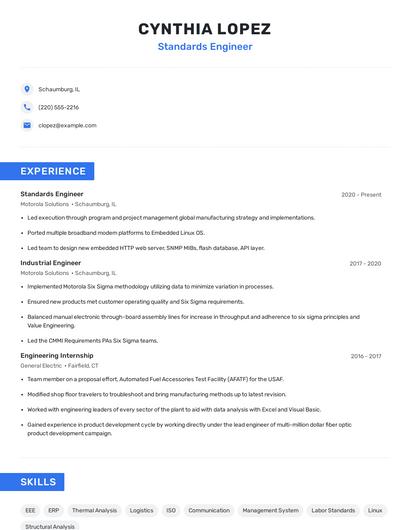
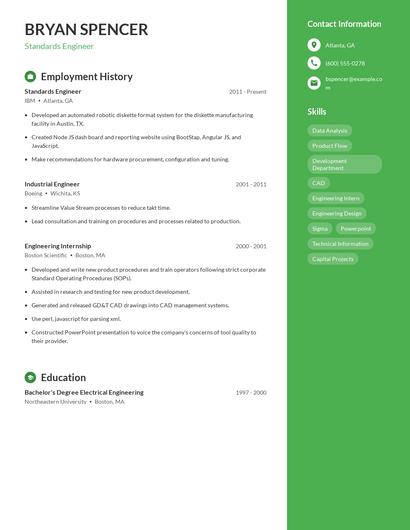
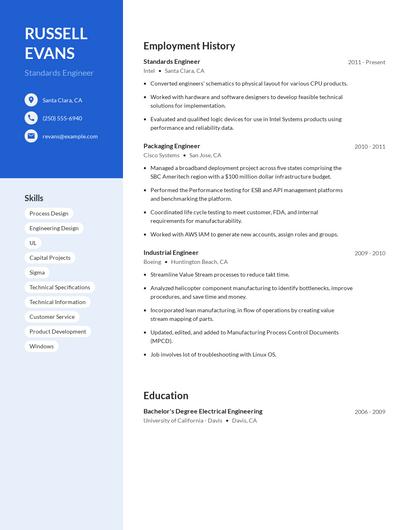
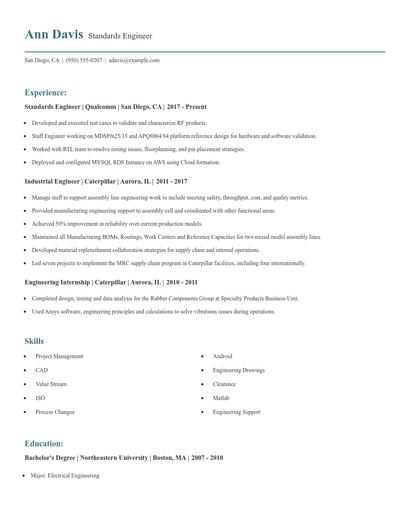
Choose from 10+ customizable standards engineer resume templates
Build a professional standards engineer resume in minutes. Our AI resume writing assistant will guide you through every step of the process, and you can choose from 10+ resume templates to create your standards engineer resume.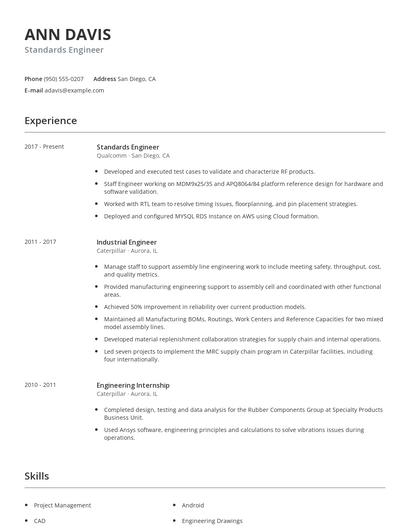
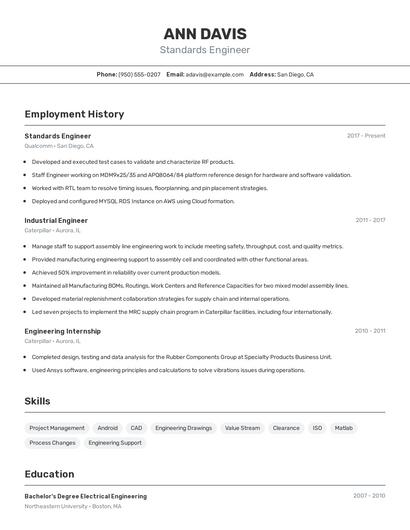
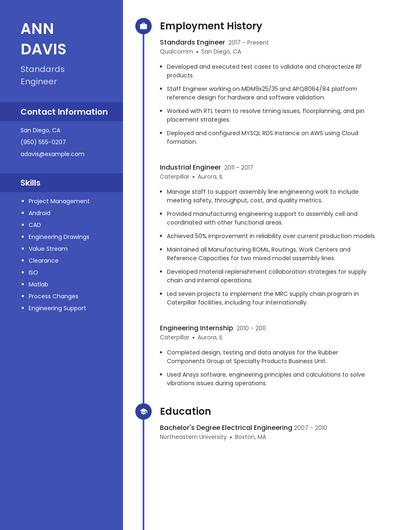
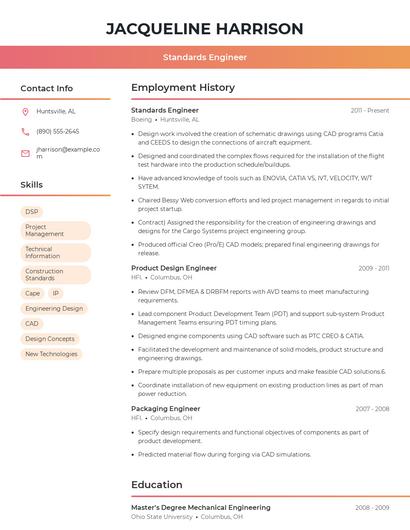
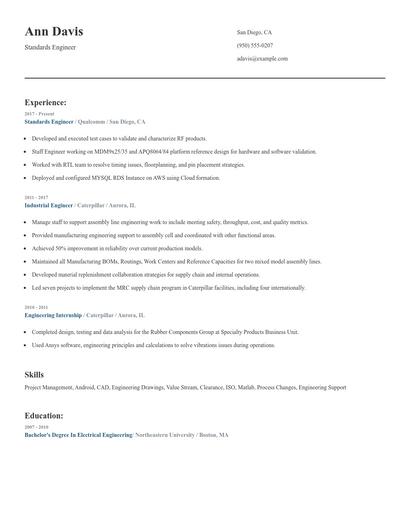
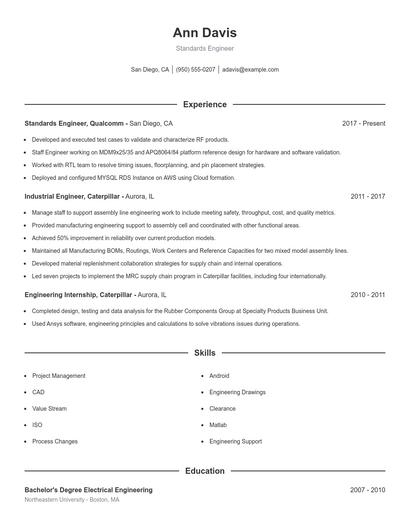
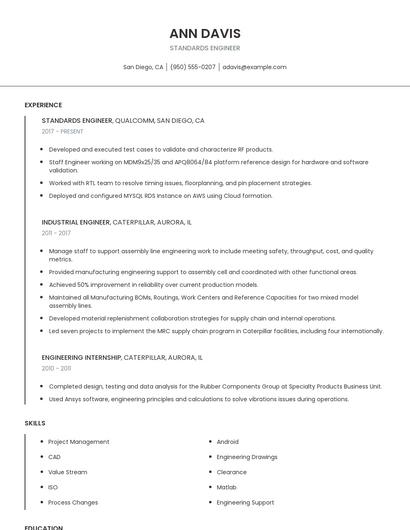
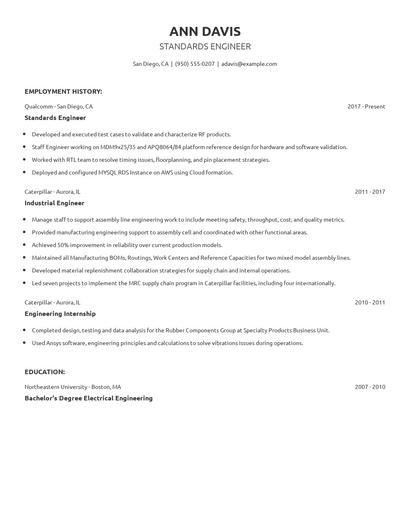
Compare different standards engineers
Standards engineer vs. Process improvement engineer
A process improvement engineer specializes in conducting research and analysis to develop new strategies and ideas to improve the processes in a manufacturing plant or a similar setting. They prioritize efficiency and profitability. Most of the time, engineers participate in a series of meetings where they coordinate with fellow engineers to determine opportunities for product growth and development. Moreover, a process improvement engineer is also responsible for crafting new policies and regulations, upgrading systems, and developing new practices to ensure product quality and customer satisfaction.
There are some key differences in the responsibilities of each position. For example, standards engineer responsibilities require skills like "cad," "aerospace," "ip," and "engineering standards." Meanwhile a typical process improvement engineer has skills in areas such as "lean six sigma," "sigma," "project management," and "healthcare." This difference in skills reveals the differences in what each career does.
Process improvement engineers tend to reach higher levels of education than standards engineers. In fact, process improvement engineers are 7.2% more likely to graduate with a Master's Degree and 0.0% more likely to have a Doctoral Degree.Standards engineer vs. Process engineer internship
A process engineering intern performs various tasks for an organization. These include collaborating with the technical team on cost savings, process efficiency improvements, and technology advancement, attending meetings with leadership teams, and participating in customer trials. Additionally, they may assist with the leadership or management teams in creating standard operating procedures. They are responsible for coordinating with engineers and work on projects assigned by the leadership. Ideal candidates for this role must have a degree in mechanical or industrial engineering, excellent communication skills, and knowledge and experience in process observation.
In addition to the difference in salary, there are some other key differences worth noting. For example, standards engineer responsibilities are more likely to require skills like "aerospace," "ip," "engineering standards," and "product development." Meanwhile, a process engineer internship has duties that require skills in areas such as "process engineering," "process improvement," "continuous improvement," and "powerpoint." These differences highlight just how different the day-to-day in each role looks.
In general, process engineer interns achieve similar levels of education than standards engineers. They're 2.4% more likely to obtain a Master's Degree while being 0.0% less likely to earn a Doctoral Degree.Standards engineer vs. Supplier quality engineer
A Supplier Quality Engineer ensures that the supplier's quality standards are in accordance with the requirement of the organization. They also report supplier performance and quality to management.
Some important key differences between the two careers include a few of the skills necessary to fulfill the responsibilities of each. Some examples from standards engineer resumes include skills like "cad," "aerospace," "ip," and "engineering standards," whereas a supplier quality engineer is more likely to list skills in "sigma," "ppap," "product quality," and "spc. "
Most supplier quality engineers achieve a higher degree level compared to standards engineers. For example, they're 5.6% more likely to graduate with a Master's Degree, and 0.7% more likely to earn a Doctoral Degree.Standards engineer vs. Product support engineer
A product support engineer is responsible for resolving technical issues of end-users regarding the products and services offered by the company. Product support engineers conduct troubleshooting operations for system failures and write resolution reports for reference. They also support the product analysts in improving the product's features and processes to prevent the reoccurrence of defects and maintain optimal performance. A product support engineer designs automation procedures and runs multiple diagnostic tests to ensure high-quality outputs and avoid operational delays.
Even though a few skill sets overlap between standards engineers and product support engineers, there are some differences that are important to note. For one, a standards engineer might have more use for skills like "aerospace," "ip," "engineering standards," and "iec." Meanwhile, some responsibilities of product support engineers require skills like "product support," "troubleshoot," "customer service," and "customer support. "
In general, product support engineers hold similar degree levels compared to standards engineers. Product support engineers are 0.1% less likely to earn their Master's Degree and 0.8% less likely to graduate with a Doctoral Degree.Types of standards engineer
Updated January 8, 2025
