What does a station operator do?
Station operator responsibilities
Here are examples of responsibilities from real station operator resumes:
- Manage LAN network and provide support for users.
- Perform PMCS on assign communications equipment, vehicles and power generators.
- Process debris and load in preparation for landfill.
- Provide services in accordance with NISPOM and UL regulations.
- Utilize GPS systems for placement of equipment during field exercises.
- Utilize GPS systems for placement of equipment in field sites.
- Ensure the air superiority of the U.S. military during combat operations in eastern Afghanistan.
- Perform additional tasks such as sweeping, mopping, removing debris and wiping windows.
- Acquire experience in self discipline, self defense, marksmanship, land navigation and combat operations.
- Check each CCTV monitor to ensure they are operational and providing full coverage of all the areas.
- Perform operational tasks such as blow drips, empty tanks, refill fluids, and testing of ESD systems.
- Assist boat owners by picking them up and helping them off their boats to bringing them safely to the main dock.
- Monitor computerized SCADA system for pump operations.
- Operate computer network systems in military CGS vehicle and analyze message traffic data.
- Perform operations and intelligence duties and operates/performs operator PMCS on vehicles/system prime power units.
Station operator skills and personality traits
We calculated that 11% of Station Operators are proficient in Routine Maintenance, Station Equipment, and Plant Equipment. They’re also known for soft skills such as Customer-service skills, Hand-eye coordination, and Hearing ability.
We break down the percentage of Station Operators that have these skills listed on their resume here:
- Routine Maintenance, 11%
Conduct routine maintenance of the machines and other equipment needed in the business.
- Station Equipment, 10%
Conducted emplacement, initialization and system maintenance on PATRIOT launching station equipment.
- Plant Equipment, 10%
Performed skilled level operation of power plant equipment and machinery.
- System Maintenance, 8%
Seasoned result producing management professional with experience steering and directing all aspects of system maintenance and multiple squads.
- Computer System, 6%
Inputted Lumber grades into a computer system to sort lumber according to quality, thickness, width, and length.
- Preventive Maintenance Checks, 5%
Operated specialized weaponry systems and vehicles, performing preventive maintenance checks and service and maintaining readiness for immediate operations.
"routine maintenance," "station equipment," and "plant equipment" are among the most common skills that station operators use at work. You can find even more station operator responsibilities below, including:
Customer-service skills. The most essential soft skill for a station operator to carry out their responsibilities is customer-service skills. This skill is important for the role because "many motorboat operators interact with passengers and must ensure that the passengers have a pleasant experience." Additionally, a station operator resume shows how their duties depend on customer-service skills: "executed plans for company growth through local advertising and superior customer service. "
Hand-eye coordination. Another essential skill to perform station operator duties is hand-eye coordination. Station operators responsibilities require that "officers and pilots who steer ships have to operate various controls while staying aware of their surroundings." Station operators also use hand-eye coordination in their role according to a real resume snippet: "meet productivity goals & quality standards- communicate in english, both verbal and written- good hand-eye coordination- attention to detail"
Hearing ability. station operators are also known for hearing ability, which are critical to their duties. You can see how this skill relates to station operator responsibilities, because "mariners must pass a hearing test to get an mmc." A station operator resume example shows how hearing ability is used in the workplace: "experienced in shearing, torching, baling, ppe, customer service, and house cleaning. "
Manual dexterity. A big part of what station operators do relies on "manual dexterity." You can see how essential it is to station operator responsibilities because "crewmembers need good balance to maneuver through tight spaces and on wet or uneven surfaces." Here's an example of how this skill is used from a resume that represents typical station operator tasks: "drafted manually and using autocad for commercial/residential buildings and mechanical/ hvac development with engineer's direction. "
Physical strength. A commonly-found skill in station operator job descriptions, "physical strength" is essential to what station operators do. Station operator responsibilities rely on this skill because "sailors on freight ships load and unload cargo." You can also see how station operator duties rely on physical strength in this resume example: "measure signal strength of satellite uplink using electronic equipment. "
Visual ability. Lastly, "visual ability" is an important element of what a station operator does. Station operator responsibilities require this skill because "mariners must pass a vision test to get an mmc." This resume example highlights how station operator duties rely on this skill: "monitor the processes through computer systems and visual inspection and recognize when process parameters deviate to alert and take action. "
The three companies that hire the most station operators are:
- Church & Dwight Co.25 station operators jobs
- Greif2 station operators jobs
- American Water1 station operators jobs
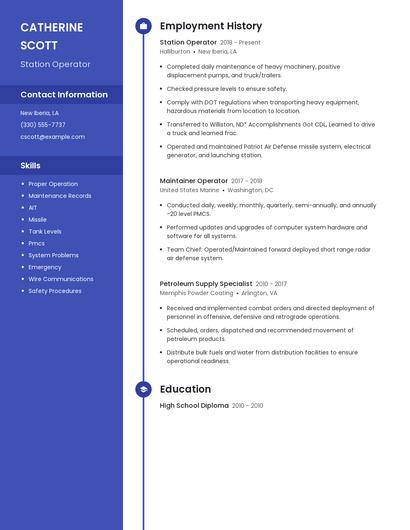
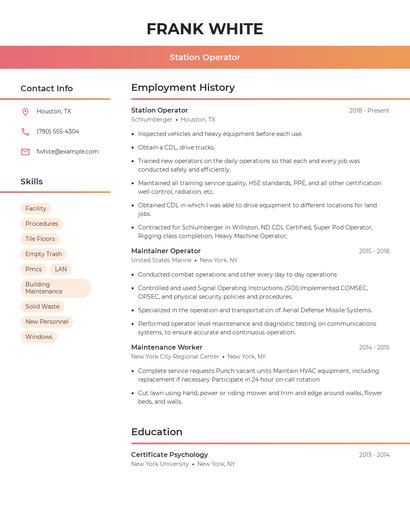
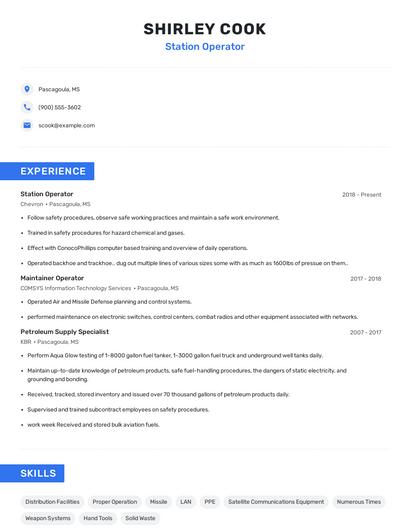
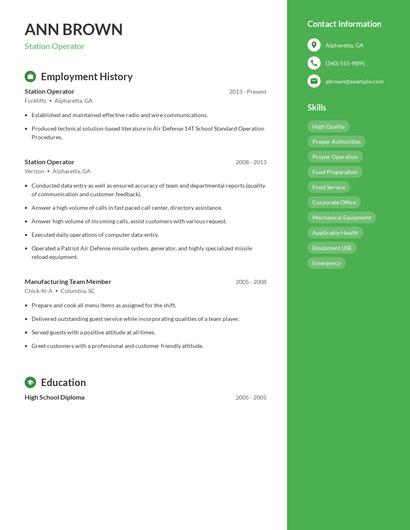
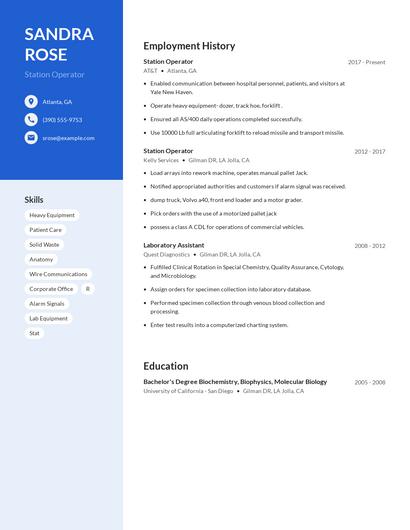
Choose from 10+ customizable station operator resume templates
Build a professional station operator resume in minutes. Our AI resume writing assistant will guide you through every step of the process, and you can choose from 10+ resume templates to create your station operator resume.



Compare different station operators
Station operator vs. Gas engineer
A Gas Engineer specializes in installing, maintaining, and repairing gas systems and appliances in homes and business establishments. They typically travel to various locations, conduct inspections using detectors and other equipment, troubleshoot problems, replace or fix parts, and enforce safety protocols in case of emergencies. Moreover, a Gas Engineer may also work for gas companies where they are in charge of designing and developing extraction systems. To carry out their duties, they perform extensive research and analysis, gather and analyze samples, conduct examinations and surveys, and implement safety policies and regulations.
There are some key differences in the responsibilities of each position. For example, station operator responsibilities require skills like "routine maintenance," "station equipment," "plant equipment," and "system maintenance." Meanwhile a typical gas engineer has skills in areas such as "project management," "technical support," "gis," and "api." This difference in skills reveals the differences in what each career does.
Gas engineers really shine in the energy industry with an average salary of $110,993. Comparatively, station operators tend to make the most money in the utilities industry with an average salary of $43,836.The education levels that gas engineers earn slightly differ from station operators. In particular, gas engineers are 11.5% more likely to graduate with a Master's Degree than a station operator. Additionally, they're 2.3% more likely to earn a Doctoral Degree.Station operator vs. Gas cylinder processor
Each career also uses different skills, according to real station operator resumes. While station operator responsibilities can utilize skills like "routine maintenance," "station equipment," "plant equipment," and "system maintenance," gas cylinder processors use skills like "preform," "dot," "quality control documentation," and "payoff quotes."
Gas cylinder processors earn similar levels of education than station operators in general. They're 2.0% more likely to graduate with a Master's Degree and 2.3% more likely to earn a Doctoral Degree.Station operator vs. Pumping station engineer
The required skills of the two careers differ considerably. For example, station operators are more likely to have skills like "routine maintenance," "station equipment," "plant equipment," and "system maintenance." But a pumping station engineer is more likely to have skills like "gd," "engineering support," "api," and "pump stations."
Pumping station engineers typically earn similar educational levels compared to station operators. Specifically, they're 2.0% less likely to graduate with a Master's Degree, and 0.3% less likely to earn a Doctoral Degree.Station operator vs. Compressor operator
Types of station operator
Updated January 8, 2025
