What does a statistical engineer do?
Statistical engineer responsibilities
Here are examples of responsibilities from real statistical engineer resumes:
- Manage Jenkins security by providing specific access to authorize developers/testers using project base matrix authorization strategy.
- Verify project impact to performance, cost, quality, yield, sigma, etc.
- Expedite and simplify the quotation process for solar water heating systems by accurately representing solar water heating system performance through MATLAB models
- Systemize the Deviation/CAPA and train on investigations utilizing DMAIC.
Statistical engineer skills and personality traits
We calculated that 18% of Statistical Engineers are proficient in Measurement System Analysis, Minitab, and SQL. They’re also known for soft skills such as Speaking skills, Writing skills, and Creativity.
We break down the percentage of Statistical Engineers that have these skills listed on their resume here:
- Measurement System Analysis, 18%
Developed Measurement System Analysis, and generated criteria for gauge R&R, accuracy, linearity, and stability.
- Minitab, 16%
Train other relative subject matter as required (Minitab, MSA, SPC, Control Methods, etc.).
- SQL, 12%
Created a user controllable, automatically updated website using SQL database.
- Statistical Process Control, 10%
Managed and facilitated all Statistical Process Control functions: This included training of employees and the determination of SPC applications.
- R, 10%
Designed and architected R workflows to calculate and compare a variety of water-energy metrics of drought-regulation compliance.
- FMEA, 7%
Consulted with new product development teams on manufacturing and design including FMEA, Quality Control and SPC.
Most statistical engineers use their skills in "measurement system analysis," "minitab," and "sql" to do their jobs. You can find more detail on essential statistical engineer responsibilities here:
Speaking skills. One of the key soft skills for a statistical engineer to have is speaking skills. You can see how this relates to what statistical engineers do because "industrial engineers sometimes have to explain their instructions to production staff or technicians before they can make written instructions available." Additionally, a statistical engineer resume shows how statistical engineers use speaking skills: "authored, presented and published papers on statistical methods for the control data statistical symposium for three years. "
Writing skills. Another soft skill that's essential for fulfilling statistical engineer duties is writing skills. The role rewards competence in this skill because "industrial engineers must prepare documentation for other engineers or scientists, or for future reference." According to a statistical engineer resume, here's how statistical engineers can utilize writing skills in their job responsibilities: "worked closely with stormwater utilities: connectivity studies, stormwater sampling, data analysis, technical writing and reporting. "
Creativity. statistical engineers are also known for creativity, which are critical to their duties. You can see how this skill relates to statistical engineer responsibilities, because "industrial engineers use creativity and ingenuity to design new production processes in many kinds of settings in order to reduce the use of material resources, time, or labor while accomplishing the same goal." A statistical engineer resume example shows how creativity is used in the workplace: "applied six sigma methodologies and inventory management concepts to a jet fuel pipeline. "
Listening skills. A big part of what statistical engineers do relies on "listening skills." You can see how essential it is to statistical engineer responsibilities because "these engineers often operate in teams, but they also must solicit feedback from customers, vendors, and production staff." Here's an example of how this skill is used from a resume that represents typical statistical engineer tasks: "communicated design criteria and specifications and helped troubleshoot the build. "
Problem-solving skills. A commonly-found skill in statistical engineer job descriptions, "problem-solving skills" is essential to what statistical engineers do. Statistical engineer responsibilities rely on this skill because "in designing facilities for manufacturing and processes for providing services, these engineers deal with several issues at once, from workers’ safety to quality assurance." You can also see how statistical engineer duties rely on problem-solving skills in this resume example: "assess risks associated with tests and solutions, e.g. "
Math skills. Lastly, "math skills" is an important element of what a statistical engineer does. Statistical engineer responsibilities require this skill because "industrial engineers use the principles of calculus, trigonometry, and other advanced topics in mathematics for analysis, design, and troubleshooting in their work." This resume example highlights how statistical engineer duties rely on this skill: "performed qualitative and quantitative analysis of the wound care console process as a part of six sigma project. "
The three companies that hire the most statistical engineers are:
- Intel3 statistical engineers jobs
- Corning Incorporated1 statistical engineers jobs
- Nexteer Automotive1 statistical engineers jobs
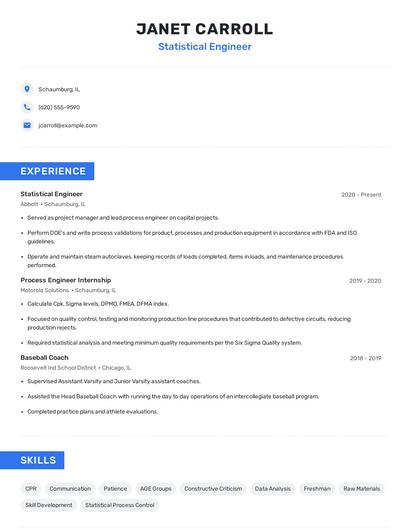
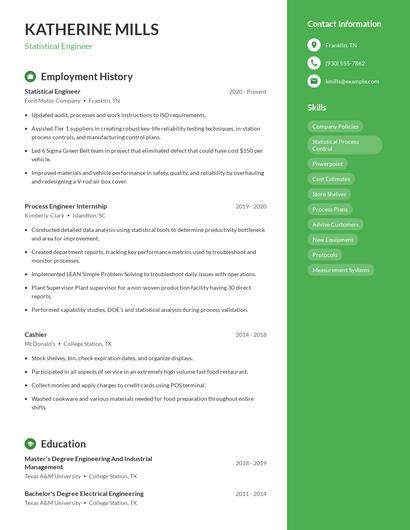
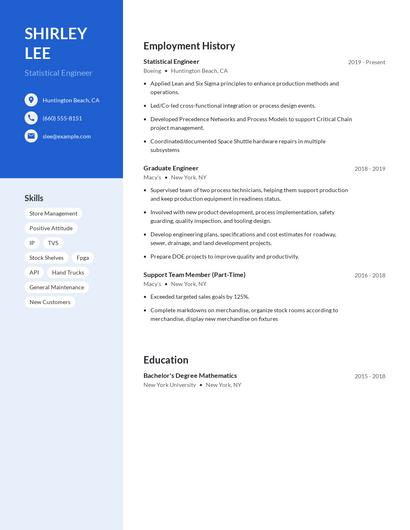
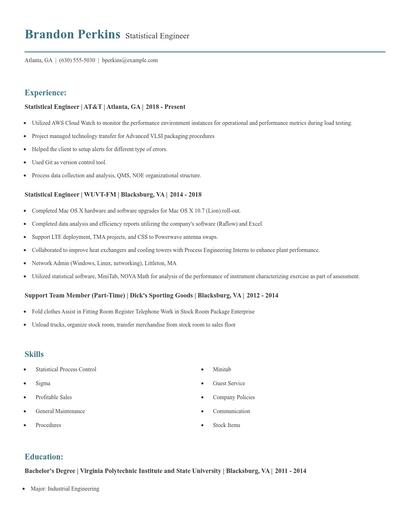
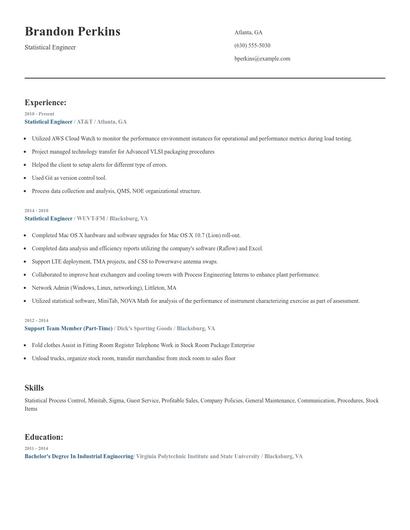
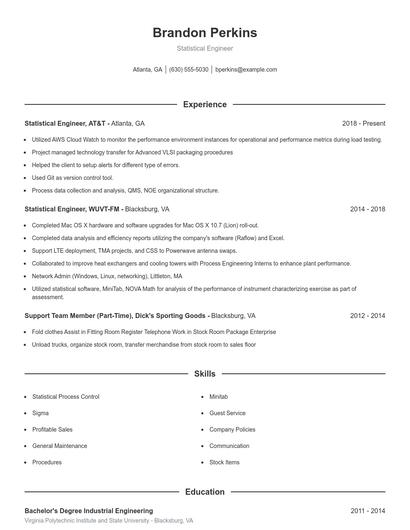
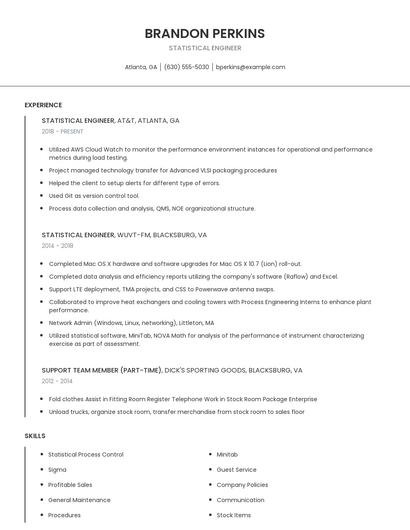
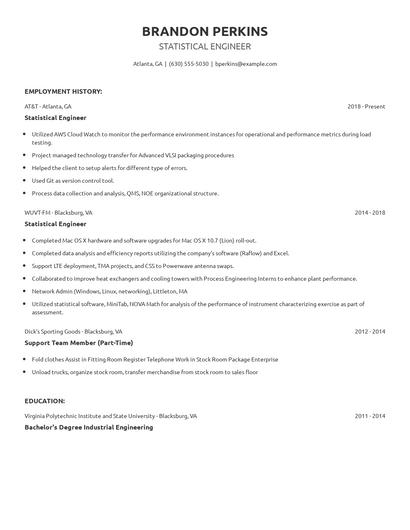
Choose from 10+ customizable statistical engineer resume templates
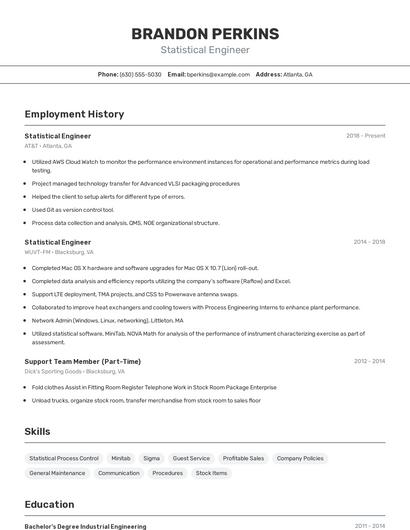
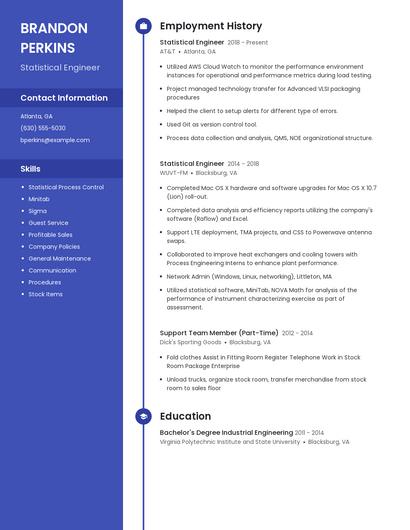
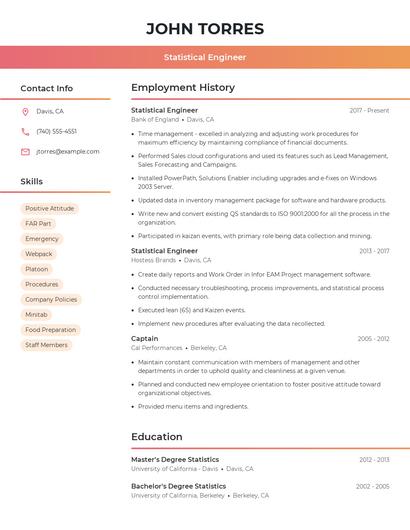
Build a professional statistical engineer resume in minutes. Our AI resume writing assistant will guide you through every step of the process, and you can choose from 10+ resume templates to create your statistical engineer resume.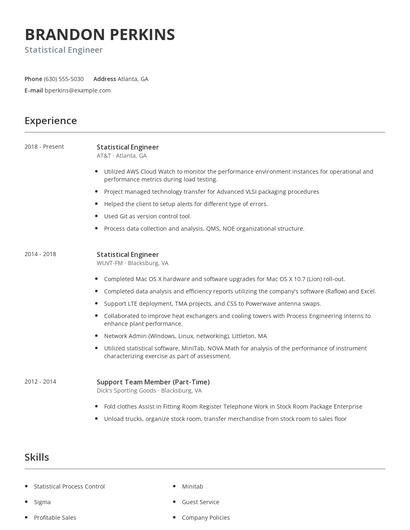
Compare different statistical engineers
Statistical engineer vs. Manufacturing engineering internship
A manufacturing engineering intern is responsible for assisting the manufacturing engineers on the plant's daily operations, analyzing the manufacturing process and procedures, and recommending strategic solutions to maximize productivity and minimize costs. Manufacturing engineering interns shadow the production staff, inspect the tools and equipment of the manufacturing, analyze the quality control documentation, and perform related administrative tasks to familiarize themselves with the plant structure. A manufacturing engineering intern must have excellent communication and organization skills, as well as the ability to adapt quickly to a fast-paced environment.
There are some key differences in the responsibilities of each position. For example, statistical engineer responsibilities require skills like "statistical techniques," "measurement system analysis," "sql," and "statistical process control." Meanwhile a typical manufacturing engineering internship has skills in areas such as "continuous improvement," "lean manufacturing," "cad," and "solidworks." This difference in skills reveals the differences in what each career does.
The education levels that manufacturing engineering interns earn slightly differ from statistical engineers. In particular, manufacturing engineering interns are 4.3% less likely to graduate with a Master's Degree than a statistical engineer. Additionally, they're 0.5% more likely to earn a Doctoral Degree.Statistical engineer vs. Process engineer internship
A process engineering intern performs various tasks for an organization. These include collaborating with the technical team on cost savings, process efficiency improvements, and technology advancement, attending meetings with leadership teams, and participating in customer trials. Additionally, they may assist with the leadership or management teams in creating standard operating procedures. They are responsible for coordinating with engineers and work on projects assigned by the leadership. Ideal candidates for this role must have a degree in mechanical or industrial engineering, excellent communication skills, and knowledge and experience in process observation.
Each career also uses different skills, according to real statistical engineer resumes. While statistical engineer responsibilities can utilize skills like "statistical techniques," "measurement system analysis," "anova," and "sas," process engineer interns use skills like "process engineering," "process improvement," "data analysis," and "continuous improvement."
Average education levels between the two professions vary. Process engineer interns tend to reach similar levels of education than statistical engineers. In fact, they're 2.9% less likely to graduate with a Master's Degree and 0.5% more likely to earn a Doctoral Degree.Statistical engineer vs. Reliability engineer
A reliability engineer is in charge of determining and managing the asset reliability risks of businesses. Reliability engineers are professionals who solve problems related to engineering. They are equipped with a better understanding of the principles of performance evaluation and prediction for product safety. The job requires knowledge of the field of engineering, strong communication, interpersonal skills, management skills, attention to detail, and reliability. They are also expected to become experts in engineering systems.
Some important key differences between the two careers include a few of the skills necessary to fulfill the responsibilities of each. Some examples from statistical engineer resumes include skills like "statistical techniques," "minitab," "sql," and "statistical process control," whereas a reliability engineer is more likely to list skills in "java," "troubleshoot," "ruby," and "tcp ip. "
When it comes to education, reliability engineers tend to earn similar degree levels compared to statistical engineers. In fact, they're 2.0% less likely to earn a Master's Degree, and 1.5% less likely to graduate with a Doctoral Degree.Statistical engineer vs. Product support engineer
A product support engineer is responsible for resolving technical issues of end-users regarding the products and services offered by the company. Product support engineers conduct troubleshooting operations for system failures and write resolution reports for reference. They also support the product analysts in improving the product's features and processes to prevent the reoccurrence of defects and maintain optimal performance. A product support engineer designs automation procedures and runs multiple diagnostic tests to ensure high-quality outputs and avoid operational delays.
Even though a few skill sets overlap between statistical engineers and product support engineers, there are some differences that are important to note. For one, a statistical engineer might have more use for skills like "statistical techniques," "measurement system analysis," "minitab," and "sql." Meanwhile, some responsibilities of product support engineers require skills like "product support," "technical support," "troubleshoot," and "customer service. "
The average resume of product support engineers showed that they earn lower levels of education compared to statistical engineers. So much so that theyacirc;euro;trade;re 5.4% less likely to earn a Master's Degree and more likely to earn a Doctoral Degree by 0.4%.Types of statistical engineer
Updated January 8, 2025
