
Automatically apply for jobs with Zippia
Upload your resume to get started.
Support worker skills for your resume and career

15 support worker skills for your resume and career
2. Crisis Intervention
- Conduct small group facilitation and mediation, provided appropriate behavior correction and minor crisis intervention as needed.
- Provided support, encouragement, and crisis intervention services to families in emergency homeless shelter.
3. Treatment Plan
- Implemented and Enforced Behavioral and Mobile Therapist Treatment plans written by the Behavioral Specialist Consultant and Mobile Therapist.
- Develop treatment plan using behavior management strategies and interventions based on the specialized needs of the foster/adoptive children/families.
5. Substance Abuse
- Facilitated educational groups that provided skill building in the areas of crisis management and recovery from substance abuse.
- Test individuals for substance abuse following company guidelines and procedures.
6. Foster Care
- Provide introduction and direction to youth and foster parents upon entry to the therapeutic foster care program and agency.
- Complete monthly foster care file Audits for foster homes and youth files per Agency and State of Georgia requirements.
Choose from 10+ customizable support worker resume templates
Build a professional support worker resume in minutes. Our AI resume writing assistant will guide you through every step of the process, and you can choose from 10+ resume templates to create your support worker resume.7. Mental Illness
- Worked educationally with agency clients regarding the nature of severe mental illness and the potential usefulness of medication.
- Assisted clients with mental illness and developmental disabilities with daily living and personal and professional development.
8. Support Services
Support services are services that support the organization internally and are usually non-revenue generating. Examples include, IT, admin, HR, etc.
- Supervised and developed staff to coordinate support services to maximize client's potential academically.
- Provided intensive, individualized mental health interventions and support services.
9. Direct Care
Direct care is the act of identifying people with special needs and offering the necessary care for them.
- Provided direct care, watchful oversight, skills training and supports to adults interested in moving toward independent living.
- Provide direct care such as feeding, bathing, and monitor while self-administer medications.
10. CPR
Cardiopulmonary resuscitation or CPR is a medical procedure that involves chest compression to help a patient breathe. This artificial ventilation helps in keeping the brain function in place and regulates blood throughout the body. CPR is a lifesaving procedure that is used in emergencies.
- MAP & CPR Certified] Ran the daily operations of a residential, adult mental-health facility.
- Teach CPR and 1st Aid(American Heart Assoc.
11. Medical Care
- Performed the Denver II Developmental Screening Program and instructed clients on the importance of preventive medical care.
- Arranged needed medical care for clients and provided required services to assure that medical care is obtained.
12. Residential Facility
- Assist with daily living activities at a residential facility with clients that have developmental disabilities.
- Assisted with daily living activities in a daytime residential facility for recovering addicts.
13. Community Resources
Community resources are a set of resources that are used in the day to day life of people which improves their lifestyle in some way. People, sites or houses, and population assistance can come under the services offered by community resources.
- Provided educational tools for families and provided referrals to community resources.
- Provided one-on-one counseling, and linkage to community resources.
14. Family Support
Family support refers to assistance provided or offered to a family with a child, adult, or elderly person living in their home with a disability. However, family support may also be offered to families experiencing domestic issues, such as abusive parents or poor living conditions. Individual family support plans may be developed in order to help a family better understand how to reach a healthy family status.
- Helped Case Managers/Family Support Workers sort and file all documents for clients.
- Supervised Visits with familys Family Support Work Transported Kids and parents Tracker Services Drug Testing EM monitoring
15. Developmental Disabilities
- Provided individuals with developmental disabilities with direct supervision in a residential setting and in the community.
- Provided assistance and community integration to seniors with developmental disabilities living in a nursing home.
5 Support Worker resume examples
Build a professional support worker resume in minutes. Browse through our resume examples to identify the best way to word your resume. Then choose from 5+ resume templates to create your support worker resume.

What skills help Support Workers find jobs?
Tell us what job you are looking for, we’ll show you what skills employers want.
What support worker skills would you recommend for someone trying to advance their career?
Abby Worland
Managing Director of People Rocky Mountain Prep Network Support Team, Rocky Mountain Prep
Many people recommend "following your passion" in your work. I would adjust that and recommend instead that you pursue work that has a purpose and mission that align with your personal values. Spend your gap year identifying what those values are. All jobs are going to have tough moments, that is the nature of work, but if the work is meaningful to you, it is far easier to be resilient.
What type of skills will young support workers need?
Dr. Thomas Dearden Ph.D.
Assistant Professor of Sociology, Virginia Polytechnic Institute and State University
What hard/technical skills are most important for support workers?
Kacie Blalock Ph.D.
Associate Professor; Director, Master of Counseling, Louisiana State University at Shreveport
List of support worker skills to add to your resume
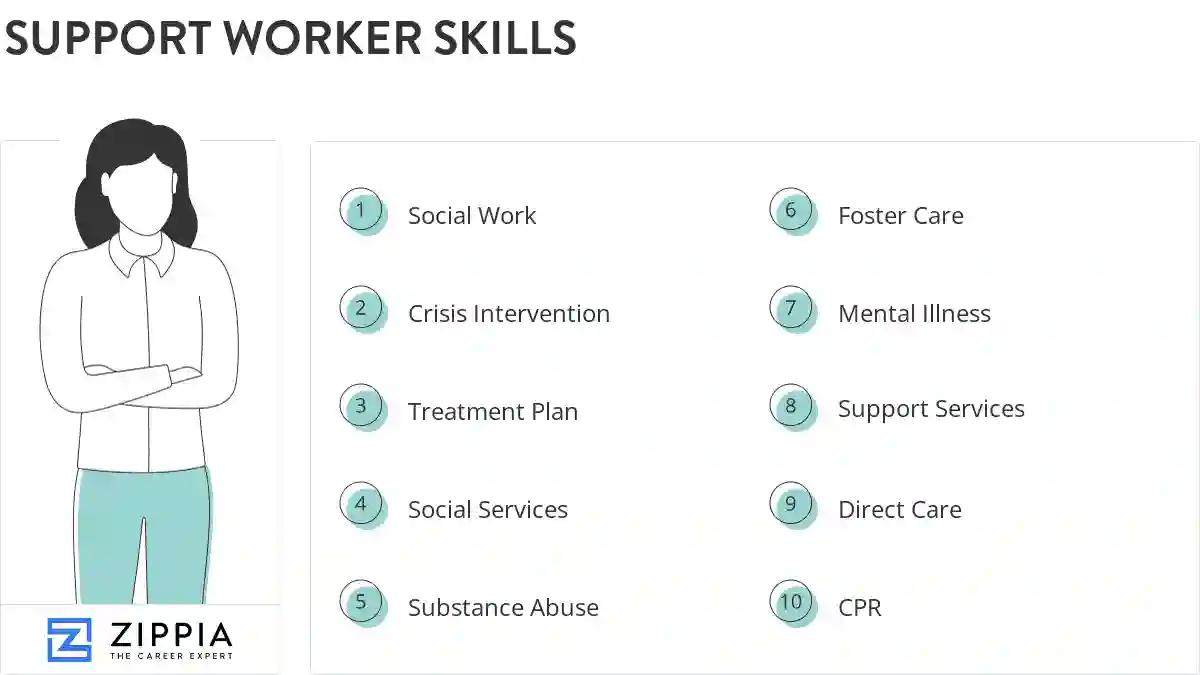
The most important skills for a support worker resume and required skills for a support worker to have include:
- Social Work
- Crisis Intervention
- Treatment Plan
- Social Services
- Substance Abuse
- Foster Care
- Mental Illness
- Support Services
- Direct Care
- CPR
- Medical Care
- Residential Facility
- Community Resources
- Family Support
- Developmental Disabilities
- Behavioral Problems
- Mental Health Issues
- Food Assistance
- Child Support
- Emotional Support
- First Aid Training
- Meal Preparation
- Independent Living
- Behavior Management
- Medication Administration
- Community Services
- Foster Children
- Vital Signs
- ADL
- Google Drive
- One Support
- DCF
- Medical Appointments
- Applied Behavior Analysis
- Court Hearings
- Retrieve Data
- Risk Assessments
- Physical Disabilities
- Public Inquiries
- Court Orders
- Patient Rooms
- Office Equipment
- Financial Reports
- PowerPoint
- Client Eligibility
Updated January 8, 2025

1. Social Work