Explore jobs
Find specific jobs
Explore careers
Explore professions
Best companies
Explore companies
What is a systems operator and how to become one

A system operator is tasked with ensuring the effective delivery of electricity to consumers, businesses, and industries. They manage the power grid from a set of computer consoles in a control center. They work with field crews, general personnel, substation personnel, and other system operators in their jurisdiction. System operators can be market, interchange, balancing, or transmission operators. They provide clearance, caution, and location orders on system devices. Also, they coordinate the work activities in the system service area and with other departments.
Employers seek candidates with at least a high school diploma or its equivalent. You must have a valid NERC system operator certification. Key skills required for this position include analytical, communication, problem-solving, attention to detail, time management, computer, and organization skills. You must know about high voltage electrical utility operations and equipment. Experience using SCADA and EMS systems is a plus. This personnel makes about $60,320 per year. Their salary falls between $34,000 and $106,000.
What general advice would you give to a systems operator?
Professor David Sanford
Associate Professor an Department Chair (MIS, CS, CYB MGT, IS CYB), Northwood University
They appreciate the diversity of projects
They enjoy the need for continuous improvement and education
Many see the global impact of their work.
They also desire and appreciate the need for versatile skills
A competitive salary is also an item that employees like
Workers dislike that the work can be stressful
Dealing with tight deadlines and/ or cybersecurity concerns.
This is a positive and a negative: The need to constantly stay up to date with technology can be a bit overwhelming for some.
There may be times of isolation, and
The unexpected system failures can be frustrating as they often require extra hours or the need to be on-call.
The multiple responsibilities and managing repetitive tasks are also issues workers point out in this field.
In short, the workplace offers exciting opportunities but comes with its fair share of pressures and challenges. Different people have different experiences based on their roles and personal preferences.
Avg. Salary $38,182
Avg. Salary $59,228
Growth rate 5%
Growth rate 0.3%
American Indian and Alaska Native 0.31%
Asian 8.78%
Black or African American 8.84%
Hispanic or Latino 12.53%
Unknown 5.08%
White 64.45%
Genderfemale 21.82%
male 78.18%
Age - 42American Indian and Alaska Native 3.00%
Asian 7.00%
Black or African American 14.00%
Hispanic or Latino 19.00%
White 57.00%
Genderfemale 47.00%
male 53.00%
Age - 42Stress level is manageable
7.1 - high
Complexity level is challenging
7 - challenging
Work life balance is good
6.4 - fair
Systems operator career paths
Key steps to become a systems operator
Explore systems operator education requirements
Start to develop specific systems operator skills
Skills Percentages Computer System 13.30% Management System 11.16% Combat 10.62% Switches 9.60% Situational Awareness 9.17% Complete relevant systems operator training and internships
Accountants spend an average of 3-6 months on post-employment, on-the-job training. New systems operators learn the skills and techniques required for their job and employer during this time. The chart below shows how long it takes to gain competency as a systems operator based on U.S. Bureau of Labor Statistics data and data from real systems operator resumes.Research systems operator duties and responsibilities
- Manage SMS and TCP/IP protocol.
- Perform and manage routine building maintenance tasks, including carpentry, plumbing, and HVAC repair and maintenance.
- Manage tactical high-speed data network (THSDN), internet subscriber IP addresses, and switch caller profiles.
- Manage print production, registration and logistics for several high-profile events, annual fund solicitations and annual telephone campaign.
Prepare your systems operator resume
When your background is strong enough, you can start writing your systems operator resume.
You can use Zippia's AI resume builder to make the resume writing process easier while also making sure that you include key information that hiring managers expect to see on a systems operator resume. You'll find resume tips and examples of skills, responsibilities, and summaries, all provided by Zippi, your career sidekick.
Choose from 10+ customizable systems operator resume templates
Build a professional systems operator resume in minutes. Browse through our resume examples to identify the best way to word your resume. Then choose from 10+ resume templates to create your systems operator resume.


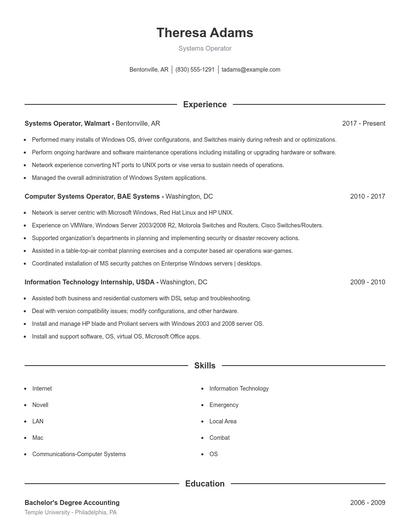


Apply for systems operator jobs
Now it's time to start searching for a systems operator job. Consider the tips below for a successful job search:
- Browse job boards for relevant postings
- Consult your professional network
- Reach out to companies you're interested in working for directly
- Watch out for job scams
How did you land your first systems operator job

Are you a systems operator?
Share your story for a free salary report.
Average systems operator salary
The average systems operator salary in the United States is $38,182 per year or $18 per hour. Systems operator salaries range between $28,000 and $51,000 per year.
What am I worth?

How do systems operators rate their job?
Systems operator reviews

I like working with a operating systems like Windows or Linux and networks.
Updated January 8, 2025
