Explore jobs
Find specific jobs
Explore careers
Explore professions
Best companies
Explore companies
Job outlook for technical writer and editors in the United States
Technical writer and editor job growth summary. After extensive research, interviews, and analysis, Zippia's data science team found that:
The projected technical writer and editor job growth rate is 6% from 2018-2028.
About 3,100 new jobs for technical writer and editors are projected over the next decade.
Technical writer and editor salaries have increased 7% for technical writer and editors in the last 5 years.
There are over 23,526 technical writer and editors currently employed in the United States.
There are 78,617 active technical writer and editor job openings in the US.
The average technical writer and editor salary is $65,088.
Are technical writer and editor jobs in demand?
Technical writer and editor job and salary trends over time
Technical writer and editor jobs over time
Technical writer and editor job growth rate over time
| Year | # of jobs | % of population |
|---|---|---|
| 2021 | 23,526 | 0.01% |
| 2020 | 24,180 | 0.01% |
| 2019 | 25,097 | 0.01% |
| 2018 | 24,902 | 0.01% |
| 2017 | 24,735 | 0.01% |
Average technical writer and editor salary over time
Technical writer and editor salary by year
| Year | Avg. salary | Hourly rate | % Change |
|---|---|---|---|
| 2026 | $65,088 | $31.29 | +2.5% |
| 2025 | $63,518 | $30.54 | +1.4% |
| 2024 | $62,646 | $30.12 | +1.3% |
| 2023 | $61,844 | $29.73 | +1.5% |
| 2022 | $60,903 | $29.28 | --0.6% |
Technical writer and editor jobs by state
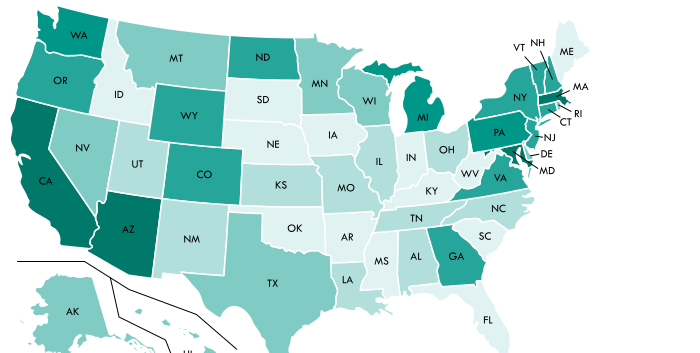
Most common states for technical writer and editors
| Rank | State | Population | # of jobs | Employment/ 1000ppl |
|---|---|---|---|---|
| 1 | District of Columbia | 693,972 | 227 | 33% |
| 2 | Wyoming | 579,315 | 112 | 19% |
| 3 | New Hampshire | 1,342,795 | 234 | 17% |
| 4 | Delaware | 961,939 | 162 | 17% |
| 5 | Alaska | 739,795 | 128 | 17% |
| 6 | Maryland | 6,052,177 | 959 | 16% |
| 7 | Colorado | 5,607,154 | 858 | 15% |
| 8 | Minnesota | 5,576,606 | 817 | 15% |
| 9 | North Dakota | 755,393 | 117 | 15% |
| 10 | Illinois | 12,802,023 | 1,745 | 14% |
| 11 | Connecticut | 3,588,184 | 455 | 13% |
| 12 | Nebraska | 1,920,076 | 252 | 13% |
| 13 | Georgia | 10,429,379 | 1,240 | 12% |
| 14 | New Jersey | 9,005,644 | 1,047 | 12% |
| 15 | Kansas | 2,913,123 | 354 | 12% |
| 16 | South Dakota | 869,666 | 104 | 12% |
| 17 | New York | 19,849,399 | 2,155 | 11% |
| 18 | North Carolina | 10,273,419 | 1,149 | 11% |
| 19 | Wisconsin | 5,795,483 | 649 | 11% |
| 20 | Iowa | 3,145,711 | 339 | 11% |
Most common cities for technical writer and editors
| Rank | City | # of jobs | Employment/ 1000ppl | Avg. salary |
|---|---|---|---|---|
| 1 | Annapolis | 5 | 13% | $73,142 |
| 2 | Bethesda | 4 | 7% | $72,985 |
| 3 | Adelanto | 2 | 6% | $70,299 |
| 4 | Bangor | 2 | 6% | $52,223 |
| 5 | Albany | 3 | 4% | $62,047 |
| 6 | Flagstaff | 3 | 4% | $74,496 |
| 7 | Warner Robins | 3 | 4% | $62,411 |
| 8 | Huntsville | 3 | 2% | $53,804 |
| 9 | Palmdale | 3 | 2% | $70,567 |
| 10 | Washington | 5 | 1% | $85,089 |
| 11 | Arlington | 3 | 1% | $64,650 |
| 12 | Anchorage | 2 | 1% | $59,285 |
| 13 | San Diego | 4 | 0% | $69,580 |
| 14 | Atlanta | 2 | 0% | $62,722 |
| 15 | Baltimore | 2 | 0% | $73,244 |
Technical Writer And Editor job outlook: Expert opinions
Our panel of technical writer and editor experts
Tusculum University
Manhattan College
Adrian College
Colorado Mesa University
Furman University
Berry College
Southern Illinois University Edwardsville
Kean University
University of Rhode Island

Milwaukee Area Technical College

Ohio Northern University
California State University, Los Angeles
University of Pittsburgh

California State Polytechnic University, Pomona
Lincoln University

Indiana University Northwest
University of South Florida

California University of Pennsylvania
Illinois Wesleyan University

DePaul University
Vicky Johnson Bós
Associate Professor of EnglishTusculum University
English Language And Literature
What will help Technical Writer And Editors increase their earning potential?
Vicky Johnson Bós: Have practical experience in that field through a summer job, internship, or access to expertise. Getting a Master's Degree or even a PhD can greatly influence salary potential. Be aware that you may have to take a 'starting' job at less of a good salary to get practical experience to make the leap to a better paying job.
What general advice would you give to a Technical Writer And Editor?
Vicky Johnson Bós: In order for a new college graduate to be successful in a career, they should have done/should do the following:
* Take advantage of an internship for practical experience
* Seriously consider a Master's Degree
* Have a portfolio of personal work to show during interviews
* Collect business cards of people in your future job market and network!
* Have a polished, professional resume`
What Technical Writer And Editor skills would you recommend for someone trying to advance their career?
Vicky Johnson Bós: Students should be very familiar with using AI in responsible, informed ways to further their writing and research. Having people-skills will never go unused. Good writing and technological skills will become even more in demand with the growth of new, unexplored job markets.
Dr. Heidi Laudien Ph.D.
Associate ProfessorManhattan College
English Language And Literature
What Technical Writer And Editor skills would you recommend for someone trying to advance their career?
Dr. Heidi Laudien Ph.D.: I think it is important for graduates to be flexible and welcome challenges. It is critical for students to be confident in their academic foundation. An English related field will undoubtedly require strong critical thinking and writing skills. To that end, it is important to read and practice one's craft daily.
What will help Technical Writer And Editors increase their earning potential?
Dr. Heidi Laudien Ph.D.: I do not feel equipped to give informed advice on what skills might be necessary in the next 3-5 years.
What will help Technical Writer And Editors increase their earning potential?
Dr. Christy Mesaros-Winckles Ph.D.: In the next few years, it will be imperative for writers to excel not only in generating original ideas but also in their prowess as editors. With the increasing integration of language-model AI tools in various workplaces, what distinguishes an outstanding writer from a mediocre one is their ability to leverage AI as an editing aid. Graduates wanting to enter writing-intensive careers will need to also effectively craft an elevator pitch to prospective explaining how their contributions as a writer provide distinctive, creative value that surpasses what AI can independently produce.
What general advice would you give to a Technical Writer And Editor?
Dr. Christy Mesaros-Winckles Ph.D.: Diversity in both experience and writing styles is essential. Aspiring graduates aiming for careers in professional writing should possess proficiency across various writing styles, ranging from business communication to journalistic reporting. Additionally, they should be well-versed in the prevalent style guides across diverse disciplines.
What Technical Writer And Editor skills would you recommend for someone trying to advance their career?
Dr. Christy Mesaros-Winckles Ph.D.: Writers need to stay up-to-date on developments in language-model AI programs like ChatGPT and effectively utilize these tools to their advantage. Ongoing education is also going to be crucial as content knowledge and creativity will increasingly become what differentiates content written by AI from that written by a human being. By staying up to date on trends and developments in their industry writes can ensure that regardless of technological advancements, their depth of content knowledge remains superior to the cookie-cutter content generated by AI.
Dr. Tiffany Kinney PhD
Associate Professor of EnglishColorado Mesa University
English Language And Literature
What general advice would you give to a Technical Writer And Editor?
Dr. Tiffany Kinney PhD: Skills that are becoming important and prevalent over the next 3-5 years would include an ability to work with artificial intelligence, an ability to collaborate, and the ability to communicate.
What Technical Writer And Editor skills would you recommend for someone trying to advance their career?
Dr. Tiffany Kinney PhD: In terms of general advice, students just entering the career field after graduating should apply far and wide. In other words, I would suggest that students not limit themselves because they might be surprised where they can land a job. With that said, they should still tailor their application materials for the job that they want, instead of just sending out the same materials again/again.
What will help Technical Writer And Editors increase their earning potential?
Dr. Tiffany Kinney PhD: Skills that are becoming important and prevalent over the next 3-5 years would include an ability to work with artificial intelligence, an ability to collaborate, and the ability to communicate.
Professor Margaret Oakes
Professor of EnglishFurman University
English Language And Literature
What Technical Writer And Editor skills would you recommend for someone trying to advance their career?
Professor Margaret Oakes: The ability to read carefully and analytically. This is a skill that has declined in the past couple of decades as people obtain more information visually - but a visual presentation cannot carry the amount of detail that written language can, and carelessness in the use of language causes a world of problems in every area of human life (law, medicine, politics, etc.).
What will help Technical Writer And Editors increase their earning potential?
Professor Margaret Oakes: Our graduates have such a variety of careers with an English major that this is hard to answer. But perhaps this is the answer - English majors have such widely applicable skills that they need to be alert to how they can be applied almost anywhere, and be prepared to sell their skills to a potential employer.
Whitney Adams
Visiting Assistant Professor of Rhetoric and WritingBerry College
Rhetoric And Composition/Writing Studies
What general advice would you give to a Technical Writer And Editor?
Whitney Adams: An individual entering the writing field may do the following tasks daily:
1. Researching and brainstorming ideas for new articles, stories, or projects
2. Writing and editing content for various platforms, including websites, blogs,
newspapers, magazines, or social media
3. Pitching ideas and articles to editors or clients
4. Conducting interviews with sources for articles or stories
5. Collaborating with other writers, editors, and team members
6. Reviewing and editing drafts of their work
7. Engaging with readers and followers on social media
8. Marketing and promoting their work
9. Attending writing workshops, events, or networking opportunities
10.Keeping up to date with industry trends and news in the writing field
What Technical Writer And Editor skills would you recommend for someone trying to advance their career?
Whitney Adams: 1. Demand for content: With the rise of digital marketing, social media, and online
publications, there is a high demand for content creators and writers. Companies need
quality written content to attract and engage their audience.
2. Remote work opportunities: Writing is a flexible profession that can often be done
remotely. This allows writers to work from anywhere in the world, making it a great
profession for those who value freedom and flexibility.
3. Growth potential: As a writer, there are many opportunities for growth and
advancement. Writers can specialize in different niches, such as copywriting, technical
writing, or content marketing, and can continue to develop their skills and expertise over
time.
4. Passive income potential: Writers can also generate passive income through
avenues such as self-publishing books, creating online courses, or starting a blog. This
allows writers to earn money even when they are not actively working.
5. Creative fulfillment: For many people, writing is a fulfilling and rewarding profession
that allows them to express their creativity and share their ideas with others. Writing can
be a way to inspire, educate, and connect with others on a deeper level.
Overall, writing is a good profession to enter now because of the high demand for
content, remote work opportunities, growth potential, passive income potential, and
creative fulfillment it can provide.
What do people dislike about being a writer?
1. Writer's block: Writer's block is a common challenge that many writers face,
where they struggle to come up with new ideas or find inspiration.
2. Criticism and rejection: Writing can be a vulnerable and subjective art form, and
writers may face criticism or rejection from publishers, readers, or reviewers.
3. Isolation: Writing can be a solitary pursuit, and some writers may find the
isolation challenging.
4. Inconsistency: Writing can often be unpredictable in terms of income and
success, with some writers facing financial
What will help Technical Writer And Editors increase their earning potential?
Whitney Adams: The day-to-day activities of a writer can vary depending on the type of writing they are
engaged in (e.g., fiction, non-fiction, journalism, technical writing, blogging, copywriting,
etc.). However, some common tasks that writers may engage in daily include:
1. Researching and brainstorming ideas for writing projects
2. Writing and drafting content
3. Editing and revising drafts
4. Collaborating with editors, clients, or other team members
5. Conducting interviews or gathering information for articles or stories
6. Pitching ideas to publications or clients
7. Managing deadlines and keeping track of assignments
8. Promoting their work through social media
9. Networking with other writers, editors, or industry professionals
10.Reading and staying current on industry trends and developments
11.Creating and editing project manuals
12.Creating and editing instructional guides
Randall Auxier
Professor of Philosophy and Communication StudiesSouthern Illinois University Edwardsville
Rhetoric And Composition/Writing Studies
What general advice would you give to a Technical Writer And Editor?
Randall Auxier: Being the writer in your workplace can be seriously enhanced by the ability to do animation, illustration, graphics, charts, and to create good-looking documents with publishing software (e.g., Indesign). Being only the writer is limiting by comparison. Working with images of all kinds is almost as important as the writing.
What Technical Writer And Editor skills would you recommend for someone trying to advance their career?
Randall Auxier: Writers have to be patient about this. The fields that were once supporting writers (e.g., journalism) have dried up. No one gets paid much for this kind of work any more. The best strategy is to seek a position that has upward mobility and become a writer in the fashion described above. You have to be good at it, of course, to increase your value to a company. Being sure that you are credited for everything you do, in the text, is very important, in creating a portfolio that makes you mobile. People will let you go uncredited unless you insist on being credited. Here you really must be bold. You are not moving your career forward unless you are credited for everything you do. No one can reasonably deny your request to be credited, so insist on it.
What will help Technical Writer And Editors increase their earning potential?
Randall Auxier: At first it isn't going to be any fun. Writing is something every office needs --and being the person in the workplace who can do that provides a secure niche. You need not start in a job that has writing as one of its main requirements; rather, you take what you can get and then work your way into the writing role --any time something needs to be written, volunteer to do it. Soon you'll have more than you can handle. At this point, look for ways to get your writing seen as yours, newsletter, liaison with the communications office for your workplace, etc. Being known by your co-workers as a writer can lead all kinds of places, although not usually toward management. It's opportunity to write increasingly important things that counts as upward movement.
What general advice would you give to a Technical Writer And Editor?
Frank Argote-Freyre: I always tell my students that a good writer never goes hungry. We emphasize writing in History and that is one of the reasons a History degree is valuable. As a corollary to that, research skills are important. The ability to identify sources of additional information that provide nuance to an employer is a valuable asset to bring to the workplace.
What Technical Writer And Editor skills would you recommend for someone trying to advance their career?
Frank Argote-Freyre: It is important to take part in a variety of internships prior to entering the workplace. You need to invest in yourself. Many of these internships might provide no pay or low pay but they are essential to gaining experience. This will allow a candidate to begin their career search with experience in the field. This makes them a more valuable asset to an employer. Language acquisition is also important. US society is diverse so the ability to reach more diverse language communities is a big plus.
What will help Technical Writer And Editors increase their earning potential?
Frank Argote-Freyre: There is no substitute for hard work and determination. While doing that it is also important to consider other employment options. Networking is a key to that -- a new graduate needs to understand their job marketplace and think strategically about where they fit into that broader landscape.
What's a good job out of college for Technical Writer And Editors?
John Pantalone: At this point, at the risk of being sarcastic, any job is a good job. The real answer is that it depends on the field you plan to go into and what you consider a good job. A livable wage with reasonable benefits is part of the equation; the other part is whether you genuinely enjoy the work.
Will there be an enduring impact of the coronavirus pandemic on Technical Writer And Editors?
John Pantalone: I don't think we have any idea what the long-term effects of the pandemic will be either in economic terms, health terms, or employment terms. It is much too soon to tell. Everything depends on what the government does, how corporations respond to the changing economic climate and evolving technologies. In the field of journalism, everything is up in the air and it will be years before we have a good idea of how journalism will evolve and survive.
What technical skills for a Technical Writer And Editor stand out to employers?
John Pantalone: Hard to say. I'm sure good computer skills are important in any job, but so are strong communication skills. If by technical skills you mean software programs, etc., it again depends on the nature of the job/work. Knowledge of basic software, social media platforms, data interpretation all seem important now.
Kevin Pulz
Academic Department Chair/Senior Producer-Director, Milwaukee PBSMilwaukee Area Technical College
Television and Video Production/eProduction- Milwaukee PBS
What technical skills for a Technical Writer And Editor stand out to employers?
Kevin Pulz: What skills AREN'T desirable to employers? Video Editors need to be motion graphics stars as well. Videographers are more valuable if they are photojournalists or video essayists in addition. On-line content mediators and creators are in demand as corporations that once flew in employees for training are finding all sorts of benefits to creating visual media locally and sharing globally.
There's no substitute for solid production skills and strength in technology as a whole; but there's a voracious appetite for cutting edge approaches to content treatment, acquisition and delivery. Possessing the ability to deliver on both the audio and video quality we've come to expect as well as the promise of developing fresh modes of content creating utilizing new and exciting technologies positions anyone early on their career well for long-term success in a rapidly challenging and exciting world of media.
What's a good job out of college for Technical Writer And Editors?
Kevin Pulz: Broadcasting is still, strangely, considered a glamor field in so many ways. Little do people realize that cable wrapping and happily executed grunt work are essential talents that often separate the job recipient from the 5 interviewees and 95 applicants for a gig that pays less than fast-food work, even with a college degree.
So a good job out of college is ANY job in the field. Being 'in' and demonstrating one's ability in a professional environment remains key to opportunity in the future.
That said, it's clear that an area of media that's ripe for growth is multiplatform content delivery. It's in the wheelhouse of recent graduates based upon age and media consumption habits and, with traditional broadcast audiences growing older, an aspect of content creation that promises to grow even more legs as distribution methodologies develop and mature.
Will there be an enduring impact of the coronavirus pandemic on Technical Writer And Editors?
Kevin Pulz: There's no doubt that the pandemic has and will continue to have a clear impact on current college/university students and upcoming and recent graduates. The way things are 'done', for example, has been redefined in a fashion that in some ways makes traditional broadcast production unrecognizable. Studio camera operators have been replaced by fixed computer camera lenses for Zoom calls; efforts to collect high-quality audio have fallen to camera mics at best, and poor computer mics at worst in order to distance audio operators from talent or interview subjects; studio productions are a shell of what they once were; sports and event programming have diminished in frequency or disappeared altogether.
However, while many facets of media and broadcasting have seen a degradation of quality, content continues to flow. Rethinking the production process is not a bad thing, rather a challenging one. Local broadcasters may not be enjoying the large production teams they were before the pandemic, but viewing has not abated. Streaming content has exploded as it offers flexibility in accessibility to viewers and all of a sudden episodes of long forgotten shows appear quite palatable.
The landscape of these industries are evolving. The challenge is to be able to adapt to that evolution, all the while ensuring that high-quality skills remain attainable and sharp for the time when viewers no longer passively accept muddy or choppy looking video content on their 4k home screens.
What's a day at work look like for a Technical Writer And Editor?
Shane Tilton Ph.D.: This line of evidence is pointing to one central truth. Those that practiced multimedia journalism techniques before the pandemic will find success now. Also, organizations are looking for those graduates that can be a "one-stop-shop" for producing stories from home. I don't believe that trend will change. This trend also addresses the third question. Graduates are leaving colleges better prepared to use computer-mediated communication tools to complete their jobs' essential tasks. They understand how to be engaging and communicate effectively via their more contemporary communication tools.
What technical skills for a Technical Writer And Editor stand out to employers?
Shane Tilton Ph.D.: Weirdly, the pandemic has been good to those trained in media production. All organizations now find themselves in the position to need to use digital media production tools more regularly. I can not count the number of conversations I have had with colleagues and interested parties looking for students and alumni to work with them to develop their media platform. Even if a student can not find a job in journalism, the skills they learn in our program are adaptable to a virtually endless number of organizations across the world. They know how to be effective communicators using media production tools.
Will there be an enduring impact of the coronavirus pandemic on Technical Writer And Editors?
Shane Tilton Ph.D.: I have argued that the pandemic has dropkicked society, culture, and daily activities fifty years into the future. We are doing more decentralized work virtually from home. The journalism industry seems to have felt the boot prints of that dropkick as much as any industry. One of the continuous influences of COVID-19 post-pandemic appears to be the "home studio model" for broadcasters and journalism organizations. I would point to the "Room Raters" Twitter account as evidence for this claim. It seems that people are more comfortable with reporting from home. Journalism graduates are now presenting news stories in a quasi-informal manner. The general public seems to be okay seeing journalists in more business casual clothing than the power suit.
It has also fundamentally changed the functional roles of journalists. Contributors and correspondents show off their credibility by displaying the books they wrote on the shelves behind them or the visual artifacts of their subject of expertise. Anchors have a screen behind them, highlighting the story with some visuals. Citizen journalists are finding more accessible access to essential sources via Zoom or Skype. Reporters are framing their interviews via those services as well.
What's a good job out of college for Technical Writer And Editors?
Kate Kurtin Ph.D.: Any job that you are passionate about and brings you joy is a great job out of college. Don't look for a "forever job" after college, look for a job where you can learn and grow and support yourself.
Will there be an enduring impact of the coronavirus pandemic on Technical Writer And Editors?
Kate Kurtin Ph.D.: Yes! Absolutely! We can only assume that the whole world will be affected by this pandemic for years to come. The workforce, for starters, will be tremendously affected. Currently, for example, there are limited service jobs in parts of the country. These are jobs that millions of graduates hold. We also have the highest unemployment rate in modern history. Once the country opens up again and companies begin to hire again, everyone who lost their job in the last year will be competing with recent graduates on the same job market. We saw this after the recession as well.
Speaking more positively, companies are now realizing that their employees can work effectively and efficiently from home. It has been predicted that this will shift many more traditional office jobs to permanent telecommuting. This is great news for graduates because they can broaden their job search.
I am also hopeful that creative industries will getting very busy soon. Personally, I teach in advertising and public relations and those industries will be in high demand.
What technical skills for a Technical Writer And Editor stand out to employers?
Kate Kurtin Ph.D.: Every article on the subject says that communication skills are the most important skills to have when on the job market - and this is not my bias speaking, even Warren Buffet said it! Public speaking, critical thinking, interpersonal skills, etc., these are things that stand out to employers.
Will there be an enduring impact of the coronavirus pandemic on Technical Writer And Editors?
Gayle Rogers: Definitely. First-year students had the strangest introduction to college one could imagine-nothing like what "college" is supposed to be. And they are still living it, with remote classes, social distancing, and few of the in-person bonding experiences that we associate with college as a whole. That will never be erased from their memories. Students who just graduated or are graduating this spring, on the other hand, are taking with them those distinct experiences into the workplace, graduate or professional schools-wherever life takes them. (It pains many of us, as teachers and administrators, that they did not have the robust graduation celebration that we all wanted them to have.) They will remember how their college experience was shaped by the pandemic, of course, but they will also have bonded with one another in uniquely difficult ways.
What's a day at work look like for a Technical Writer And Editor?
Gayle Rogers: Much like it does for many for us: remote and hybrid situations until the pandemic is over. If they have been fortunate in their education, however, they will be equipped with some knowledge and some skills to help them manage that well.
What technical skills for a Technical Writer And Editor stand out to employers?
Gayle Rogers: Many employers tell me that they seek graduates who can bridge the stereotypical-yet very real-divide in the technical world between the more rote elements of coding and the more creative elements of narrative that departments like my own (English) have traditionally taught. Creative coding and the ability to mesh what computer scientists and poets do-employers have consistently told me that there is great promise in that, now and going forward.
Aaron DeRosa Ph.D.
Associate Professor, 20th/21st C. American LiteratureCalifornia State Polytechnic University, Pomona
College of Letters, Arts and Social Sciences
Will there be an enduring impact of the coronavirus pandemic on Technical Writer And Editors?
Aaron DeRosa Ph.D.: Many of our students work and go to school at the same time, so the pandemic's impact is being lived right now. The pandemic only exacerbates problems already embedded in the labor market: a move toward contingent labor and freelance work. This generation of graduates will be asked to continue jumping from job to job, never allowed to settle into a "career." The flip side is that the precarity of these jobs and their ability to move through different work environments will make them more versatile critical thinkers and more compassionate people.
What technical skills for a Technical Writer And Editor stand out to employers?
Aaron DeRosa Ph.D.: English majors find homes in every major industry because they are trained to think about the precision of language and its impact, to critically think through problems and imagine the implications of the projects they work on, and to conduct sound research while being critical of the material they encounter. They do this whether the field is technical writing, advertising, law, journalism, publishing, teaching, retail, or whatever new positions arise in the years to come.
Will there be an enduring impact of the coronavirus pandemic on Technical Writer And Editors?
Jason Whittaker Ph.D.: With regard to whether there will be an enduring impact of the pandemic on graduates, the glib answer is, of course, it must be. What I would emphasise, however, is that after nearly a year teaching under very constrained conditions the changes are not simply negative ones - or rather, students are already learning to adapt. Among journalists, it's becoming quite clear that what we're witnessing in part is a rapid acceleration of trends that were already beginning to take place, with reporters being expected to be more mobile and work remotely. For those students who are engaging actively, we're seeing a greater takeup of mobile skills and those required for accessing and interviewing sources remotely.
What certifications/licenses/courses can have the biggest impact for Technical Writer And Editors?
Jason Whittaker Ph.D.: In the UK, the most important certification for students wishing to pursue a degree in journalism remains those courses that offer accreditation by the National Council for the Training of Journalists (NCTJ). With an emphasis on writing, reporting, media law and practical production skills, this remains immensely valuable for employers.
What soft skills should all Technical Writer And Editors possess?
Jason Whittaker Ph.D.: Among the key skills for graduates, some of these remain the same as before, particularly in terms of being able to communicate clearly, analyse information, and engage creatively with problem solving. The past year, however, has really brought to the fore the importance of resilience in our students, especially as they will need to be even more flexible as their careers develop in the future. We spend a considerable amount of time working on building confidence among our students, so that rather than being overwhelmed by rapid change they see this as a challenge and opportunity.
Brian O'Camb Ph.D.
Associate Professor and Chair in EnglishIndiana University Northwest
English Department
What experience really stands out on Technical Writer And Editor resumes?
Brian O'Camb Ph.D.: Honestly, I am not qualified to respond to that question because I don't hire recent graduates, so I don't see resumes from them. However, as a professor, I recommend that all my students get as much writing experience as possible, ideally through an internship, so they can lean on that experience in their job materials.
How do you envision technology impacting Technical Writer And Editors in the next 5 years?
Brian O'Camb Ph.D.: It depends on what you mean by field. All writing done today is done digitally, and job-seekers are increasingly being asked to have some basic Web publishing experience. If, however, you mean higher education, the turn toward online teaching will continue to exert its influence on university and college instructors.
Will there be an enduring impact of the coronavirus pandemic on Technical Writer And Editors?
Brian O'Camb Ph.D.: Without a doubt. As employers come to realize that many jobs can be done remotely, I imagine graduates can expect a significant shift in how they connect and collaborate with colleagues in the workplace. And, as industries adapt to non-contact models during the pandemic, there will be space for graduates trained in critical thinking and reading skills to reimagine how various services and suppliers connect with their clients.
What type of skills will young Technical Writer And Editors need?
Dr. Wilma Davidson: According to the National Association of Colleges and Employers (NACE), there are 20 skills listed to increase their value in the workplace. Yearly, NACE surveys employers and ranks these skills and, according to their latest survey, the top five skills new graduates should possess are the following:
Problem-solving
Ability to work on a team
Strong work ethic
Analytic/quantitative skill
Written communication skills
For several decades, the ability to write well has appeared near the top of NACE's list of skills valued by employees. And, I suspect, it will remain among the top for decades to come. Writing, so your ideas and plans are understandable and actionable, is the secret sauce of your workplace success. No matter how good your idea is, if you cannot communicate it easily to another, you won't receive the attention and accolades you deserve.
Are there any particularly good places in the United States for Technical Writer And Editors to find work opportunities?
Dr. Wilma Davidson: All businesses need good writers. You can work remotely as a freelancer or an employee without concern about where your employer is located. Technology makes it easy for an excellent writer to write productively from anywhere. Naturally, if you wish to enter a field like PR or Advertising or Editing/Publishing, you might want to live in a large city where major firms are located. However, right that advice might have been a decade ago, it no longer applies. If you'd like to be a technical writer, there is an advantage to being close to the engineers you may be working with as you write their manuals, but that can be handled-and already is-being handled remotely.
How do you envision technology impacting Technical Writer And Editors in the next 5 years?
Dr. Wilma Davidson: Technology will make it easier to communicate remotely, and software programs will continue to evolve, creating a writer's output easy to publish, edit, and reach an audience. The hard part will be keeping up and being knowledgeable about the programs available and used by different companies.
What type of skills will young Technical Writer And Editors need?
Dr. Christina Fisanick: College graduates in 2021 and beyond, need all of the skills that English programs have to offer: critical thinking, effective communication, creativity, and flexibility. New hires need to be able to adapt to workplace changes quickly and with aplomb, which requires critical thinking and problem solving and the ability to communicate those solutions to a diverse audience clearly and effectively. Those skills are refined and practiced regularly in English programs.
Are there any particularly good places in the United States for Technical Writer And Editors to find work opportunities?
Joanne Diaz Ph.D.: Quite often, people assume that teaching is the only professional path available to students who major in English. While we are delighted when English majors pursue careers in education, our graduates go on to a wide range of careers in law, journalism, public relations, marketing, information technology, library science, public policy, museum curation, and publishing.
English, like all of the humanities disciplines (Philosophy, Religion, History, and Classics), prepares students to read, write, listen, and persuade well; in addition, these disciplines help students to create habits of mind. These are the graduates who are flexible, resilient, and adaptable. Those last three descriptors are incredibly important for students who are entering the workforce in the twenty-first century.
How do you envision technology impacting Technical Writer And Editors in the next 5 years?
Joanne Diaz Ph.D.: Technology, whether it be the scroll, the illuminated codex, the printing press, or digital technology, is always transforming how we read, write, and think. In the next five years, I sense that English majors will not only need to master traditional forms of analytical and argumentative writing but also master writing to an audience beyond the classroom. So, for example, it would be great if an English major can also tell stories via podcasts, videos, and other forms of web content that are shareable via social media. We must do more to show the world how valuable the humanities disciplines are, and when students share their amazing projects, it confirms their value.
You didn't ask this question, but I want to address it: in the next five years, English majors can and must be more attentive to social justice issues. How an English major prepares students for a life of civic engagement? How can those excellent critical thinking skills help English majors solve the world's most wicked problems? Through rigorous readings and discussions in their humanities courses, they can and will answer these questions.
What type of skills will young Technical Writer And Editors need?
Ted Anton: They will need to know how to understand and communicate complex information, often contradictory, in a catchy and understandable way. They will have to read professional data online, in business, medicine, health, you name it and then create a sales or summary pitch for investors. So, reading, writing, communication skills will continue to be important. Math, of course, is a big plus, but up to the advanced algebra level... Statistical skills will be helpful. Overall, employers are seeking curious, adventurous, bold, and creative thinkers and communicators for an ever-changing world.
Are there any particularly good places in the United States for Technical Writer And Editors to find work opportunities?
Ted Anton: Well, the big growth in biotech in California, Massachusetts, New Jersey, and Illinois, as well as Minnesota (Mayo Clinic) and Texas (MD Anderson) are hubs of expansion and investment, with Operation Warpspeed and other large scale investments in health and medicine and genetic counseling, etc. The society is aging, and people with patience can be looking, as well, at states like Florida and Arizona, with a high proportion of elderly who need a variety of services.
How do you envision technology impacting Technical Writer And Editors in the next 5 years?
Ted Anton: Certainly, grads should develop their social media skills, which is not hard; it just takes some time and concentration-Twitter, Instagram, Linked In, etc. Web designers will always get interviews as every business organization is looking to expand its web presence. Communication skills in this tricky, ever-moving world are easily translated to tech and still required.