
Automatically apply for jobs with Zippia
Upload your resume to get started.
Telecommunication operator skills for your resume and career

15 telecommunication operator skills for your resume and career
1. Patients
- Help disabled patients with physical difficulties by providing wheelchairs or requesting transport assistance
- Research staff members and patients by use of hospital software programs, Microsoft Word, Excel, and Outlook programs.
2. Customer Service
Customer service is the process of offering assistance to all the current and potential customers -- answering questions, fixing problems, and providing excellent service. The main goal of customer service is to build a strong relationship with the customers so that they keep coming back for more business.
- Created and implanted office procedures that ensure delivery on information and customer service within the established deadlines.
- Provided customer service for over 100 different clinics after hours and paged physicians upon patient/hospital request.
3. Emergency Situations
- Recognized for my ability to coordinate efforts with multiple agencies and remain in control during emergency situations.
- Operated radios and other computer-aided dispatch equipment for and in emergency situations.
4. Telephone Calls
Telephone calls are a communication means through which a caller is connected to the called party. The call is done through a telecommunications device called a telephone. The caller can use a landline, mobile phone, or satellite phone to make the call.
- Answer and forward telephone calls using computerized telephone systems.
- Updated and maintained accurate records and logs of all radio transmissions, telephone calls and other records within computer-aided dispatch systems.
5. Non-Emergency Calls
Non-emergency calls are calls that do not require immediate attention or intervention. They are simply a request for police, fire or rescue service that does not present a life or death situation. In this case, the local non-emergency number should be used if immediate dispatch of the police is not required.
- Answered and dispatched 911 emergency and non-emergency calls to surrounding police and fire municipalities.
- Determined the nature and location of calls while prioritizing emergency and non-emergency calls.
6. Telecommunication
- Supervised telecommunication operations and reinforced the confidentiality in telecommunications.
- Developed telecommunication skills in telemarketing.
Choose from 10+ customizable telecommunication operator resume templates
Build a professional telecommunication operator resume in minutes. Our AI resume writing assistant will guide you through every step of the process, and you can choose from 10+ resume templates to create your telecommunication operator resume.7. Computer Aided Dispatch
- Screened and obtained essential information from computer aided dispatch or caller.
- Operated a Computer Aided Dispatch program to record calls for service and to dispatch Police, Fire, and EMS Units.
8. Emergency Codes
- Monitored and dispatched internal emergency response to all Kansas Standardized Emergency Codes integrated with life and facility safety alarms.
- Announced emergency codes and contacted pertinent personnel and agencies according to emergency protocol.
9. Computer System
- Follow emergency protocol and notifying personnel using various communication devices and computer systems while maintaining composure in high intensity conditions.
- Acted as department representative for inputting and validating information in national and state computer systems.
10. Public Safety Agencies
- Build relationships with dispatching team, law enforcement emergency services, public safety agencies, etc.
- Communicated effectively to neighboring local public safety agencies via live broadcast of two-way digital high frequency radio.
11. EMS
Emergency Medical Services, also known as EMS, is an emergency medical response system that provides stabilization and urgent preclinical and on-site treatment for serious illness and injury, as well as the transportation of patients who are unable to transport themselves to a definite health care center. The main objective of EMS is to provide emergency medical treatment to those who need urgent medical attention and to properly treat the patient's condition and transport them to a suitable health center or medical facility.
- Dispatched and monitored numerous radio transmissions for DPS, Sheriff's Department, Fire Department, and EMS.
- Monitored surveillance cameras and handled all aspects of Fire, EMS, and Police for base operations.
12. CAD
- Utilize various other programs (LawSoft CAD, CJIS, InfoCop and AOCTELE) to assist patrol and detectives.
- Use the CAD tools to research call history and locate callers who are unsure of their location.
13. Emergency Services
- Process and dispatch the appropriate emergency services required for a law enforcement environment.
- Processed and prioritized calls requesting emergency services.
14. PBX
PBX represents Private Branch Exchange, which is a private phone network utilized inside an organization or association. The clients of the PBX telephone framework can call internally (inside their organization) and remotely (with the rest of the world), utilizing diverse correspondence stations like Voice over IP or ISDN.
- Answered PBX, used computerized system for physician's answering service, hospital phones and paging.
- Fast and accurate operation of a PBX Console during routine and heavy traffic.
15. Law Enforcement Agencies
- Relay information and messages to law enforcement agencies and emergency response personnel.
- Provide support to Parker County and other law enforcement agencies to obtain driving records and criminal history returns when requested.
5 Telecommunication Operator resume examples
Build a professional telecommunication operator resume in minutes. Browse through our resume examples to identify the best way to word your resume. Then choose from 5+ resume templates to create your telecommunication operator resume.

What skills help Telecommunication Operators find jobs?
Tell us what job you are looking for, we’ll show you what skills employers want.
List of telecommunication operator skills to add to your resume
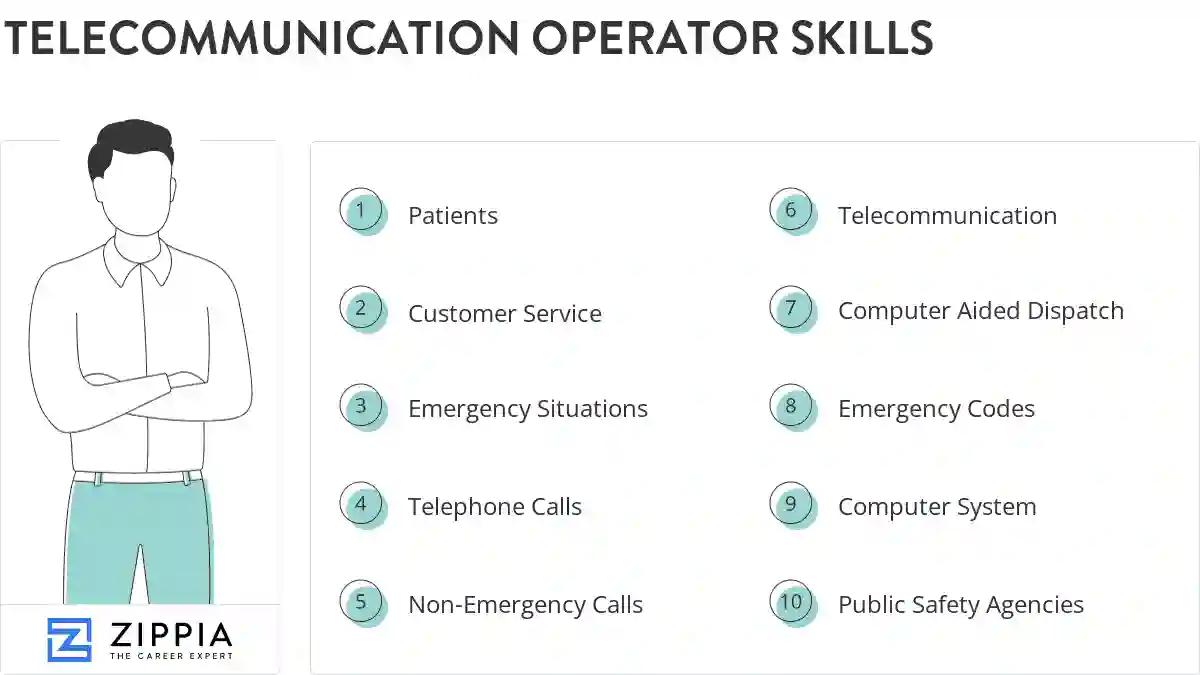
The most important skills for a telecommunication operator resume and required skills for a telecommunication operator to have include:
- Patients
- Customer Service
- Emergency Situations
- Telephone Calls
- Non-Emergency Calls
- Telecommunication
- Computer Aided Dispatch
- Emergency Codes
- Computer System
- Public Safety Agencies
- EMS
- CAD
- Emergency Services
- PBX
- Law Enforcement Agencies
- Two-Way Radio
- Alarm Systems
- HIPAA
- Dispatch System
- Windows
- Communications Equipment
- TDD
- Emergency Procedures
- Radio Traffic
- Multi-Line Phone System
- Inbound Calls
- Transferring Calls
- Stressful Situations
- Outbound Calls
- Alertness
- Computer Equipment
- Paging Systems
- Computer Terminals
- Communication Systems
- Conference Calls
- CPR
- Radio Systems
- Computer Screens
- Customer Inquiries
- COMSEC
- Background Checks
- Tcic
- NCIC
- Message Traffic
- Teleconferencing
- Transmitters
- Switchboards
- Data Systems
- Protective Orders
- Medical Emergencies
Updated January 8, 2025
