What does a traffic coordinator do?
A traffic coordinator is responsible for monitoring the operations of various departments within a company, ensuring the timely submission of project deliverables to meet clients' demands and attain their highest satisfaction. Traffic coordinators evaluate production schedule, including the delivery of materials and proper allocation of resources, and identify areas of improvement on the workflow to avoid delays in production. They also respond to the client's inquiries and concerns, provide updates, and inform them of any adjustments as needed. A traffic coordinator works closely with the project teams to develop a strategy that would increase the staff's productivity and increase efficiency.
Traffic coordinator responsibilities
Here are examples of responsibilities from real traffic coordinator resumes:
- Manage return shipments for LTL and small packages, ensuring they are return or redirect to new locations as instructed.
- Complete documentation and manage inventory levels by utilizing ERP systems.
- Communicate and coordinate with customs brokers and freight forwarders to facilitate creation of documentation for overseas import and export shipments.
- Correspond with overseas vendors for shipping allocations and delivery schedules with nominate freight forwarders to assure timely mode of transportation.
- Write SQL queries when specific information is requested.
- Verify all transmitter log readings as requested by FCC rules and regulations
- Used different functions within the WMS system to ensure load accuracy.
- Compile traffic drops and increase reports (including CIC reports) using SQL queries.
- Assist programming, sales and promotion departments in creation of daily FCC on air log.
- Establish and monitor KPI's to hold suppliers accountable and create additional leverage for negotiations.
- Develop KPI reporting metrics for on time delivery and review monthly with the carrier partners.
- Work with scheduling system WMS to maintain driver's information and appointments as well as shipping records.
- Operate UHF/VHF and FM air to grind communications equipment to communicate with pilots before and during flight operations.
- Research, analyze, and administer domestic truckload and less-than-truckload transportation programs.
- Monitor temperature, product condition and timing by documenting and recording load and shipment activity for temperature control LTL.
Traffic coordinator skills and personality traits
We calculated that 19% of Traffic Coordinators are proficient in Customer Service, Data Entry, and Freight Carriers. They’re also known for soft skills such as Customer-service skills, Detail oriented, and Communication skills.
We break down the percentage of Traffic Coordinators that have these skills listed on their resume here:
- Customer Service, 19%
Provide support to external customers and internal customer service team in expediting shipments and providing tracking information as required.
- Data Entry, 9%
Applied exceptional project management skills in scheduling customer appointments, confirming Product deliveries and overseeing clerical and data entry responsibilities.
- Freight Carriers, 5%
Coordinate transportation with freight carriers and systematically process Caterpillar dealer supply orders.
- PowerPoint, 5%
Developed innovative PowerPoint presentations used by the management teams and sales executives to market products to potential clients.
- Account Executives, 5%
Perform billing procedures of sending out invoices/affidavits, accounts payable/receivable, and prepare weekly reports for Account Executives and management.
- Wide Orbit, 4%
Input titles of client advertisements and enter the instructions for ad airing into the traffic database system IBMS and Wide Orbit.
Most traffic coordinators use their skills in "customer service," "data entry," and "freight carriers" to do their jobs. You can find more detail on essential traffic coordinator responsibilities here:
Customer-service skills. One of the key soft skills for a traffic coordinator to have is customer-service skills. You can see how this relates to what traffic coordinators do because "material recording clerks may interact with customers in order to respond to problems or complaints." Additionally, a traffic coordinator resume shows how traffic coordinators use customer-service skills: "report high value shipments using aes system to ensure smooth deliveries to our customers. "
Detail oriented. Another soft skill that's essential for fulfilling traffic coordinator duties is detail oriented. The role rewards competence in this skill because "material and product inspecting clerks must pay attention to detail when checking items for defects, some of which are small and difficult to spot." According to a traffic coordinator resume, here's how traffic coordinators can utilize detail oriented in their job responsibilities: "cleaned and detailed motor homes, trailers, offices data entry of freight bills. "
Communication skills. traffic coordinators are also known for communication skills, which are critical to their duties. You can see how this skill relates to traffic coordinator responsibilities, because "material recording clerks are frequently in contact with suppliers, vendors, or managers and need to convey their company’s needs effectively." A traffic coordinator resume example shows how communication skills is used in the workplace: "maintain communication between local account executives and myself to ensure accuracy of data input. "
Math skills. A big part of what traffic coordinators do relies on "math skills." You can see how essential it is to traffic coordinator responsibilities because "material recording clerks may need to calculate shipping costs or take measurements." Here's an example of how this skill is used from a resume that represents typical traffic coordinator tasks: "used my math skills to construct and arrange broadcast schedules. "
The three companies that hire the most traffic coordinators are:
- Nexstar Media Group6 traffic coordinators jobs
- Gray Television5 traffic coordinators jobs
- Robert Half4 traffic coordinators jobs
Choose from 10+ customizable traffic coordinator resume templates
Build a professional traffic coordinator resume in minutes. Our AI resume writing assistant will guide you through every step of the process, and you can choose from 10+ resume templates to create your traffic coordinator resume.


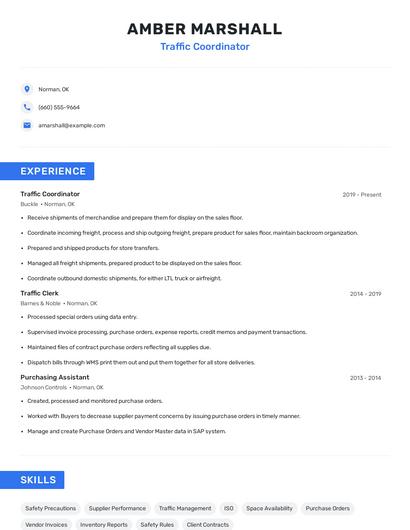


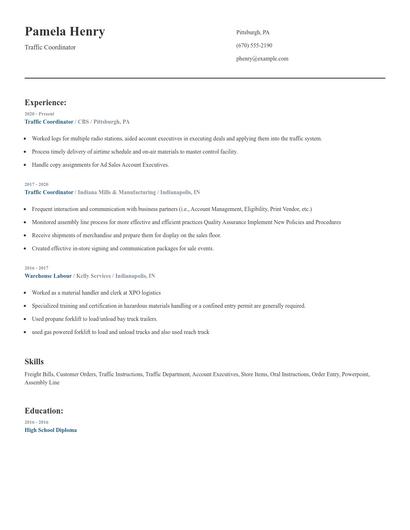

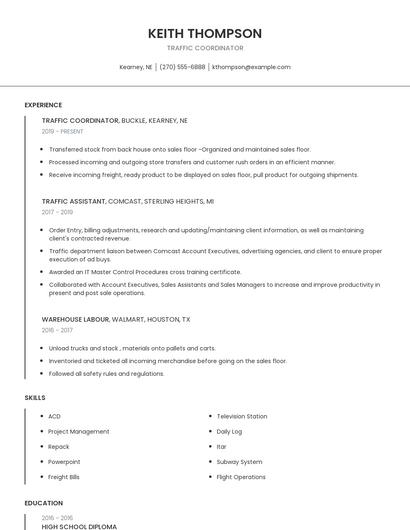

Compare different traffic coordinators
Traffic coordinator vs. Receiver
A receiver is responsible for confirming receipt of items delivered from distribution centers to the warehouse. Receivers carefully evaluate order invoices, ensuring the correct quantity of the items, and inspect the merchandise for any possible mislabeling and defects. They also coordinate with the distributors for replacement and verifications concerning the delivery. A receiver must have excellent organizational and analytical skills, especially on billing discrepancies by utilizing specific shipping software to monitor the delivery activities.
There are some key differences in the responsibilities of each position. For example, traffic coordinator responsibilities require skills like "freight carriers," "powerpoint," "account executives," and "wide orbit." Meanwhile a typical receiver has skills in areas such as "math," "basic math," "ladders," and "pet." This difference in skills reveals the differences in what each career does.
Receivers tend to make the most money working in the manufacturing industry, where they earn an average salary of $33,859. In contrast, traffic coordinators make the biggest average salary, $44,875, in the media industry.The education levels that receivers earn slightly differ from traffic coordinators. In particular, receivers are 2.5% less likely to graduate with a Master's Degree than a traffic coordinator. Additionally, they're 0.1% more likely to earn a Doctoral Degree.Traffic coordinator vs. Shipper
A shipper is an employee who is responsible for filling customer orders and ensures that the quality of these orders meets the company standards. Shippers are tasked with locating items in a warehouse and preparing them for shipping while completing all the transportation procedures so that no complications arise during the cargo-sending process. They use different trays, forklifts, and scissor lifts following the safety standards set by government regulations and company rules. Shippers must also know how to operate a scanner or use the shipping system to track inventory.
While some skills are similar in these professions, other skills aren't so similar. For example, resumes show us that traffic coordinator responsibilities requires skills like "customer service," "data entry," "freight carriers," and "powerpoint." But a shipper might use other skills in their typical duties, such as, "pallets," "basic math," "math," and "shipping receiving."
On average, shippers earn a lower salary than traffic coordinators. Some industries support higher salaries in each profession. Interestingly enough, shippers earn the most pay in the manufacturing industry with an average salary of $35,425. Whereas traffic coordinators have higher pay in the media industry, with an average salary of $44,875.In general, shippers achieve similar levels of education than traffic coordinators. They're 2.2% less likely to obtain a Master's Degree while being 0.1% more likely to earn a Doctoral Degree.Traffic coordinator vs. Shipper receiver
A shipper receiver is responsible for processing and packaging items for shipment and receiving incoming merchandise for warehouse storage. Shipper receivers assist in loading and unloading items from the distribution trucks, checking inventory receipts, inspecting the quality and quantity of the items, preparing shipping documents, and ensuring the cleanliness and orderliness of storage areas. They also update inventory records on the warehouse's database, administering orders and payments, and responding to the customer's inquiries and concerns. A shipper receiver should have a working knowledge of the mechanical industry, especially on operating warehouse tools and equipment safely and efficiently.
There are many key differences between these two careers, including some of the skills required to perform responsibilities within each role. For example, a traffic coordinator is likely to be skilled in "customer service," "data entry," "freight carriers," and "powerpoint," while a typical shipper receiver is skilled in "shipping receiving," "pallets," "basic math," and "electric pallet jack."
Shipper receivers earn the best pay in the construction industry, where they command an average salary of $37,076. Traffic coordinators earn the highest pay from the media industry, with an average salary of $44,875.shipper receivers typically earn similar educational levels compared to traffic coordinators. Specifically, they're 2.7% less likely to graduate with a Master's Degree, and 0.1% less likely to earn a Doctoral Degree.Traffic coordinator vs. Receivables specialist
A receivables specialist is in charge of overseeing and processing account receivables, ensuring accuracy and timeliness. They typically perform bookkeeping tasks, update records and databases, reconcile accounts, and develop strategies to optimize collection procedures. They must also maintain streamlined and organized systems, addressing any issues and resolving them promptly and efficiently while adhering to the company's policies and regulations. Moreover, a receivables specialist must maintain an active communication line with staff for a smooth and efficient workflow.
Types of traffic coordinator
Updated January 8, 2025
