What does a usability engineer do?
A usability engineer conducts studies to ensure a user can easily access all features of a product. They design questionnaires, interview-based studies, and tests. They also design and prototype user interfaces in HTML. They usually have a narrow area of specialization.
Usability engineer responsibilities
Here are examples of responsibilities from real usability engineer resumes:
- Gather and evaluate requirement using UCD principles to automate business processes, design prototypes.
- Define user requirements, application UI design, layout and user interaction design.
- Learned to use Balsalmiq prototyping tool to prototype a tool to be study.
- Conduct usability testing, create low and high fidelity prototypes, develop html and css guides.
- Design a Java user interface for displaying large-scale data sets of real-time status information and perform usability studies of iterative designs.
- Develop web page prototypes in HTML.
- Review requirement, for UI work coordinate associate.
- Lead GUI designer responsible for design and development for the SpaceWorks B2B ecommerce platform.
- Select to produce video product of HFI founder Eric Schaffer instructing on GUI design.
- Collaborate on OWF, GWT, EXT-JS, CSS and JQPLOT cross-team software development activities.
- Perform heuristic reviews, design and run studies, and present results and recommendations to management.
- Redesign the Unix V6 file system in order to access a new file system with a larger file size.
- Expedite and simplify the quotation process for solar water heating systems by accurately representing solar water heating system performance through MATLAB models
- Participate in release of avionics telephony unit, with responsibility expanding from hardware integration to software development in Unix environment.
Usability engineer skills and personality traits
We calculated that 9% of Usability Engineers are proficient in User Experience, UI, and User Research. They’re also known for soft skills such as Analytical skills, Communication skills, and Detail oriented.
We break down the percentage of Usability Engineers that have these skills listed on their resume here:
- User Experience, 9%
Instituted a rapid, iterative design-test process to systematically capture customer input and improve the overall user experience.
- UI, 8%
Designed and developed high-fidelity user interface (UI) prototypes in Visual Basic based on product requirements and user needs.
- User Research, 6%
Designed and lead early-stage user research activities for development of enterprise software applications.
- Interaction Design, 6%
Trained Interaction Designers and Usability Assistant in usability principles and techniques.
- Web Application, 5%
Created wireframes and simulations for a suite of Health Insurance web applications.
- Usability Tests, 5%
Set up and managed recording devices, developed usability test scripts, reviewed and analyzed data and developed presentations for stakeholders.
Most usability engineers use their skills in "user experience," "ui," and "user research" to do their jobs. You can find more detail on essential usability engineer responsibilities here:
Analytical skills. The most essential soft skill for a usability engineer to carry out their responsibilities is analytical skills. This skill is important for the role because "developers must analyze users’ needs and then design software to meet those needs." Additionally, a usability engineer resume shows how their duties depend on analytical skills: "co-authored the data visualization guideline document used by oracle's peoplesoft, siebel, and obiee products. "
Communication skills. Another essential skill to perform usability engineer duties is communication skills. Usability engineers responsibilities require that "developers must be able to give clear instructions to others working on a project." Usability engineers also use communication skills in their role according to a real resume snippet: "demonstrated excellent communication skills in presenting, advocating, and negotiating with internal/external stakeholders on the processes and procedures. "
Detail oriented. This is an important skill for usability engineers to perform their duties. For an example of how usability engineer responsibilities depend on this skill, consider that "developers often work on many parts of an application or system at the same time and must therefore be able to concentrate and pay attention to detail." This excerpt from a resume also shows how vital it is to everyday roles and responsibilities of a usability engineer: "consulted on the architecture and detailed design of online user experiences in both b2c and b2b environments. ".
Creativity. For certain usability engineer responsibilities to be completed, the job requires competence in "creativity." The day-to-day duties of a usability engineer rely on this skill, as "developers are the creative minds behind new computer software." For example, this snippet was taken directly from a resume about how this skill applies to what usability engineers do: "used balsamiq mockups and adobe creative suite for wireframe and prototype development. "
Problem-solving skills. Another common skill required for usability engineer responsibilities is "problem-solving skills." This skill comes up in the duties of usability engineers all the time, as "because developers are in charge of software from beginning to end, they must be able to solve problems that arise throughout the design process." An excerpt from a real usability engineer resume shows how this skill is central to what a usability engineer does: "prototyped the user interface to incrementally improve the usability of a java storage management gui for an iscsi san solution. "
The three companies that hire the most usability engineers are:
- Raytheon Technologies1 usability engineers jobs
- iNovex
1 usability engineers jobs
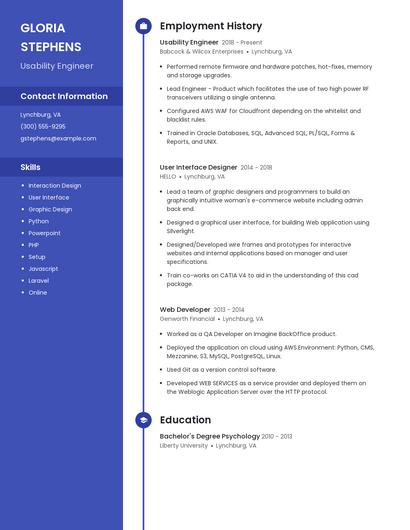
Choose from 10+ customizable usability engineer resume templates
Build a professional usability engineer resume in minutes. Our AI resume writing assistant will guide you through every step of the process, and you can choose from 10+ resume templates to create your usability engineer resume.



Compare different usability engineers
Usability engineer vs. Developer
Developers are usually system or application developers in a company who work on specific projects related to networks or applications from conception to implementation. They attend planning sessions to ensure that the program is feasible. They are responsible for designing the system through coding and basic user interface design. They also work on troubleshooting any challenges that may be met at the testing stage of the program's development. They solve challenges and ensure that minimal problems will arise upon publishing the system or application. They also manage the evaluation to ensure that the program's goals are accomplished and that the end-users are satisfied with the results.
There are some key differences in the responsibilities of each position. For example, usability engineer responsibilities require skills like "user experience," "user research," "interaction design," and "usability tests." Meanwhile a typical developer has skills in areas such as "python," "c++," "api," and "git." This difference in skills reveals the differences in what each career does.
Developers really shine in the finance industry with an average salary of $104,286. Comparatively, usability engineers tend to make the most money in the health care industry with an average salary of $108,628.developers tend to reach similar levels of education than usability engineers. In fact, developers are 3.9% less likely to graduate with a Master's Degree and 6.3% less likely to have a Doctoral Degree.Usability engineer vs. Software developer
A software developer is responsible for designing application systems to support the user and business' needs. Duties of a software developer include testing software codes, performing diagnostic programs and troubleshooting, interpreting system data and establishing efficient parameters, and ensuring the compatibility of the systems. A software developer must have an excellent knowledge of computer programs and programming languages to understand its complexities, especially on detecting system defects and malfunctions. A software developer must have strong attention to detail, communication, and decision-making skills to coordinate with the team and also work independently under minimal supervision.
In addition to the difference in salary, there are some other key differences worth noting. For example, usability engineer responsibilities are more likely to require skills like "user experience," "user research," "interaction design," and "usability tests." Meanwhile, a software developer has duties that require skills in areas such as "python," "c++," "software development," and "database." These differences highlight just how different the day-to-day in each role looks.
Software developers may earn a lower salary than usability engineers, but software developers earn the most pay in the finance industry with an average salary of $96,138. On the other hand, usability engineers receive higher pay in the health care industry, where they earn an average salary of $108,628.In general, software developers achieve similar levels of education than usability engineers. They're 3.4% less likely to obtain a Master's Degree while being 6.3% less likely to earn a Doctoral Degree.Usability engineer vs. Software engineer-consultant
A software engineer consultant develops and recommends strategies to optimize a company's software engineering operations. Their responsibilities revolve around conducting extensive research and analysis to find new opportunities, performing software evaluations and risk assessments, identifying the strengths and weaknesses of existing processes, and developing solutions against problem areas. Through the findings of their research, a software engineer consultant draws conclusions and recommendations that will help the company to reach their short and long-term goals and resolve issues or concerns.
There are many key differences between these two careers, including some of the skills required to perform responsibilities within each role. For example, a usability engineer is likely to be skilled in "user experience," "user research," "interaction design," and "usability tests," while a typical software engineer-consultant is skilled in "python," "architecture," "software development," and "api."
Software engineers-consultant earn the highest salary when working in the insurance industry, where they receive an average salary of $118,185. Comparatively, usability engineers have the highest earning potential in the health care industry, with an average salary of $108,628.Most software engineers-consultant achieve a similar degree level compared to usability engineers. For example, they're 3.1% less likely to graduate with a Master's Degree, and 5.6% less likely to earn a Doctoral Degree.Usability engineer vs. Senior systems software engineer
A senior systems software engineer is an individual responsible for managing a firm's computer network systems. The professional's roles include resolving complex application and network issues through the development of new solutions, overseeing systems developers and other information technology (IT) personnel, and integrating new technology. The job requires proficiency in the MySQL, Python, and Linux programming languages and excellent skills in organizational and time management and communication. The education requirements for the job include a bachelor's degree in electrical engineering, computer science, or a related field.
Even though a few skill sets overlap between usability engineers and senior systems software engineers, there are some differences that are important to note. For one, a usability engineer might have more use for skills like "user experience," "user research," "interaction design," and "web application." Meanwhile, some responsibilities of senior systems software engineers require skills like "python," "software development," "architecture," and "linux. "
The technology industry tends to pay the highest salaries for senior systems software engineers, with average annual pay of $125,048. Comparatively, the highest usability engineer annual salary comes from the health care industry.In general, senior systems software engineers hold similar degree levels compared to usability engineers. Senior systems software engineers are 4.2% less likely to earn their Master's Degree and 5.7% less likely to graduate with a Doctoral Degree.Types of usability engineer
Updated January 8, 2025
