What does a validation manager do?
A Validation Manager oversees and validates manufacturing plants' daily operations, ensuring compliance with standards and regulations. They often inspect information technology systems and machinery, review specifications and documentation, gather and analyze feedback, and observe various areas' maintenance procedures. It is also their responsibility to manage validation teams, supervising them while implementing policies and regulations. Moreover, a Validation Manager develops validation plans for various facilities and produces detailed reports, along with recommendations and conclusions.
Validation manager responsibilities
Here are examples of responsibilities from real validation manager resumes:
- Manage the CSV project that validate 76 within 17 months saving $1.0 MM out of $8.8MM.
- Implement a regression process, and manage the execution of the regression testing.
- Manage an SSD validation team responsible for testing and debugging the next generation PCIe SSD's.
- Manage QA disposition and review of commercial stability material and conduct investigations on out-of-specification/anomalous results.
- Coordinate site training requirements, deliver GMP and technical specific training, create and manage associated metrics.
- Perform computer and control system validation for QC analytical instrumentation and manufacturing process systems.
- Automate projects with PLC, DCS & MMI.
- Revise and approve all commissioning books for GMP and Non-GMP systems.
- Audit suppliers to insure compliance to 21 CFR 820 and ISO 13485:2003 standards.
- Review IQ/OQ/PQ protocols and reports for accuracy, thoroughness and relevancy to the subject matter.
- Serve as validation liaison during FDA and EU regulatory inspections; authorize all validation protocols and process changes.
- Investigate manufacturing and validation deviations, recommend corrective & preventative actions (CAPA), & prepare related technical reports.
- Identify and assign CAPA responsibilities.
- Participate in QA review of RIBC department validation documents
- Participate in FDA regulatory audits and present validation updates.
Validation manager skills and personality traits
We calculated that 7% of Validation Managers are proficient in Project Management, QC, and FDA. They’re also known for soft skills such as Interpersonal skills, Leadership skills, and Problem-solving skills.
We break down the percentage of Validation Managers that have these skills listed on their resume here:
- Project Management, 7%
Reviewed & approved Engineering Product Specifications, Software Requirements Specifications, Project Management Plans, Design Descriptions, etc.
- QC, 6%
Designed and Implemented Failure Analysis Process for the instrument QC failures.
- FDA, 6%
Participated in FDA regulatory audits and presented validation updates.
- Cleaning Validation, 5%
Executed Process Validation, Cleaning Validation and Equipment Qualification activities for the oral liquid dosage products manufactured at the Baltimore site.
- Regression, 5%
Defined the regression suite and tracked manual regression versus automated coverage.
- Regulatory Agencies, 4%
Provide validation support during Regulatory Agencies and Corporate inspections by presenting Site Validation Program, Strategies and Protocols.
Most validation managers use their skills in "project management," "qc," and "fda" to do their jobs. You can find more detail on essential validation manager responsibilities here:
Interpersonal skills. One of the key soft skills for a validation manager to have is interpersonal skills. You can see how this relates to what validation managers do because "industrial production managers must have excellent communication skills to work well other managers and with staff." Additionally, a validation manager resume shows how validation managers use interpersonal skills: "have a good understanding of sdlc best practices and strong interpersonal, written and verbal communication skills. "
Leadership skills. Another essential skill to perform validation manager duties is leadership skills. Validation managers responsibilities require that "to keep the production process running smoothly, industrial production managers must motivate and direct employees." Validation managers also use leadership skills in their role according to a real resume snippet: "train site and corporate osc leadership/management teams in industry gxp risk assessments tools. "
Problem-solving skills. This is an important skill for validation managers to perform their duties. For an example of how validation manager responsibilities depend on this skill, consider that "production managers must identify and address problems that arise." This excerpt from a resume also shows how vital it is to everyday roles and responsibilities of a validation manager: "sap solution manager was used for project management, configuring and testing. ".
The three companies that hire the most validation managers are:
- Avantor28 validation managers jobs
- U.S. Bank27 validation managers jobs
- Takeda Pharmaceuticals U.S.A., Inc.6 validation managers jobs
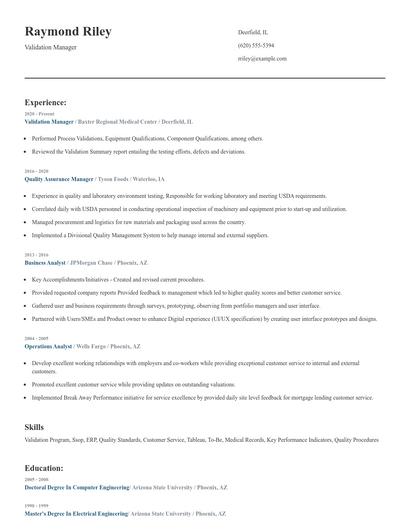
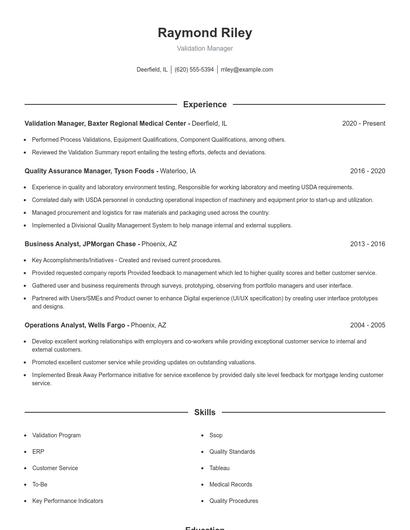
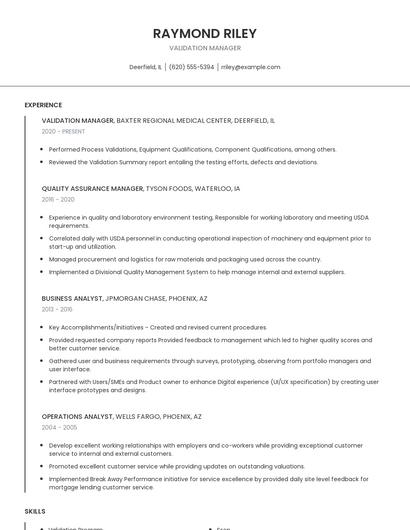
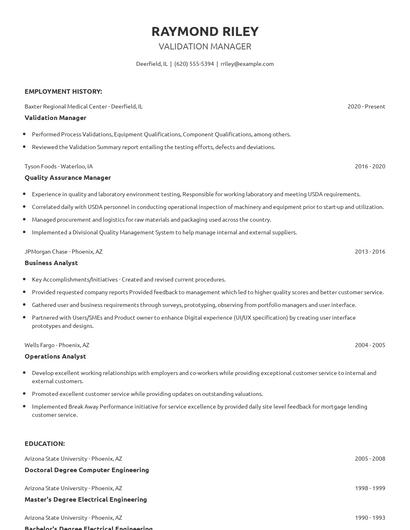
Choose from 10+ customizable validation manager resume templates
Build a professional validation manager resume in minutes. Our AI resume writing assistant will guide you through every step of the process, and you can choose from 10+ resume templates to create your validation manager resume.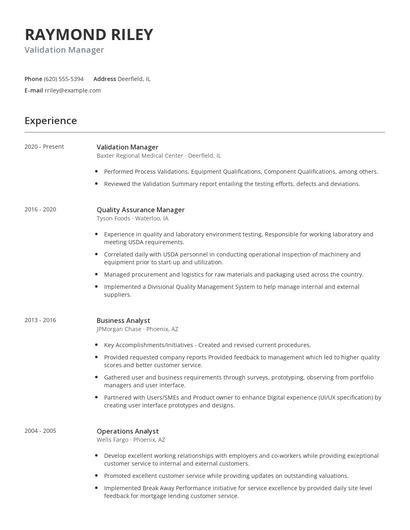
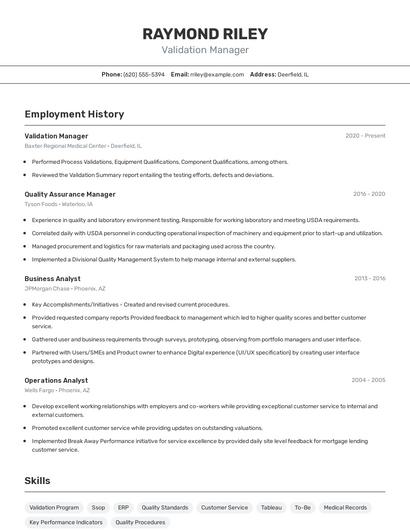
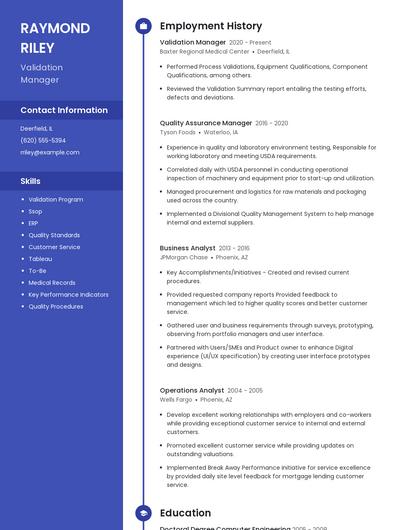


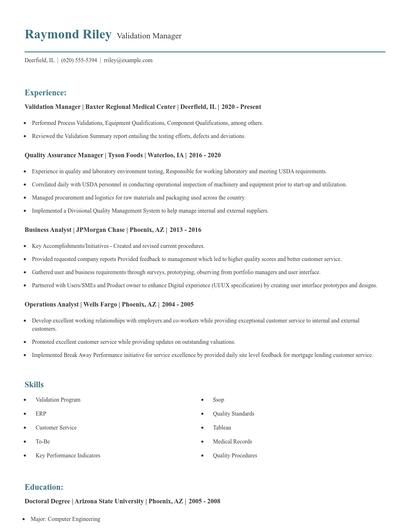
Compare different validation managers
Validation manager vs. Director of quality
In the manufacturing industry, a director of quality is primarily in charge of spearheading and overseeing the daily operations in a quality assurance department. They work to ensure that products adhere to the company's quality standards and industry regulations by conducting research and assessments, developing quality test systems, and reviewing reports. As a director of quality, they have the authority to make significant decisions, establish protocols and guidelines, set objectives and timelines, and implement rules and policies, creating new ones as necessary.
While similarities exist, there are also some differences between validation managers and director of quality. For instance, validation manager responsibilities require skills such as "regression," "process validation," "risk assessments," and "validation program." Whereas a director of quality is skilled in "healthcare," "quality improvement," "patients," and "oversight." This is part of what separates the two careers.
Directors of quality tend to make the most money working in the finance industry, where they earn an average salary of $155,704. In contrast, validation managers make the biggest average salary, $127,014, in the pharmaceutical industry.directors of quality tend to reach higher levels of education than validation managers. In fact, directors of quality are 5.0% more likely to graduate with a Master's Degree and 0.6% less likely to have a Doctoral Degree.Validation manager vs. Vice-president of quality
A vice president of quality is responsible for monitoring the quality performance and delivery of the company outputs and deliverables to serve customers and clients. Vice presidents of quality analyze the production and operational processes to ensure that everything adheres to the internal guidelines and regulations. They also coordinate with the stakeholders for project updates and identify opportunities for revenue resources to increase the company's profits. A vice president of quality must have excellent communication and leadership skills, especially in minimizing loss from operational failures and increasing productivity results.
While some skills are similar in these professions, other skills aren't so similar. For example, resumes show us that validation manager responsibilities requires skills like "cleaning validation," "regression," "process validation," and "risk assessments." But a vice-president of quality might use other skills in their typical duties, such as, "oversight," "risk management," "patient safety," and "performance improvement."
Vice-president of qualities earn a higher average salary than validation managers. But vice-president of qualities earn the highest pay in the finance industry, with an average salary of $122,006. Additionally, validation managers earn the highest salaries in the pharmaceutical with average pay of $127,014 annually.Average education levels between the two professions vary. Vice-president of qualities tend to reach similar levels of education than validation managers. In fact, they're 5.0% more likely to graduate with a Master's Degree and 0.6% more likely to earn a Doctoral Degree.Validation manager vs. Quality improvement coordinator
In the medical industry, a quality improvement coordinator is in charge of developing programs and projects designed to improve medical services and employee performance. Their responsibilities typically include gathering and analyzing data to identify the strengths and weaknesses of current procedures, performing research and analysis to determine the ideal care practices, studying feedback from different parties, conducting inspections and assessments, and implementing solutions against problem areas. Moreover, a quality improvement coordinator must develop programs while enforcing and promoting the facility's policies and regulations.
The required skills of the two careers differ considerably. For example, validation managers are more likely to have skills like "qc," "fda," "cleaning validation," and "regression." But a quality improvement coordinator is more likely to have skills like "performance improvement," "patients," "quality improvement," and "patient care."
Quality improvement coordinators make a very good living in the insurance industry with an average annual salary of $77,330. On the other hand, validation managers are paid the highest salary in the pharmaceutical industry, with average annual pay of $127,014.Most quality improvement coordinators achieve a similar degree level compared to validation managers. For example, they're 0.6% less likely to graduate with a Master's Degree, and 0.3% less likely to earn a Doctoral Degree.Validation manager vs. Quality assurance administrator
A quality assurance administrator oversees the daily operations of the QA branch of a company. The QA team's main task is to ensure all products or services provided by the company meet the standards prescribed by management and customer feedback. Aside from this, the QA team makes sure that all company output meets government standards, policies, and regulations. The quality assurance administrator must handle all personnel under the department effectively and accomplish each daily task consistently.
Types of validation manager
Updated January 8, 2025
