Explore jobs
Find specific jobs
Explore careers
Explore professions
Best companies
Explore companies
Job outlook for wireless consultants in the United States
Wireless consultant job growth summary. After extensive research, interviews, and analysis, Zippia's data science team found that:
The projected wireless consultant job growth rate is 0% from 2018-2028.
About 1,900 new jobs for wireless consultants are projected over the next decade.
Wireless consultant salaries have increased 19% for wireless consultants in the last 5 years.
There are over 47,051 wireless consultants currently employed in the United States.
There are 167,638 active wireless consultant job openings in the US.
The average wireless consultant salary is $42,960.
Are wireless consultant jobs in demand?
Wireless consultant job and salary trends over time
Wireless consultant jobs over time
Wireless consultant job growth rate over time
| Year | # of jobs | % of population |
|---|---|---|
| 2021 | 47,051 | 0.01% |
| 2020 | 46,620 | 0.01% |
| 2019 | 55,006 | 0.02% |
| 2018 | 56,664 | 0.02% |
| 2017 | 56,587 | 0.02% |
Average wireless consultant salary over time
Wireless consultant salary by year
| Year | Avg. salary | Hourly rate | % Change |
|---|---|---|---|
| 2026 | $42,960 | $20.65 | +7.2% |
| 2025 | $40,057 | $19.26 | +4.3% |
| 2024 | $38,391 | $18.46 | +4.3% |
| 2023 | $36,821 | $17.70 | +2.3% |
| 2022 | $35,980 | $17.30 | +4.1% |
Wireless consultant jobs by state
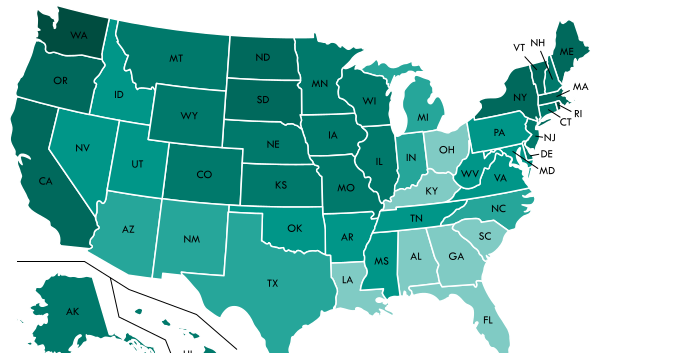
Most common states for wireless consultants
| Rank | State | Population | # of jobs | Employment/ 1000ppl |
|---|---|---|---|---|
| 1 | South Dakota | 869,666 | 179 | 21% |
| 2 | District of Columbia | 693,972 | 105 | 15% |
| 3 | Alabama | 4,874,747 | 692 | 14% |
| 4 | Massachusetts | 6,859,819 | 824 | 12% |
| 5 | Oklahoma | 3,930,864 | 474 | 12% |
| 6 | Mississippi | 2,984,100 | 329 | 11% |
| 7 | Vermont | 623,657 | 69 | 11% |
| 8 | Oregon | 4,142,776 | 394 | 10% |
| 9 | Rhode Island | 1,059,639 | 101 | 10% |
| 10 | Connecticut | 3,588,184 | 330 | 9% |
| 11 | Utah | 3,101,833 | 274 | 9% |
| 12 | New Hampshire | 1,342,795 | 117 | 9% |
| 13 | Montana | 1,050,493 | 90 | 9% |
| 14 | California | 39,536,653 | 2,986 | 8% |
| 15 | Florida | 20,984,400 | 1,686 | 8% |
| 16 | New Jersey | 9,005,644 | 702 | 8% |
| 17 | Minnesota | 5,576,606 | 459 | 8% |
| 18 | Illinois | 12,802,023 | 895 | 7% |
| 19 | Wisconsin | 5,795,483 | 419 | 7% |
| 20 | Nebraska | 1,920,076 | 126 | 7% |
Most common cities for wireless consultants
| Rank | City | # of jobs | Employment/ 1000ppl | Avg. salary |
|---|---|---|---|---|
| 1 | Cedar Falls | 2 | 5% | $42,155 |
| 2 | Howell | 2 | 4% | $42,684 |
| 3 | Evansville | 2 | 2% | $36,193 |
| 4 | Long Beach | 3 | 1% | $46,443 |
| 5 | Wichita | 3 | 1% | $41,865 |
| 6 | Elk Grove | 2 | 1% | $47,267 |
| 7 | San Jose | 3 | 0% | $47,452 |
| 8 | Boston | 2 | 0% | $47,265 |
| 9 | Colorado Springs | 2 | 0% | $42,934 |
| 10 | Columbus | 2 | 0% | $33,436 |
Wireless Consultant job outlook: Expert opinions
Our panel of wireless consultant experts
University of Hawaii at Manoa

The University of Findlay

University of Mount Union

Franklin and Marshall College

California State University Channel Islands

Drexel University, Antoinette Westphal College of Media Arts & Design
Dr. Barbara Joyce
ACCESS Academic Advisor for undergraduate students in Sociology, Departmental advisorUniversity of Hawaii at Manoa
Department of Sociology
What's a good job out of college for Wireless Consultants?
Dr. Barbara Joyce: A good job out of college is one that the graduates want, a job that is meaningful, that uplifts and inspires them, a job in which they use, and continue to develop, their talents and skills, and, of course, a job that provides them with the material resources and benefits they need to enjoy life. Credit where credit is due, Stephen R. Covey writes of the importance of those elements in his book Principle-Centered Leadership. I like his work a lot.
What's a good job out of college for Wireless Consultants?
Amy Rogan: There are any number of ways to break into journalism. There is no one true path. If a journalist is interested in television I recommend they look for assistant producer positions or assignment editor positions. Many people who think they want to be on-air talent figure out they really enjoy producing much better.
Digital content producer is another good way to work a journalist way into on-air television work. It's also a way to work into newspapers as they are now more digitally dependent.
Larger organizations have more specialty digital positions in research or digital analytics. But starting out in a small market allows you to learn a lot and work your way into bigger markets and responsibilities.
Michael Grossman Ph.D.
Professor, Political Studies and International StudiesUniversity of Mount Union
Department of Political Science and International Studies
What certifications/licenses/courses can have the biggest impact for Wireless Consultants?
Michael Grossman Ph.D.: It is less about licenses or courses and more about experiences. In this regard, internships are crucial.
What will help Wireless Consultants increase their earning potential?
Michael Grossman Ph.D.: It's all about practical knowledge. Employers are less interested in your major or the classes you take. They want to see that you can do the work they need you to do. So internships are important. Also employers want to see you can be trained and can think critically, write well, and speak well. So in this regard more liberal arts focused curriculum is important.
What certifications/licenses/courses can have the biggest impact for Wireless Consultants?
Cynthia Krom: Professional certifications matter. If your profession has a certification, you need to have that certification to be competitive in this new world. So, a public accountant needs to have a CPA, and a corporate accountant needs to have their CMA. A fraud examiner needs their CFE. Find out what is available in your profession and take whatever courses or exams are needed to be at the top of your game, because everyone else will.
We don't really know what will be happening with professional licenses with remote work. A psychotherapist may be licensed in New York, but remotely treating a client in New Mexico. Technically, they probably need a license in New Mexico. But who will control that? Will it just be the professional responsibility of the therapist to only practice where licensed? Will their malpractice insurance only cover them if the client is where they are licensed? What about a physician operating on someone a thousand miles away using robotics?
In terms of courses not related to professional certification or licensure, technology is where it is at. First and foremost, polish your Zoom skills. Zoom is now your face-to-face workplace and you need to be a pro. YouTube has great videos about lighting for Zoom, even with reflective eyeglasses. Perhaps your IT department is able to help with connectivity issues and learning remote technologies. And, as we have all recently seen, you need to learn how to turn off filters that make you look like a kitten! For nearly every field, you have to know Microsoft Office (Word, PowerPoint, and Excel) or similar programs. You need to know how to work collaboratively on projects through things like Google Drive. If you are not fluent in the basics, you are showing up for a horse race with a little pony.
Ekin Pehlivan Ph.D.
Associate Professor of MarketingCalifornia State University Channel Islands
Martin V. Smith School of Business and Economics
What's a good job out of college for Wireless Consultants?
Ekin Pehlivan Ph.D.: I think a description of a "good" job opportunity is dependent on so many factors, almost all subjective. What I recommend my students usually, is that they try different things before graduation and find something that makes them feel a purpose other than (and in addition to) making ends meet. For this reason we started a program on our campus where students are hired to help non-profits and small businesses in our area of service. In this program, students get to gain and practice skills that can help them succeed in a corporate or freelance capacity. The students get to experiment without fear of losing a job and find what they would like their entry level positions to look like. While doing this they also help organizations and individuals who have the need but not the resources to get the services from professionals.
What's a day at work look like for a Wireless Consultant?
Joseph Hancock: New graduates will need to be self-disciplined and self-motivated. No one is going to hold your hand and tell you "get to work" or you will soon be looking for a new job. The new world may be one where you don't go to an office, but instead work right from home, scheduling appointments and doing your own calendar. My last years working for Target in a regional field position taught me that no one was going to motivate me each day, I had to motivate myself. Also, it can be lonely working from home as a new graduate, so find outside interests and ways to make friends. I am from the old fashion ideologies that getting a hobby is extremely important, and that hobby is not going to the gym or watching television. It includes something that enriches your life to be a better person in society.