What does a work distributor do?
Work distributor responsibilities
Here are examples of responsibilities from real work distributor resumes:
- Distribute production materials to designate locations on assembly lines observing the first-in-first-out (FIFO) inventory control practice.
- Use of forks, barrel, clamp and pull-pack attachments.
- Handle and coordinate incoming and outgoing product and accessory equipment to and from freight forwarders and/or customer materials personnel.
Work distributor skills and personality traits
We calculated that 39% of Work Distributors are proficient in Pallets, Pallet Jack, and Customer Orders. They’re also known for soft skills such as Hand-eye coordination, Listening skills, and Physical stamina.
We break down the percentage of Work Distributors that have these skills listed on their resume here:
- Pallets, 39%
Hand packed buns into boxes and stacked onto pallets.
- Pallet Jack, 15%
Used pallet jacks and hand carts to transport cases to other locations throughout the warehouse.
- Customer Orders, 13%
Completed 10 month temporary assignment..Pick and pack customer orders.
- OSHA, 11%
Maintained accurate and timely documentation as is required by organization and OSHA.
- RF, 5%
Used RF guns to complete picks and orders daily.
- Inventory Control, 5%
Verified all product mixtures were properly packaged, matched bill of material and generated labels utilizing computerized inventory control systems.
Common skills that a work distributor uses to do their job include "pallets," "pallet jack," and "customer orders." You can find details on the most important work distributor responsibilities below.
Hand-eye coordination. One of the key soft skills for a work distributor to have is hand-eye coordination. You can see how this relates to what work distributors do because "most hand laborers and material movers use their arms and hands to manipulate objects or move objects into specific positions." Additionally, a work distributor resume shows how work distributors use hand-eye coordination: "managed the coordination of interfaces between logistics, transportation, and warehousing. "
Listening skills. Another soft skill that's essential for fulfilling work distributor duties is listening skills. The role rewards competence in this skill because "hand laborers and material movers follow instructions that a supervisor gives them." According to a work distributor resume, here's how work distributors can utilize listening skills in their job responsibilities: "followed safety procedures * updated an electronic database and operated heavy machinery * communicated with others. "
Physical stamina. Another skill that relates to the job responsibilities of work distributors is physical stamina. This skill is critical to many everyday work distributor duties, as "hand laborers and material movers need the endurance to perform strenuous tasks, such as moving or cleaning objects, throughout the day." This example from a resume shows how this skill is used: "place pallets in hi-racks using standup and sit down forklift while using attention to detail and stamina because job is repetitive. "
Physical strength. For certain work distributor responsibilities to be completed, the job requires competence in "physical strength." The day-to-day duties of a work distributor rely on this skill, as "some hand laborers and material movers must be able to lift and carry heavy objects." For example, this snippet was taken directly from a resume about how this skill applies to what work distributors do: "participated in physical inventory and weekly cycle counts. "
Customer-service skills. Another crucial skill for a work distributor to carry out their responsibilities is "customer-service skills." A big part of what work distributors relies on this skill, since "hand laborers and material movers who work with the public, such as grocery baggers or carwash attendants, must be pleasant and courteous to customers." How this skill relates to work distributor duties can be seen in an example from a work distributor resume snippet: "filled customer orders to be boxed and shipped out. "
The three companies that hire the most work distributors are:
- Primerica2 work distributors jobs
- The Walt Disney Company2 work distributors jobs
- Bothwell Regional Health Center2 work distributors jobs
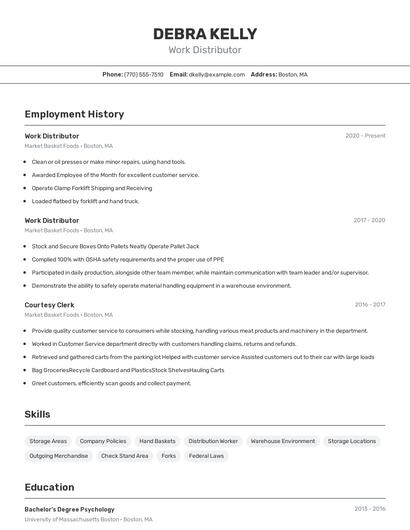
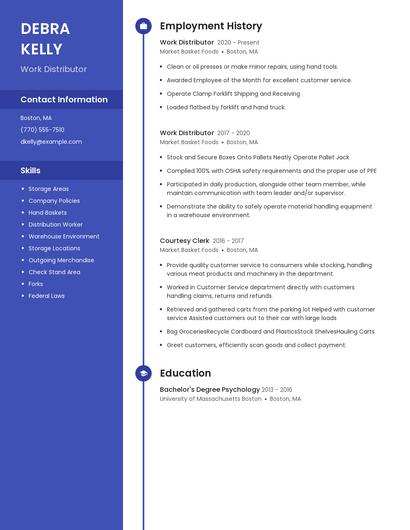
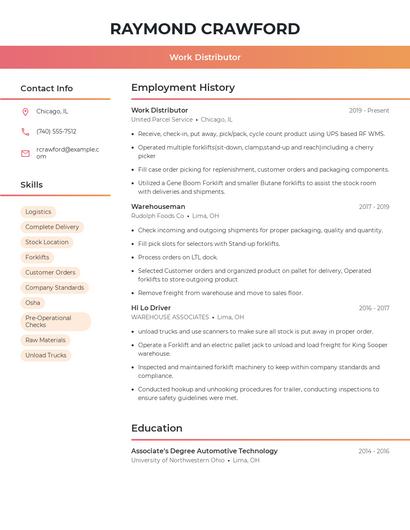
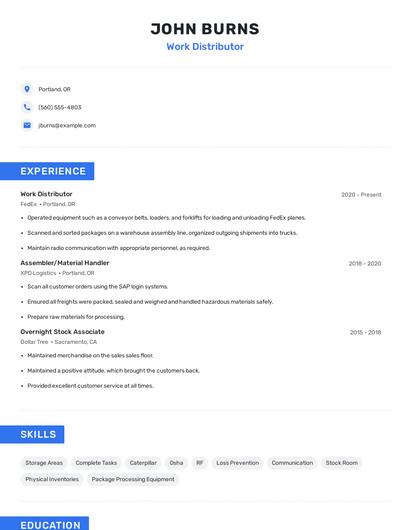
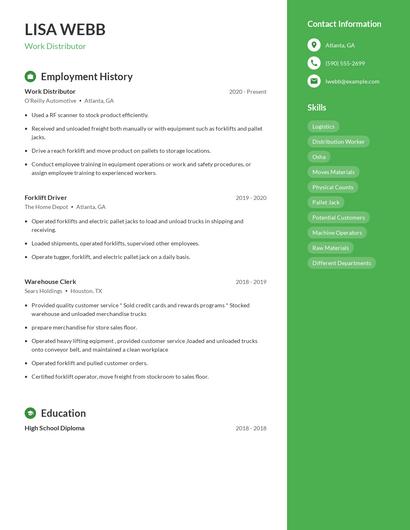
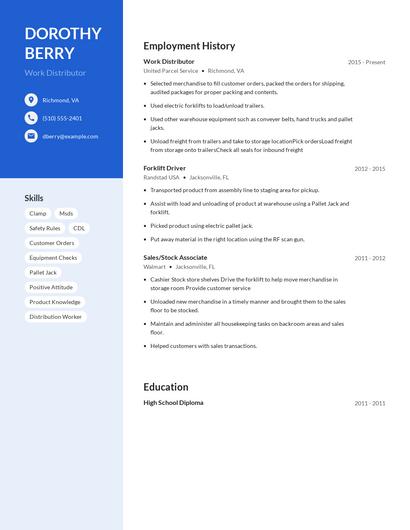
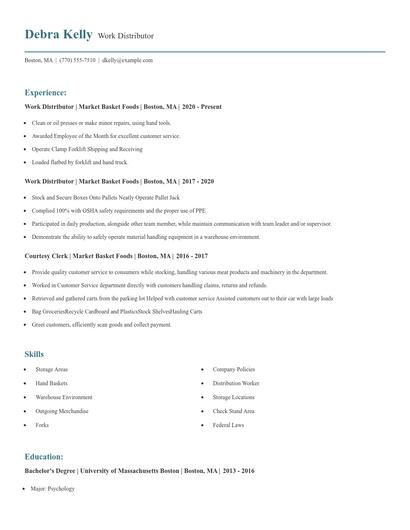
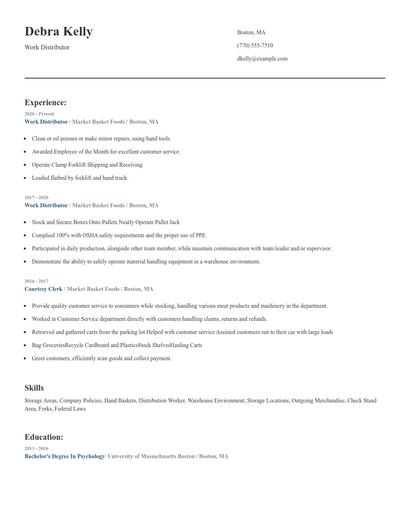
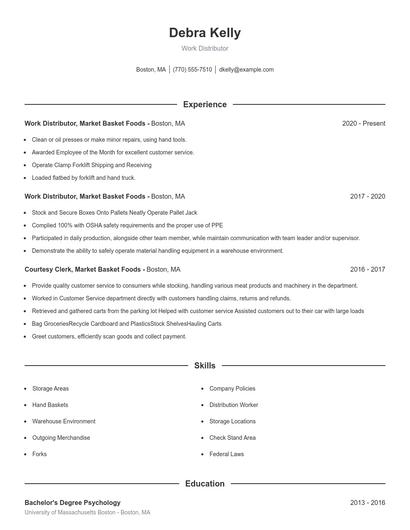
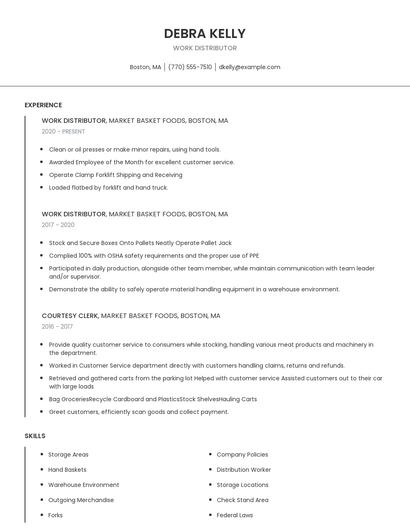
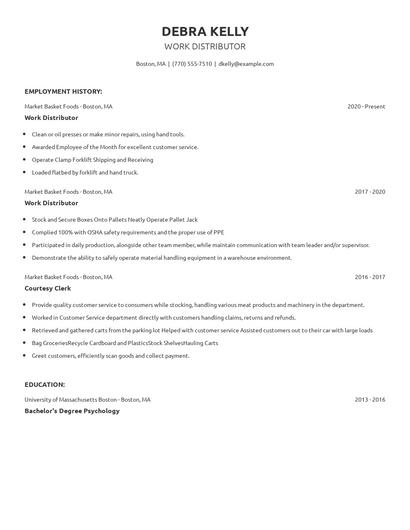
Choose from 10+ customizable work distributor resume templates
Build a professional work distributor resume in minutes. Our AI resume writing assistant will guide you through every step of the process, and you can choose from 10+ resume templates to create your work distributor resume.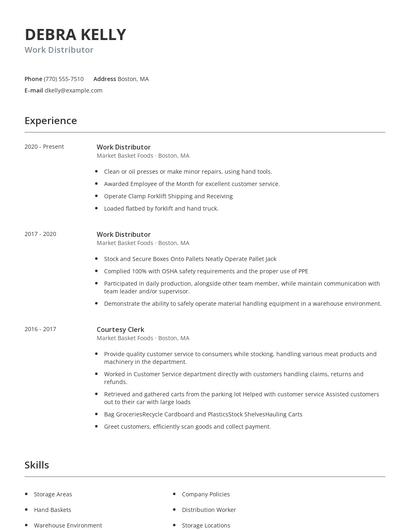
Compare different work distributors
Work distributor vs. Package handler
A package handler's primary duty is to place and load correct packages to delivery vehicles and review inventory upon shipments. Package handlers are responsible for analyzing product labels to make sure that the items are accurately processed. A package handler should also have basic knowledge on running warehouse equipment and loading tools to finish the task more efficiently. Package handlers must be able to communicate with other personnel for any concerns that might affect the parcel condition and customer's satisfaction.
There are some key differences in the responsibilities of each position. For example, work distributor responsibilities require skills like "pallets," "customer orders," "osha," and "fork-lift." Meanwhile a typical package handler has skills in areas such as "warehouse environment," "load trailers," "load packages," and "load trucks." This difference in skills reveals the differences in what each career does.
Package handlers earn the highest salaries when working in the retail industry, with an average yearly salary of $38,714. On the other hand, work distributors are paid more in the manufacturing industry with an average salary of $33,690.The education levels that package handlers earn slightly differ from work distributors. In particular, package handlers are 0.2% less likely to graduate with a Master's Degree than a work distributor. Additionally, they're 0.1% more likely to earn a Doctoral Degree.Work distributor vs. Can handler
Can handlers or material handlers have various duties and responsibilities within an organization. These include maintaining production and product distribution, staging finished products, and delivering production supplies and materials. Other responsibilities include maintaining inventory, documenting supplies and materials disposition, and receiving supplies and materials from production. They receive credit-return materials by verifying the code, quantity, and lot number. Can handlers also prepare products for shipment, maintain material-handling equipment, and contribute to teamwork and effort. The skills and qualifications needed for this position include organizational skills, inventory control, and data entry skills.
While some skills are similar in these professions, other skills aren't so similar. For example, resumes show us that work distributor responsibilities requires skills like "pallets," "osha," "fork-lift," and "water mains." But a can handler might use other skills in their typical duties, such as, "customer service," "patients," "supply support," and "safety regulations."
On average, can handlers earn a higher salary than work distributors. Some industries support higher salaries in each profession. Interestingly enough, can handlers earn the most pay in the automotive industry with an average salary of $33,051. Whereas work distributors have higher pay in the manufacturing industry, with an average salary of $33,690.can handlers earn similar levels of education than work distributors in general. They're 0.9% more likely to graduate with a Master's Degree and 0.1% more likely to earn a Doctoral Degree.Work distributor vs. Unloader
An unloader is responsible for monitoring truck deliveries and managing all goods and merchandise to the store. Unloaders verify the deliveries' correct quantity by checking the receipts and ensuring its quality for customers' purchase. They respond to the customers' inquiries and concerns, facilitate the shelf arrangement of the products, sort items, and help with the store's organization and cleanliness. An unloader must have excellent time-management skills and the ability to multitask to perform various tasks in the fast-paced industry.
The required skills of the two careers differ considerably. For example, work distributors are more likely to have skills like "pallet jack," "customer orders," "osha," and "fork-lift." But a unloader is more likely to have skills like "work ethic," "strong work ethic," "customer service," and "electric pallet jack."
Unloaders make a very good living in the transportation industry with an average annual salary of $37,212. On the other hand, work distributors are paid the highest salary in the manufacturing industry, with average annual pay of $33,690.When it comes to education, unloaders tend to earn similar degree levels compared to work distributors. In fact, they're 0.8% less likely to earn a Master's Degree, and 0.1% less likely to graduate with a Doctoral Degree.Work distributor vs. Warehouse labour
Warehouse labour workers are responsible for organizing shipment details by processing the correct quantity of orders, ensuring that the items are free from any defects and mislabeling. Warehouse labourers prepare the items for packaging efficiently, update the inventory records, and escalate production discrepancy to the management for immediate resolution. They should also strictly adhere to the production area's safety regulations, especially on loading and unloading items, and moving each package to appropriate shelves using warehouse equipment.
Types of work distributor
Updated January 8, 2025
