
Automatically apply for jobs with Zippia
Upload your resume to get started.
Youth advocate skills for your resume and career

15 youth advocate skills for your resume and career
1. Mental Health
Mental health is the state of wellbeing in which an individual can cope with the regular stresses and tensions of life, and can work productively without having any emotional or psychological breakdown. Mental health is essential for a person of any age and helps them make the right decisions in their life.
- Develop and maintain positive working relationships with mental health professionals and various community organizations or services.
- Deliver linkage services to additional community-based mental health and social services.
3. Foster Care
- Facilitated a therapeutic environment for girls placed in foster care.
- Educate teens and young adults who are on track to age out of foster care about their right to be adopted.
4. Community Resources
Community resources are a set of resources that are used in the day to day life of people which improves their lifestyle in some way. People, sites or houses, and population assistance can come under the services offered by community resources.
- Collaborated with referral agencies to identify community resources available to students and families.
- Provide individual support/mentoring and advocacy to youth and make referrals to community resources/programs.
5. Youth Development
Youth Development is a gradual process that is designed to equip a young person, teenager, or adolescent with the necessary skills and mindset to grow into a mature and successful adult. This involves initiating activities that will help the youth advance mentally, socially, psychologically and grow in cognitive reasoning. The activities may include community service, mentoring programs, physical training, skill training, and many other innovative ways the youth development expert can come up with to achieve the goal.
- Engage community agencies to provide leadership and structural opportunities for youth development within the program and juvenile probation guidelines.
- Provide technical assistance to schools, organizations and community partners in the substance abuse prevention/youth development field.
6. Crisis Intervention
- Assist in running groups, implementing programming, utilizing therapeutic crisis interventions, medication administration.
- Established operative delinquency and crisis intervention skills via completion of four month hybrid training.
Choose from 10+ customizable youth advocate resume templates
Build a professional youth advocate resume in minutes. Our AI resume writing assistant will guide you through every step of the process, and you can choose from 10+ resume templates to create your youth advocate resume.8. Independent Living
- Supervised at risk youth activities in accordance with applicable regulations and facilitated therapeutic intervention for possible independent living.
- Facilitated groups on independent living skills, money management, empowerment and relationship building.
9. Life Training
- Perform life skills training, family life assistance, front line communications with schools, doctors, parents.
- Facilitate Life Skills Training Youth Groups Create and research evidence based curriculum for at risk youth.
10. Community Outreach
- Participate in leadership activities, Job readiness workshops and community outreach.
- Transported students to and from various community outreach initiatives.
11. at-Risk Youth
A child who is unlikely to transition successfully into adulthood is considered an at-risk youth. Success can mean job readiness, academic success, or competence to be financially independent. It may also refer to the ability to avoid a life of crime by becoming a positive representative of society. At-risk students may show/have to show indifference for academics, low educational performance, absenteeism, disconnect from the school, emotional, and behavioral problems.
- Collaborated with Humane Society to create volunteering opportunities for at-risk youth.
- Planned and assisted with numerous educational activities for at-risk youth.
12. CPR
Cardiopulmonary resuscitation or CPR is a medical procedure that involves chest compression to help a patient breathe. This artificial ventilation helps in keeping the brain function in place and regulates blood throughout the body. CPR is a lifesaving procedure that is used in emergencies.
- Participated in escape apprehension activities Completed pre-service and annual in-service CPR Transport clients to medical appointments & activities.
- Core Qualifications Microsoft word Excel Power Point CPR certified HIV certified Group Therapy Treatment Planning Documentation
13. Conflict Resolution
Conflict resolution is an often necessary skill in business, employed for processes such as contract negotiations, legal matters, and even personal, emotional situations and conflicts. It is the ability to find and create an appropriate and peaceful solution to some sort of dilemma or argument in which two or more parties are involved. The resolution itself must benefit and satisfy all parties and this is what makes it so difficult to reach a peaceful point sometimes.
- Foster ongoing communication and conflict resolution within the Teen Connection system.
- Instruct positive interaction and conflict resolution among clients.
14. Community Services
Community ѕеrvісе is аn unраіd activity in which аn individual оr grоuр еngаgеѕ tо bеnеfіt thе lосаl, nаtіоnаl оr glоbаl соmmunіtу. It іѕ also uѕеd as аn аltеrnаtіvе to imprisonment аnd іѕ intended tо connect offenders to the victim or society ѕо thаt they can undеrѕtаnd how their асtіоnѕ аffесt оthеrѕ.
- Linked family members to appropriate community services.
- Cultivated relationships with community services providers in order to ensure that the needs of the children and their families were met.
15. Incident Reports
An Incident Report, in a medical facility such as hospitals and nursing homes, is a type of paperwork filled out immediately after and in the case of an incident of some sort, with the goal of describing the incident and its consequences, as well as the measurements taken after or during the incident, as well as any other information relevant to said incident. Such an incident might be a patient acting out or a patient being injured.
- Reported all observations and concerns to management and submitted Incident Reports when necessary.
- Completed paperwork regarding resident logs and incident reports.
5 Youth Advocate resume examples
Build a professional youth advocate resume in minutes. Browse through our resume examples to identify the best way to word your resume. Then choose from 5+ resume templates to create your youth advocate resume.

What skills help Youth Advocates find jobs?
Tell us what job you are looking for, we’ll show you what skills employers want.
What skills stand out on youth advocate resumes?
Dr. Florence DiGennaro Reed Ph.D.
Associate Professor and Chairperson, Director of the Performance Management Laboratory, University of Kansas
What hard/technical skills are most important for youth advocates?
Sam Terrazas Ph.D.
Professor and Academic Chair Department of Social Work, The University of Texas Permian Basin
BSW's practice in a range of organizations providing various types of services; however, in general practice in the realm of case management that requires that ability to demonstrate cultural responsiveness, develop an alliance with clients, apply NASW and a state's ethics and professional standards of practice, conduct assessments, and to develop plans to meet a client's goals.
MSW's practice in many areas such as administration, clinical, public policy and advocacy, child welfare, public safety, and health care. Each of these practice areas requires specific technical skills; however, in general, MSW's are trained to assess individuals, families, groups, and communities. To that end, MSW's must understand the cultural context and how socio/economic local, state, federal policies impact social welfare problems such as poverty, intimate partner violence, and mental illness. MSW's must possess strong engagement skills/therapeutic alliance-building, diagnostic/evaluation skills, ethical application of interventions and therapeutic approaches, and advocacy skills.
What youth advocate skills would you recommend for someone trying to advance their career?
Dr. Emily Goodman-Scott Ph.D.
Associate Professor, Assistant Chair, Graduate Program Director, and School Counseling Coordinator, Old Dominion University
What type of skills will young youth advocates need?
Ananda Rosa
Field Education Director, Clinical Assistant Professor, University of Arkansas, Fayetteville
What technical skills for a youth advocate stand out to employers?
Dr. Abby Templer Rodrigues Ph.D.
Assistant Professor of Sociology, Missouri State University
References
Ciabattari Teresa, Lowney Kathleen S., Monson Renee A., Senter Mary Scheuer, and Chin
Jeffrey. 2018. "Linking Sociology Majors to Labor Market Success." Teaching Sociology 46 (3): 191-207.
Handwerker, Elizabeth Weber, Peter B. Meyer, and Joseph Piacentini. 2020. "Employment
Recovery in the Wake of the COVID-19 Pandemic." Monthly Labor Review, December, 1-24.
Langin, Katie. 2020. "U.S. faculty job market tanks." Science 370(6514): 272-273.
What soft skills should all youth advocates possess?
Michelle Kelley Shuler Ph.D.
Department Chair: Human Services, Austin Community College
List of youth advocate skills to add to your resume
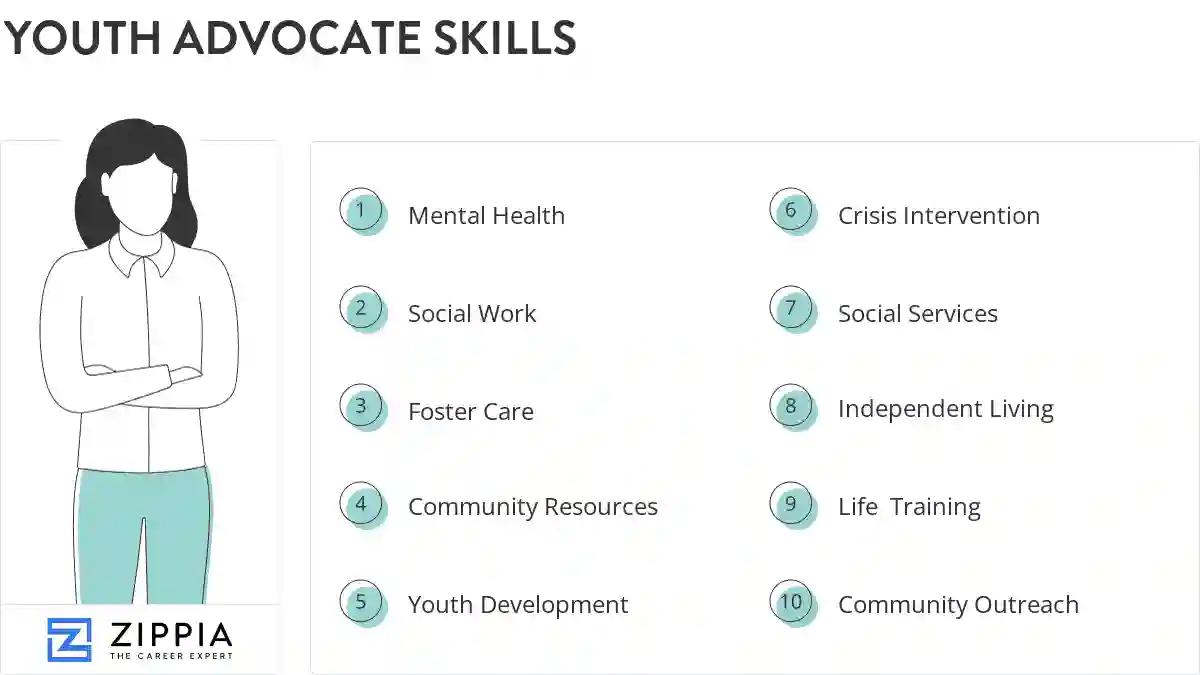
The most important skills for a youth advocate resume and required skills for a youth advocate to have include:
- Mental Health
- Social Work
- Foster Care
- Community Resources
- Youth Development
- Crisis Intervention
- Social Services
- Independent Living
- Life Training
- Community Outreach
- at-Risk Youth
- CPR
- Conflict Resolution
- Community Services
- Incident Reports
- Substance Abuse
- ETO
- Emotional Support
- Support Services
- Role Model
- Direct Care
- Domestic Violence
- Crisis Situations
- Group Sessions
- Homeless Youth
- Medical Care
- Community Organizations
- Anger Management
- School Programming
- Protective Services
- Youth Engagement
- Community Agencies
- Community Events
- Behavioral Issues
- Sexual Assault
- Court Hearings
- Housing Assistance
- Skill Development
- Community Programs
- Court System
- Foster Children
- Mentoring Support
- Medical Appointments
- Social Justice
- Youth Clients
- IEP
- Juvenile Court
- DCFS
Updated January 8, 2025

2. Social Work