What does an accounting instructor do?
Accounting instructor responsibilities
Here are examples of responsibilities from real accounting instructor resumes:
- Utilize blackboard management system to encourage online discussions and manage grades.
- Develop detailed lesson plans to enhance the learning environment for students that incorporate Microsoft PowerPoint and Prezi presentation tools.
- Organize concepts to be teach in a logical and understandable sequence covering all objectives as outlined in the course syllabus.
- Develop syllabus and overall course structure, and administrate all grades
- Identify appropriate techniques for teaching and responding to literature, and ways to effectively use literacy to positively impact diversity education.
- Develop registration processes, monitor educational quality, and provide instruction on CPR as needed.
Accounting instructor skills and personality traits
We calculated that 13% of Accounting Instructors are proficient in PowerPoint, CPA, and Student Learning. They’re also known for soft skills such as Communication skills, Organizational skills, and Interpersonal skills.
We break down the percentage of Accounting Instructors that have these skills listed on their resume here:
- PowerPoint, 13%
Teach students Microsoft Office programs and test them for proficiency in Excel, Word, Outlook and PowerPoint and QuickBooks.
- CPA, 10%
Mentor and advise students on course selection, career path options and CPA exam strategies.
- Student Learning, 9%
Directed student learning, prepare lesson plans and syllabus, create exams and quizzes, and initiate grades of student performance.
- Course Materials, 9%
Prepare course materials and develop adaptive teaching methodologies based on experience to improve the quality of student instruction.
- Teaching Methodologies, 8%
Facilitated class discussions that incorporated a variety of teaching methodologies to capture various learning styles while ensuring maximum content coverage
- Classroom Environment, 6%
Introduced multimedia and online learning technologies into the classroom environment.
Common skills that an accounting instructor uses to do their job include "powerpoint," "cpa," and "student learning." You can find details on the most important accounting instructor responsibilities below.
Communication skills. To carry out their duties, the most important skill for an accounting instructor to have is communication skills. Their role and responsibilities require that "career and technical education teachers must explain concepts in terms that students can understand." Accounting instructors often use communication skills in their day-to-day job, as shown by this real resume: "supported freshman students in principles of accounting and business communication. "
Organizational skills. Many accounting instructor duties rely on organizational skills. "career and technical education teachers must coordinate their time and teaching materials.," so an accounting instructor will need this skill often in their role. This resume example is just one of many ways accounting instructor responsibilities rely on organizational skills: "teach organizational behavior classes to undergrad students in the adult continuing education program. "
The three companies that hire the most accounting instructors are:
- State of Georgia: Teachers Retirement System of Georgia6 accounting instructors jobs
- Daemen College2 accounting instructors jobs
- Bryant & Stratton College2 accounting instructors jobs
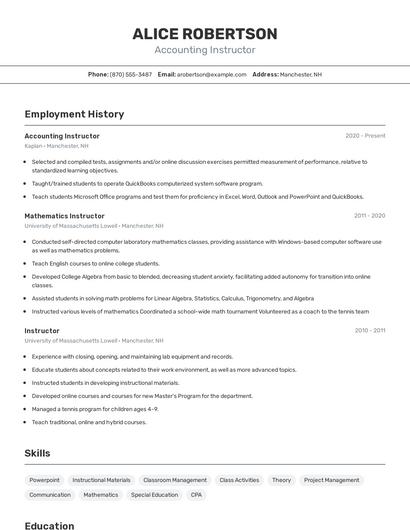
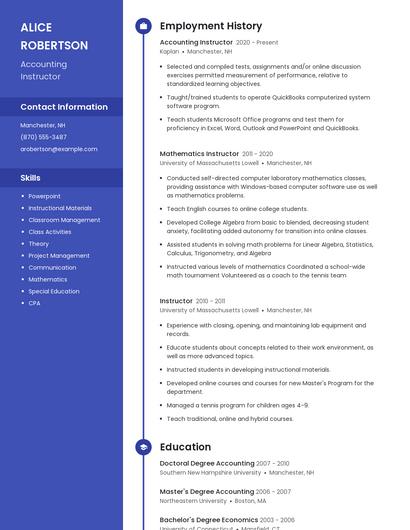
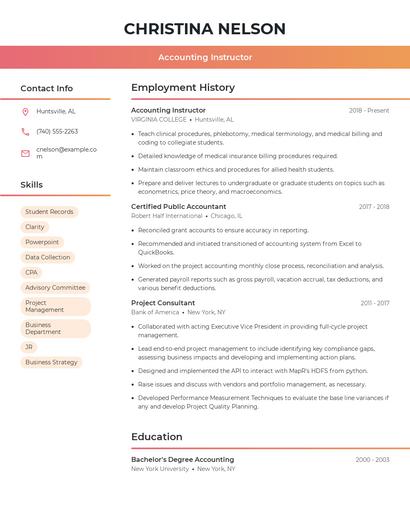
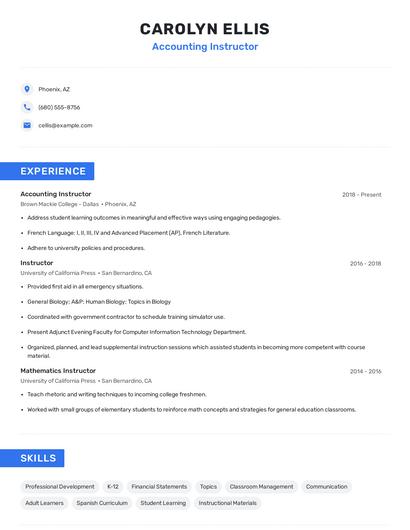
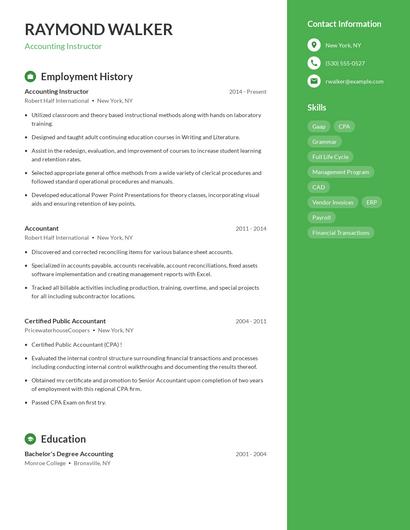
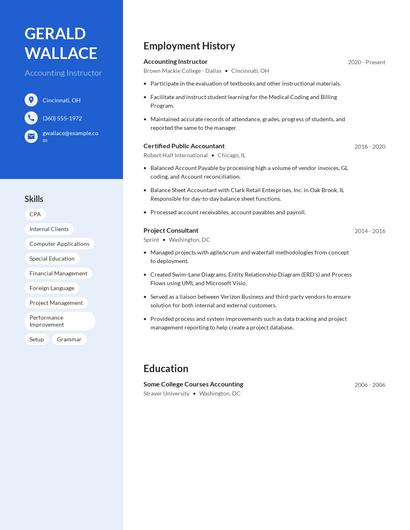
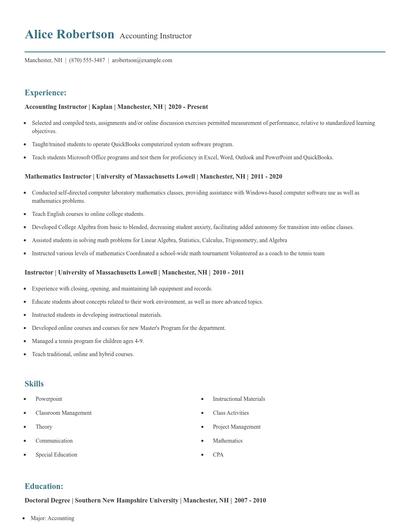
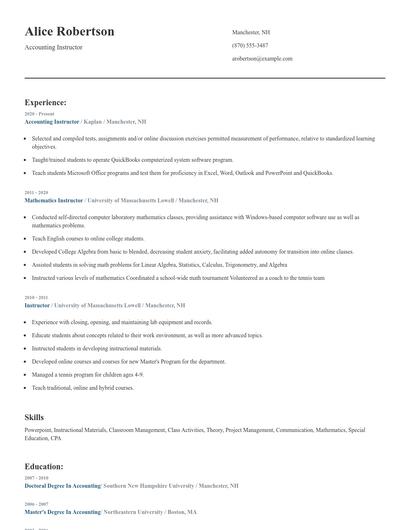
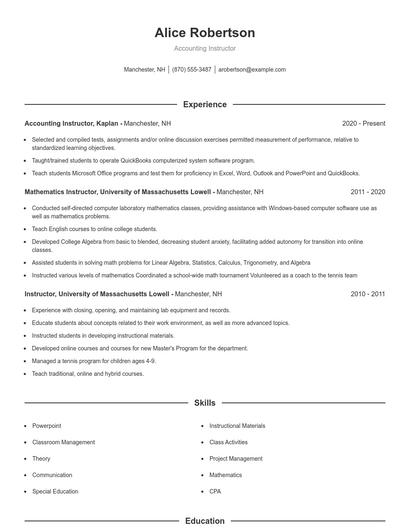
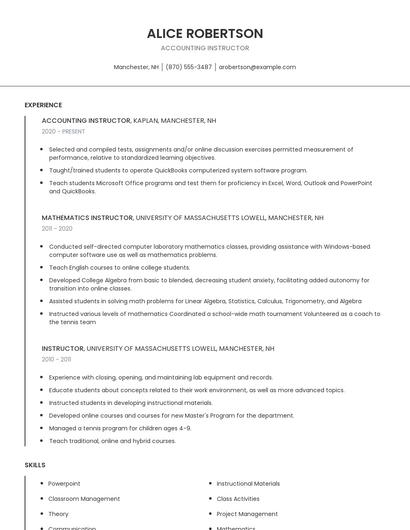
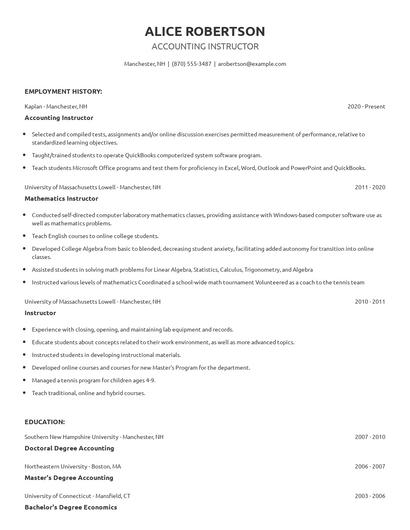
Choose from 10+ customizable accounting instructor resume templates
Build a professional accounting instructor resume in minutes. Our AI resume writing assistant will guide you through every step of the process, and you can choose from 10+ resume templates to create your accounting instructor resume.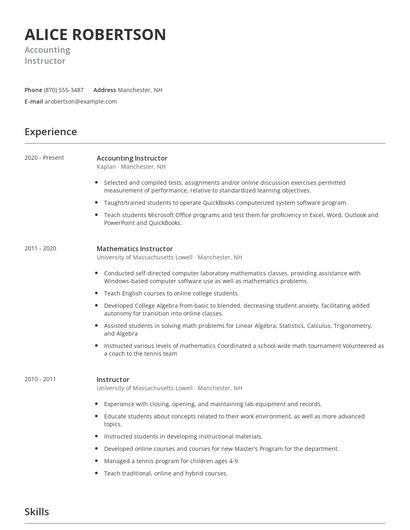
Compare different accounting instructors
Accounting instructor vs. Cooperative education student
A teacher-in-training is a teaching professional who offers technical teaching assistance to teachers in developing effective behavior management and instructional strategies to support student learning. The teacher must collaborate with principals while employing diverse techniques to increase the effectiveness of student learning. By observing classes and then giving feedback to teachers about their teaching style, classroom management, and techniques are some of the responsibilities of a teacher-in-training. The teacher must also develop a wide array of curriculum materials and lesson plans for classroom instruction.
These skill sets are where the common ground ends though. The responsibilities of an accounting instructor are more likely to require skills like "cpa," "course materials," "teaching methodologies," and "classroom environment." On the other hand, a job as a cooperative education student requires skills like "patient care," "co-op," "gpa," and "classroom management." As you can see, what employees do in each career varies considerably.
Cooperative education students tend to reach lower levels of education than accounting instructors. In fact, cooperative education students are 19.9% less likely to graduate with a Master's Degree and 0.4% more likely to have a Doctoral Degree.Accounting instructor vs. Teacher-in-training
Adjunct faculty is the collective term for adjunct professors or lecturers. The adjunct faculty teaches students based on the limited-term of their contract. Oftentimes, they teach preparatory or introductory courses by semester arrangement for the entire academic year. Most of them are employed in higher education. Unlike regular professors, adjunct faculty do not have benefits and are not required to be present in meetings. They can work as either a contract professor or a part-time professor.
While some skills are similar in these professions, other skills aren't so similar. For example, resumes show us that accounting instructor responsibilities requires skills like "cpa," "student learning," "course materials," and "teaching methodologies." But a teacher-in-training might use other skills in their typical duties, such as, "classroom management," "k-12," "staff development," and "student achievement."
On average, teachers-in training earn a lower salary than accounting instructors. Some industries support higher salaries in each profession. Interestingly enough, teachers-in training earn the most pay in the education industry with an average salary of $39,697. Whereas accounting instructors have higher pay in the telecommunication industry, with an average salary of $63,206.In general, teachers-in training achieve lower levels of education than accounting instructors. They're 7.1% less likely to obtain a Master's Degree while being 0.4% more likely to earn a Doctoral Degree.Accounting instructor vs. Adjunct faculty
An adjunct faculty member works in a state university or college. They typically work on a part-time or contractual basis. Although they work in a university, they have limited responsibilities compared to those who work as a regular instructor, but they still need appropriate work etiquette and a love of teaching and working with students. Like any other instructor, they develop learning material, conduct lectures, prepare exams, and assess students' grades.
Some important key differences between the two careers include a few of the skills necessary to fulfill the responsibilities of each. Some examples from accounting instructor resumes include skills like "cpa," "classroom environment," "income tax," and "payroll," whereas an adjunct faculty is more likely to list skills in "philosophy," "course syllabus," "mathematics," and "social work. "
Adjunct faculties make a very good living in the government industry with an average annual salary of $115,189. On the other hand, accounting instructors are paid the highest salary in the telecommunication industry, with average annual pay of $63,206.adjunct faculties typically earn similar educational levels compared to accounting instructors. Specifically, they're 2.4% more likely to graduate with a Master's Degree, and 7.5% more likely to earn a Doctoral Degree.Accounting instructor vs. Instructor, adjunct faculty
Even though a few skill sets overlap between accounting instructors and instructors, adjunct faculty, there are some differences that are important to note. For one, an accounting instructor might have more use for skills like "cpa," "classroom environment," "income tax," and "taxation." Meanwhile, some responsibilities of instructors, adjunct faculty require skills like "course syllabus," "learning outcomes," "mathematics," and "instructional strategies. "
In general, instructors, adjunct faculty earn the most working in the education industry, with an average salary of $54,888. The highest-paying industry for an accounting instructor is the telecommunication industry.In general, instructors, adjunct faculty hold similar degree levels compared to accounting instructors. Instructors, adjunct faculty are 0.3% less likely to earn their Master's Degree and 4.3% more likely to graduate with a Doctoral Degree.Types of accounting instructor
Updated January 8, 2025
