Find a Job You Really Want In
Research Summary: In today’s digital landscape, the exposure of personal data is a growing concern. Cybercriminals exploit vulnerabilities from data breaches to steal money, identities, and sensitive information. Data breaches remain one of the most significant security challenges in the U.S. and worldwide.
So, how costly are data breaches in 2026? Our comprehensive analysis reveals the following key statistics:
-
In 2025, there were 4,134 publicly disclosed data breaches globally.
-
In 2025, 1,732 data compromises occurred in the U.S.
-
The average cost of a data breach in the U.S. reached $4.35 million.
-
On average, it takes 287 days to identify and contain a major data breach.
-
45% of U.S. companies have reported experiencing a data breach.
-
80% of data breaches are attributable to human error.
-
Data breaches in the healthcare sector account for 30% of the total breaches.
For deeper insights, explore our breakdowns below:
Victim and Response | Cost | Trends | Healthcare
General Data Breach Statistics
Data breaches affect millions annually, exposing billions of records. Here are some insightful statistics from our research:
-
A new data breach or cyber attack occurs every 11 seconds.
In the few minutes it takes you to read this article, there could be over 27-55 cyber attacks happening globally.
-
The Yahoo! data breach remains the largest in history, exposing over 3 billion user accounts.
Beginning in 2013, this breach impacted nearly 42% of the global population.
-
Total cybercrime costs reached $6 trillion in 2021.
This figure positions cybercrime as the third-largest economy globally, projected to grow to $10.5 trillion by 2025.
Data Breach Victim and Response Statistics
Data breaches jeopardize both personal and business information, complicating recovery efforts. Our research indicates:
-
28% of data breach victims are small businesses.
Struggling to stay afloat, over a quarter of those affected are small businesses, with 60% closing within six months post-breach.
-
Organized crime accounts for up to 85% of data breaches.
Common tactics include phishing, hacking, and deploying malware, all of which pose serious threats to inadequately protected companies.
-
Identifying and containing a major data breach takes an average of 287 days.
This includes an average of 212 days to identify the breach and approximately 75 days to contain it, during which time sensitive data can be compromised.
-
80% of breaches stem from poor or reused passwords.
Using the same passwords across multiple accounts can jeopardize security, especially if any of those sites have previously been breached.
-
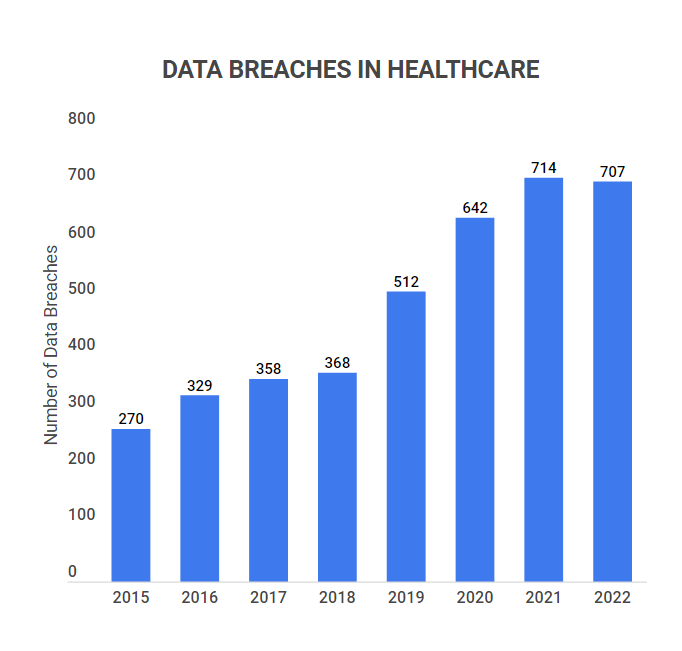
Healthcare data breaches have surged by 164% from 2015-2021.
From 270 breaches in 2015 to 714 in 2021, healthcare data breaches have been consistently rising.
The Cost of Data Breaches Statistics
Data breaches incur significant costs to consumers, small businesses, large corporations, and governments. Our research highlights:
-
Company sale prices typically drop by an average of -3.5% following a data breach.
Out of 40 data security breaches analyzed, 21 resulted in decreased stock performance, explaining why businesses may struggle after a breach.
-
The average cost per record in a data breach is $210.
For healthcare breaches, this cost rises to $429 per record. For a breach involving over a million records, companies could face losses exceeding $210 million.
-
The average cost of a data breach is currently $4.35 million.
This figure marks a 12.7% increase since 2020, reflecting the rising costs associated with remote work and increased digital operations.
Trends In Data Breach Statistics
As technology becomes more ingrained in our lives, data breaches continue to escalate. Key trends include:
-
2016 was particularly devastating, with 2.54 billion individuals affected by data breaches.
This period saw the number of affected individuals surpassing 1 billion each year from 2016-2018.
-
471.23 million records were exposed in 2018.
This level of exposure resulted in nearly $100 billion in losses for companies that year.
-
1,862 data breaches occurred in 2021.
This represents a significant 137% increase from 2015, despite individual breaches being smaller in scale.
Annual Data Compromises In The U.S.
Year Data compromises Number of records exposed (millions) Individuals impacted (millions) 2015 785 169.1 318.28 2016 1,099 36.6 2,540 2017 1,506 198 1,820 2018 1,175 471.23 2,230 2019 1,279 164.68 883.56 2020 1,108 N/A 310.12 2021 1,862 N/A 298.08 2022 1,802 N/A 422.14
Healthcare Data Breach Statistics
The healthcare industry remains a prime target for data breaches, leading to significant exposure of sensitive information. Consider these statistics:
-
Over the past decade, there have been 4,202 large healthcare data breaches.
-
In 2021 alone, healthcare breaches compromised 45.67 million patient records.
-
The average cost per record of a data breach in healthcare is $429.
-
On average, at least one patient record is breached every day.
-
80% of data breaches result from human error.
-
Healthcare data breaches constitute 30% of total breaches.
Data Compromises In Healthcare
Year Data compromises 2015 270 2016 329 2017 358 2018 368 2019 512 2020 642 2021 714
Data Breach Statistics FAQ
-
How many people experience data breaches?
Anywhere from a few hundred million to over a billion individuals are affected by data breaches annually. In 2021, 212.4 million U.S. users were impacted, and this number is relatively low in comparison to global figures.
For instance, in 2016, 2.54 billion people faced data breaches worldwide.
-
How many data breaches happen every day?
Approximately 20 data breaches occur daily. This includes breaches in the healthcare sector, where at least one data breach happens each day, totaling over 4,000 breaches yearly.
-
What is the most common cause of data breaches?
The leading cause of data breaches is weak and stolen credentials. In fact, 80% of breaches arise from poor or reused passwords.
Other prevalent causes include:
-
Application vulnerabilities
-
Malware
-
Malicious insiders
-
Insider error
-
Conclusion
In a technology-driven world, data breaches are increasingly frequent and costly. Approximately 45% of companies in the U.S. have experienced a data breach.
With the average cost of a data breach exceeding $4 million and each exposed record averaging $210, the implications are profound. The most effective way to safeguard your data is to engage with trustworthy companies and use unique, secure passwords across all accounts. Given that 80% of breaches are due to poor password practices, taking these steps will significantly enhance your security.
References
-
Security. “Over 22 billion records exposed in 2021.” Accessed on August 10th, 2022.
-
TechRepublic. “Average cost of data breach surpasses $4 million for many organizations.” Accessed on August 10th, 2022.
-
GRC. “Human Error is Responsible for 80% of Data Breaches.” Accessed on August 10th, 2022.
-
Infima. “Every 11 Seconds.” Accessed on August 10th, 2022.
-
DataProt. “10 of the Biggest Data Breaches in History.” Accessed on August 10th, 2022.
-
Cybercrime Magazine. “Cybercrime To Cost The World $10.5 Trillion Annually By 2025.” Accessed on August 10th, 2022.
-
Cybercrime Magazine. “60 Percent Of Small Companies Close Within 6 Months Of Being Hacked.” Accessed on August 10th, 2022.
-
OCCRP. “US Telecom Giant: Most Data Breaches are the Work of Organized Crime.” Accessed on August 10th, 2022.
-
Comparitech. “How data breaches affect stock market share prices.” Accessed on August 10th, 2022.
-
CyLumena. “Cost Of A Data Breach In 2020: 7 Hidden Soft-Costs.” Accessed on August 10th, 2022.
-
CRN. “LogMeIn: Poor or Reused Passwords Responsible for 80 Percent of Breaches.” Accessed on August 10th, 2022.
-
IBM. “How much does a data breach cost in 2022?” Accessed on August 10th, 2022.
-
Statista. “Annual number of data compromises and individuals impacted in the United States from 2005 to first half 2022.” Accessed on August 10th, 2022.
-
HIPAA Journal. “Healthcare Data Breach Statistics.” Accessed on August 10th, 2022.
-
Media. “Breaches exposed 45.67M patient records in 2021, largest annual total since 2015.” Accessed on August 10th, 2022.
-
Statista. “Annual number of data compromises and individuals impacted in the United States from 2005 to 2022.” Accessed on February 13, 2023.
-
Statista. “Average cost of a data breach in the United States from 2006 to 2022.” Accessed on February 13, 2023.

Author

Jack Flynn is a writer for Zippia. In his professional career he’s written over 100 research papers, articles and blog posts. Some of his most popular published works include his writing about economic terms and research into job classifications. Jack received his BS from Hampshire College.