- Facts and Figures
- Social Security Statistics
- Social Media Statistics
- Cell Phone Usage Statistics
- Cryptocurrency Statistics
- White Collar Crime Statistics
- Crowdfunding Statistics
- Branding Statistics
- How Many Emails Are Sent Per Day
- Money Laundering Statistics
- Childcare Availability Statistics
- Cold Calling Statistics
- Automation And Job Loss Statistics
- Student Loan Statistics
- Spam Statistics
- Password Statistics
- Ransomware Statistics
- Christmas Spending Statistics
- Average Grocery Cost By State
- Average Screen Time Statistics
- Average Monthly Expenses
- IoT Statistics
- Gen Z Statistics
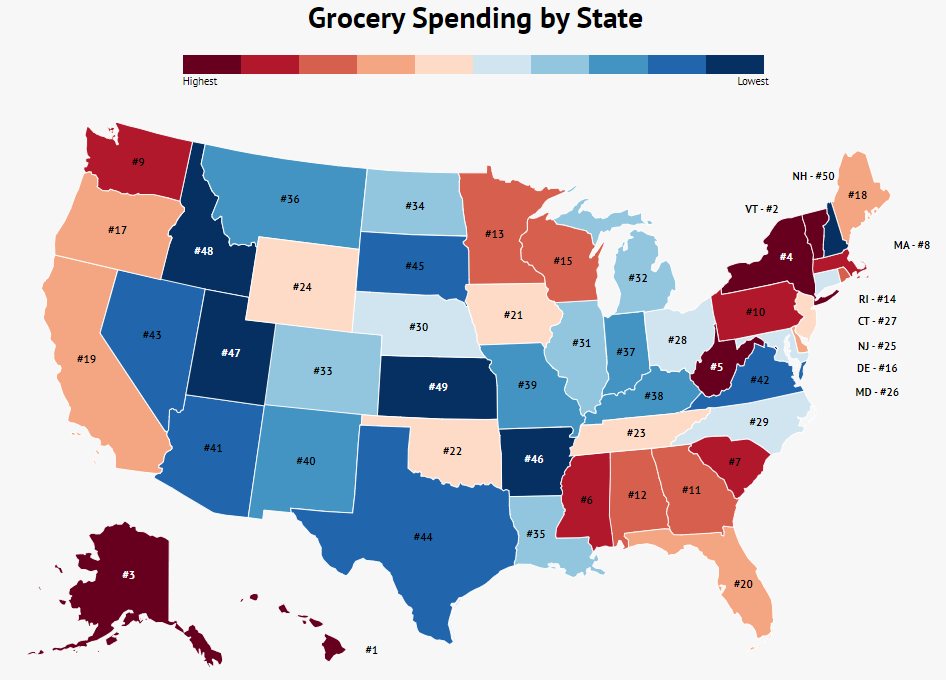
Research Summary: If you’re not living off the grid with your own garden, you’ve likely felt the impact of rising food costs. Prices for staples have soared, with grocery bills climbing significantly in recent years. It’s clear that food expenses are a growing concern for many households across the United States.
The cost of groceries varies widely by state, with some locations offering more affordable options than others. In this analysis, we delve into the average grocery costs across different states, revealing surprising insights.
Your Salary Should Rise Faster Than Grocery Prices
Zippia+ is an AI-powered career map that helps you plan your future career.
We examined the average grocery costs in each state, and the findings may surprise you. Here’s what our research uncovered:
| Rank | State | City analyzed (population) | Average monthly cost of groceries per person |
|---|---|---|---|
| 1 | Hawaii | Honolulu (337,200) | $556.76 |
| 2 | Vermont | Burlington (42,400) | $497.41 |
| 3 | Alaska | Anchorage (291,800) | $483.24 |
| 4 | New York | New York City (8.17M) | $482.87 |
| 5 | West Virginia | Charleston (51,400) | $427.19 |
| 6 | Mississippi | Jackson (173,500) | $423.33 |
| 7 | South Carolina | Charleston (136,200) | $411.29 |
| 8 | Massachusetts | Boston (617,600) | $406.21 |
| 9 | Washington | Seattle (608,600) | $402.08 |
| 10 | Pennsylvania | Philadelphia (1.52M) | $401.02 |
| 11 | Georgia | Atlanta (420,000) | $397.97 |
| 12 | Alabama | Birmingham (212,200) | $397.39 |
| 13 | Minnesota | Minneapolis (382,600) | $395.39 |
| 14 | Rhode Island | Providence (178,000) | $390.19 |
| 15 | Wisconsin | Milwaukee (594,800) | $385.97 |
| 16 | Delaware | Wilmington (70,800) | $380.39 |
| 17 | Oregon | Portland (583,800) | $375.41 |
| 18 | Maine | Portland (66,200) | $372.21 |
| 19 | California | Los Angeles (4.79M) | $370.96 |
| 20 | Florida | Jacksonville (880,600) | $364.25 |
| 21 | Iowa | Des Moines (215,500) | $347.05 |
| 22 | Oklahoma | Oklahoma City (580,000) | $346.37 |
| 23 | Tennessee | Nashville (660,400) | $346.37 |
| 24 | Wyoming | Cheyenne (59,400) | $345.62 |
| 25 | New Jersey | Newark (277,100) | $343.67 |
| 26 | Maryland | Baltimore (620,900) | $343.67 |
| 27 | Connecticut | Bridgeport (144,200) | $343.30 |
| 28 | Ohio | Columbus (879,200) | $341.48 |
| 29 | North Carolina | Charlotte (731,400) | $341.10 |
| 30 | Nebraska | Omaha (408,900) | $336.90 |
| 31 | Illinois | Chicago (2.69M) | $327.31 |
| 32 | Michigan | Detroit (713,800) | $327.12 |
| 33 | Colorado | Denver (600,100) | $326.92 |
| 34 | North Dakota | Fargo (105,500) | $326.66 |
| 35 | Louisiana | New Orleans (343,800) | $325.19 |
| 36 | Montana | Billings (104,100) | $323.91 |
| 37 | Indiana | Indianapolis (820,400) | $318.03 |
| 38 | Kentucky | Louisville (597,300) | $315.20 |
| 39 | Missouri | Kansas City (459,800) | $312.63 |
| 40 | New Mexico | Albuquerque (545,800) | $307.79 |
| 41 | Arizona | Phoenix (1.44M) | $302.80 |
| 42 | Virginia | Virginia Beach (438,000) | $298.01 |
| 43 | Nevada | Las Vegas (583,700) | $293.43 |
| 44 | Texas | Houston (2.10M) | $286.64 |
| 45 | South Dakota | Sioux Falls (153,900) | $286.23 |
| 46 | Arkansas | Little Rock (193,500) | $282.46 |
| 47 | Utah | Salt Lake City (186,400) | $282.23 |
| 48 | Idaho | Boise (205,700) | $281.12 |
| 49 | Kansas | Wichita (382,400) | $261.35 |
| 50 | New Hampshire | Manchester (109,500) | $183.00 |
For further analysis, we broke down the data in the following ways:
Most Expensive | Cheapest
The Top 10 States With The Most Expensive Groceries
The state with the highest grocery costs in the US is Hawaii. This is largely due to the fact that Hawaii imports a significant portion of its food from distant locations, which drives up prices. Alaska follows a similar trend.
For a detailed breakdown of average costs in the most expensive states, see below:
| State | Avg. monthly cost of groceries | Avg. cost of milk | Avg. cost of bread | Avg. cost of eggs |
|---|---|---|---|---|
| Hawaii | $556.76 | $7.08 | $5.62 | $5.92 |
| Vermont | $497.41 | $4.06 | $3.25 | $3.40 |
| Alaska | $483.24 | $4.26 | $4.39 | $4.29 |
| New York | $482.87 | $4.76 | $3.87 | $4.64 |
| West Virginia | $427.19 | $3.69 | $1.99 | $3.00 |
| Mississippi | $423.33 | $3.40 | $2.41 | $4.00 |
| South Carolina | $411.29 | $3.09 | $2.59 | $4.00 |
| Massachusetts | $406.21 | $4.20 | $3.61 | $4.26 |
| Washington | $402.08 | $4.31 | $3.82 | $3.71 |
| Pennsylvania | $401.02 | $4.66 | $3.28 | $4.02 |
The Top 10 States With The Cheapest Groceries
The state offering the most affordable groceries in the US is New Hampshire. This affordability may be linked to local shopping preferences, with many residents opting for budget-friendly stores like Market Basket.
Here are the average costs of staple foods in the cheapest states:
| State | Avg. monthly cost of groceries | Avg. cost of milk | Avg. cost of bread | Avg. cost of eggs |
|---|---|---|---|---|
| New Hampshire | $183.00 | $3.30 | $2.44 | $2.90 |
| Kansas | $261.35 | $3.08 | $2.45 | $3.50 |
| Idaho | $293.43 | $3.12 | $2.77 | $3.99 |
| Utah | $282.23 | $3.52 | $3.02 | $4.47 |
| Arkansas | $282.46 | $3.95 | $3.03 | $3.56 |
| South Dakota | $286.23 | $3.69 | $2.85 | $3.98 |
| Texas | $286.64 | $3.57 | $2.82 | $3.59 |
| Nevada | $293.43 | $3.86 | $3.17 | $4.51 |
| Virginia | $298.01 | $3.74 | $3.13 | $3.83 |
| Arizona | $302.80 | $3.22 | $2.91 | $4.50 |
Cost of Groceries By State FAQ
-
How much should a two-person household spend on groceries?
The average two-person household can expect to spend between $510-$820 per month on groceries. The average moderate cost between these two figures is around $655 per month. Here’s a weekly breakdown:
-
Thrifty: $119.40 per week
-
Low-cost: $122.90 per week
-
Moderate-cost: $152.30 per week
-
Liberal: $190.10 per week
These numbers will vary based on your state and city, as costs in Hawaii are significantly higher than those in Idaho.
-
-
What is a good daily food budget?
A good daily food budget is typically 10%-15% of take-home pay. For instance, if you earn an average of $200 per day, aim to spend no more than $20-$30 on food that day. On a weekly basis, making approximately $1,000 would mean spending no more than $100-$150 on groceries with this guideline.
-
How can I cut my grocery bill?
There are several effective strategies to reduce your grocery expenses. Here are ten tips to help you save:
-
Shop at discount grocery stores (e.g., Aldi or Trader Joe’s)
-
Utilize supermarket websites to compare prices
-
Create a weekly meal plan to only buy what you need
-
Stick to your grocery list to avoid impulse buys
-
Utilize leftovers instead of cooking new meals
-
Use coupons and search for discount codes
-
Buy in bulk for better prices
-
Opt for store brands
-
Make your own sauces and spice mixes at home
-
Grow your own vegetables and herbs
-
-
Is buying groceries cheaper than eating out?
Yes, purchasing groceries is generally more economical than dining out. On average, a meal prepared at home costs about $4 per person, compared to around $13 per person at a restaurant. For a family of four dining out every night would cost approximately $1,600 per month, whereas cooking at home could bring that down to just under $500.
Moreover, home-cooked meals often provide better nutrition, which can lead to long-term health savings.
Conclusion
In recent years, the landscape of grocery prices has changed dramatically due to various factors, including supply chain disruptions and inflation. As of 2026, Americans can expect to spend over $556 per person on groceries in Hawaii, with costs exceeding $400 in several of the most expensive states. While states like Hawaii and Alaska face high costs due to import reliance, other regions have their own unique challenges contributing to elevated prices.
Fortunately, some states still offer reasonable grocery prices. For example, New Hampshire boasts an average grocery cost of just $183, with Virginia, Nevada, Texas, South Dakota, Arkansas, Utah, Idaho, and Kansas all averaging under $300.
To manage your grocery expenses effectively, it’s essential to budget and plan meals accordingly. Implementing these strategies can potentially save you hundreds of dollars each month.
- Facts and Figures
- Social Security Statistics
- Social Media Statistics
- Cell Phone Usage Statistics
- Cryptocurrency Statistics
- White Collar Crime Statistics
- Crowdfunding Statistics
- Branding Statistics
- How Many Emails Are Sent Per Day
- Money Laundering Statistics
- Childcare Availability Statistics
- Cold Calling Statistics
- Automation And Job Loss Statistics
- Student Loan Statistics
- Spam Statistics
- Password Statistics
- Ransomware Statistics
- Christmas Spending Statistics
- Average Grocery Cost By State
- Average Screen Time Statistics
- Average Monthly Expenses
- IoT Statistics
- Gen Z Statistics

Author

Jack Flynn is a writer for Zippia. In his professional career he’s written over 100 research papers, articles and blog posts. Some of his most popular published works include his writing about economic terms and research into job classifications. Jack received his BS from Hampshire College.