- Quality Of Life At Work Statistics
Research Summary: In the ever-evolving landscape of work, whether you’re a remote employee, a gig worker, or a corporate leader, burnout remains a pervasive issue. The stress and lack of motivation stemming from burnout can have severe implications for both individuals and organizations.
How serious is the situation? To shed light on this pressing concern, we’ve compiled a range of insightful statistics and trends regarding burnout. Our research indicates:
-
89% of workers have reported experiencing burnout in the past year.
-
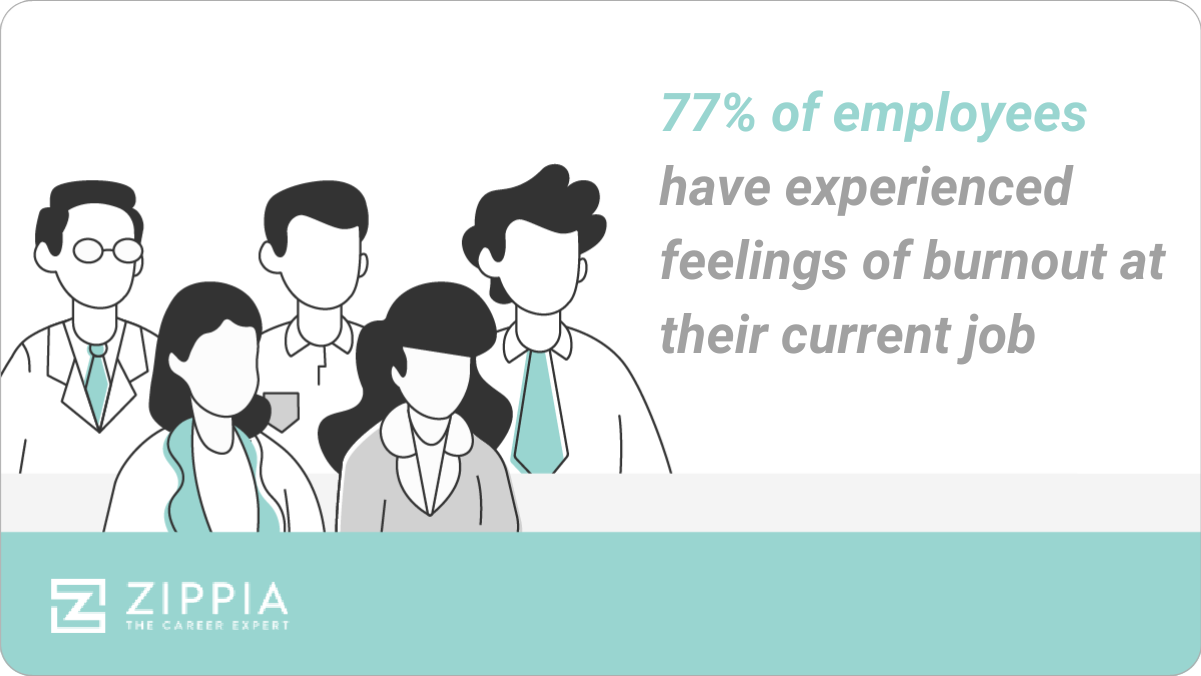
77% of employees feel burned out at their current job.
-
21% of workers state that their company lacks programs to address burnout.
-
By 2030, it is projected that 37% of Americans will be working remotely.
-
The burnout rate was 59% in 2022, an increase of 13.5% from 2021.
For deeper insights, we’ve categorized the data into the following sections:
Employer Burnout Response | Workplace Stress | Demographics | Remote Work Challenges
Employer Burnout Response
Many employers’ responses to increased burnout rates have exacerbated the issue. A significant number of employees feel unsupported, and our research reveals:
-
70% of professionals believe employers are not adequately addressing burnout.
While long hours and understaffing contribute to burnout, 21% of workers also report lacking access to programs designed to mitigate burnout.
-
Employees who feel unsupported are 70% more likely to experience burnout.
The situation worsens for those who perceive unfair treatment; such employees are 2.3 times more likely to suffer from burnout.
-
40% of workers have resigned due to burnout.
Burnout stands as the primary reason for employee turnover in the US, driving the popularity of remote work, with 24% of employees believing that flexibility and a better work-life balance can help prevent burnout.
-
Workplace stress costs the US economy approximately $300 billion annually.
This figure encompasses costs related to absenteeism, decreased productivity, and accidents, which collectively contribute to annual healthcare costs of $190 billion.
Workplace Stress Statistics
Burnout incurs substantial costs, but what are the real-life impacts of workplace stress? Here are some key findings:
-
67% of workers report that stress and burnout at work have increased in recent years.
Only 13% believe the situation has improved, as there was a 21% increase in reported burnout from December 2020 to July 2021.
-
83% of Americans face work-related stress.
Notably, 40% categorize their job as “extremely stressful,” and 25% identify it as their top stressor.
-
Three in five employees report adverse effects from work-related stress.
This prevalence raises concerns, considering that many employees experience both physical and mental health issues.
-
44% of employees face physical fatigue due to work-related stress.
Physical fatigue is the most common symptom, alongside cognitive weariness (36%), emotional exhaustion (32%), lack of interest, motivation, or energy (26%), and reduced effort at work (19%).
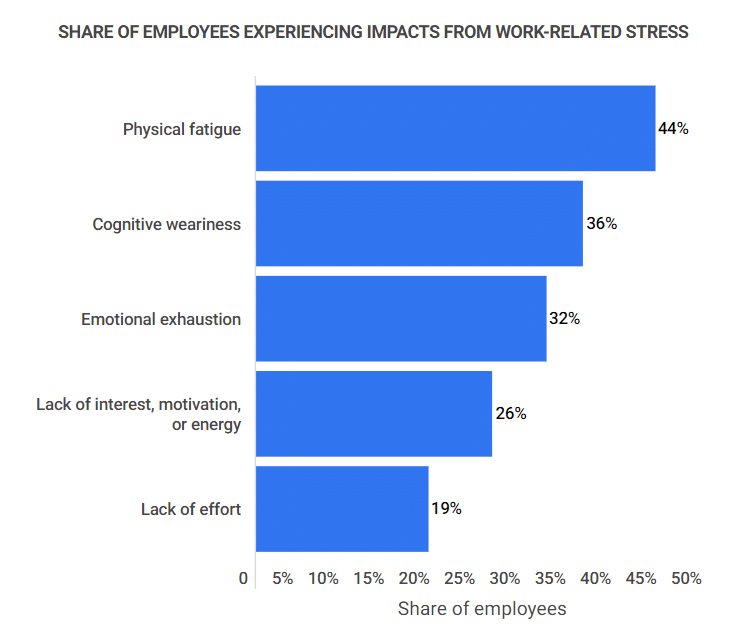
Impacts of Work-Related Stress Share of Employees Physical Fatigue 44% Cognitive Weariness 36% Emotional Exhaustion 32% Lack of Interest, Motivation, or Energy 26% Lack of Effort at Work 19% -
79% of workers have experienced work-related stress in the past month.
A staggering 57% of US workers report feeling work-related stress on a daily basis.
Workplace Burnout by Demographics
Workplace stress disproportionately impacts certain demographics, influenced by various factors including job roles. Here are some significant insights:
-
59% of Millennial workers report feeling burnt out at work.
Millennials experience the highest burnout rates among all generations, particularly in management roles, where 42% report burnout, followed by Gen Z (34%), Gen X (27%), and Baby Boomers (21%).
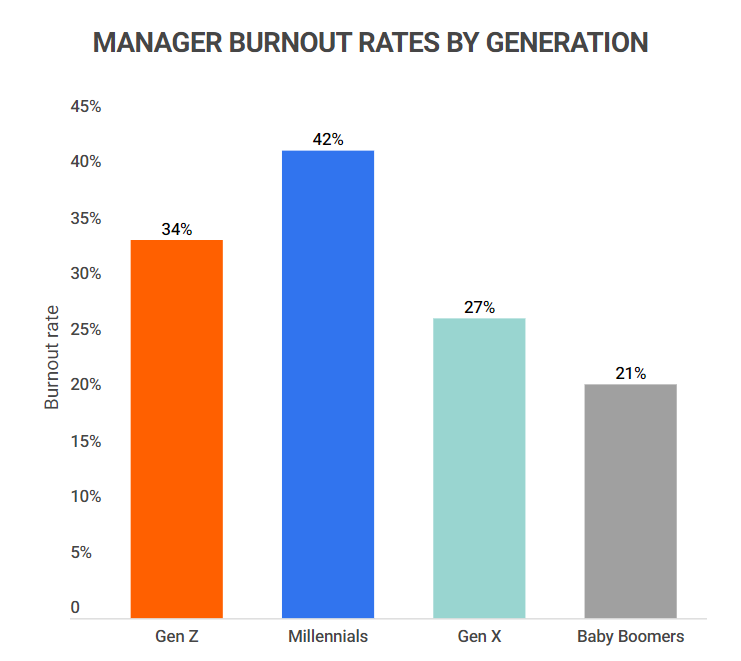
Generation Share of Managers Who Feel Burnt Out Gen Z 34% Millennials 42% Gen X 27% Baby Boomers 21% -
74% of women report experiencing work-related stress.
This is compared to 61% of men, indicating that women are over 21% more likely to experience stress in the workplace.
-
48.5% of White American workers report feeling burnt out.
In comparison, 45.3% of Hispanic and Latino workers and 41.7% of Black Americans also report burnout.
Remote Burnout Statistics
Although remote work offers flexibility, it does not exempt workers from burnout. In fact, remote work introduces unique challenges. Here’s what our research revealed:
-
86% of full-time remote workers have experienced burnout.
While many argue remote work provides better work-life balance, this is often not the case, as remote workers frequently struggle to know when to disconnect.
-
76% of remote workers say workplace stress impacts their mental health.
This figure is slightly higher than the 73% reported across the entire US workforce.
-
48% of remote workers feel a lack of emotional support from their employers.
This situation often stems from insufficient interaction between managers and staff and a lack of accessible mental health resources.
-
40% of remote workers cite difficulty unplugging from work as their biggest challenge.
Unlike in-office work, where it’s easier to leave work behind, remote environments blur these boundaries, increasing burnout rates.
Burnout Statistics FAQ
-
What percentage of people suffer from burnout?
89% of Americans have experienced burnout in the past year. Symptoms may include:
-
Physical fatigue (44% of respondents)
-
Cognitive weariness (36%)
-
Emotional exhaustion (32%)
-
Lack of interest, motivation, or energy (26%)
-
Lack of effort at work (19%)
-
-
An excessive workload is the leading cause of burnout, but several other factors contribute as well. Some of these include:
-
Workload. Many professionals, especially in high-demand fields like healthcare, experience burnout due to excessive workloads, often exacerbated by understaffing or poor management.
-
Lack of control. Employees who feel they lack agency over their work or are constantly contacted after hours may experience significantly higher levels of burnout.
-
Lack of support. A staggering 91% of employees feel their managers do not communicate effectively, leading to feelings of isolation and burnout.
-
Lack of resources. Many workers (21%) report their companies do not provide effective burnout prevention programs, and many more view existing programs as inadequate.
-
-
What job has the highest burnout rate?
Physicians exhibit the highest burnout rate, with 62.8% reporting symptoms. Other high-burnout professions include:
-
Retail and Fast Food
-
Emergency Response
-
Certified Public Accountants (CPAs)
-
What job has the lowest burnout rate?
Geoscientists have the lowest burnout rate, reported as low as 29%. Other professions with low burnout rates include:
-
Jewelry Making
-
Hairstyling
Conclusion
Burnout continues to affect a staggering 89% of American workers in the past year. Consequently, the implications are profound, with 44% of employees suffering from physical fatigue and 32% experiencing cognitive exhaustion due to workplace stress.
Millennials are particularly susceptible, being twice as likely to experience burnout compared to Baby Boomers, while women are 21% more likely to face this issue than men.
Moreover, the rise of remote work has not alleviated burnout, with remote employees experiencing stress levels comparable to their in-office counterparts. Employers must prioritize mental health support, fostering open communication and providing effective programs to combat burnout.
References
-
Deloitte – Workplace Burnout Survey
-
Indeed – Employee Burnout Report: COVID-19’s Impact and 3 Strategies to Curb It
-
Inc. – Why Are People Really Quitting Their Jobs? Burnout Tops the List, New Research Shows
-
AIS – Workplace Stress
-
CNBC – Millennial managers are more burned out than any other generation
-
GDC – Why women are more burned out than men
-
eClinicalMedicine – Prevalence and correlates of stress and burnout among U.S. healthcare workers during the COVID-19 pandemic: A national cross-sectional survey study
-
Zippia – 25 Crucial Remote Work Burnout Statistics [2022]: How to Recognize and Avoid Workplace Stress
-
Insight – Remote workers struggle most to switch off from work
- Quality Of Life At Work Statistics

Author

Jack Flynn is a writer for Zippia. In his professional career he’s written over 100 research papers, articles and blog posts. Some of his most popular published works include his writing about economic terms and research into job classifications. Jack received his BS from Hampshire College.