- HR Statistics
- Average Labor Cost Percent Of Sales
- Average Time to Reach Profitability At A Startup
- Office Space Per Employee
- Recruitment Statistics
- Employee Engagement Statistics
- Work-Life Balance Statistics
- BYOD Statistics
- Paternity Leave Statistics
- Onboarding Statistics
- Average Paid Maternity Leave In Us
- Average Cost Of A Bad Hire
- Employee Theft Statistics
- Paid Family Leave Statistics
- Cost Of Hiring Statistics
- Employee Turnover Statistics
- Average Cost Of Employer Sponsored Health Insurance Statistics
- Sexual Harassment In The Workplace Statistics
- HR Statistics
- PTO Statistics
- Social Media Recruitment Statistics
- Hiring Statistics
- Out Of Prison Employment Statistics
23 Recruitment Statistics [2026]: Insights for HR Professionals and Hiring Managers
Research Summary. In today’s competitive job market, understanding recruitment trends has never been more important. With a plethora of job search platforms and social networking sites, many job seekers remain passive, presenting a prime opportunity for recruiters. Our updated research reveals:
-
73% of potential candidates are passive job seekers who are currently employed and open to exploring new job opportunities but are hesitant to apply.
-
94% of hiring professionals using Applicant Tracking Systems (ATS) report that these tools have significantly enhanced their hiring processes.
-
The average job vacancy costs a company $98 per day.
-
It takes an average of 42 days to fill a position.
-
60% of candidates abandon their online job applications due to complicated or lengthy forms.
-
Top candidates are typically on the job market for only ten days, on average.
For further insights, we categorized the data in various ways:
Recruitment Strategies | Job Seekers | Trends + Projections | Recruitment Challenges

General Recruitment Statistics
Understanding that a large portion of candidates are passive job seekers is crucial for effective recruitment. Here are some insights from our research:
-
73% of potential candidates are passive job seekers.
Additionally, a significant 87% of these candidates are receptive to new job opportunities presented through active recruitment.
-
The average job vacancy lasts 42 days.
While the typical job listing remains active for only 30 days, this prolonged vacancy results in an average loss of $4,129.
-
Only half of employers utilize ATS (Applicant Tracking Software).
However, among those leveraging ATS, at least 78% find that it significantly streamlines their hiring process.
Recruitment Statistics by Strategy
Recruiters are adopting various strategies to remain competitive in attracting candidates. Given that 73% of candidates are passive job seekers, here’s how they are tapping into this potential:
-
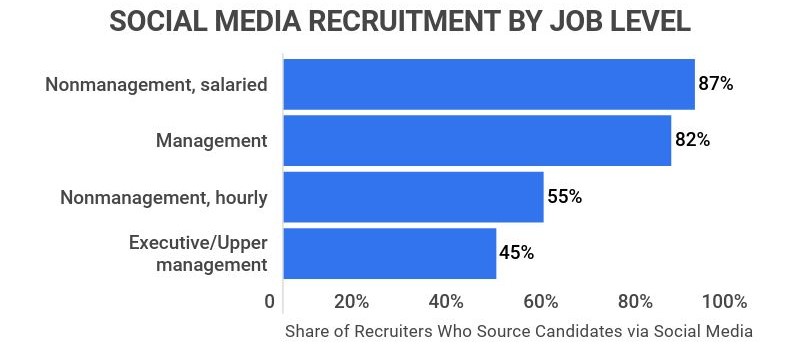
84% of companies recruit through social media.
The average recruitment through social media includes 87% non-management salaried employees, 82% management roles, 55% non-management hourly employees, and only 45% executive or upper management positions.
-
70% of job seekers expect to learn about salary ranges in initial recruiter communications.
Being transparent about salary is crucial, especially since 67% of job seekers cite compensation as their primary motivator.
-
88% of companies report that their best hires come from referrals.
Referrals are highly effective; candidates are 46% more likely to respond positively to InMails if referred by current employees. Notably, 65% of contingent workers found jobs through referrals.
-
Strong employer branding reduces recruiting costs by 43%.
Moreover, it decreases turnover rates by 28%, as nearly 50% of workers are deterred from joining companies with a negative reputation.
-
39% of companies using contingent workers rely on direct sourcing for recruitment.
The interest in direct sourcing is rising, with 23% of companies planning to implement it, as it can accelerate the hiring process and lower costs by up to 30%.
-
Recruiting through employee networks can increase talent pool size by 10x.
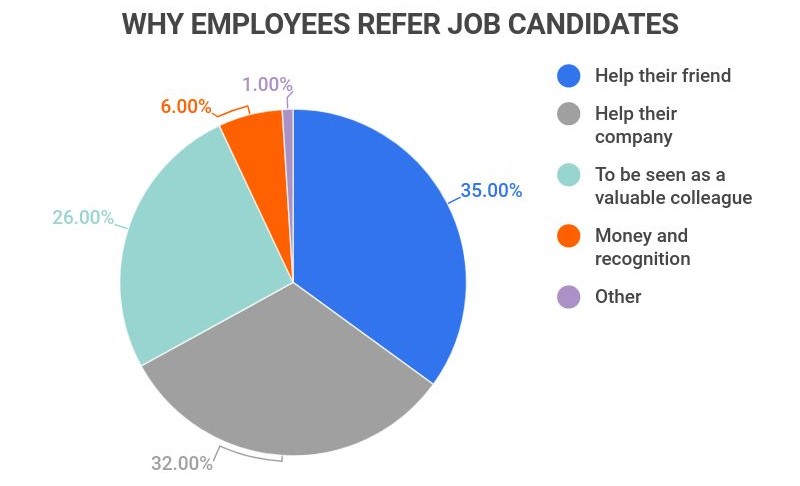
Most employees are willing to refer candidates voluntarily, with 67% doing so to assist their friends or the company, compared to just 6% seeking monetary rewards.
-
89% of applicants accept job offers more quickly when contacted by a recruiter.
This can significantly reduce costs for companies, given that the average job vacancy incurs $98 in daily expenses.
-
Social professional networks are the top source for quality hires.
Among social media platforms, LinkedIn stands out, with over 75% of individuals who recently changed jobs indicating it was a key factor in their decision.
Recruitment Statistics by Job Seekers
Job seekers’ preferences and behaviors are fundamental to successful recruitment. Our findings show that:
-
52% of workers considered changing jobs in 2021.
Of these, 44% had concrete plans to switch, indicating a significant portion of the workforce is susceptible to recruitment efforts.
-
Cultural fit is a factor in about 10% of hiring decisions.
However, this varies by industry; for instance, 59% of recruiters in tech have reported rejecting candidates due to cultural misalignment.
-
At least 50% of job seekers express frustration over a lack of salary transparency.
This is the leading grievance among job seekers, alongside issues like canceled interviews and ghosting.
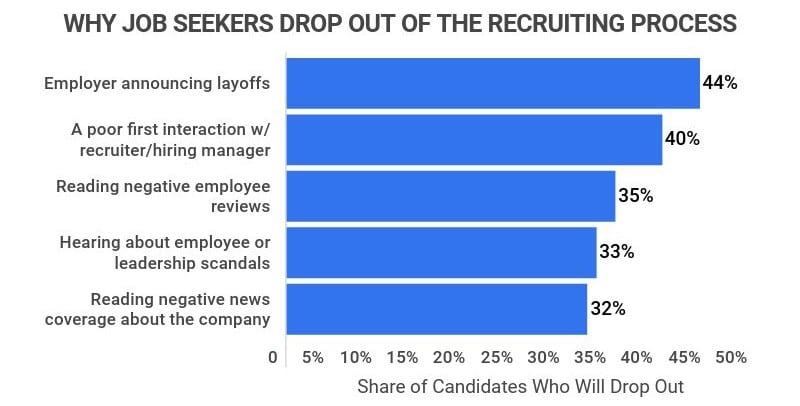
The chart below illustrates other common reasons candidates withdraw from the recruitment process.
-
79% of applicants utilize social media in their job search.
Furthermore, social media significantly impacts how applicants are viewed by employers, with 21% of employers unlikely to consider candidates without an online presence and 54% having disqualified candidates based on their social media activity.
-
41% of candidates turn to job boards for job opportunities.
However, around 80% of jobs are filled through personal and professional networks; approximately 70% of individuals found their current positions through networking.
-
At least 45% of applicants apply for jobs online.
With a notable increase in demand for remote jobs, this number is expected to rise.
-
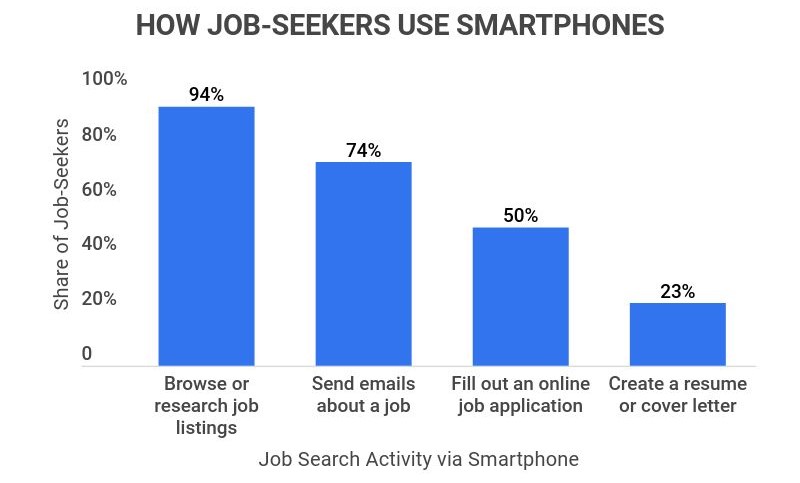
94% of job seekers utilize smartphones for job searches.
Mobile usage is prevalent in job searching, with approximately 75% sending emails via mobile during the recruitment process and around half completing job applications on their smartphones.
Recruitment Trends and Projections
As we assess the current landscape of recruitment, it’s important to consider where it is heading. The rise of digital engagement and remote work necessitates evolution in recruitment practices. Here are some insights:
-
68% of recruiters believe investing in new recruiting technology is key to enhancing performance over the next five years.
This trend aligns with the fact that 94% of recruiters acknowledge a positive impact from utilizing recruitment software.
-
70% of professionals anticipate that virtual recruiting will become the norm.
Moreover, 81% agree that virtual recruiting will remain prevalent post-pandemic, with 86% of interviews currently conducted virtually.
-
77% of professionals assert that diversity will be essential in the future of recruiting.
The ongoing shift toward remote interviewing appears to be fostering this diversity, with projections suggesting a 20% increase in geographical diversity among applicants due to remote work flexibility.
Recruitment Statistics by Common Issues
Every recruitment system has its challenges. Here are notable trends that hinder effective recruitment:
-
75% of recruiters report candidates changing their minds before hiring.
Many withdrawals are linked to prolonged hiring processes. The average recruitment takes about 42 days; securing a candidate within 10 days is recommended to avoid losing them to competitors.
-
39% of candidates decline offers due to receiving other job proposals.
Overall, 74% of recruiters face competitive hiring environments. Delays in decision-making can lead candidates to accept offers from other companies.
-
72% of employers struggle to find skilled candidates.
This figure represents a 15-year peak in hiring difficulties, indicating a significant challenge in the current labor market.
Recruitment Statistics FAQ
-
Is recruiting a dying industry?
No, recruiting is far from a dying industry. In fact, with 72% of employers facing challenges in finding skilled candidates, recruitment is poised to become an even more crucial function. This role is essential for tapping into the 73% of passive job seekers and attracting talent away from competitors.
-
What is the average time to hire in 2021?
The average time to hire remains 42 days. Likewise, the typical job listing is active for only about 30 days, leading to significant cost implications, averaging $98 in losses daily.
-
What are the latest trends in recruitment?
The latest trends in recruitment focus on remote work, diversity initiatives, and technological advancements.
For instance, 68% of recruiters believe investing in new technology will enhance recruiting performance over the next five years, and 70% of professionals expect virtual recruiting to become standard.
Diversity is also highlighted, with 77% of professionals agreeing it will be critical in future recruitment efforts. Remote work is anticipated to improve geographical diversity among applicants by 20%.
-
What are the best recruitment strategies?
The most effective recruitment strategies emphasize salary transparency, referrals, and social media.
For example, 84% of companies leverage social media for recruiting, 70% of job seekers prefer to learn about salary in initial recruiter communications, and 88% of companies report that their best hires come from referrals.
-
What are recruitment ratios?
Recruitment ratios are essential metrics that recruiters and hiring managers use to evaluate recruitment success. Common ratios include:
-
Selection ratio. The number of hires divided by total applicants. For example, if 100 candidates apply and 10 are hired, the selection ratio is 10:1.
-
Interview to hire ratio. The number of interviews conducted divided by total hires. If 8 interviews lead to 2 hires, the interview-to-hire ratio is 4:1.
-
Success ratio. The number of successful hires divided by total hires. If 10 candidates are hired and 9 succeed, the success ratio is 9:1.
These ratios help identify strengths and weaknesses in the recruitment process. A high selection ratio may appear favorable, but if it compromises the success ratio, reevaluating quality control in candidate selection is necessary.
-
-
What is the recruitment funnel?
The recruitment funnel describes the stages a candidate goes through, from job seeker to hire. It begins with awareness of the company and job openings, followed by application, interviews, and selection, culminating in a job offer. The final stage is the candidate accepting the offer.
-
What factors influence recruitment?
Both internal and external factors impact recruitment efforts and candidate sourcing. Internal factors include recruitment policies, HR planning, and organizational size, while external factors encompass market supply and demand, labor market conditions, and unemployment rates.
Conclusion
Recruiting is a vital function in securing top talent, especially as 73% of potential candidates are passive job seekers. This highlights the importance of proactive recruitment strategies, particularly as 72% of employers report difficulties in finding skilled candidates.
Effective recruitment strategies emphasize salary transparency and utilize referrals and social media. With 84% of companies using social media for recruitment, 70% of job seekers seeking salary information upfront, and 88% of businesses acknowledging that referrals yield the best hires, the landscape is evolving.
Recruitment is by no means diminishing; rather, as technology progresses, new and innovative strategies will emerge. The fact that 70% of professionals now view virtual recruiting as the new standard illustrates a significant shift in the recruitment paradigm.
References
-
LinkedIn. “The Ultimate List of Hiring Statistics.” Accessed on October 18th, 2021.
-
JSG Blog. “Are You Aware of the Cost of Vacancies?” Accessed on October 18th, 2021.
-
Accurate. “Expand your perspective with our background screening resources.” Accessed on October 18th, 2021.
-
SHRM. “Using Social Media for Talent Acquisition.” Accessed on October 18th, 2021.
-
SHRM. “Salary Is the Most Important Part of Job Ad.” Accessed on October 18th, 2021.
-
CBIZ. “How Your Employer Brand Impacts Recruiting Retention.” Accessed on October 18th, 2021.
-
Harver. “9 Things You Need to Know About Direct Sourcing.” Accessed on October 18th, 2021.
-
Fast Company. “Is now a good time to change careers? More workers are feeling good about it.” Accessed on October 18th, 2021.
-
Dice. “What Went Wrong with Culture Fit in Tech?” Accessed on October 18th, 2021.
-
Glassdoor. “The Biggest Frustration for Job Seekers Is…” Accessed on October 18th, 2021.
-
ApolloTechnical. “Surprising Social Media Recruiting Statistics (2021).” Accessed on October 18th, 2021.
-
Payscale. “How Many Jobs Are Found Through Networking, Really?” Accessed on October 18th, 2021.
-
SHRM. “Online Job Searching Has Doubled Since 2005.” Accessed on October 18th, 2021.
-
Capterra. “Recruiting Software Impact Report.” Accessed on October 19th, 2021.
-
Inc. “Why Your Candidates Prefer Virtual Interviews and You Should Too.” Accessed on October 19th, 2021.
-
LinkedIn. “6 Recruiting Trends That Will Shape 2021.” Accessed on October 19th, 2021.
-
Manpower Group. “Solving the Talent Shortage.” Accessed on October 19th, 2021.
-
LinkedIn. “Factors Affecting Recruitment.” Accessed on February 23rd, 2023.
- HR Statistics
- Average Labor Cost Percent Of Sales
- Average Time to Reach Profitability At A Startup
- Office Space Per Employee
- Recruitment Statistics
- Employee Engagement Statistics
- Work-Life Balance Statistics
- BYOD Statistics
- Paternity Leave Statistics
- Onboarding Statistics
- Average Paid Maternity Leave In Us
- Average Cost Of A Bad Hire
- Employee Theft Statistics
- Paid Family Leave Statistics
- Cost Of Hiring Statistics
- Employee Turnover Statistics
- Average Cost Of Employer Sponsored Health Insurance Statistics
- Sexual Harassment In The Workplace Statistics
- HR Statistics
- PTO Statistics
- Social Media Recruitment Statistics
- Hiring Statistics
- Out Of Prison Employment Statistics

Author

Jack Flynn is a writer for Zippia. In his professional career he’s written over 100 research papers, articles and blog posts. Some of his most popular published works include his writing about economic terms and research into job classifications. Jack received his BS from Hampshire College.