What does an art supervisor do?
An art supervisor focuses on designing a commissioned project or a creative marketing campaign focused on graphics and artistic visuals. The art supervisor determines the course of action and an innovative plan that will fit the customer's requirements. Experience is essential for an art supervisor. This person will base decisions on both previous artistic successes and test new concepts and ideas that will maximize the reach to people and improve the visibility of the customer's business or the supervisor's studio.
Art supervisor responsibilities
Here are examples of responsibilities from real art supervisor resumes:
- Lead 4 brands in Alcon's eye care portfolio and supervise digital and print for ECPs and consumers.
- Manage art assistant, including scheduling and quality control of art photography and certificates of authenticity.
- Brand development, and stewardship.Multiple new business pitches, including multiple sclerosis, diabetes, hepatitis.
- Conceptualize and successfully develop numerous creative visual concepts for online sites, print materials, and PowerPoint presentations.
- Collaborate with CEO on product definition and execution of social 3D chat application for Facebook.
- Manage translation and localization for Facebook game into Spanish and Portuguese.
Art supervisor skills and personality traits
We calculated that 26% of Art Supervisors are proficient in Visualization, Brainstorming, and User Experience. They’re also known for soft skills such as Communication skills, Creativity, and Leadership skills.
We break down the percentage of Art Supervisors that have these skills listed on their resume here:
- Visualization, 26%
Created responsive websites, iPad data visualization sales aids, convention tactics, and print material for a large mCRPC drug.
- Brainstorming, 23%
Supervised product launches, initiated vision for client branding by participating in creative team planning committees and brainstorming sessions.
- User Experience, 12%
Examined user experience through an internal web-based administrative system, created weekly reports, and provided recommendations to improve performance.
- Concept Development, 11%
Participated in concept development and creation of global prelaunch and launch materials for Fuzeon, a first-in-class HIV medication.
- Art Direction, 7%
Logged jobs into production, scheduled, provided art direction, monitored progress.
- Creative Concepts, 6%
Produced creative concepts that transcended digital tactics that immediately drew public emotions, and directly affected and positively engaged the audience.
Common skills that an art supervisor uses to do their job include "visualization," "brainstorming," and "user experience." You can find details on the most important art supervisor responsibilities below.
Communication skills. The most essential soft skill for an art supervisor to carry out their responsibilities is communication skills. This skill is important for the role because "art directors must be able to listen to and speak with staff and clients to ensure that they understand employees’ ideas and clients’ desires for advertisements, publications, or movie sets." Additionally, an art supervisor resume shows how their duties depend on communication skills: "supported director by handling communications andadobe indesign delegating workload. "
Creativity. Another soft skill that's essential for fulfilling art supervisor duties is creativity. The role rewards competence in this skill because "art directors must be able to come up with interesting and innovative ideas to develop advertising campaigns, set designs, or layout options." According to an art supervisor resume, here's how art supervisors can utilize creativity in their job responsibilities: "supervised product launches, initiated vision for client branding by participating in creative team planning committees and brainstorming sessions. "
Leadership skills. This is an important skill for art supervisors to perform their duties. For an example of how art supervisor responsibilities depend on this skill, consider that "art directors must be able to organize, direct, and motivate other artists." This excerpt from a resume also shows how vital it is to everyday roles and responsibilities of an art supervisor: "provided creative leadership for j&j; acuvue account with focus on trueye product launch. ".
Time-management skills. A big part of what art supervisors do relies on "time-management skills." You can see how essential it is to art supervisor responsibilities because "balancing competing priorities and multiple projects while meeting strict deadlines is critical for art directors." Here's an example of how this skill is used from a resume that represents typical art supervisor tasks: "managed deadlines day-to-day with production, senior graphic designer and graphic designer. "
The three companies that hire the most art supervisors are:
- Riot Games4 art supervisors jobs
- Activision Blizzard1 art supervisors jobs
- Wpp Us Holdings Inc1 art supervisors jobs
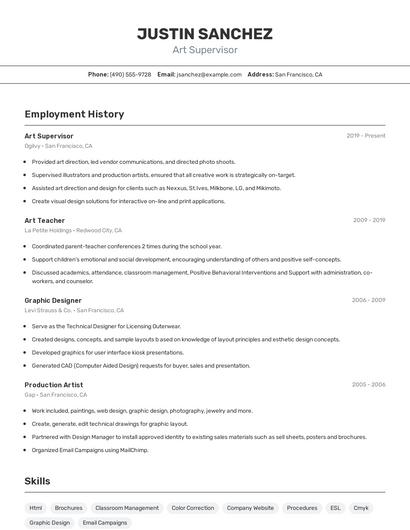
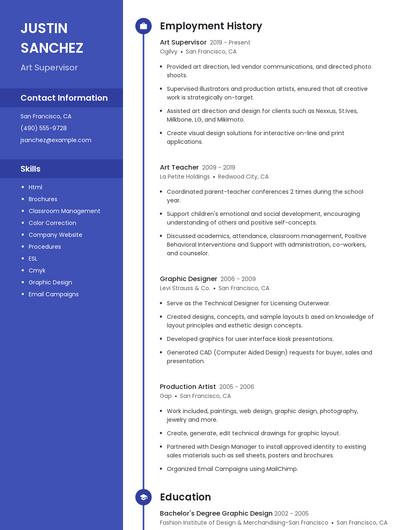
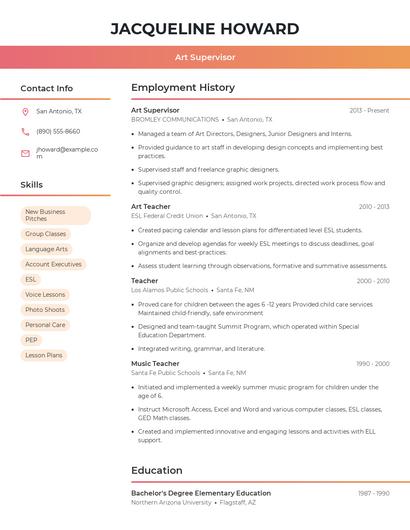
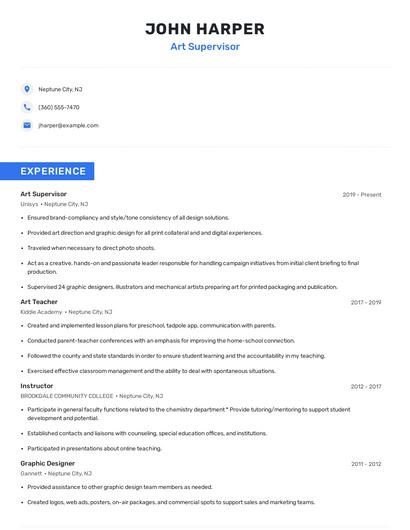
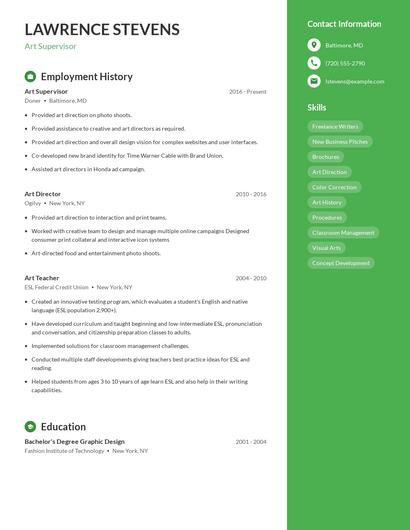
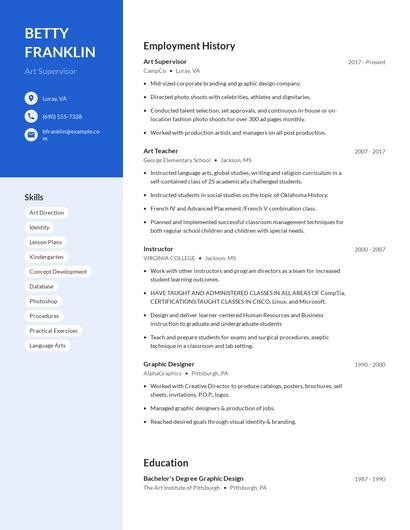
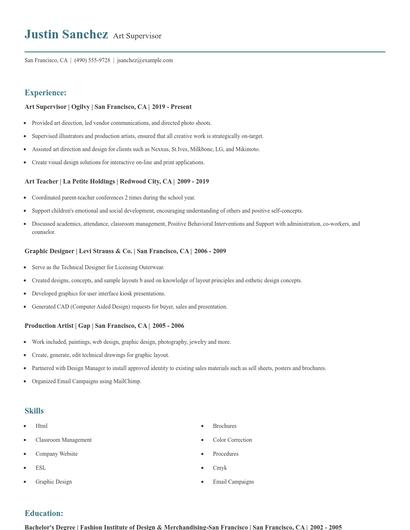
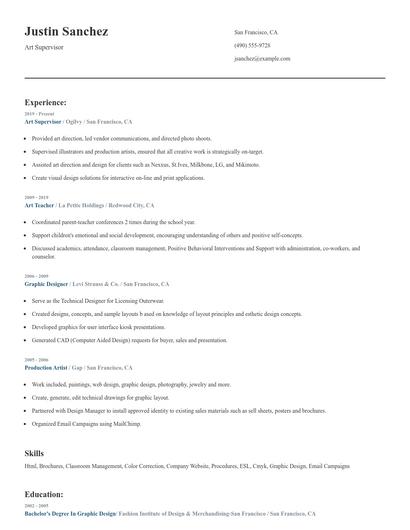
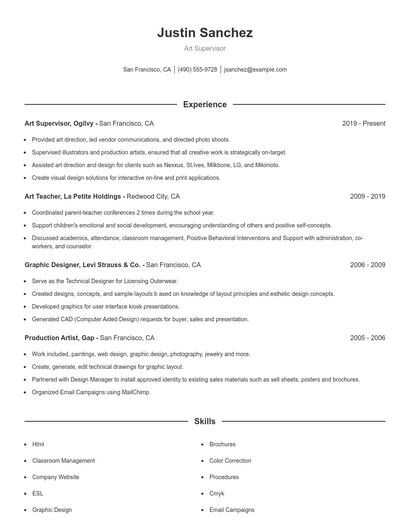
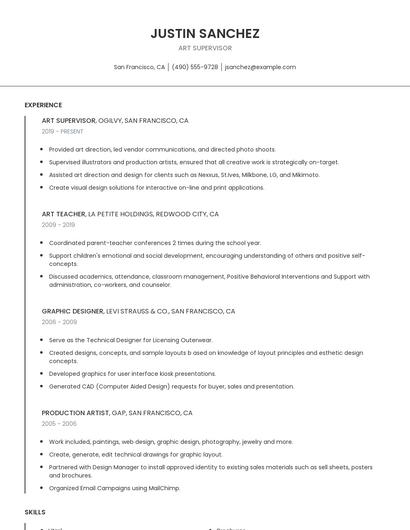
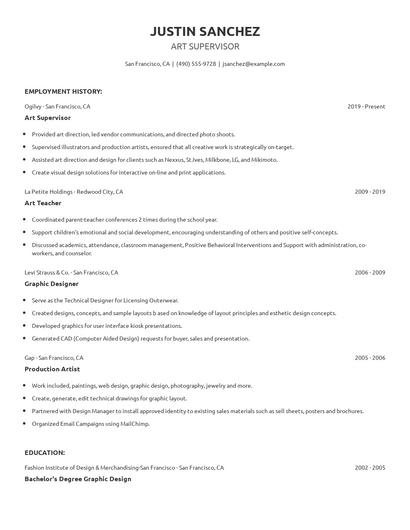
Choose from 10+ customizable art supervisor resume templates
Build a professional art supervisor resume in minutes. Our AI resume writing assistant will guide you through every step of the process, and you can choose from 10+ resume templates to create your art supervisor resume.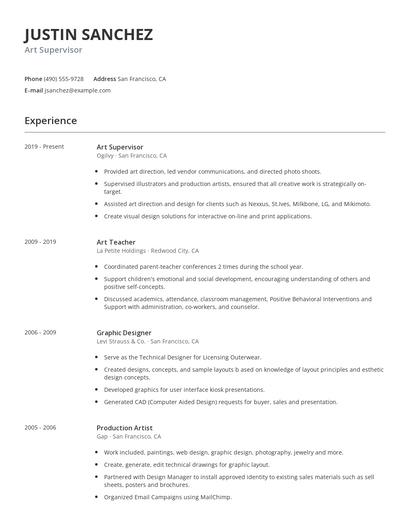
Compare different art supervisors
Art supervisor vs. Associate creative director
An associate creative director helps the creative director in creating design concepts and directions for multiple design projects, marketing materials, and campaigns. Other tasks include researching marketing trends and strategies and overseeing multiple design projects. The skills that an associate creative director should possess to accomplish his/her or her responsibilities include good interpersonal skills and knowledge of social media platforms and trends. The requirements to qualify for the job including possessing a degree in advertising, fine arts, or related fields and experience in supervising staff.
While similarities exist, there are also some differences between art supervisors and associate creative director. For instance, art supervisor responsibilities require skills such as "visualization," "creative strategies," "sketch," and "animation." Whereas a associate creative director is skilled in "digital marketing," "acd," "creative direction," and "adobe creative suite." This is part of what separates the two careers.
Associate creative directors tend to make the most money working in the media industry, where they earn an average salary of $141,342. In contrast, art supervisors make the biggest average salary, $81,023, in the media industry.associate creative directors tend to reach similar levels of education than art supervisors. In fact, associate creative directors are 1.1% less likely to graduate with a Master's Degree and 0.1% more likely to have a Doctoral Degree.Art supervisor vs. Senior creative director
A senior creative director spearheads the visual aspects of a company's marketing and advertising departments. They manage creative teams and lead the efforts from conceptualizing to executing projects and campaigns. As a senior creative director, their responsibilities typically include setting goals and budgets, establishing guidelines, coordinating departments, delegating tasks to managers, researching new business opportunities, liaising with internal and external parties, and developing strategies to optimize procedures. Furthermore, they must serve as a mentor to junior directors and staff, promoting and enforcing the company's policies and regulations.
In addition to the difference in salary, there are some other key differences worth noting. For example, art supervisor responsibilities are more likely to require skills like "visualization," "brainstorming," "creative strategies," and "art therapy." Meanwhile, a senior creative director has duties that require skills in areas such as "creative direction," "brand development," "digital marketing," and "photography." These differences highlight just how different the day-to-day in each role looks.
Senior creative directors may earn a higher salary than art supervisors, but senior creative directors earn the most pay in the manufacturing industry with an average salary of $161,176. On the other hand, art supervisors receive higher pay in the media industry, where they earn an average salary of $81,023.Average education levels between the two professions vary. Senior creative directors tend to reach similar levels of education than art supervisors. In fact, they're 2.2% less likely to graduate with a Master's Degree and 0.1% more likely to earn a Doctoral Degree.Art supervisor vs. Creative director/owner
An executive creative director is primarily in charge of directing and overseeing creative projects and campaigns. They manage a company's creative team that typically consist of writers, graphic designers, and content specialists. As an executive creative director, it is their duty to set goals and timelines, understand the client or company's needs, conceptualize plans and insights, control the budget, and develop strategies to optimize operations and outcomes. Moreover, they monitor the progress of all projects and campaigns, resolving issues and concerns should there be any.
There are many key differences between these two careers, including some of the skills required to perform responsibilities within each role. For example, an art supervisor is likely to be skilled in "visualization," "brainstorming," "creative strategies," and "concept development," while a typical creative director/owner is skilled in "photography," "video production," "website design," and "creative direction."
Creative directors/owner typically earn similar educational levels compared to art supervisors. Specifically, they're 1.4% less likely to graduate with a Master's Degree, and 0.1% less likely to earn a Doctoral Degree.Art supervisor vs. Executive creative director
Types of art supervisor
Updated January 8, 2025
