
Automatically apply for jobs with Zippia
Upload your resume to get started.
Auditor supervisor skills for your resume and career

15 auditor supervisor skills for your resume and career
1. Audit Reports
- Analyzed and investigated a variety of situations, synthesized data, made evaluations and submitted audit reports with appropriate recommendations.
- Prepared and submitted audit reports to management regarding findings, comments, appraisals and recommendations on business activity/processes under review.
2. CPA
- Schedule and supervise the audit process of contracted CPA and Audit firms for financial reviews and operational audits.
- Passed CPA exam and was certified in the State of Michigan.
3. Excellent Interpersonal
- Worked collaboratively with internal and external contacts, utilizing excellent interpersonal and communication skills.
4. Audit Results
- Interacted directly with store managers and district managers to provide audit results and investigate questionable data.
- Work with Operational Partners to ensure accurate understanding of audit results and audit resolution.
5. Internal Audit
Internal audit is an evaluation process that ensures that a company's risk management, governing body, and other internal processes are running effectively. People who perform internal audits must be highly qualified, have experience, and knowledge to work accordingly with the international standards and the code of ethics.
- Developed and cultivated strong business relationships with key operational personnel to carry out the Internal Audit responsibilities and duties.
- Assumed newly created corporate position, establishing and leading internal audit operations and implementing department processes and controls.
6. Business Processes
- Audit responsibilities included coordinating, planning and leading operational and financial audits of various business processes and affiliated companies.
- Skilled in developing practical and value-added solutions for business processes designed to mitigate risk and improve operational performance.
Choose from 10+ customizable auditor supervisor resume templates
Build a professional auditor supervisor resume in minutes. Our AI resume writing assistant will guide you through every step of the process, and you can choose from 10+ resume templates to create your auditor supervisor resume.7. Risk Assessments
The process of analyzing and identifying the acts or events that have the potential to negatively affect an individual, asset, or business is called risk assessment. Risk assessments are important because they form an integral part of an organization as well as occupational safety plans
- Performed risk assessments of business unit operations and functional areas.
- Prepared risk assessments and developed audit programs.
8. Audit Procedures
- Fostered financial statements audit procedures, presented findings to senior management teams, both domestically and abroad.
- Perform self-directed analysis of audit procedures among the four Corporate Commissions audit teams.
9. Internal Controls
- Planned and executed audits for management to assess effectiveness of internal controls, accuracy of financial records and efficiency of operations.
- Assisted agency in performance audits to assess if they properly designed and implemented management processes and internal controls for mission assignments.
10. Night Audit
A night audit is conducted at the end of every day to determine the daily sales and revenue taken in. This process is frequently found in companies offering hospitality services, such as hotels and restaurants. Night audits also help managers confirm that any accounting conducted by the front desk is accurate, regardless of whether this system is done by hand or automated.
- Supervised property operations overnight as MOD when necessary while ensuring accuracy of Night Audit procedure.
- Assisted upper-level management with implementation of rate qualification e-mail to night audit team.
11. Front Desk
- Checked and corrected postings made by other departments, assisted guests at the front desk, and prepared spreadsheets for accounting
- Manage and oversee four employees directly under the front desk operations as well as housekeeping and maintenance departments when needed.
12. Real Estate
Real estate is land that has buildings on it. This kind of property consists of permanent improvements either natural or man-made, which include, houses, fences, bridges, water trees, and minerals. There are 4 types of real estate namely; residential real estate, commercial real estate, industrial real estate, and vacant land.
- Project leader for development, implementation, training, and developing a training manual for a Real Estate Management System.
- Reviewed real estate files from the branch network and approve for charge-off, foreclosure or lien monitor.
13. Audit Programs
- Developed and maintained effective working relationships with outside agencies and departmental management; supervised development and implementation of all audit programs.
- Supervised audit interviews, reviewed audit programs to ensure audit recommendations, and addressed relevant risk exposures as appropriate.
14. Team-Oriented Environment
- Followed established best-practice procedures to accomplish defined goals and performed independently and within team-oriented environment.
15. Compliance Audits
A compliance audit is a report on the assessment of a company and its adherence to policies and regulatory guidelines. They evaluate the strength, policy adherence, user access, and risk and complex issue management.
- Lead and supervised numerous financial, operational and compliance audits from planning to report completion and delivery.
- Provided review and guidance of compliance audits on statutory financial statements and government compliance audits.
5 Auditor Supervisor resume examples
Build a professional auditor supervisor resume in minutes. Browse through our resume examples to identify the best way to word your resume. Then choose from 5+ resume templates to create your auditor supervisor resume.

What skills help Auditor Supervisors find jobs?
Tell us what job you are looking for, we’ll show you what skills employers want.
What auditor supervisor skills would you recommend for someone trying to advance their career?
Dr. Kelly Green
Assistant Professor, University of Louisiana at Lafayette
What soft skills should all auditor supervisors possess?
Stacy Mastrolia Ph.D.
Associate Professor of Accounting, Bucknell University
While these skills are still in high demand for accountants, post-pandemic, I believe we will see an increased need for job candidates to demonstrate flexibility and adaptability. This year's graduates are entering a work environment that is not "traditional"; at this point it seems unlikely that this year's graduates will start their careers in a traditional office (or at a client) in close proximity to more experienced professionals who are immediately available to provide instruction and assistance. So, this year's graduates need to be prepared - professionally and emotionally - to adapt to the work environment in place at their employer. And they need to be prepared for that environment to change with little warning. This semester I am teaching almost exclusively undergraduate seniors, and at Bucknell we started classes in-person, after one week we went remote for two weeks and now we are back to in-person learning. During these transitions, I have found that some students are struggling to keep up with the material; they are falling behind and missing deadlines in far greater numbers than in previous semesters. The ability to be flexible and adapt to changing circumstances while still accomplishing goals will be in great demand by employers.
I also think that graduates should place an emphasis on developing time-management skills and the ability to prioritize effectively. Alternative work environments, like working remotely, remove certain cues that the day is passing. For example, in a "normal" work day, a young professional would find routines including a mid-morning coffee break and lunch with friends or colleagues and these daily routines would help to mark the passing of time. When someone works from home, these cues may not occur naturally so time can "slip away". Also, working from home provides any number of distractions that may seem urgent in the moment but are not important to achieve that day's work goals; effectively prioritizing tasks in a distracting environment is a skill that will also be in great demand by employers.
List of auditor supervisor skills to add to your resume
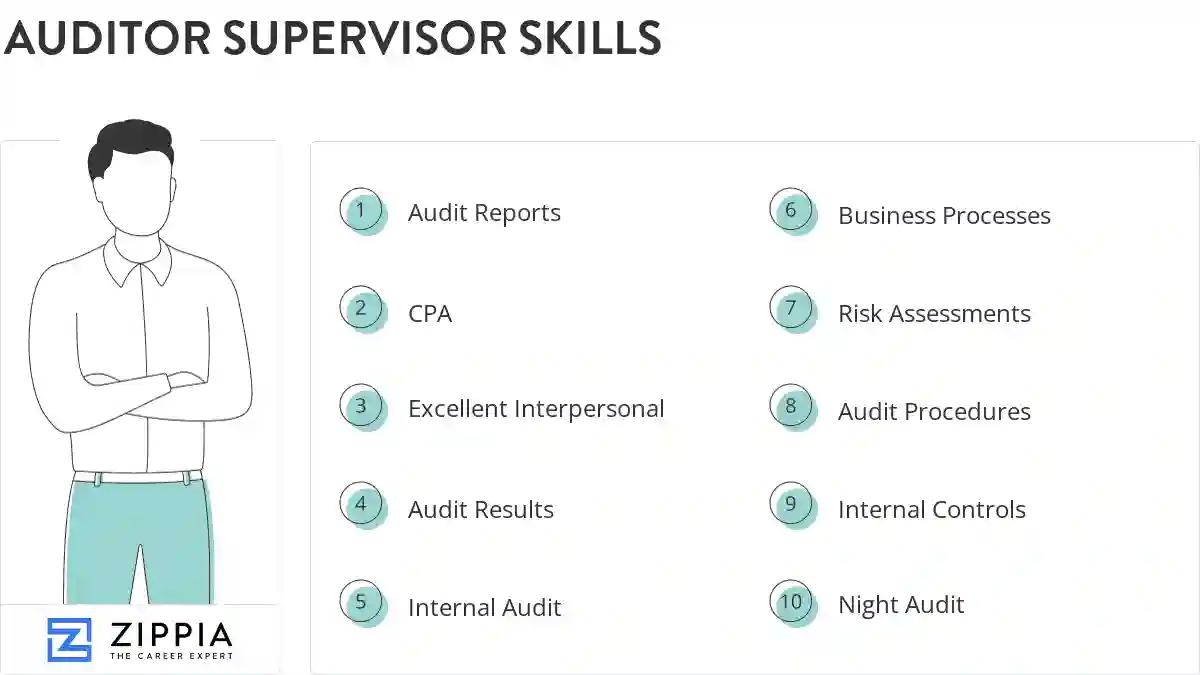
The most important skills for an auditor supervisor resume and required skills for an auditor supervisor to have include:
- Audit Reports
- CPA
- Excellent Interpersonal
- Audit Results
- Internal Audit
- Business Processes
- Risk Assessments
- Audit Procedures
- Internal Controls
- Night Audit
- Front Desk
- Real Estate
- Audit Programs
- Team-Oriented Environment
- Compliance Audits
- Audit Process
- Strong Analytical
- Audit Findings
- Audit Engagements
- Payroll
- SOX
- GAAS
- Sarbanes-Oxley
- General Ledger
- Financial Institutions
- Performance Evaluations
- Audit Scope
- Audit Plan
- Process Improvement
- Journal Entries
- Medicare
- Financial Statement Audits
- Financial Reports
- Corrective Action
- External Auditors
- Audit Issues
- Staff Auditors
- Operational Audits
- POS
- Tax Returns
- Management Letters
- Sox Testing
- Guest Complaints
- Guest Accounts
- Anti-Money Laundering
- Executive Management
- Due Diligence
- Financial Data
- Bad Debts
Updated January 8, 2025
