What does a bilingual instructor do?
Bilingual instructor responsibilities
Here are examples of responsibilities from real bilingual instructor resumes:
- Utilize training in medical English to facilitate preparation of study and achieve require educational standards necessary to successfully complete course.
- Record IEP goals, short term objectives and progress reports.
- Prepare juvenile ESL inmates to take the GED exam through remediation of general skills that are test.
- Participate in IEP /IFSP meeting and evaluations, serving as an intermediary between speaking Spanish families and interdisciplinary team.
- Proctore and provide special educational accommodations to students in the ESL program in testing environment.
- Utilize training in medical English to facilitate preparation of study and achieve require educational standards necessary to successfully complete course.
- Teach ESOL classes to adults applying different teaching techniques and strategies.
- Maintain laptops and utilize Plato software.
Bilingual instructor skills and personality traits
We calculated that 35% of Bilingual Instructors are proficient in Spanish Language, Instructional Materials, and Training Materials. They’re also known for soft skills such as Physical stamina, Communication skills, and Resourcefulness.
We break down the percentage of Bilingual Instructors that have these skills listed on their resume here:
- Spanish Language, 35%
Evaluate the Spanish language proficiency and instructional effectiveness of instructors by observing training in the field and in the classrooms.
- Instructional Materials, 33%
Translated FIFC and FDP1 & FDP2 instructional material from English to Spanish.
- Training Materials, 9%
Researched and prepared varied instructional aides and developed training materials for the classroom.
- ESL, 8%
Proctored and provided special educational accommodations to students in the ESL program in testing environment.
- Language Acquisition, 5%
Developed appreciation among middle school students for language acquisition through World Language Spanish (Grade 6).
- Social Studies, 5%
Instruct adult students in the four of five subjects: science, writing, reading, and social studies.
Common skills that a bilingual instructor uses to do their job include "spanish language," "instructional materials," and "training materials." You can find details on the most important bilingual instructor responsibilities below.
Physical stamina. To carry out their duties, the most important skill for a bilingual instructor to have is physical stamina. Their role and responsibilities require that "working with kindergarten- and elementary-age students can be tiring." Bilingual instructors often use physical stamina in their day-to-day job, as shown by this real resume: "organize and lead activities designed to promote physical, mental and social development such as games, arts. "
Communication skills. Another soft skill that's essential for fulfilling bilingual instructor duties is communication skills. The role rewards competence in this skill because "teachers need to discuss students’ needs with parents and administrators." According to a bilingual instructor resume, here's how bilingual instructors can utilize communication skills in their job responsibilities: "assisted teachers in communications with parents of students assigned to the esl program. "
Resourcefulness. This is an important skill for bilingual instructors to perform their duties. For an example of how bilingual instructor responsibilities depend on this skill, consider that "kindergarten and elementary school teachers must be able to get students engaged in learning." This excerpt from a resume also shows how vital it is to everyday roles and responsibilities of a bilingual instructor: "showed resourcefulness and teaching effectiveness in meeting the needs of students with limited english language proficiency as well as learning disabilities. ".
The three companies that hire the most bilingual instructors are:
- New York Edge Music2 bilingual instructors jobs
- University of Colorado2 bilingual instructors jobs
- The Menta Group1 bilingual instructors jobs
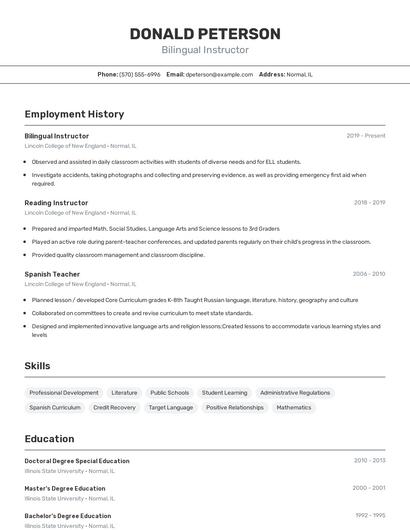
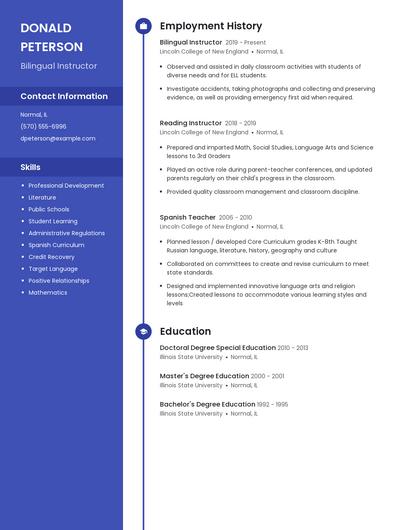
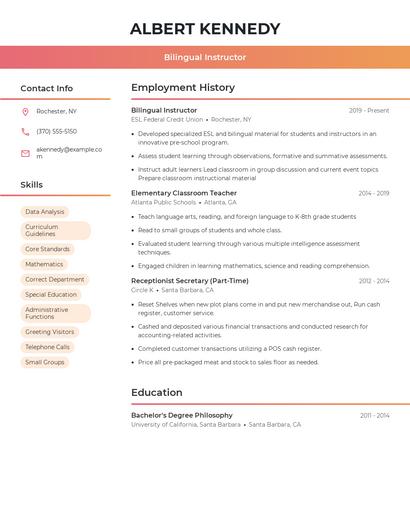
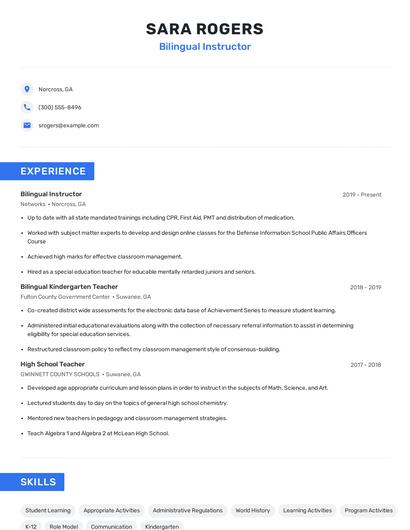
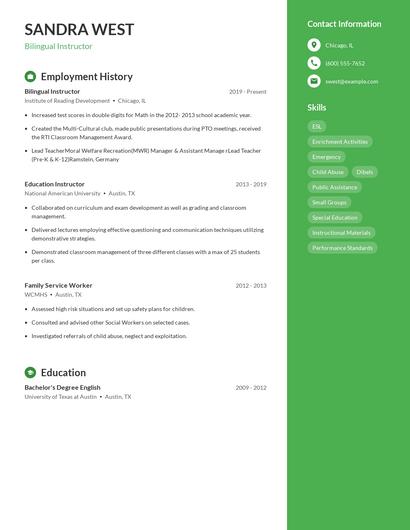
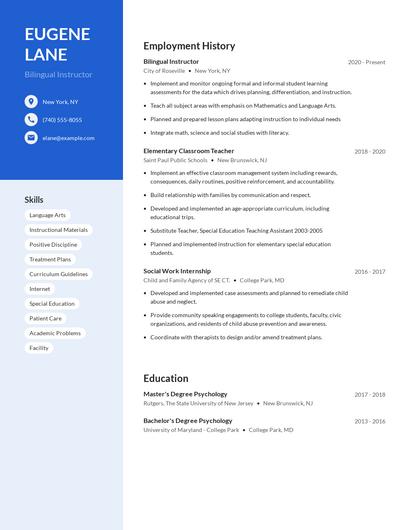
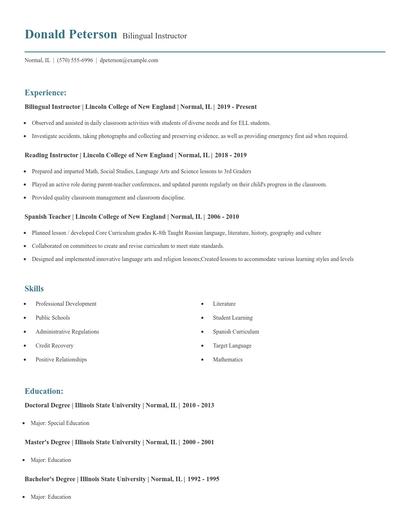
Choose from 10+ customizable bilingual instructor resume templates
Build a professional bilingual instructor resume in minutes. Our AI resume writing assistant will guide you through every step of the process, and you can choose from 10+ resume templates to create your bilingual instructor resume.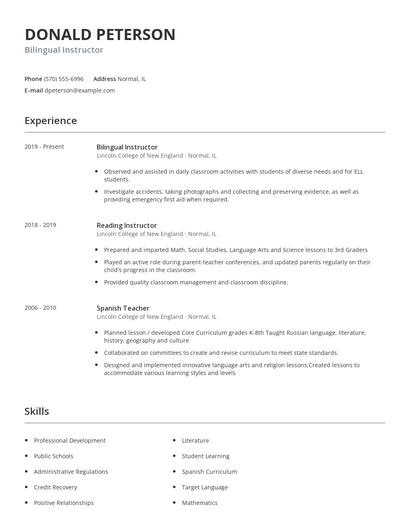
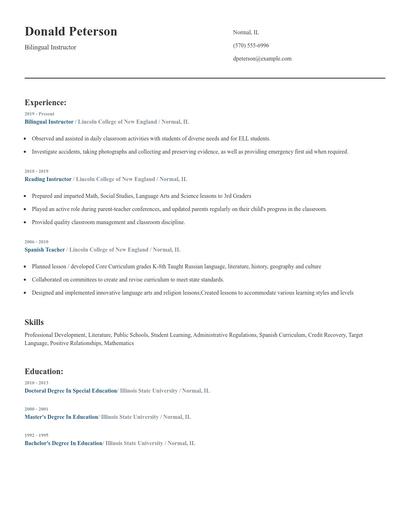
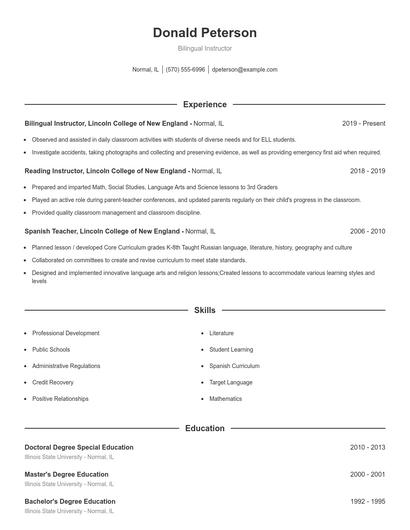
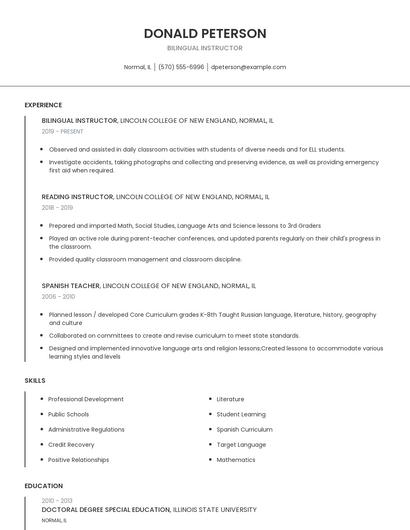
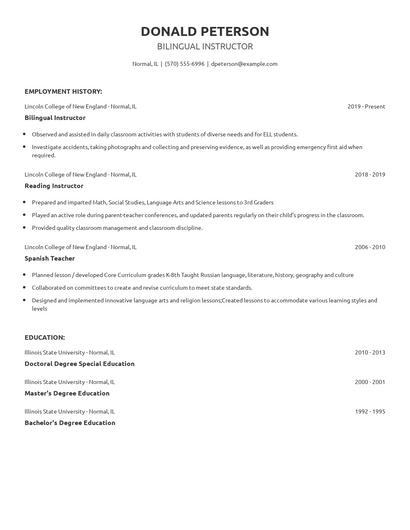
Compare different bilingual instructors
Bilingual instructor vs. Art teacher
An art teacher is responsible for teaching students of art history, disciplines, and techniques to bring out the learners' maximum potential and creativity. Art teachers develop engaging plans for art strategies, ensuring the adequacy of art tools and materials for the learners' use, and design art development courses. An art teacher must have excellent knowledge of the art industry and communication and organization skills to address the different learning methods of the students and identify their areas of improvement.
These skill sets are where the common ground ends though. The responsibilities of a bilingual instructor are more likely to require skills like "spanish language," "training materials," "language acquisition," and "child development." On the other hand, a job as an art teacher requires skills like "classroom management," "professional development," "art curriculum," and "student learning." As you can see, what employees do in each career varies considerably.
Art teachers tend to make the most money working in the education industry, where they earn an average salary of $49,855. In contrast, bilingual instructors make the biggest average salary, $76,544, in the finance industry.art teachers tend to reach similar levels of education than bilingual instructors. In fact, art teachers are 4.0% less likely to graduate with a Master's Degree and 1.5% less likely to have a Doctoral Degree.Bilingual instructor vs. Esl teacher
An ESL teacher specializes in teaching the English language to non-native speakers of all ages, usually in a virtual setting. Their responsibilities revolve around devising lesson plans, organizing learning materials, evaluating progress, and coming up with strategies to make learners feel comfortable. Furthermore, they must maintain a healthy and safe learning environment, whether the lessons are in a one-on-one or group setting. When it comes to virtual learning, an ESL teacher must have the necessary equipment, a stable internet connection, and an obstruction-free teaching location.
Each career also uses different skills, according to real bilingual instructor resumes. While bilingual instructor responsibilities can utilize skills like "spanish language," "training materials," "esl," and "child development," esl teachers use skills like "kids," "whiteboards," "classroom management," and "curriculum development."
On average, esl teachers earn a higher salary than bilingual instructors. Some industries support higher salaries in each profession. Interestingly enough, esl teachers earn the most pay in the retail industry with an average salary of $52,367. Whereas bilingual instructors have higher pay in the finance industry, with an average salary of $76,544.Average education levels between the two professions vary. Esl teachers tend to reach similar levels of education than bilingual instructors. In fact, they're 0.1% more likely to graduate with a Master's Degree and 1.5% less likely to earn a Doctoral Degree.Bilingual instructor vs. Teacher
Being a teacher is one of the most passionate professions, among others. Teachers educate, motivate, and guide every generation of learners to prepare them for the real world. Every teacher is unique and has their own teaching styles and methods depending on the subject they teach and the age of their students. Oftentimes they also function as a parent, counselor, coach, friend, and even a lawmaker. There is essentially no limit to the roles a teacher portrays.
The required skills of the two careers differ considerably. For example, bilingual instructors are more likely to have skills like "spanish language," "training materials," "language acquisition," and "child development." But a teacher is more likely to have skills like "handle scheduling," "kids," "classroom management," and "cpr."
Teachers earn the best pay in the education industry, where they command an average salary of $49,700. Bilingual instructors earn the highest pay from the finance industry, with an average salary of $76,544.When it comes to education, teachers tend to earn similar degree levels compared to bilingual instructors. In fact, they're 4.3% less likely to earn a Master's Degree, and 0.9% less likely to graduate with a Doctoral Degree.Bilingual instructor vs. Practicum student
Practicum students are responsible for applying their classroom learning to practical application, depending on their chosen field. A practicum student shadows an experienced staff of an organization and learns everything on how a certain profession works. Practicum students must be detail-oriented and fast-learners to perform basic duties as their mentor advises, such as performing administrative tasks as- needed. A practicum student should have excellent communication and organizational skills, as well as the ability to focus on the learnings for evaluation.
Types of bilingual instructor
Updated January 8, 2025
