What does a bridge design engineer do?
A bridge design engineer plans and oversees bridge development projects. Through their expertise, a bridge design engineer creates structural designs for building or restoring bridges, developing guidelines for structural repairs, preparing drafts according to project requirements, and providing technical support to different teams. They meet with clients or representatives to discuss requirements, specifications, and cost estimates. They may also answer inquiries and recommend other options, revising drafts when necessary. Moreover, as a bridge design engineer, they are responsible for managing and overseeing staff while implementing project standards and regulations.
Bridge design engineer responsibilities
Here are examples of responsibilities from real bridge design engineer resumes:
- Manage the development of the next generation products base on existing refrigerants and CO2 system including prototyping and initial manufacturing run.
- Prepare complex structural drawings for clients with MicroStation and AutoCAD.
- Assist in coordinating work with other disciplines such as roadway, geotechnical and hydraulics.
- Used AutoCAD as the primary software tool from draft prototypes to final design in majority projects.
- Evaluate damage to structures, review bridge maintenance books and design strategies for bridge rehabilitation and repair.
- Review geotechnical reports and specifications.
- Inspect and document structures to compose written reports that rate conditions while providing cost-effectiverecommendations if rehabilitation or replacement is needed.
- Formulate conceptual design of aeronautical, aerospace products or systems to meet customer requirements and communicate feed back to design engineers.
- Create and present technical PowerPoint presentations to customers which are instrumental in wining new business.
Bridge design engineer skills and personality traits
We calculated that 11% of Bridge Design Engineers are proficient in Civil Engineering, CAD, and Structural Design. They’re also known for soft skills such as Leadership skills, Organizational skills, and Speaking skills.
We break down the percentage of Bridge Design Engineers that have these skills listed on their resume here:
- Civil Engineering, 11%
Coordinated, designed and implemented Civil Engineering projects and subcontracts, including electric transmission/distribution, oil/gas and refinery projects.
- CAD, 11%
Supervised the drafters activity and led the CAD designers, AutoCAD was used for drafting.
- Structural Design, 9%
Work assignments included structural design of Naval Hawk and Presidential helicopters in direct relation to various systems and aircraft modifications.
- Cost Estimates, 9%
Design calculations included hydraulic and structural analyses, quantities and cost estimates.
- Retaining Walls, 8%
Design retaining walls as required (Gravity, Reinforced concrete cantilever, Reinforced Earth, Sheet pile, Soldier pile).
- Autocad, 7%
Provided site investigations of structural foundations, produced AutoCAD drawings, and made structural recommendations regarding number of piers needed.
"civil engineering," "cad," and "structural design" are among the most common skills that bridge design engineers use at work. You can find even more bridge design engineer responsibilities below, including:
Organizational skills. Many bridge design engineer duties rely on organizational skills. "civil engineers often oversee several projects at the same time and must be able to allocate resources effectively.," so a bridge design engineer will need this skill often in their role. This resume example is just one of many ways bridge design engineer responsibilities rely on organizational skills: "increased organizational efficiency by modifying iso forms and documents to be simpler, user-friendly, and up to date. "
Math skills. A commonly-found skill in bridge design engineer job descriptions, "math skills" is essential to what bridge design engineers do. Bridge design engineer responsibilities rely on this skill because "civil engineers use calculus, trigonometry, and other mathematics for analysis, design, and troubleshooting." You can also see how bridge design engineer duties rely on math skills in this resume example: "maintained detailed calculations using mathcad and microsoft office. "
Problem-solving skills. Lastly, "problem-solving skills" is an important element of what a bridge design engineer does. Bridge design engineer responsibilities require this skill because "civil engineers may encounter problems during each stage of their work." This resume example highlights how bridge design engineer duties rely on this skill: "provided spontaneous solutions and technical supports to management; performed feasibility studies for technical and construction issues. "
The three companies that hire the most bridge design engineers are:
- HDR30 bridge design engineers jobs
- Larson Design Group16 bridge design engineers jobs
- AECOM5 bridge design engineers jobs
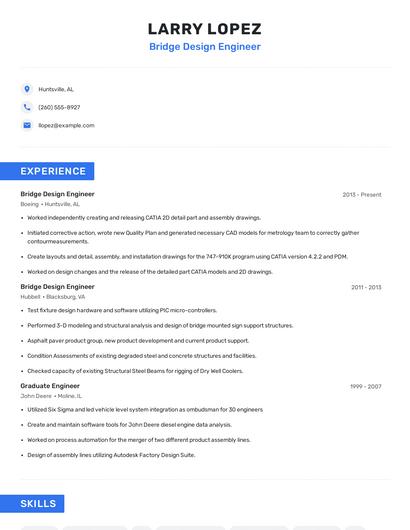
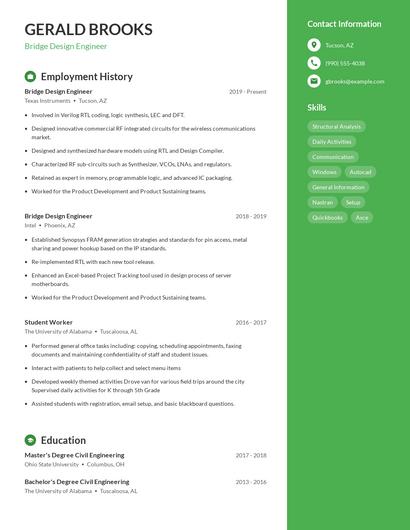
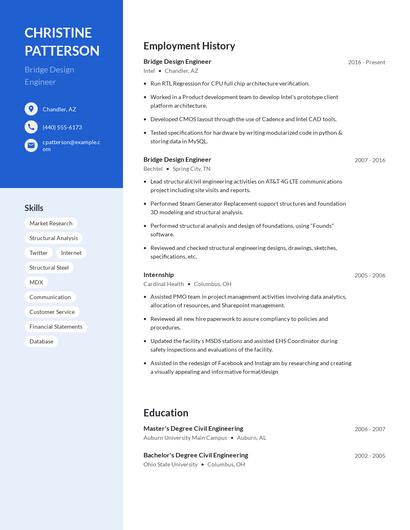
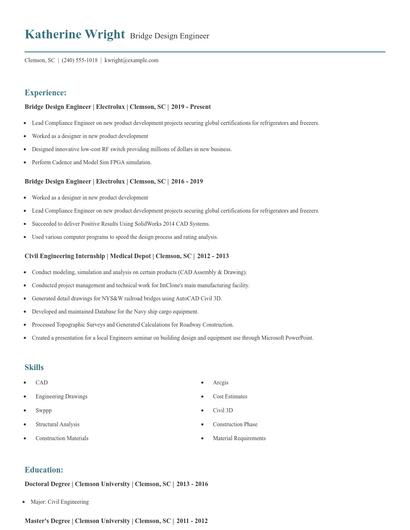
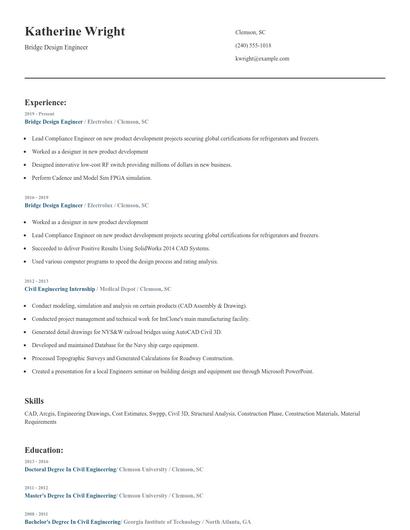
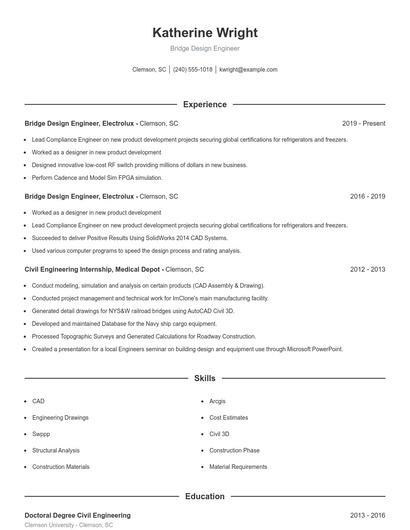
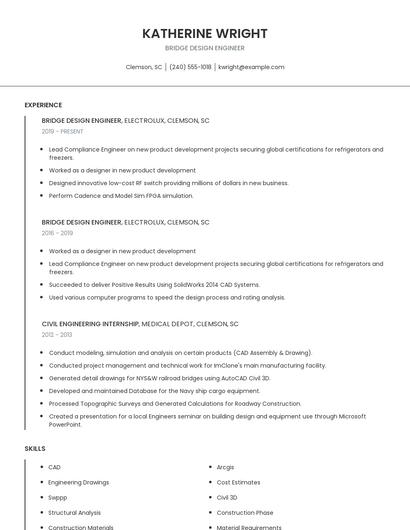
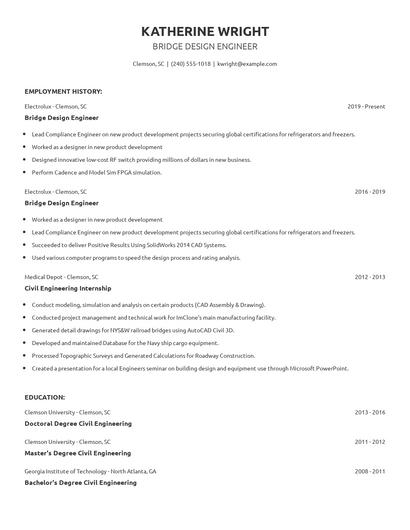
Choose from 10+ customizable bridge design engineer resume templates
Build a professional bridge design engineer resume in minutes. Our AI resume writing assistant will guide you through every step of the process, and you can choose from 10+ resume templates to create your bridge design engineer resume.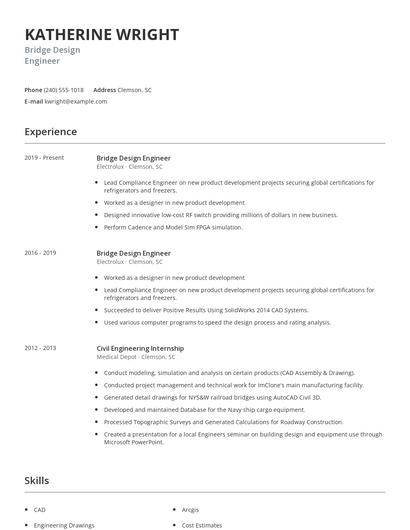
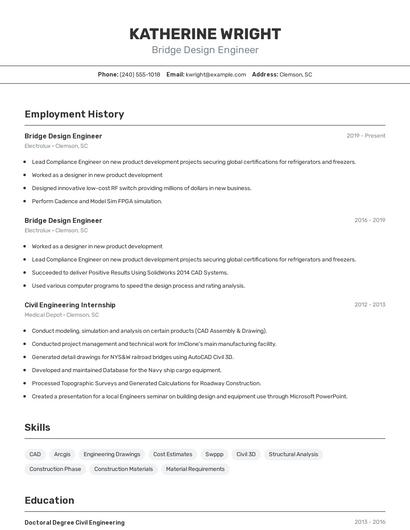
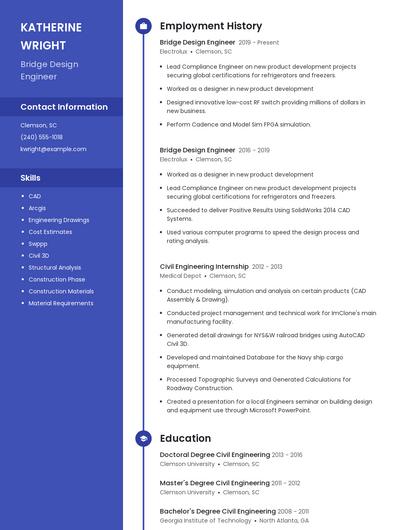
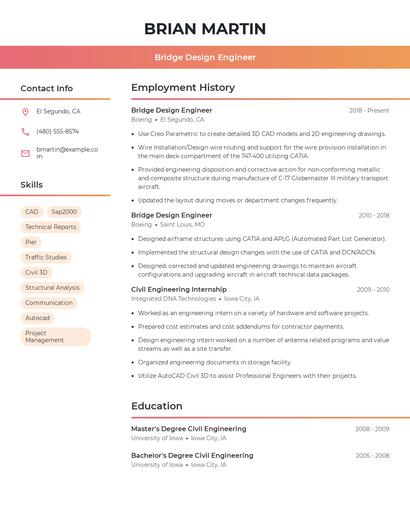
Compare different bridge design engineers
Bridge design engineer vs. Representative projects
A structural engineering intern is responsible for supporting the engineering team on construction and structural projects, identifying cost-reduction techniques, and drafting layouts that adhere to clients' specifications, business requirements, and budget limitations. Structural engineering interns join the engineers on area visits, inspecting site foundation, and calculating dimensions and material costing. They also shadow the team's best practices and recommend ways to maximize productivity and efficiency to deliver high-quality outputs within the required deadlines. A structural engineering intern must be highly technical and analytical, especially on designing deliverables that meet quality standards.
There are some key differences in the responsibilities of each position. For example, bridge design engineer responsibilities require skills like "civil engineering," "cad," "structural design," and "cost estimates." Meanwhile a typical representative projects has skills in areas such as "construction projects," "infrastructure," "osha," and "construction observation." This difference in skills reveals the differences in what each career does.
Representative projects tend to make the most money working in the technology industry, where they earn an average salary of $64,096. In contrast, bridge design engineers make the biggest average salary, $72,956, in the telecommunication industry.On average, representative projects reach similar levels of education than bridge design engineers. Representative projects are 2.9% less likely to earn a Master's Degree and 0.4% less likely to graduate with a Doctoral Degree.Bridge design engineer vs. Structural engineering internship
Civil/Structural Engineers are engineers who specialize in designing structures. They usually design buildings, bridges, tunnels, or any other infrastructure. They ensure that these buildings are structurally sound, and their design maintains physical integrity. Civil/Structural Engineers have an in-depth knowledge of physics and building structures, and they use this knowledge in designing, planning, and building strong infrastructures.
While some skills are similar in these professions, other skills aren't so similar. For example, resumes show us that bridge design engineer responsibilities requires skills like "civil engineering," "cad," "autocad," and "eit." But a structural engineering internship might use other skills in their typical duties, such as, "revit," "powerpoint," "engineering software," and "engineering calculations."
Structural engineering interns may earn a lower salary than bridge design engineers, but structural engineering interns earn the most pay in the technology industry with an average salary of $56,459. On the other hand, bridge design engineers receive higher pay in the telecommunication industry, where they earn an average salary of $72,956.structural engineering interns earn higher levels of education than bridge design engineers in general. They're 5.2% more likely to graduate with a Master's Degree and 0.4% less likely to earn a Doctoral Degree.Bridge design engineer vs. Civil/structural engineer
Civil engineer interns work to improve their knowledge about construction and its relevant works. An internship provides them insight into various aspects of construction and how things run at the site. Through an internship, they learn how to differentiate between reality and engineering. Civil engineering interns will typically perform various tasks, including preparing and monitoring documents, working closely with the civil engineer to resolve issues and review complaints, and preparing plans and maps. They are also expected to visit construction sites to do their planning, quality control, documentation, and site execution.
The required skills of the two careers differ considerably. For example, bridge design engineers are more likely to have skills like "structural design," "eit," "mathcad," and "preliminary design." But a civil/structural engineer is more likely to have skills like "structural engineering," "aci," "aisc," and "strong analytical."
Civil/structural engineers earn the best pay in the energy industry, where they command an average salary of $80,624. Bridge design engineers earn the highest pay from the telecommunication industry, with an average salary of $72,956.Most civil/structural engineers achieve a higher degree level compared to bridge design engineers. For example, they're 6.2% more likely to graduate with a Master's Degree, and 0.0% more likely to earn a Doctoral Degree.Bridge design engineer vs. Civil engineering internship
Types of bridge design engineer
Updated January 8, 2025
