What does a business architect do?

A business architect is responsible for developing strategic techniques and procedures that would support operational efficiency and performance according to business requirements and clients' specifications. Business architects conduct quality control inspections to evaluate processes through system and data analysis, as well as working with the technology team to design system solutions that would maximize productivity and develop time-reduction procedures for deliverables. They also identify business opportunities from their findings and by analyzing market trends and sales graphs that would generate more revenues and potential partnerships.
Business architect responsibilities
Here are examples of responsibilities from real business architect resumes:
- Architect and manage various Linux flavors consisting of RHEL 6/7, CentOS 5-7, Ubuntu 14/15 and FreeBSD 10/11.
- Manage risk, audit compliance per federal security policy which encompasses OPM, NIST standards and follow ITIL best practices.
- Used Microsoft Visio to provide team leads, stake holders and other teams with video flow, P2P, flow diagrams.
- Collaborate with business operations leads to create a governance model with define roles and responsibilities.
- Facilitate and lead weekly JAD sessions with developers and business units in a collaborative environment.
- Create application specific data marts and deploy SSAS cubes on top the data marts.
- Co-Authore an internal white paper to simplify cloud transformation vision for non-technical staff and business stakeholders.
- Perform L1 - L3 support for CAD/CAM/CAE and PLM infrastructure.
- Install the java app as an NT service.
- Document, test and debug new API releases.
- Provide business support as part of the development scrum team.
- Analyze the MIE multiple UI forms and flows for efficiency.
- Develop an EnterpriseOne interfaces to call third party Java classes directly.
- Design and present re-engineer business process on the newer CRM platform.
- Gather user issues, analyze, prioritize and document using JIRA.
Business architect skills and personality traits
We calculated that 8% of Business Architects are proficient in Governance, Digital Transformation, and Cloud. They’re also known for soft skills such as Interpersonal skills, Problem-solving skills, and Time-management skills.
We break down the percentage of Business Architects that have these skills listed on their resume here:
- Governance, 8%
Create compelling and vibrant Governance processes with key corporate leaders while aligning Technology strategy to Business vision.
- Digital Transformation, 7%
Develop new solution offerings to drive innovation and digital transformation for customers.
- Cloud, 7%
Co-authored an internal white paper to simplify cloud transformation vision for non-technical staff and business stakeholders.
- Cycle Management, 6%
Installed, configured and validated Life Cycle Management and Explorer Tools.
- Business Capabilities, 5%
Designed an automated method to assemble standardized business requirements to aid in identifying business capabilities for strategic planning.
- Enterprise Architecture, 5%
Developed and presented a one-day training course on the essential enterprise architecture models and associated standards.
Most business architects use their skills in "governance," "digital transformation," and "cloud" to do their jobs. You can find more detail on essential business architect responsibilities here:
Interpersonal skills. One of the key soft skills for a business architect to have is interpersonal skills. You can see how this relates to what business architects do because "management analysts work with managers and other employees of the organizations for which they provide consulting services." Additionally, a business architect resume shows how business architects use interpersonal skills: "used strong analytical background and excellent communication and interpersonal skills in order to communicate with technical staff, management and end-users. "
Problem-solving skills. Another essential skill to perform business architect duties is problem-solving skills. Business architects responsibilities require that "management analysts must be able to think creatively to solve clients’ problems." Business architects also use problem-solving skills in their role according to a real resume snippet: "created mock-up forms for better visualization and understanding of the software solution. "
Time-management skills. business architects are also known for time-management skills, which are critical to their duties. You can see how this skill relates to business architect responsibilities, because "management analysts often work under tight deadlines and must use their time efficiently to complete projects on schedule." A business architect resume example shows how time-management skills is used in the workplace: "undertake the project management of application related programs to ensure that assigned projects are completed on time and on budget. "
Analytical skills. A big part of what business architects do relies on "analytical skills." You can see how essential it is to business architect responsibilities because "management analysts must be able to interpret information and use their findings to make proposals." Here's an example of how this skill is used from a resume that represents typical business architect tasks: "create utility to automate the test case generation using java, grail and groovy, database. "
Communication skills. Another common skill required for business architect responsibilities is "communication skills." This skill comes up in the duties of business architects all the time, as "management analysts must be able to convey information clearly in both writing and speaking." An excerpt from a real business architect resume shows how this skill is central to what a business architect does: "assisted in establishing stakeholder governance framework and pmo structures to manage 2-year implementation program and change/communications across the organizations. "
The three companies that hire the most business architects are:
- Oracle95 business architects jobs
- Applied Materials67 business architects jobs
- The Independent Traveler51 business architects jobs
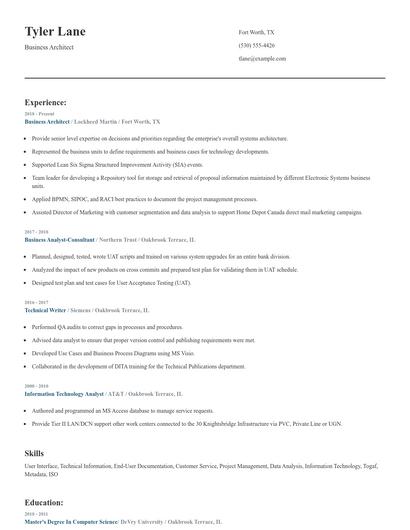
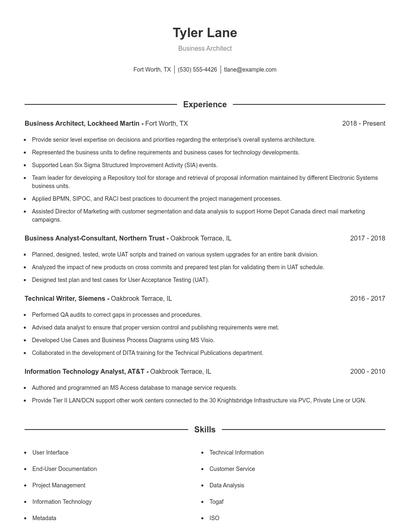
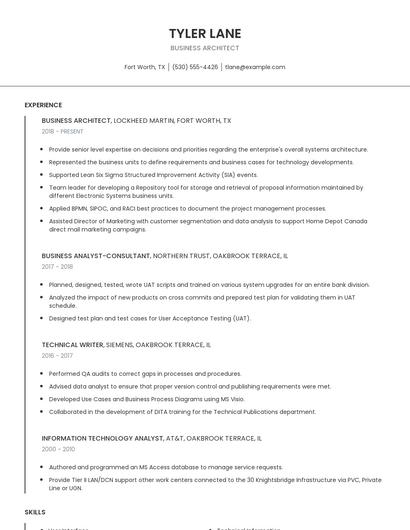
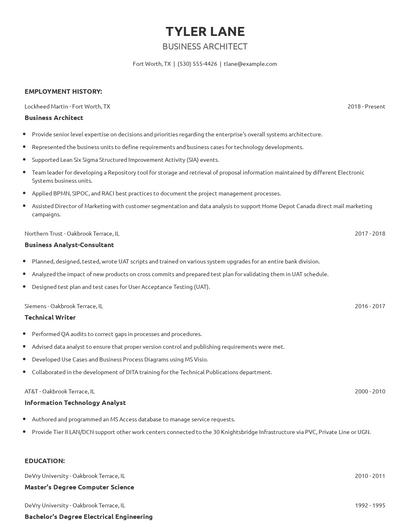
Choose from 10+ customizable business architect resume templates
Build a professional business architect resume in minutes. Our AI resume writing assistant will guide you through every step of the process, and you can choose from 10+ resume templates to create your business architect resume.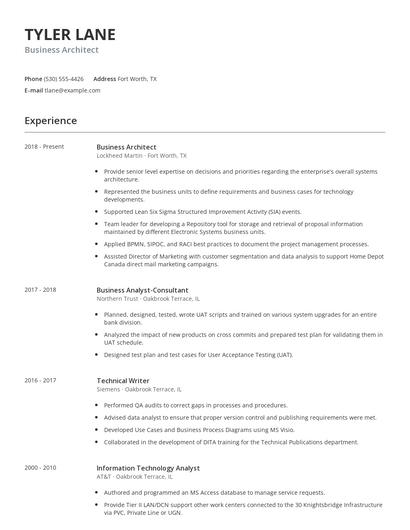


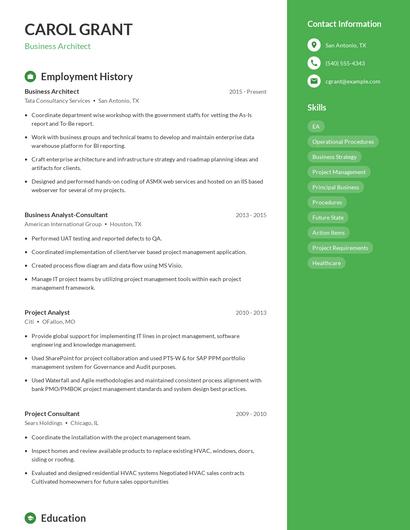
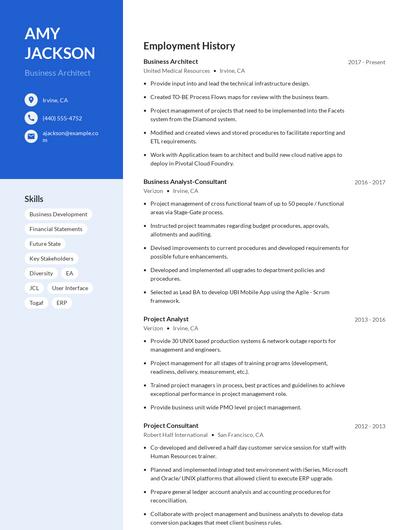
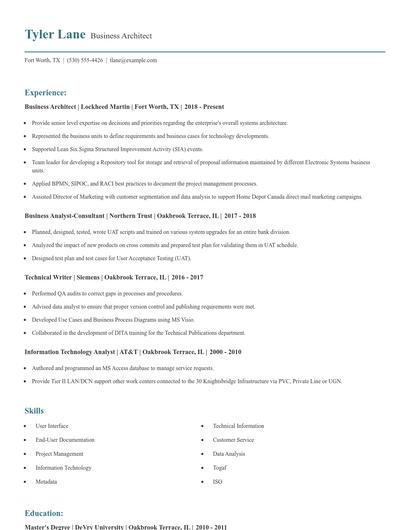
Compare different business architects
Business architect vs. Senior infrastructure engineer
A senior infrastructure engineer specializes in designing and developing systems and infrastructures based on client preferences and industry standards. They have the duty to identify and understand the project's needs, streamline project requirements, produce drafts, create prototypes and models, and establish tests to identify potential issues and ensure the projects' quality. Additionally, a senior infrastructure engineer has the authority to make decisions, train and supervise junior engineers, establish goals and timelines, provide technical support, and implement policies and guidelines.
While similarities exist, there are also some differences between business architects and senior infrastructure engineer. For instance, business architect responsibilities require skills such as "governance," "digital transformation," "cycle management," and "business capabilities." Whereas a senior infrastructure engineer is skilled in "aws," "linux," "customer service," and "powershell." This is part of what separates the two careers.
Senior infrastructure engineers tend to make the most money working in the hospitality industry, where they earn an average salary of $123,360. In contrast, business architects make the biggest average salary, $121,197, in the pharmaceutical industry.On average, senior infrastructure engineers reach lower levels of education than business architects. Senior infrastructure engineers are 12.4% less likely to earn a Master's Degree and 0.3% less likely to graduate with a Doctoral Degree.Business architect vs. Senior system administrator
A senior system administrator specializes in overseeing the computer system operations in an organization. Their responsibilities primarily revolve around monitoring the performance of all software and hardware, installing servers, configuring systems, and making sure every technical aspect is running smoothly. Should there be any issues, they must take charge of troubleshooting and providing solutions. As someone with more experience, a senior system administrator leads and evaluates the performances of fellow skilled professionals in the department, all while adhering to the company's policies and regulations.
While some skills are similar in these professions, other skills aren't so similar. For example, resumes show us that business architect responsibilities requires skills like "pre sales," "governance," "digital transformation," and "cloud." But a senior system administrator might use other skills in their typical duties, such as, "linux," "windows server," "troubleshoot," and "system administration."
Senior system administrators may earn a lower salary than business architects, but senior system administrators earn the most pay in the finance industry with an average salary of $104,418. On the other hand, business architects receive higher pay in the pharmaceutical industry, where they earn an average salary of $121,197.In general, senior system administrators achieve lower levels of education than business architects. They're 11.8% less likely to obtain a Master's Degree while being 0.3% less likely to earn a Doctoral Degree.Business architect vs. Senior technical business analyst
Senior Technical Business Analysts are experienced employees who primarily work on business improvements. They review business processes and other operations-related procedures in relation to the current business landscape. They should be familiar with the trends in the industry and how these trends affect the company. They should also be familiar with the company processes, people's capabilities, and other context-setting information related to the business. Senior Technical Business Analysts work with different departments to get a holistic view of the company. This would help them recommend action plans and next steps to address the company's challenges and ensure that the company overcomes these challenges.
The required skills of the two careers differ considerably. For example, business architects are more likely to have skills like "pre sales," "governance," "digital transformation," and "cloud." But a senior technical business analyst is more likely to have skills like "business process," "jira," "data analysis," and "strong analytical."
Senior technical business analysts earn the best pay in the energy industry, where they command an average salary of $122,449. Business architects earn the highest pay from the pharmaceutical industry, with an average salary of $121,197.Most senior technical business analysts achieve a similar degree level compared to business architects. For example, they're 4.0% less likely to graduate with a Master's Degree, and 0.5% less likely to earn a Doctoral Degree.Business architect vs. Contractor-business analyst
A contractor-business analyst is responsible for analyzing business processes and strategizing on efficient project management techniques to enhance productivity goals and achieve maximum performance. Contractor-business analysts conduct data and statistical analysis to determine areas of improvement and identify business opportunities that would generate more revenue resources and increase profits. They also review client accounts, measure sales performance, and design solutions by utilizing various software applications and system tools. A contractor-business analyst advises the management of necessary training for the staff to enhance services and close more business partnerships.
Even though a few skill sets overlap between business architects and contractor-business analysts, there are some differences that are important to note. For one, a business architect might have more use for skills like "pre sales," "governance," "digital transformation," and "cloud." Meanwhile, some responsibilities of contractor-business analysts require skills like "business process," "data analysis," "data entry," and "financial analysis. "
The average resume of contractor-business analysts showed that they earn lower levels of education compared to business architects. So much so that theyacirc;euro;trade;re 5.9% less likely to earn a Master's Degree and more likely to earn a Doctoral Degree by 1.0%.Types of business architect
Updated January 8, 2025
