What does a cable assembler do?
A cable assembler specializes in assembling and maintaining electronic equipment, particularly its wiring systems. They focus on managing cable components according to protocols, cutting or soldering wires, performing installations and adjustments, and understanding blueprints to identify and track cables. There are also times when they are required to climb up high places, troubleshoot problems, and perform repairs while adhering to the safety standards and regulations. Most cable assemblers work in a group setting, which requires an open and transparent communication line for a safe and productive workflow.
Cable assembler responsibilities
Here are examples of responsibilities from real cable assembler resumes:
- Mount assembled components, such as transformers, resistors, transistors, capacitors, integrate circuits and sockets on chassis panels.
- Apply manual dexterity to preform various job functions.
- Input those chips, resistors, magnetics, core, and etc.
- Use cable stretch, cable cutter, dies, jigs, shims and other equipment to ensure the assembling.
- Follow all ESD applicable methods ,
- Solder cables and harnesses to IPC standards.
- Solder with both solder iron and tweezers.
- Experience utilizing hot plates and/or hot tweezers.
- Ensure all cab le assemblies are build to IPC standards.
- Select and install dies, jigs, shims, or other accessories in swaging machine, using handtools.
- Perform electro-mechanical assembly including point-to-point wiring, wring-out and cable harness layout, and basic mechanical assembly.
- Set up and operate HASS chambers to test PC boards used in assembling products.
- Interpret blue prints, schematics, color codes, stuffing PC boards, harnessing, wire wrapping and flow-soldering.
- Build and wire control panels consisting of control relays, timers, and DC motor drives.
- Assemble winches and hoists following control documentation and specifications.
Cable assembler skills and personality traits
We calculated that 14% of Cable Assemblers are proficient in Hand Tools, IPC, and Heat Gun.
We break down the percentage of Cable Assemblers that have these skills listed on their resume here:
- Hand Tools, 14%
Used various hand tools to strip, crimp, cut, measure, test and repair different wires and cables.
- IPC, 11%
Solder Certified IPC J-STD-001E Read and follow instructions such as process details, diagrams, customer-supplier prints, etc.
- Heat Gun, 8%
Use heat gun for heat shrinking markers on cables.
- Assembly Drawings, 7%
Read and understand schematics, work instructions, assembly drawings and bill of materials in hard copy & electronic format.
- Dexterity, 6%
Assembled voting systems mouth pieces for individuals with motor disabilities and limited dexterity
- Assembly Process, 5%
Provided detailed analyses accurately, and promptly to improve productivity and streamlined assembly process via detailed note system.
"hand tools," "ipc," and "heat gun" are among the most common skills that cable assemblers use at work. You can find even more cable assembler responsibilities below, including:
The three companies that hire the most cable assemblers are:
- Techneeds8 cable assemblers jobs
- ICONMA6 cable assemblers jobs
- Amphenol3 cable assemblers jobs
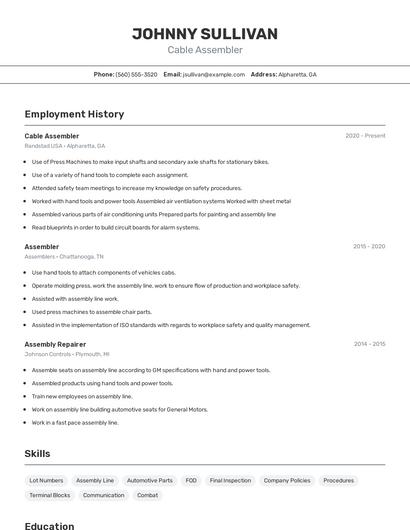
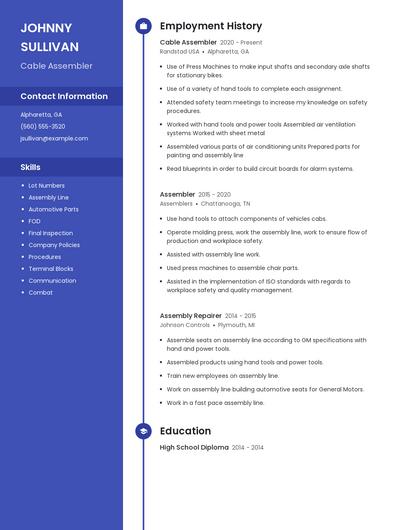
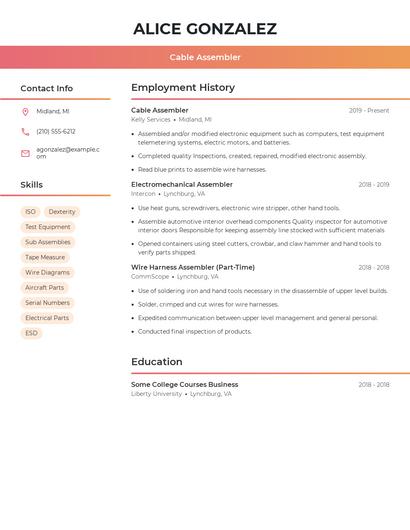
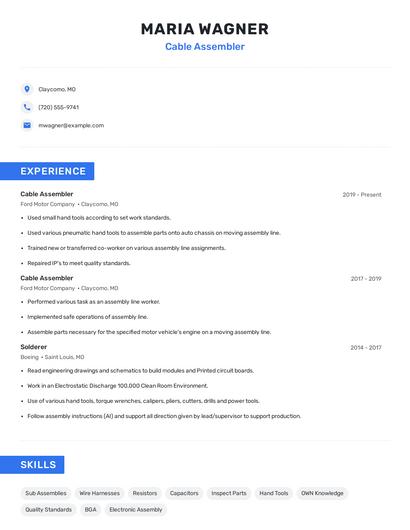
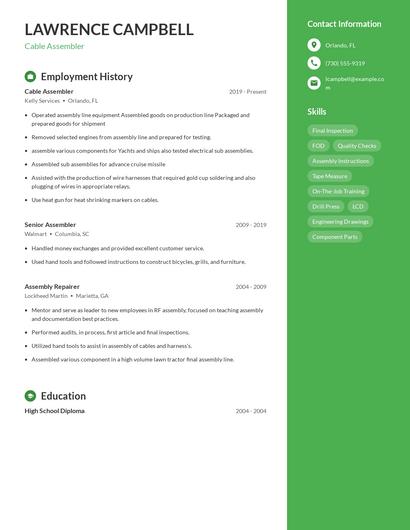
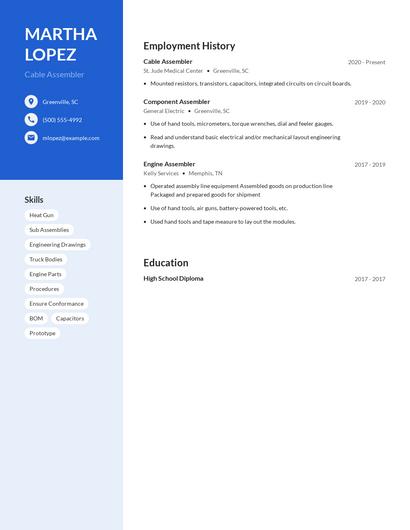
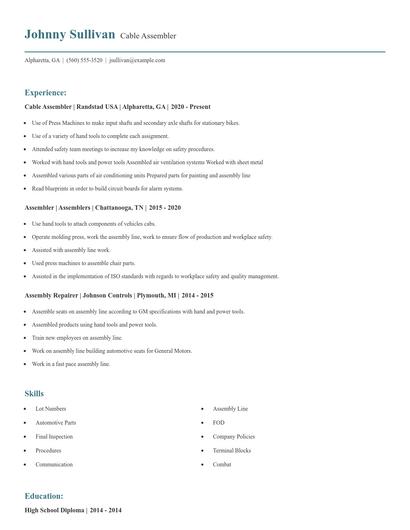
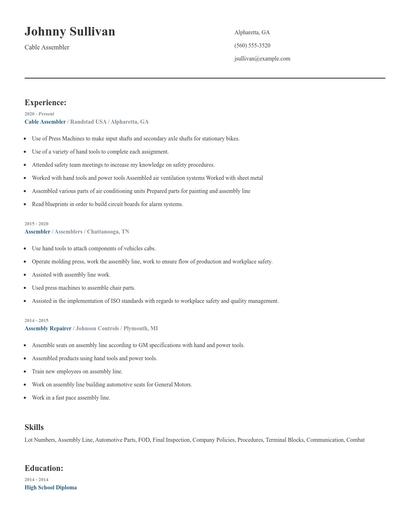
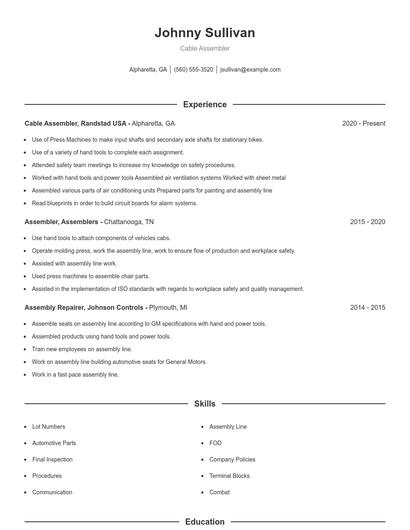
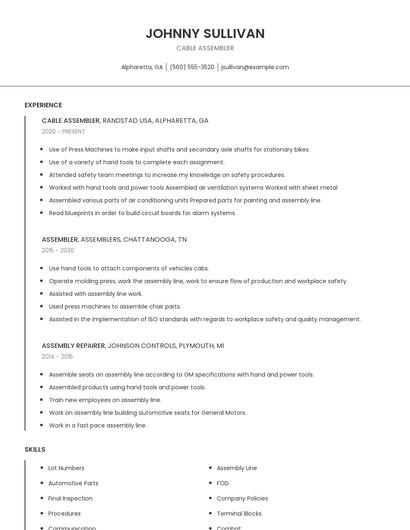
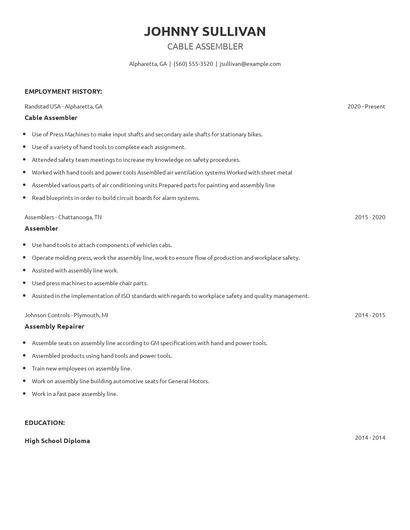
Choose from 10+ customizable cable assembler resume templates
Build a professional cable assembler resume in minutes. Our AI resume writing assistant will guide you through every step of the process, and you can choose from 10+ resume templates to create your cable assembler resume.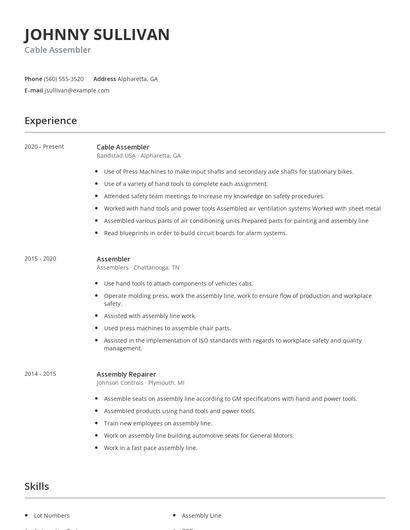
Compare different cable assemblers
Cable assembler vs. Solder technician
Assembly technicians are responsible for constructing small parts and components to create a new product according to the specifications of a client or a supervisor. An assembly technician performs diagnostic tests on the assembled product to ensure efficiency and conduct adjustments as needed. An assembly technician also provides manual instructional guides for product use and troubleshooting procedures. Assembly technicians must be knowledgeable about the technology and mechanical industry, as well as have the ability to analyze designs as a guide for creating high-quality products.
There are some key differences in the responsibilities of each position. For example, cable assembler responsibilities require skills like "ipc," "assembly drawings," "component installation," and "assembly process." Meanwhile a typical solder technician has skills in areas such as "through-hole," "ipc-a-610," "quality standards," and "circuit board assembly." This difference in skills reveals the differences in what each career does.
The education levels that solder technicians earn slightly differ from cable assemblers. In particular, solder technicians are 0.5% more likely to graduate with a Master's Degree than a cable assembler. Additionally, they're 0.4% more likely to earn a Doctoral Degree.Cable assembler vs. Assembler & quality control
In addition to the difference in salary, there are some other key differences worth noting. For example, cable assembler responsibilities are more likely to require skills like "hand tools," "heat gun," "dexterity," and "component installation." Meanwhile, an assembler & quality control has duties that require skills in areas such as "part numbers," "quality checks," "safety guidelines," and "r." These differences highlight just how different the day-to-day in each role looks.
On average, assemblers & quality control earn a lower salary than cable assemblers. Some industries support higher salaries in each profession. Interestingly enough, assemblers & quality control earn the most pay in the automotive industry with an average salary of $34,668. Whereas cable assemblers have higher pay in the technology industry, with an average salary of $33,441.assemblers & quality control earn similar levels of education than cable assemblers in general. They're 0.5% more likely to graduate with a Master's Degree and 0.4% less likely to earn a Doctoral Degree.Cable assembler vs. Assembler musical equipment
Some important key differences between the two careers include a few of the skills necessary to fulfill the responsibilities of each. Some examples from cable assembler resumes include skills like "ipc," "heat gun," "assembly drawings," and "dexterity," whereas an assembler musical equipment is more likely to list skills in "extreme temperature changes," "fitness equipment," "forks," and "assembly diagrams. "
Assembler musical equipment make a very good living in the manufacturing industry with an average annual salary of $35,148. On the other hand, cable assemblers are paid the highest salary in the technology industry, with average annual pay of $33,441.When it comes to education, assembler musical equipment tend to earn similar degree levels compared to cable assemblers. In fact, they're 0.7% more likely to earn a Master's Degree, and 0.7% more likely to graduate with a Doctoral Degree.Cable assembler vs. Assembly technician
Types of cable assembler
Updated January 8, 2025
