What does a chairperson, board of directors do?
Chairperson, board of directors responsibilities
Here are examples of responsibilities from real chairperson, board of directors resumes:
- Manage all accounting functions including those necessary for budgeting, financial analysis, property management and payroll for a non-profit.
- Work with local and national alumni chapter to coordinate expansion.
- Maintain update all web communications, including website and Facebook page.
- Monitor payroll, labor and productivity, minimize overtime from> 90 hours to <11 per pay period.
- Develop networking and social events for area alumni.
- Board meetings, operational oversight, and maintenance when between caretakers
- Provide strategic leadership in the direction and oversight of agency activities.
- Establish a scholarship committee to oversee the identification and selection of potential applicants.
- Participate in major annual fundraisers to raise scholarship funds supporting military families and local charities.
- Analyze mission effectiveness, identify needed changes to bylaws, policies and procedures base on changing industry requirements and association abilities.
- Provide public forum on all issues of concern to the community.
- Spearhead numerous sub-committees for sister city program long term sustainability.
Chairperson, board of directors skills and personality traits
We calculated that 13% of Chairpeople, Board Of Directors are proficient in Financial Statements, Non-Profit Organization, and Policy Development. They’re also known for soft skills such as Leadership skills, Management skills, and Time-management skills.
We break down the percentage of Chairpeople, Board Of Directors that have these skills listed on their resume here:
- Financial Statements, 13%
Evaluated the organization s financial statements each quarter.
- Non-Profit Organization, 10%
Helped create the most ambitious non-profit organization to date that dramatically reduces the energy requirements of communication networks.
- Policy Development, 9%
Supported research policy development, funding, and compliance issues within local, state, national and international environments.
- Oversight, 6%
Chair of the Board responsibilities include management of complex projects while conducting oversight of operational obligations.
- Strategic Plan, 6%
Developed strategic plan and created marketing and outreach materials/efforts.
- Executive Board, 4%
Chair chapter and executive board meetings along with facilitating all fraternity events.
Most chairpeople, board of directors use their skills in "financial statements," "non-profit organization," and "policy development" to do their jobs. You can find more detail on essential chairperson, board of directors responsibilities here:
Leadership skills. One of the key soft skills for a chairperson, board of directors to have is leadership skills. You can see how this relates to what chairpeople, board of directors do because "top executives must be able to shape and direct an organization by coordinating policies, people, and resources." Additionally, a chairperson, board of directors resume shows how chairpeople, board of directors use leadership skills: "provided strategic leadership in the direction and oversight of agency activities. "
Time-management skills. chairpeople, board of directors are also known for time-management skills, which are critical to their duties. You can see how this skill relates to chairperson, board of directors responsibilities, because "top executives do many tasks concurrently to ensure that their work gets done and that the organization meets its goals." A chairperson, board of directors resume example shows how time-management skills is used in the workplace: "applied dynamic strategic planning, prioritization and project management skills toward consistently achieving critical deadlines while maintaining high quality standards. "
Communication skills. A big part of what chairpeople, board of directors do relies on "communication skills." You can see how essential it is to chairperson, board of directors responsibilities because "top executives must be able to convey information clearly and persuasively." Here's an example of how this skill is used from a resume that represents typical chairperson, board of directors tasks: "required leadership and communication skills. "
Problem-solving skills. Another common skill required for chairperson, board of directors responsibilities is "problem-solving skills." This skill comes up in the duties of chairpeople, board of directors all the time, as "top executives need to identify and resolve issues within an organization." An excerpt from a real chairperson, board of directors resume shows how this skill is central to what a chairperson, board of directors does: "attended biweekly meetings responsible for enforcing bylaws amongst sorority members managed and resolved issues within the chapter"
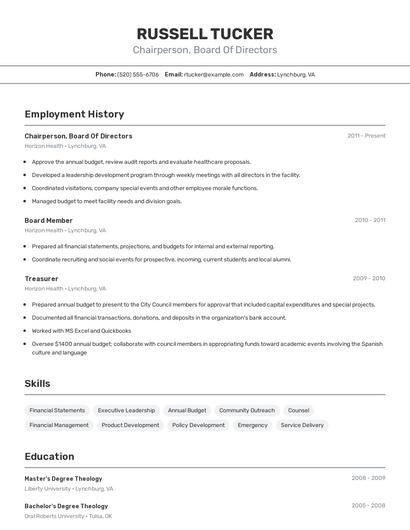
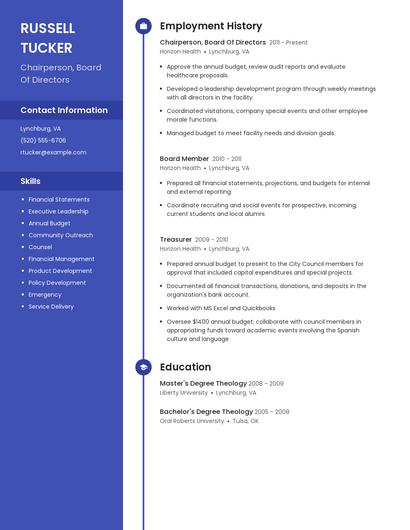
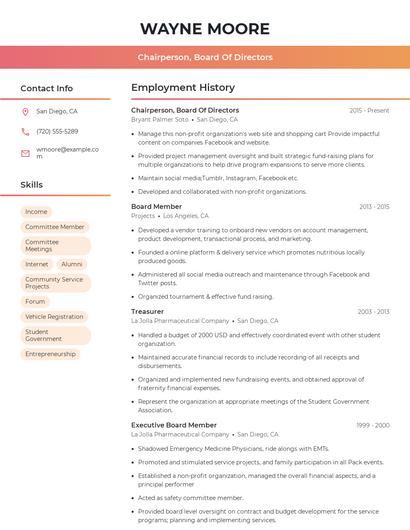
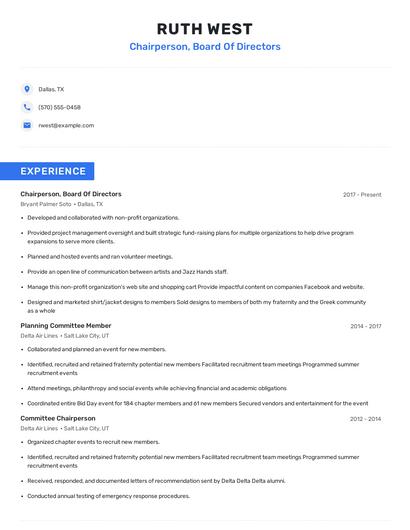
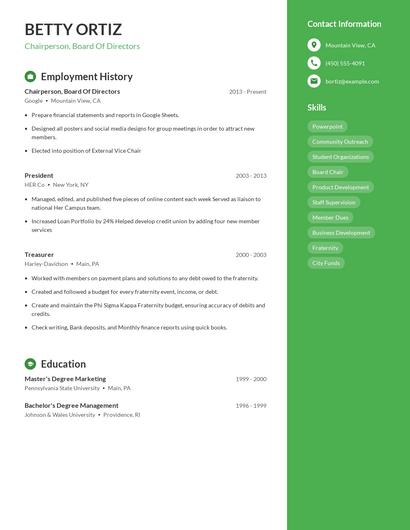
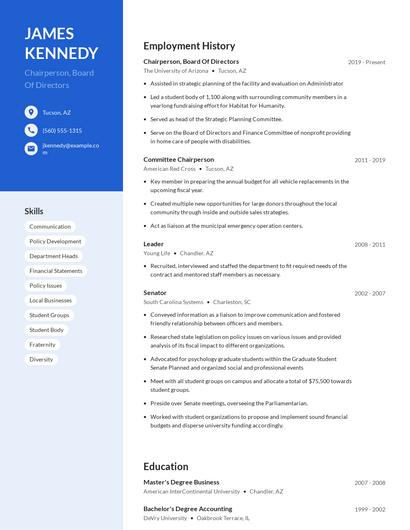
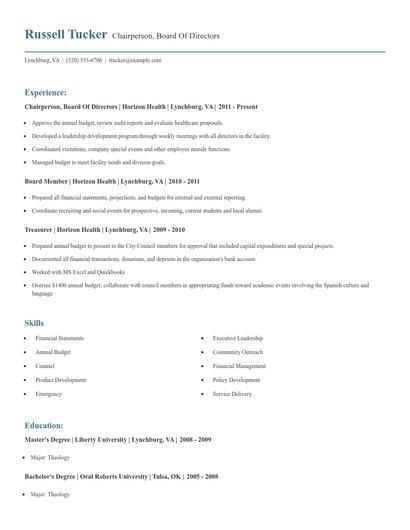
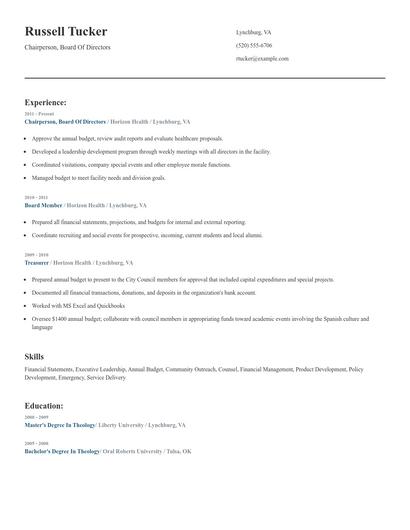
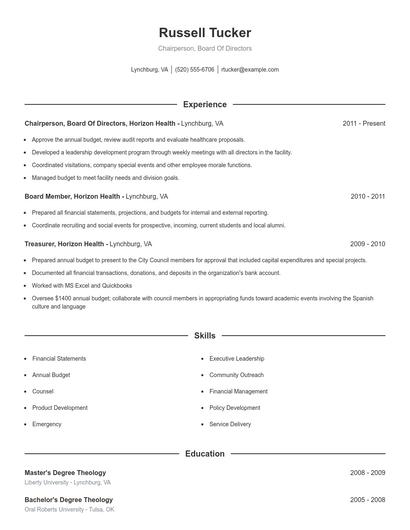
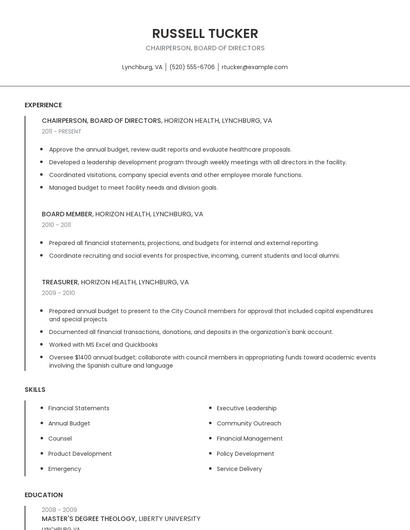
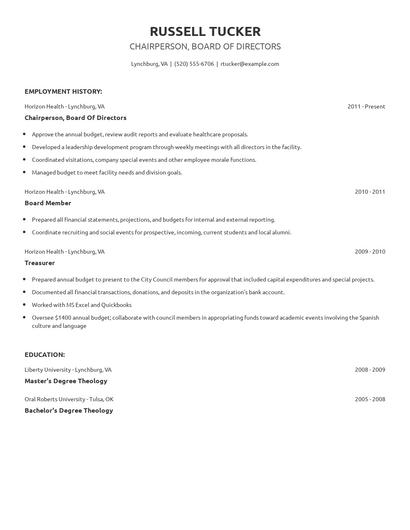
Choose from 10+ customizable chairperson, board of directors resume templates
Build a professional chairperson, board of directors resume in minutes. Our AI resume writing assistant will guide you through every step of the process, and you can choose from 10+ resume templates to create your chairperson, board of directors resume.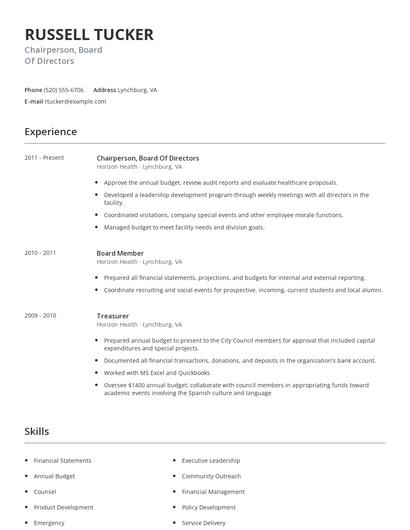
Compare different chairpeople, board of directors
Chairperson, board of directors vs. Owner
Owners, in the most basic sense, own the business, company, or organization. They are responsible for building the business. They create business plans and the general vision and mission of the company, set goals, work on these goals, and ensure that the business keeps running. They manage all aspects of their business, from finances to marketing to people, etc. When the business becomes stable, owners eventually hire more employees. As such, owners also become overseers who would ensure that the organization remains afloat.
While similarities exist, there are also some differences between chairpeople, board of directors and owner. For instance, chairperson, board of directors responsibilities require skills such as "non-profit organization," "policy development," "oversight," and "strategic plan." Whereas a owner is skilled in "customer service," "payroll," "product development," and "real estate." This is part of what separates the two careers.
Owners tend to reach lower levels of education than chairpeople, board of directors. In fact, owners are 9.3% less likely to graduate with a Master's Degree and 4.2% less likely to have a Doctoral Degree.Chairperson, board of directors vs. Co-founder
A Co-Founder is an essential member of a company as they complement the skills, vision, and mission of the Founder. Most of the time, the tasks of a Co-Founder revolve around the financial planning and developing strategies that would be beneficial for the company's financial gain and workforce. Furthermore, a Co-Founder must coordinate with the Founder and other staff and departments to remain aware of the progress or issues, should there be any, to provide timely resolutions.
Each career also uses different skills, according to real chairperson, board of directors resumes. While chairperson, board of directors responsibilities can utilize skills like "policy development," "oversight," "strategic plan," and "executive board," co-founders use skills like "business strategy," "r," "human resources," and "market research."
In general, co-founders achieve similar levels of education than chairpeople, board of directors. They're 1.8% less likely to obtain a Master's Degree while being 4.2% less likely to earn a Doctoral Degree.Chairperson, board of directors vs. President
Presidents are usually the highest-level executives in an organization. They oversee the whole company. They identify clear goals and provide strategic direction as the company works towards the achievement of their overall vision. Presidents are the decision-makers in the company. They make crucial decisions to ensure that the company continues to grow and survives challenges that come their way. They are expected to consider all stakeholders, from the board of directors and employees to the customers in their decision-making process. Presidents also represent the company in external functions, especially during high-level events. As such, they are expected to be professional, well-mannered, and good communicators.
The required skills of the two careers differ considerably. For example, chairpeople, board of directors are more likely to have skills like "policy development," "oversight," "community outreach," and "board chair." But a president is more likely to have skills like "product development," "r," "real estate," and "human resources."
Presidents typically earn lower educational levels compared to chairpeople, board of directors. Specifically, they're 5.1% less likely to graduate with a Master's Degree, and 3.3% less likely to earn a Doctoral Degree.Chairperson, board of directors vs. Executive
An Executive's responsibilities vary depending on an organization or company. However, most of the time, it involves a great deal of leadership and communication. An Executive must oversee and direct employees towards particular sets of goals and vision, create strategies and plans that will benefit the company's financial gains and workforce, and as well as evaluate and analyze the progress of various company departments. Moreover, an Executive holds the power of decision-making, such as in the aspects of budget, promotions, and policies.
Even though a few skill sets overlap between chairpeople, board of directors and executives, there are some differences that are important to note. For one, a chairperson, board of directors might have more use for skills like "non-profit organization," "policy development," "oversight," and "strategic plan." Meanwhile, some responsibilities of executives require skills like "customer service," "digital transformation," "customer satisfaction," and "payroll. "
Executives reach similar levels of education compared to chairpeople, board of directors, in general. The difference is that they're 3.4% more likely to earn a Master's Degree, and 3.9% less likely to graduate with a Doctoral Degree.Types of chairperson, board of directors
Updated January 8, 2025
