What does a citrix engineer do?
A Citrix engineer specializes in developing and establishing Citrix software and application technologies. It is their responsibility to identify project requirements, develop prototypes and test structures, identify and eliminate bugs, troubleshoot issues, and perform repairs and upgrades as necessary. They also establish guidelines and protocols, providing technical support to staff as necessary. Moreover, as a Citrix engineer, it is essential to keep abreast of the latest innovations to deliver efficient information technology systems and optimize company operations.
Citrix engineer responsibilities
Here are examples of responsibilities from real citrix engineer resumes:
- Manage physical and virtual servers with multiple OS's, includes provisioning, monitoring, governance and upgrades.
- Deploy and manage Citrix environments utilizing publish desktops and publish applications to make available to users both internally and externally.
- Experience in deploying provisioning services both MCS and PVS.
- Implement and support DNS and DHCP servers for local and company domains.
- Project lead for migrating legacy core applications into new OS platform for virtualization delivery into warehouses and corporate locations.
- Use of SCOM, SCCM.
- Deploy new software via SCCM.
- Carry out OS and software upgrades as required.
- Maintain SharePoint environments for multiple vendors and clients.
- Work with hardware and software vendors to troubleshoot problems.
- Involve in setup of NetApp filer in the environment.
- Build and test multi-protocol NAS cluster with storage, snapshots.
- Perform in-depth troubleshooting analysis and resolution of Xenapp, OS, and applications.
- Create knowledge base articles (KB's) for help desk to troubleshoot any known issues.
- Help to restore communications for Citrix database for 6.5 Farm in order to minimize downtime using Powershell.
Citrix engineer skills and personality traits
We calculated that 9% of Citrix Engineers are proficient in Infrastructure, Citrix Xenapp, and Windows Server. They’re also known for soft skills such as Analytical skills, Communication skills, and Problem-solving skills.
We break down the percentage of Citrix Engineers that have these skills listed on their resume here:
- Infrastructure, 9%
Involved in infrastructure planning, operational analysis, development, testing, setup, technical documentation and reporting.
- Citrix Xenapp, 7%
Designed and Deployed Disaster Recovery (DR) architecture of Citrix XenApp 6.5 application servers on a remote DR site.
- Windows Server, 7%
Capture a Windows Server 2008 R2 golden image with PVS 7.8 target software for Migration of XenApp 6.5 to 7.8 project.
- PowerShell, 6%
Create AD reports using output from Microsoft PowerShell.
- VDI, 5%
Manage VDI environment, configured XD (pervasive desktop) vs XA (non-pervasive laptop) environments.
- Citrix Xendesktop, 5%
Provide Citrix XenDesktop 5/5.5 technical support for systems.
Most citrix engineers use their skills in "infrastructure," "citrix xenapp," and "windows server" to do their jobs. You can find more detail on essential citrix engineer responsibilities here:
Analytical skills. One of the key soft skills for a citrix engineer to have is analytical skills. You can see how this relates to what citrix engineers do because "administrators need to evaluate networks and systems to make sure that they perform reliably and to anticipate new requirements as customers’ needs change." Additionally, a citrix engineer resume shows how citrix engineers use analytical skills: "installed and configured the xenapp 5.0 for citrix farm for the citrix provisioning server using the access data store. "
Communication skills. Another essential skill to perform citrix engineer duties is communication skills. Citrix engineers responsibilities require that "administrators must describe problems and their solutions to non-it workers." Citrix engineers also use communication skills in their role according to a real resume snippet: "created virtual private servers via vmware, and provisioning services in order to extend communications to applications via the farm. "
Problem-solving skills. This is an important skill for citrix engineers to perform their duties. For an example of how citrix engineer responsibilities depend on this skill, consider that "administrators must quickly resolve problems that arise with computer networks." This excerpt from a resume also shows how vital it is to everyday roles and responsibilities of a citrix engineer: "advised on the potential citrix vdi solutions. ".
The three companies that hire the most citrix engineers are:
- Teleperformance USA208 citrix engineers jobs
- Guidehouse51 citrix engineers jobs
- Motion Recruitment6 citrix engineers jobs
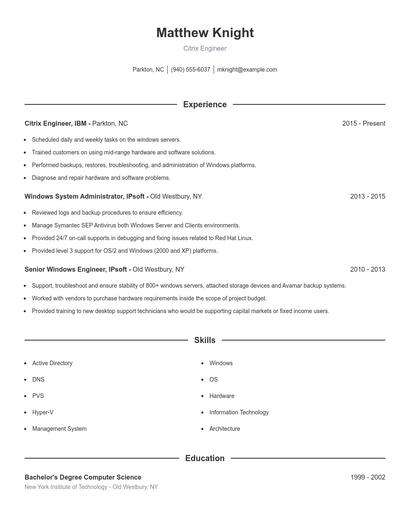
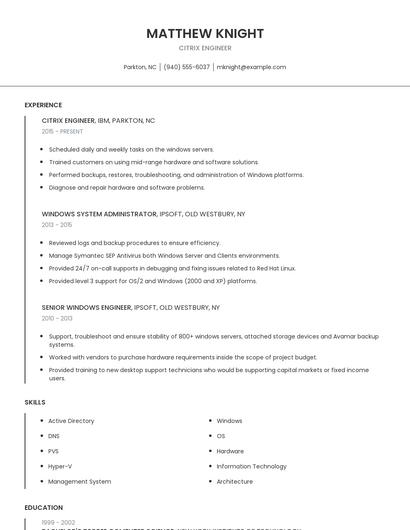
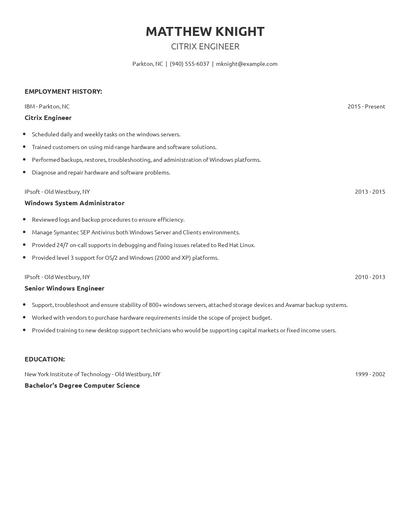
Choose from 10+ customizable citrix engineer resume templates
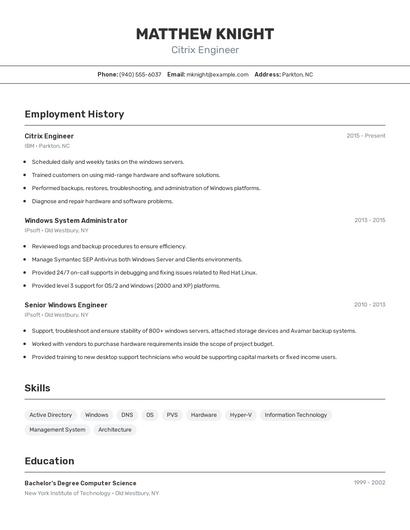
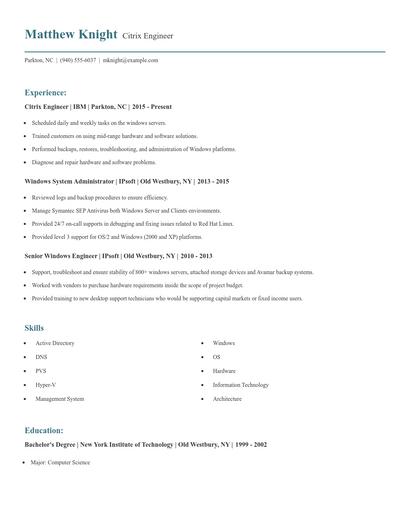
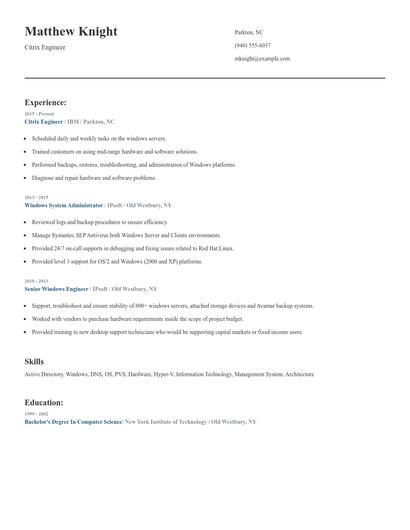
Build a professional citrix engineer resume in minutes. Our AI resume writing assistant will guide you through every step of the process, and you can choose from 10+ resume templates to create your citrix engineer resume.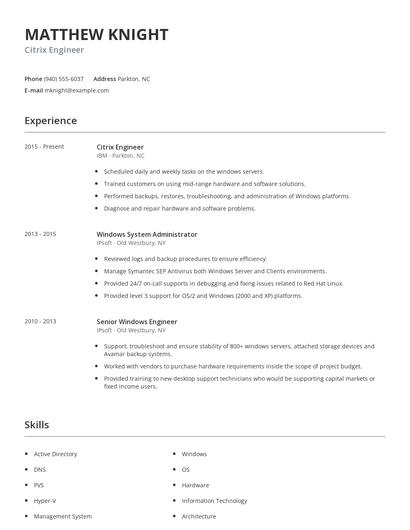


Compare different citrix engineers
Citrix engineer vs. Windows system administrator
A Windows System Administrator maintains the systems and servers of a Windows operating system. They evaluate and modify the system's performance.
These skill sets are where the common ground ends though. The responsibilities of a citrix engineer are more likely to require skills like "citrix xendesktop," "citrix netscaler," "architecture," and "pvs." On the other hand, a job as a windows system administrator requires skills like "linux," "group policy," "system administration," and "microsoft windows." As you can see, what employees do in each career varies considerably.
Windows system administrators earn the highest salaries when working in the finance industry, with an average yearly salary of $93,089. On the other hand, citrix engineers are paid more in the health care industry with an average salary of $98,256.The education levels that windows system administrators earn slightly differ from citrix engineers. In particular, windows system administrators are 3.2% less likely to graduate with a Master's Degree than a citrix engineer. Additionally, they're 0.6% less likely to earn a Doctoral Degree.Citrix engineer vs. Network/server administrator
A Network Administrator ensures an organizations' network is operational and up to date. They solve problems that arise within computer networks, maintaining computer networks, interacting with clients, and consulting with them to determine their system requirements.
Each career also uses different skills, according to real citrix engineer resumes. While citrix engineer responsibilities can utilize skills like "infrastructure," "citrix xenapp," "vdi," and "citrix xendesktop," network/server administrators use skills like "customer service," "linux," "server administration," and "microsoft windows."
On average, network/server administrators earn a lower salary than citrix engineers. Some industries support higher salaries in each profession. Interestingly enough, network/server administrators earn the most pay in the manufacturing industry with an average salary of $84,609. Whereas citrix engineers have higher pay in the health care industry, with an average salary of $98,256.In general, network/server administrators achieve lower levels of education than citrix engineers. They're 7.2% less likely to obtain a Master's Degree while being 0.6% less likely to earn a Doctoral Degree.Citrix engineer vs. Systems integration engineer
A systems integration engineer is responsible for evaluating the efficiency and performance of the control systems to support business operations and requirements. Systems integration engineers develop technical solutions from business initiatives that would maximize a team's productivity and increase target performance. They also handle the upgrades of network infrastructure and system configuration and resolve technical failures as soon as they arise. A systems integration engineer must have excellent communication and technical skills, especially in providing recommendations to improve the network's capability and prevent downtimes.
The required skills of the two careers differ considerably. For example, citrix engineers are more likely to have skills like "infrastructure," "citrix xenapp," "powershell," and "vdi." But a systems integration engineer is more likely to have skills like "python," "system integration," "c++," and "c #."
Systems integration engineers earn the best pay in the professional industry, where they command an average salary of $105,674. Citrix engineers earn the highest pay from the health care industry, with an average salary of $98,256.systems integration engineers typically earn similar educational levels compared to citrix engineers. Specifically, they're 3.3% more likely to graduate with a Master's Degree, and 0.3% more likely to earn a Doctoral Degree.Citrix engineer vs. Senior infrastructure engineer
A senior infrastructure engineer specializes in designing and developing systems and infrastructures based on client preferences and industry standards. They have the duty to identify and understand the project's needs, streamline project requirements, produce drafts, create prototypes and models, and establish tests to identify potential issues and ensure the projects' quality. Additionally, a senior infrastructure engineer has the authority to make decisions, train and supervise junior engineers, establish goals and timelines, provide technical support, and implement policies and guidelines.
Types of citrix engineer
Updated January 8, 2025
