What does a client support professional do?
Also called a customer support specialist, a client support professional is someone who responds to client requests, inquiries, comments, and complaints. Client support professionals cater to customer issues accurately and on time thru email, chat, or phone. They determine client needs and help them use particular features. It is their job to process customer accounts from opening and closing these accounts and handling the billing information. Also, they analyze and report the malfunctions of products.
Client support professional responsibilities
Here are examples of responsibilities from real client support professional resumes:
- Manage project SharePoint site for the purpose of supporting ongoing collaboration
- Perform personal care and assist with ADL s when necessary
- Recieve PIA crisis intervention training as well as CPR and first aid.
- integrate adults with autism back into their community
- Promote continuity of care by accurately and completely communicating to other caregivers the status of patients for which care is provided.
- Transport individuals to purchase groceries.
- Document progress and communicate to MHMR case manager.
Client support professional skills and personality traits
We calculated that 8% of Client Support Professionals are proficient in Support Professionals, Developmental Disabilities, and Data Entry. They’re also known for soft skills such as Customer-service skills, Listening skills, and Speaking skills.
We break down the percentage of Client Support Professionals that have these skills listed on their resume here:
- Support Professionals, 8%
Mentored assigned team of Support Professionals.
- Developmental Disabilities, 7%
Support individuals with developmental disabilities living in a group apartment setting and working toward obtaining living independently in their own apartments.
- Data Entry, 7%
Provided data entry and other administrative support increasing positive customer experiences.
- Physical Disabilities, 6%
Provide quality supported living assistance to clients with mental and physical disabilities.
- PowerPoint, 6%
Create Word, Excel and PowerPoint documents that include presentations, estimates/proposals and responses to requests for proposals.
- Proofreading, 5%
Performed administrative support tasks, such as proofreading, transcribing handwritten information and computer work with invoices or other documents.
Most client support professionals use their skills in "support professionals," "developmental disabilities," and "data entry" to do their jobs. You can find more detail on essential client support professional responsibilities here:
Customer-service skills. One of the key soft skills for a client support professional to have is customer-service skills. You can see how this relates to what client support professionals do because "computer support specialists must be patient and sympathetic." Additionally, a client support professional resume shows how client support professionals use customer-service skills: "provide responsive and competent customer support within a call center environment. "
Listening skills. Another soft skill that's essential for fulfilling client support professional duties is listening skills. The role rewards competence in this skill because "support workers must be able to understand the problems that their customers are describing and know when to ask questions to clarify the situation." According to a client support professional resume, here's how client support professionals can utilize listening skills in their job responsibilities: "communicated to persons of interest what issues are important in the lives of persons with developmental disabilities. "
Speaking skills. This is an important skill for client support professionals to perform their duties. For an example of how client support professional responsibilities depend on this skill, consider that "support workers must describe the solutions to computer problems in a way that a nontechnical person can understand." This excerpt from a resume also shows how vital it is to everyday roles and responsibilities of a client support professional: "addressed behavioral issues with supervisor and supervisor assistant. ".
Writing skills. client support professional responsibilities often require "writing skills." The duties that rely on this skill are shown by the fact that "strong writing skills are useful for preparing instructions and email responses for employees and customers, as well as for real-time web chat interactions." This resume example shows what client support professionals do with writing skills on a typical day: "worked directly with children with mental illness assisted deaf children with reading and writing"
Problem-solving skills. A commonly-found skill in client support professional job descriptions, "problem-solving skills" is essential to what client support professionals do. Client support professional responsibilities rely on this skill because "support workers must identify both simple and complex computer problems, analyze them, and solve them." You can also see how client support professional duties rely on problem-solving skills in this resume example: "provided in-depth telephone support to clients troubleshooting computer problems focused on first-call resolution. "
The three companies that hire the most client support professionals are:
- Cintas13 client support professionals jobs
- Fiserv8 client support professionals jobs
- Lutheran Social Services Of Wi & Upper Mi5 client support professionals jobs
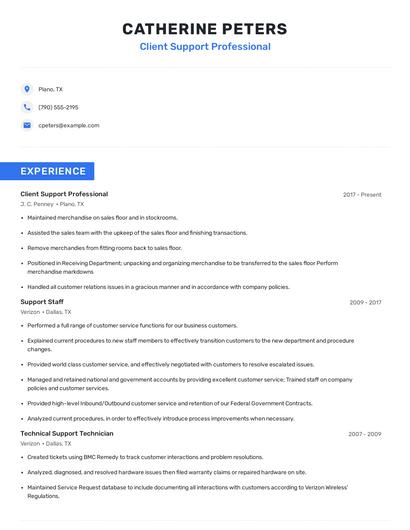
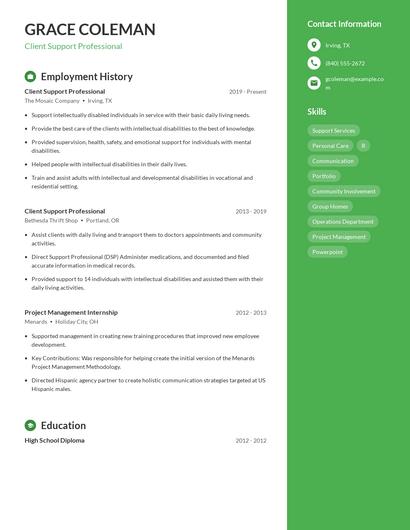
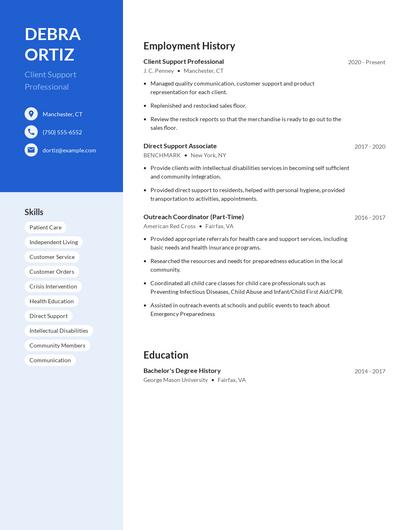
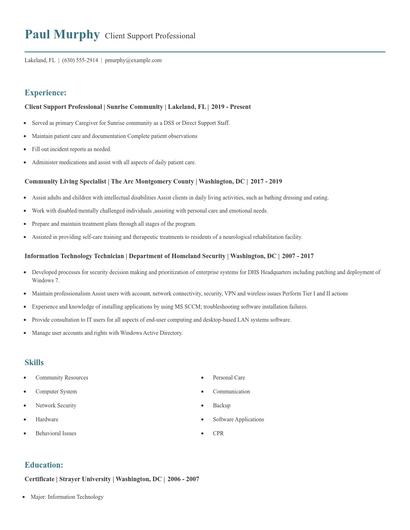
Choose from 10+ customizable client support professional resume templates
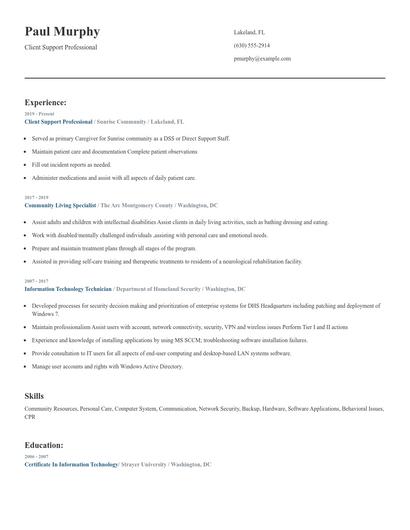
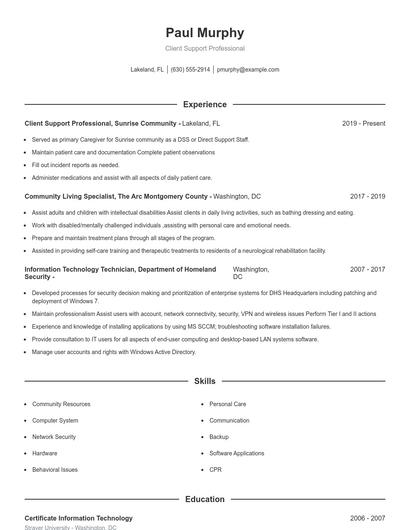
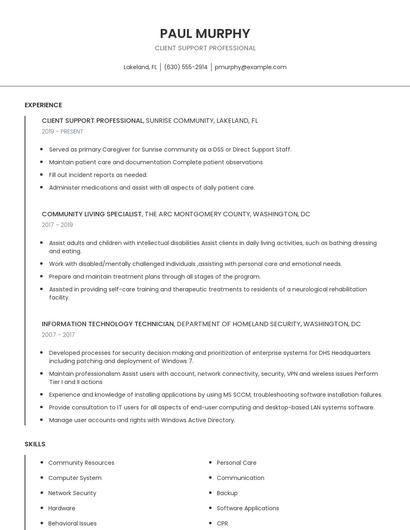
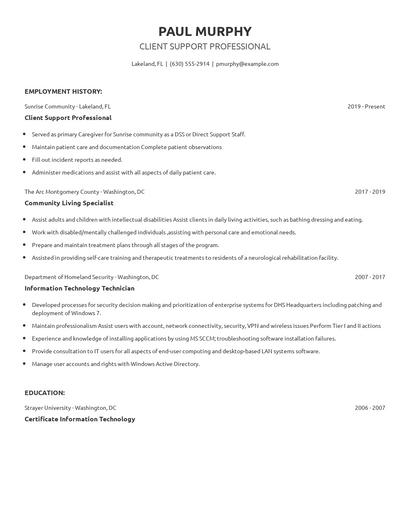
Build a professional client support professional resume in minutes. Our AI resume writing assistant will guide you through every step of the process, and you can choose from 10+ resume templates to create your client support professional resume.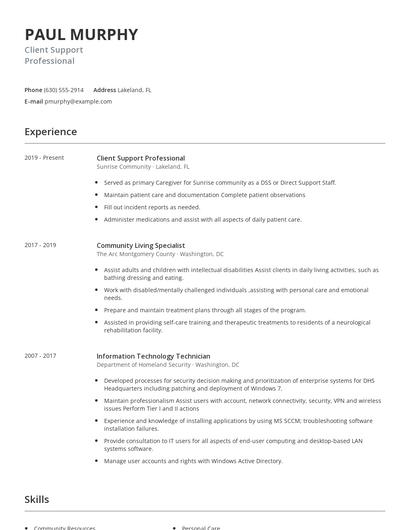
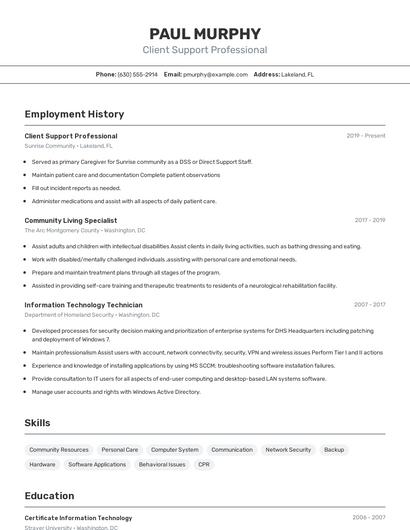
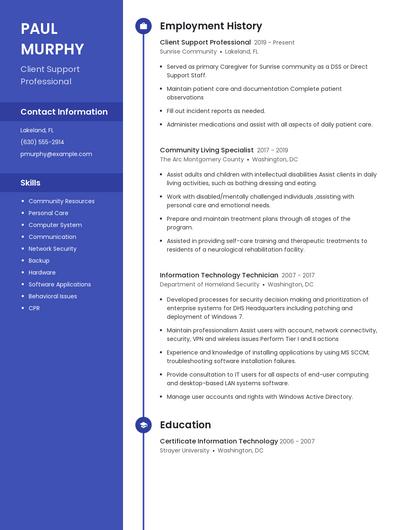
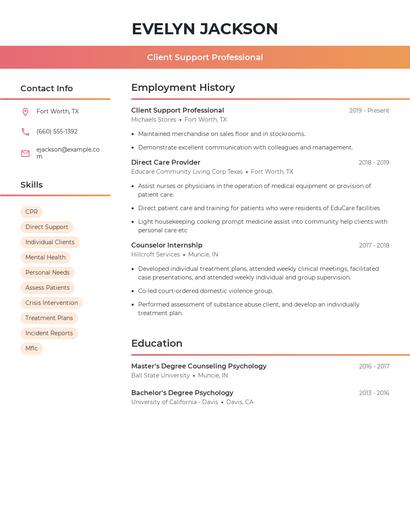
Compare different client support professionals
Client support professional vs. Support
A support employee is responsible for assisting the business operations and responding to customers' inquiries and concerns regarding its goods and services. Support logs all customers' interaction and escalates potential complaints to the appropriate department. They also help with implementing strategic procedures to improve operations and reach maximum productivity. A support employee must have excellent communication and customer service skills, ensuring clients' satisfaction with the services and maintain good feedback to boost the company's brand, attract more clients, and increase revenues.
These skill sets are where the common ground ends though. The responsibilities of a client support professional are more likely to require skills like "support professionals," "physical disabilities," "proofreading," and "direct care." On the other hand, a job as a support requires skills like "customer service," "cash management," "inventory control," and "ladders." As you can see, what employees do in each career varies considerably.
On average, supports reach similar levels of education than client support professionals. Supports are 1.1% less likely to earn a Master's Degree and 0.3% more likely to graduate with a Doctoral Degree.Client support professional vs. Systems support
A systems support agent is responsible for resolving system applications and network issues, performing technical configuration, and upgrading systems infrastructure. A systems support representative conducts regular maintenance and diagnostic tests on the computer applications to ensure its optimal performance and efficiency to support business operations and avoid delays in deliverables. They also assist the technology team in designing backup systems and improve existing networks according to business requirements and specifications. They write resolution reports for reference to prevent the reoccurrence of system malfunction and inconsistencies.
In addition to the difference in salary, there are some other key differences worth noting. For example, client support professional responsibilities are more likely to require skills like "support professionals," "developmental disabilities," "data entry," and "physical disabilities." Meanwhile, a systems support has duties that require skills in areas such as "customer service," "troubleshoot," "pc," and "provides technical support." These differences highlight just how different the day-to-day in each role looks.
Average education levels between the two professions vary. Systems supports tend to reach similar levels of education than client support professionals. In fact, they're 1.0% more likely to graduate with a Master's Degree and 0.3% more likely to earn a Doctoral Degree.Client support professional vs. Support staff
School support staff provide specialized instructional and student support while utilizing school facilities. They often include diverse staff members whose main role is to ensure that students learn in a supportive and safe learning environment. It is also their duty to enhance school climate by promoting the involvement of parent and family in education as well as to encourage trusting, positive student relationships. They should inhibit positive behavior and send uplifting messages to students as they often connect with them throughout the day.
Some important key differences between the two careers include a few of the skills necessary to fulfill the responsibilities of each. Some examples from client support professional resumes include skills like "support professionals," "data entry," "proofreading," and "photocopying," whereas a support staff is more likely to list skills in "customer service," "home maintenance," "crisis intervention," and "behavioral issues. "
When it comes to education, desk clerks supervisors tend to earn similar degree levels compared to client support professionals. In fact, they're 1.2% less likely to earn a Master's Degree, and 0.2% less likely to graduate with a Doctoral Degree.Client support professional vs. Technical support agent
A technical support agent specializes in providing computer and system support through calls and correspondence, ensuring optimal customer satisfaction. They are primarily responsible for assisting customers in troubleshooting and evaluating systems to figure out the cause of technical issues and talk them through its corresponding solution. Moreover, an agent must make follow-up calls to ensure that the problem no longer persists or forward them to higher authority personnel when necessary.
Types of client support professional
Updated January 8, 2025
