What does a compensator worker do?
A compensator worker manages office upkeep organization supplies and vendors and works with CPT coding and ICD9 coding. Besides using CPT codes and ICD9 codes to code all Coe or Aoe evaluations, surgical procedures, and consultations, compensation workers also direct and supervise law office tasks, including subpoenas delivery. These professionals facilitate close working relationships between medical providers, managers, injured workers, and third-party administrators. Moreover, compensator workers resolve key issues by corresponding with opposition counsel, clients, and WCAB.
Compensator worker responsibilities
Here are examples of responsibilities from real compensator worker resumes:
- Manage OSHA logs and insure ongoing awareness for warehouse safety and risk management guidelines
- Enter job numbers into QuickBooks.
- Look up case information in EAMS.
- Have basic knowledge of NCCI regulations.
- Work extensively with ICD9 and CPT coding.
- Enter all new hires into QuickBooks and timekeeping system.
- Experience in medical terminology as well as ICD-9 and CPT codes.
- Use of EAMS and EDEX to verify and investigate status of claims/cases.
- Serve as liaison between injure workers, TPA, managers, and medical providers.
- Assure that appropriate class codes are used and that NCCI rules are being adhere to.
- Participate in semi-annual file reviews at the TPA office preparing a summary of all action items identify.
- Work closely with in-house counsel to stay connect with all updates and changes within the FMLA law.
- Experience in medical records, general understanding of legal protocols, efficient knowledge of HIPPA laws and practices.
- Test & troubleshoot DS0 phone lines in retirement/nursing homes and call vendors to test and dispatch their techs.
- Draft and file pleadings, handle discovery demands, draft subpoenas, request state and federal workers' compensation hearings.
Compensator worker skills and personality traits
We calculated that 15% of Compensator Workers are proficient in Litigation, Patients, and Legal Research. They’re also known for soft skills such as Business skills, Analytical skills, and Detail oriented.
We break down the percentage of Compensator Workers that have these skills listed on their resume here:
- Litigation, 15%
Prepared client files for litigation with discovery, interrogatory findings and reviewed medical records.
- Patients, 14%
Issued medical billing for workers compensation patients which required selection and delivery of the required documents.
- Legal Research, 8%
Perform legal research, including cite-check of judicial filings and computerized legal research.
- Management System, 5%
Coordinated maintenance of online claims management system and interfaced computer systems through Ascension IS department.
- Appeals, 5%
Drafted settlement documentation and Medicare appeals for lien reduction process.
- Compensation Benefits, 5%
Obtain workers compensation benefits for clients who are not being paid out by insurance companies.
"litigation," "patients," and "legal research" are among the most common skills that compensator workers use at work. You can find even more compensator worker responsibilities below, including:
Analytical skills. Another essential skill to perform compensator worker duties is analytical skills. Compensator workers responsibilities require that "adjusters and examiners must each evaluate whether the insurance company is obligated to pay a claim and determine the amount to pay." Compensator workers also use analytical skills in their role according to a real resume snippet: "completed contract analysis and research assignments for legal issues related to pending litigation. "
Detail oriented. compensator workers are also known for detail oriented, which are critical to their duties. You can see how this skill relates to compensator worker responsibilities, because "adjusters, appraisers, examiners, and investigators must carefully review documents and damaged property, because small details can have large financial consequences." A compensator worker resume example shows how detail oriented is used in the workplace: "completed detailed fee applications and filed with the workers' compensation board. "
Communication skills. For certain compensator worker responsibilities to be completed, the job requires competence in "communication skills." The day-to-day duties of a compensator worker rely on this skill, as "claims adjusters and investigators must get information from a range of people, including claimants, witnesses, and medical experts." For example, this snippet was taken directly from a resume about how this skill applies to what compensator workers do: "direct communication with insurance adjusters, attorneys, nurse case managers and clients. "
The three companies that hire the most compensator workers are:
- Gallagher8 compensator workers jobs
- Justworks4 compensator workers jobs
- Chartwell Law4 compensator workers jobs
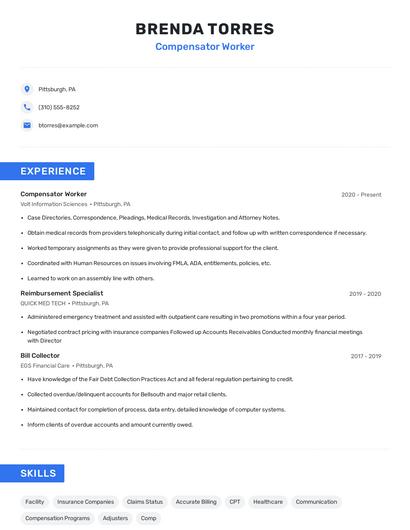
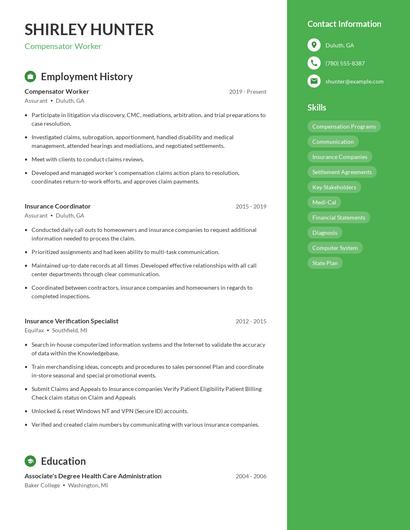
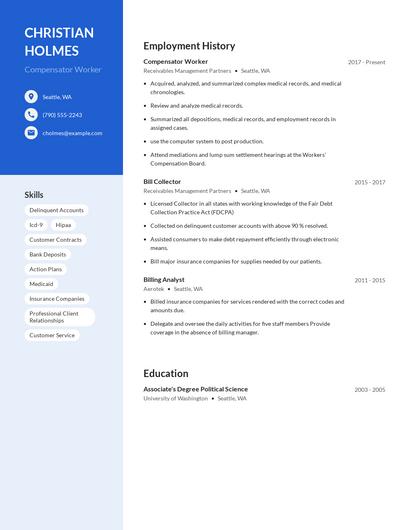
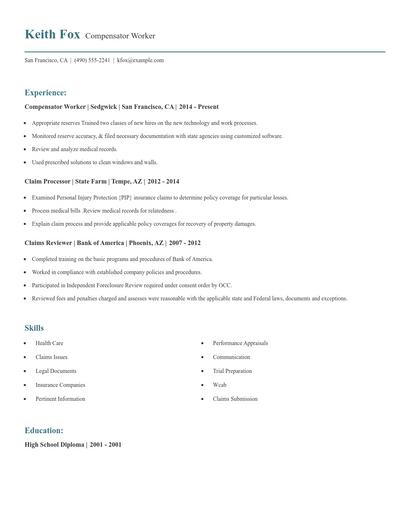
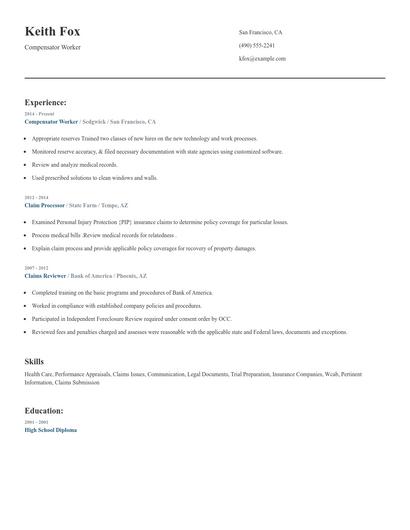
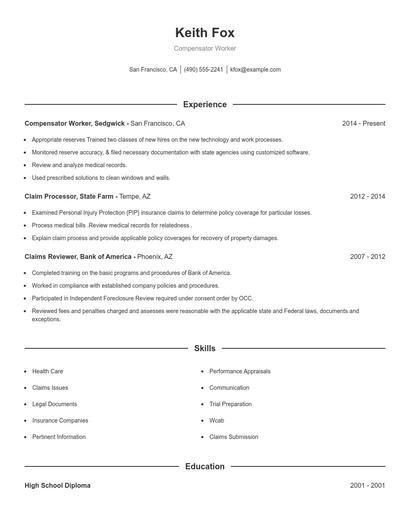
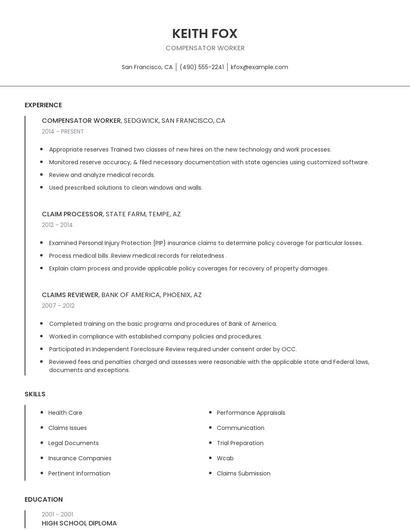
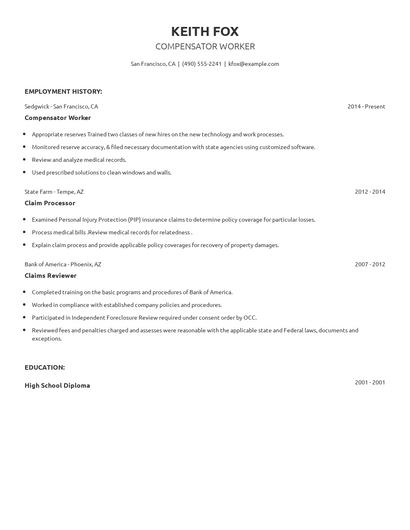
Choose from 10+ customizable compensator worker resume templates
Build a professional compensator worker resume in minutes. Our AI resume writing assistant will guide you through every step of the process, and you can choose from 10+ resume templates to create your compensator worker resume.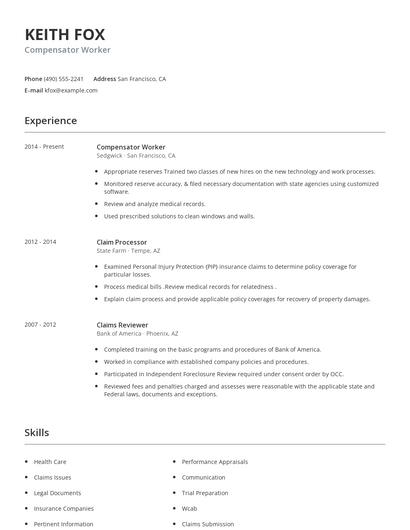
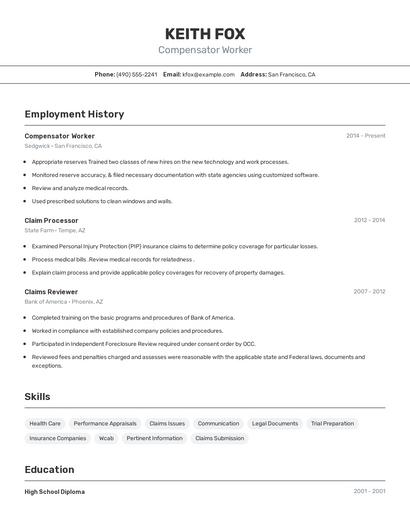
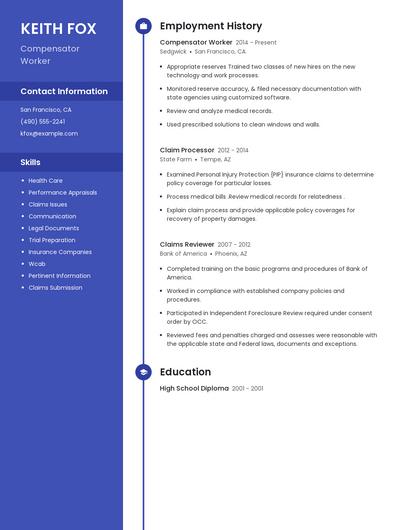
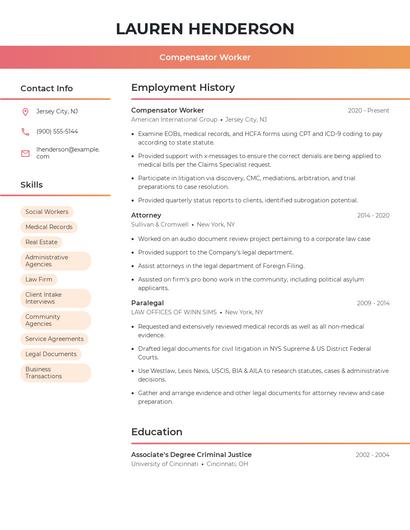
Compare different compensator workers
Compensator worker vs. Fabric finisher
These skill sets are where the common ground ends though. The responsibilities of a compensator worker are more likely to require skills like "litigation," "patients," "legal research," and "management system." On the other hand, a job as a fabric finisher requires skills like "grinders," "mig," "calipers," and "band saws." As you can see, what employees do in each career varies considerably.
The education levels that fabric finishers earn slightly differ from compensator workers. In particular, fabric finishers are 1.9% less likely to graduate with a Master's Degree than a compensator worker. Additionally, they're 4.7% less likely to earn a Doctoral Degree.Compensator worker vs. Shrinking machine operator
Each career also uses different skills, according to real compensator worker resumes. While compensator worker responsibilities can utilize skills like "litigation," "patients," "legal research," and "management system," shrinking machine operators use skills like "pallets," "customer specifications," "code dates," and "wrap machine."
Average education levels between the two professions vary. Shrinking machine operators tend to reach similar levels of education than compensator workers. In fact, they're 5.0% less likely to graduate with a Master's Degree and 4.7% less likely to earn a Doctoral Degree.Compensator worker vs. Washing machine operator
The required skills of the two careers differ considerably. For example, compensator workers are more likely to have skills like "litigation," "patients," "legal research," and "management system." But a washing machine operator is more likely to have skills like "washing machines," "dryers," "lock out-tag," and "safety procedures."
Washing machine operators typically earn similar educational levels compared to compensator workers. Specifically, they're 1.7% less likely to graduate with a Master's Degree, and 4.7% less likely to earn a Doctoral Degree.Compensator worker vs. Jetting machine operator
Types of compensator worker
Updated January 8, 2025
