What does a component assembler do?
Component assembler responsibilities
Here are examples of responsibilities from real component assembler resumes:
- Cut & form components for PCB in manufacturing
- Perform electro-mechanical assembly including point-to-point wiring, wring-out and cable harness layout, and basic mechanical assembly.
- Assemble, wire, troubleshoot, test and repair industrial G6 gas fill circuit breakers
- Diagnose, troubleshoot and repair damage or out of revision control cables as well as construct new complex cable harnesses.
- Assist with the assembling and packing of medical/surgical components/devices to manufacturer and FDA specifications.
Component assembler skills and personality traits
We calculated that 32% of Component Assemblers are proficient in Assembly Line, Safety Procedures, and Assembly Process.
We break down the percentage of Component Assemblers that have these skills listed on their resume here:
- Assembly Line, 32%
Performed labor along an assembly line building automotive parts, verifying component accuracy and providing accurate component placement against blueprints.
- Safety Procedures, 31%
Followed all safety procedures, environmental guidelines and company rules and regulations while performing assembly of products.
- Assembly Process, 26%
Provided detailed analyses accurately, and promptly to improve productivity and streamlined assembly process via detailed note system.
- Hand Tools, 4%
Assembled structural parts, such as metal, fiberglass ladders, using hand tools and portable power tools.
- Assembly Operations, 3%
Led bench assembly operations which produced components at a required.
- Electrical Components, 1%
Assembled various electrical components for workstations
Most component assemblers use their skills in "assembly line," "safety procedures," and "assembly process" to do their jobs. You can find more detail on essential component assembler responsibilities here:
The three companies that hire the most component assemblers are:
- Builders FirstSource9 component assemblers jobs
- ITW4 component assemblers jobs
- NESCO3 component assemblers jobs
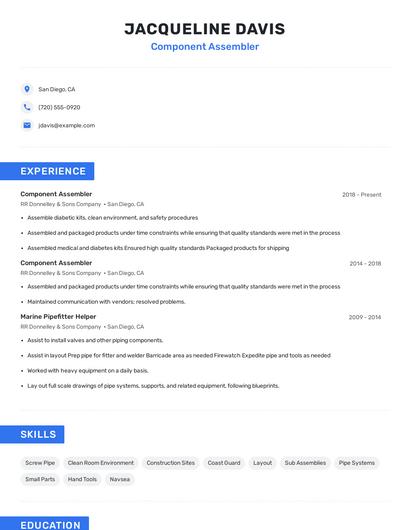
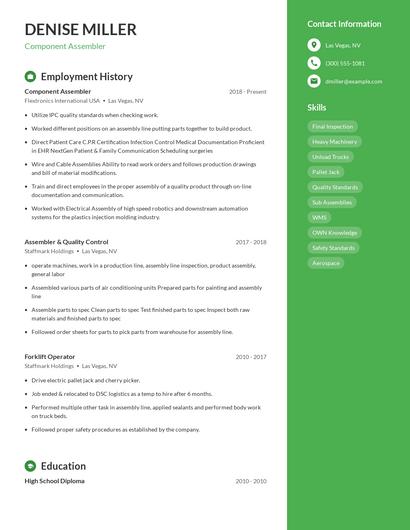
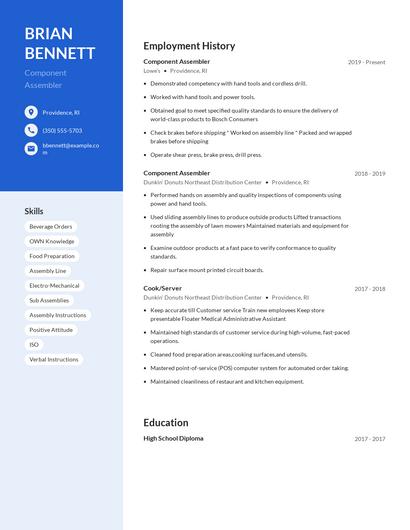
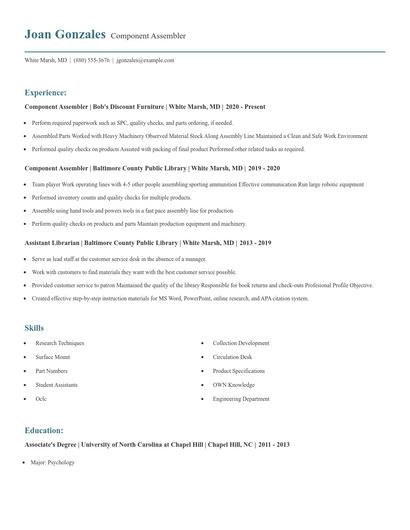
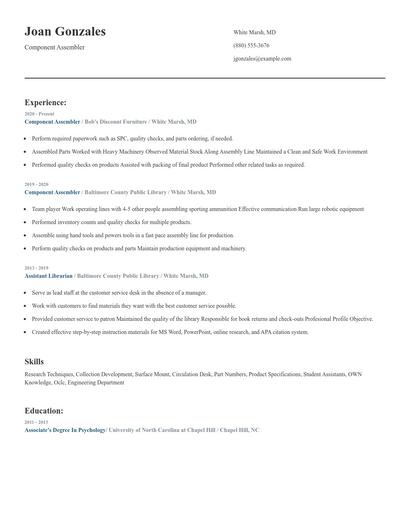
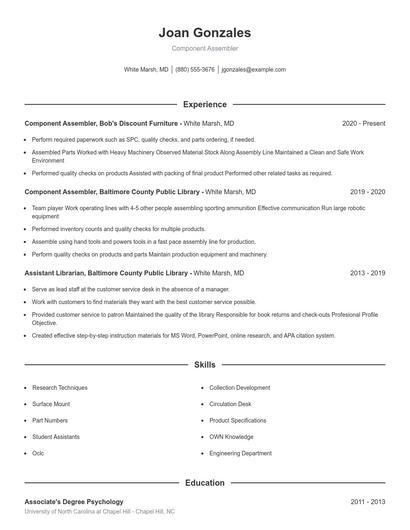
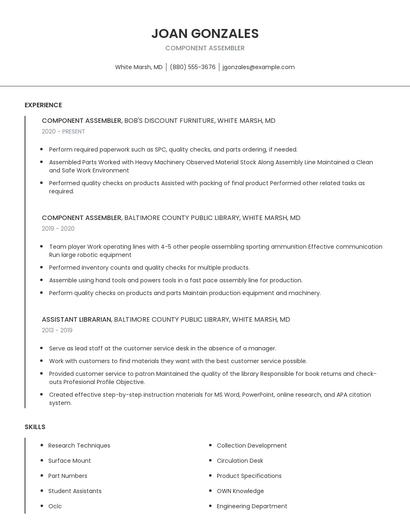
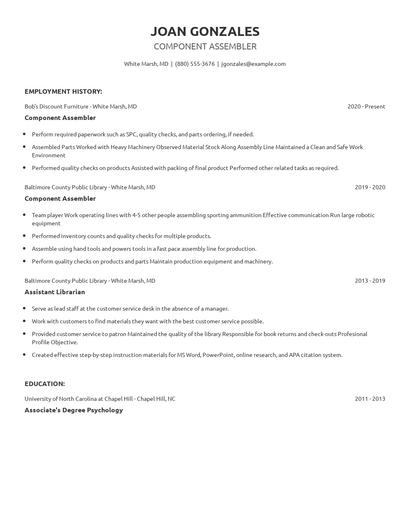
Choose from 10+ customizable component assembler resume templates
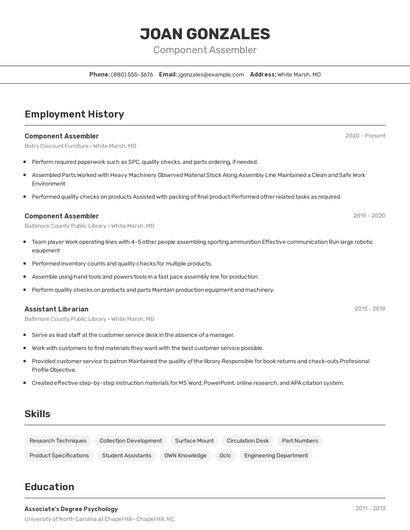
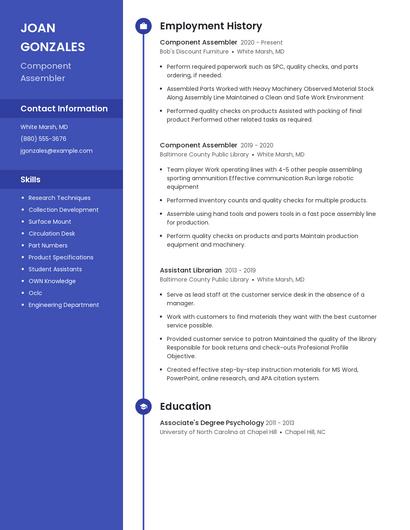
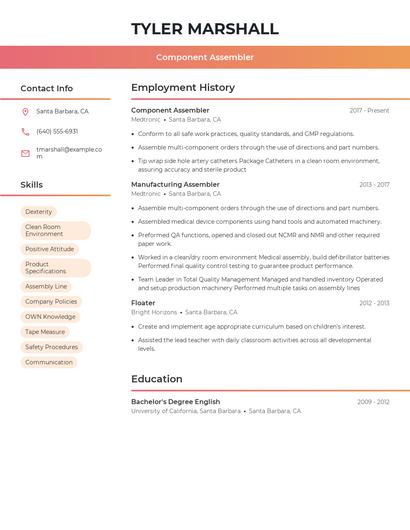
Build a professional component assembler resume in minutes. Our AI resume writing assistant will guide you through every step of the process, and you can choose from 10+ resume templates to create your component assembler resume.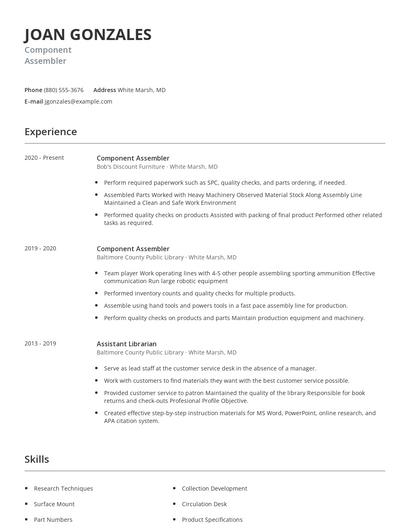
Compare different component assemblers
Component assembler vs. Solder technician
Assembly technicians are responsible for constructing small parts and components to create a new product according to the specifications of a client or a supervisor. An assembly technician performs diagnostic tests on the assembled product to ensure efficiency and conduct adjustments as needed. An assembly technician also provides manual instructional guides for product use and troubleshooting procedures. Assembly technicians must be knowledgeable about the technology and mechanical industry, as well as have the ability to analyze designs as a guide for creating high-quality products.
These skill sets are where the common ground ends though. The responsibilities of a component assembler are more likely to require skills like "safety procedures," "assembly process," "set-up sheets," and "process improvement." On the other hand, a job as a solder technician requires skills like "through-hole," "ipc-a-610," "circuit board assembly," and "dexterity." As you can see, what employees do in each career varies considerably.
Solder technicians tend to reach similar levels of education than component assemblers. In fact, solder technicians are 0.5% less likely to graduate with a Master's Degree and 0.4% more likely to have a Doctoral Degree.Component assembler vs. Assembler & quality control
While some skills are similar in these professions, other skills aren't so similar. For example, resumes show us that component assembler responsibilities requires skills like "safety procedures," "set-up sheets," "process improvement," and "hand tools." But an assembler & quality control might use other skills in their typical duties, such as, "part numbers," "quality checks," "safety guidelines," and "control panels."
Assemblers & quality control may earn a lower salary than component assemblers, but assemblers & quality control earn the most pay in the automotive industry with an average salary of $34,668. On the other hand, component assemblers receive higher pay in the manufacturing industry, where they earn an average salary of $38,984.Average education levels between the two professions vary. Assemblers & quality control tend to reach similar levels of education than component assemblers. In fact, they're 0.5% less likely to graduate with a Master's Degree and 0.4% less likely to earn a Doctoral Degree.Component assembler vs. Assembler musical equipment
There are many key differences between these two careers, including some of the skills required to perform responsibilities within each role. For example, a component assembler is likely to be skilled in "safety procedures," "assembly process," "set-up sheets," and "process improvement," while a typical assembler musical equipment is skilled in "extreme temperature changes," "fitness equipment," "forks," and "assembly diagrams."
Assembler musical equipment earn the best pay in the manufacturing industry, where they command an average salary of $35,148. Component assemblers earn the highest pay from the manufacturing industry, with an average salary of $38,984.Most assembler musical equipment achieve a similar degree level compared to component assemblers. For example, they're 0.3% less likely to graduate with a Master's Degree, and 0.7% less likely to earn a Doctoral Degree.Component assembler vs. Assembly technician
Types of component assembler
Updated January 8, 2025
