What does a conference interpreter do?
Conference interpreter responsibilities
Here are examples of responsibilities from real conference interpreter resumes:
- Coach and teach students to achieve grades at or beyond expect IEP goals.
- Help to build collaboration with internal and international patients with medical staff, social organizations and insurance companies.
- Follow establish departmental guidelines and protect confidentiality of member's information (HIPPA )
Conference interpreter skills and personality traits
We break down the percentage of Conference Interpreters that have these skills listed on their resume here:
- Police Reports, 100%
Translated contracts, personal statements, medical and police reports, technical materials.
Business skills. One of the key soft skills for a conference interpreter to have is business skills. You can see how this relates to what conference interpreters do because "self-employed interpreters and translators must be able to manage their finances." Additionally, a conference interpreter resume shows how conference interpreters use business skills: "instructed sign language classes for professional businesses and area community education. "
Cultural sensitivity. Another soft skill that's essential for fulfilling conference interpreter duties is cultural sensitivity. The role rewards competence in this skill because "interpreters and translators must be aware of expectations among the people for whom they are helping to facilitate communication." According to a conference interpreter resume, here's how conference interpreters can utilize cultural sensitivity in their job responsibilities: "planed opportunities to develop the social, emotional and cultural aspects of pupils' learning. "
Dexterity. Another skill that relates to the job responsibilities of conference interpreters is dexterity. This skill is critical to many everyday conference interpreter duties, as "sign language interpreters must be able to make quick and coordinated hand, finger, and arm movements when interpreting." This example from a resume shows how this skill is used: "perform frequent transfers and lifting, dressing, bathing, grooming and feeding for all assigned patients. "
Interpersonal skills. For certain conference interpreter responsibilities to be completed, the job requires competence in "interpersonal skills." The day-to-day duties of a conference interpreter rely on this skill, as "interpreters and translators must be able to put clients and others at ease." For example, this snippet was taken directly from a resume about how this skill applies to what conference interpreters do: "helped break down language barriers, effective communication and interpersonal skillsworked well under emotionally charged conversations. "
Listening skills. Another crucial skill for a conference interpreter to carry out their responsibilities is "listening skills." A big part of what conference interpreters relies on this skill, since "interpreters must pay attention when interpreting for audiences to ensure that they hear and interpret correctly." How this skill relates to conference interpreter duties can be seen in an example from a conference interpreter resume snippet: "communicated and consult with parents over all aspects of their children's education - academic, social and emotional. "
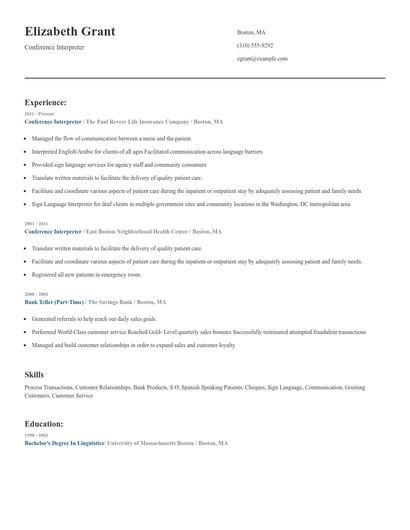
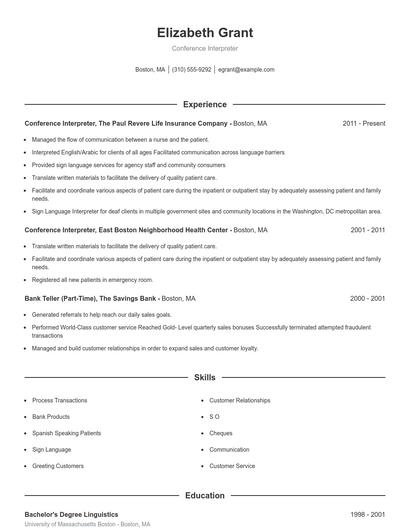
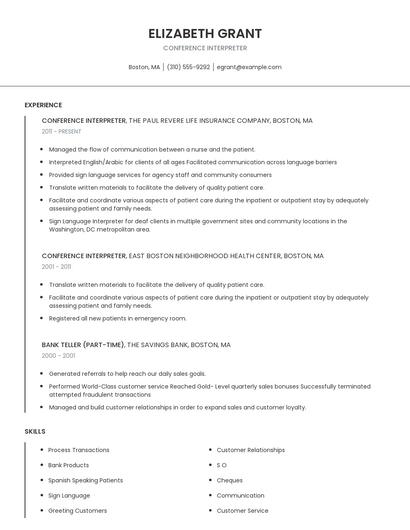
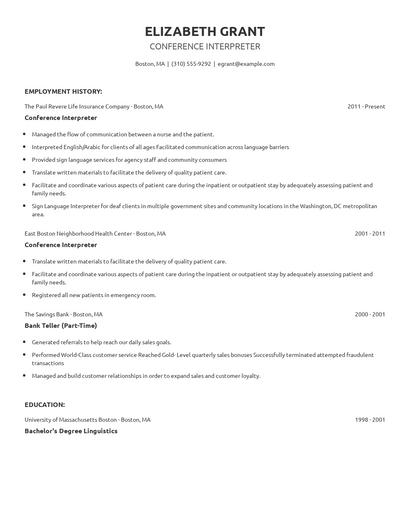
Choose from 10+ customizable conference interpreter resume templates
Build a professional conference interpreter resume in minutes. Our AI resume writing assistant will guide you through every step of the process, and you can choose from 10+ resume templates to create your conference interpreter resume.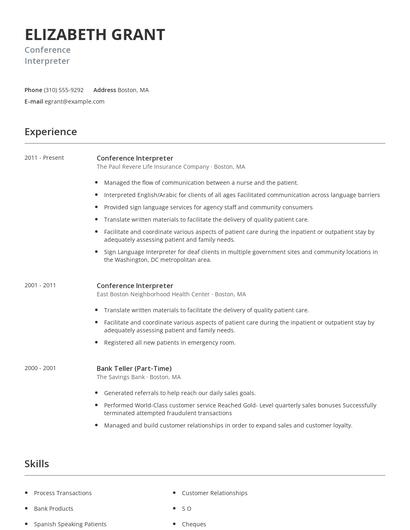
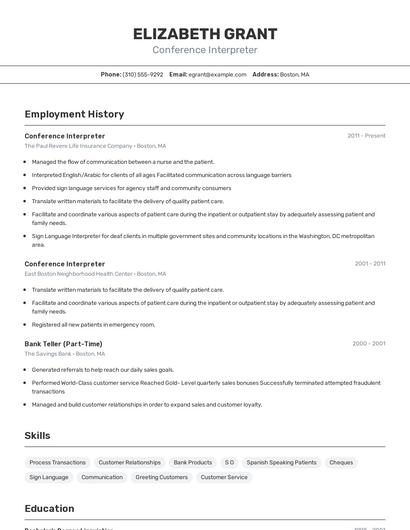
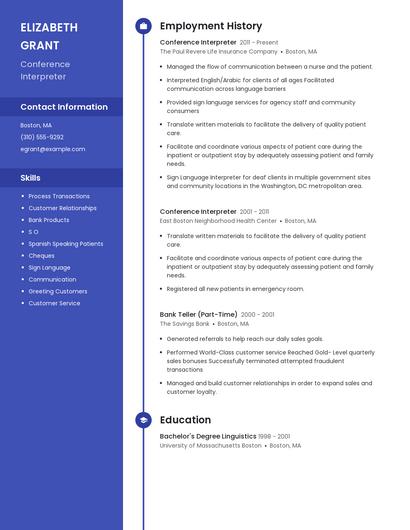
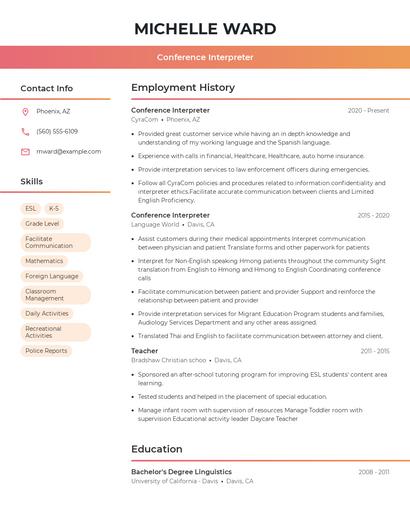
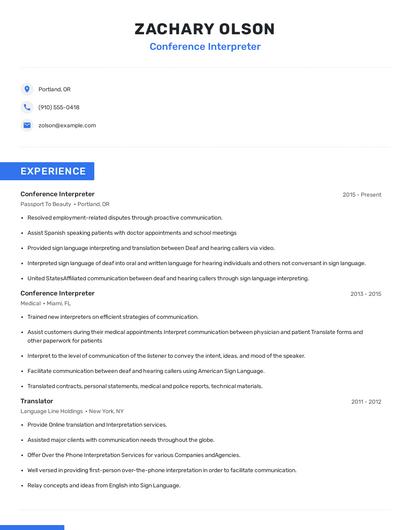
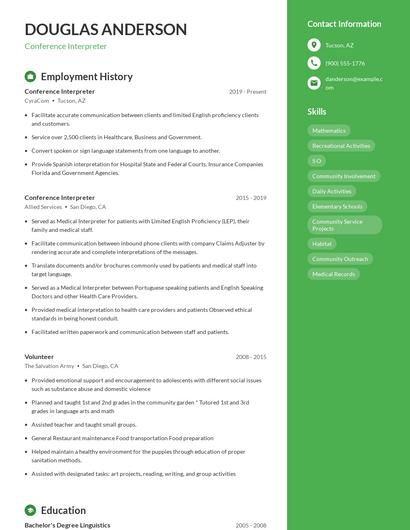
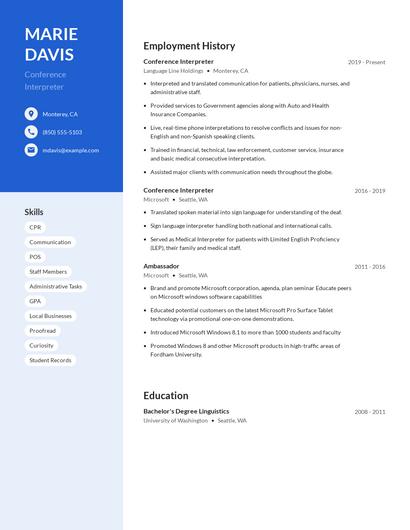
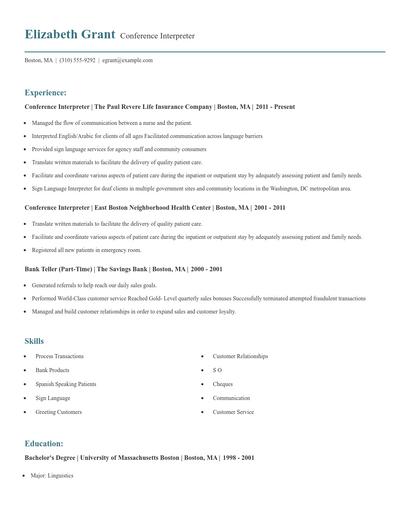
Compare different conference interpreters
Conference interpreter vs. Technical translator
Technical Translation is the act of translating materials in a specific technical or scientific subject domain. A Technical Translator understands the nitty-gritty of the subject matter and knows the specialized terms in that field in both the source and secondary languages. This individual works to produce translations and interpretations of either written or oral communications of one language to another for a specific purpose or industry. As a Technical Translator, your duties may include interpreting conferences and emails in an organization.
These skill sets are where the common ground ends though. The responsibilities of a conference interpreter are more likely to require skills like "police reports," "asl," "international conferences," and "forum." On the other hand, a job as a technical translator requires skills like "technical translation," "technical manuals," "proofreading," and "user interface." As you can see, what employees do in each career varies considerably.
The education levels that technical translators earn slightly differ from conference interpreters. In particular, technical translators are 11.1% less likely to graduate with a Master's Degree than a conference interpreter. Additionally, they're 0.0% more likely to earn a Doctoral Degree.Conference interpreter vs. Arabic translator
Arabic linguists are experts who interpret and translate research or business documents that are written in the Arab language or its dialects. These linguists are required to advise peers and superiors about the Arabic language and culture while providing inputs of written reports developed from target materials utilizing the specific Arabic language. They must conduct simultaneous interpretations of conversations during diplomatic meetings and conferences. Arabic linguists must also create and manage Arabic language training for the newly hired linguists.
In addition to the difference in salary, there are some other key differences worth noting. For example, conference interpreter responsibilities are more likely to require skills like "police reports," "asl," "international conferences," and "forum." Meanwhile, an arabic translator has duties that require skills in areas such as "vice versa," "english language," "transcription," and "target language." These differences highlight just how different the day-to-day in each role looks.
Arabic translators earn lower levels of education than conference interpreters in general. They're 17.9% less likely to graduate with a Master's Degree and 0.0% less likely to earn a Doctoral Degree.Conference interpreter vs. Arabic linguist
A translator is an expert of one or multiple languages, responsible for transcribing communication between parties for easy comprehension. Translators often work with written documents, relaying the core context and original message from the source. They should also be able to translate jargon, slang, cultural expressions, and related technical terms in an understandable format, depending on the level of the target audience. A translator must be highly fluent with the language to render ideas accurately, as well as have excellent time-management skills to meet project deadlines.
The required skills of the two careers differ considerably. For example, conference interpreters are more likely to have skills like "police reports," "asl," "international conferences," and "forum." But a arabic linguist is more likely to have skills like "english language," "transcription," "target language," and "language."
Arabic linguists typically earn lower educational levels compared to conference interpreters. Specifically, they're 16.9% less likely to graduate with a Master's Degree, and 1.3% less likely to earn a Doctoral Degree.Conference interpreter vs. Translator
Types of conference interpreter
Updated January 8, 2025
