What does a configuration analyst do?
Configuration Analysts work in the business technology department of the company. They handle the hardware, software, and other technological needs of the company. They evaluate the organization's needs and its people and come up with solutions to address these needs. They develop solutions based on the requirements of the different users in the company. Upon identifying solutions, configuration analysts test the feasibility of these solutions. They conduct trials to see whether the solutions meet the technological requirements and if such investments would provide long-term solutions. Configuration Analysts also manage the installation and upkeep of different software and hardware while ensuring that everything is working and is properly configured.
Configuration analyst responsibilities
Here are examples of responsibilities from real configuration analyst resumes:
- Manage upgrade of WSW SPEEDI product used to manage inbound EDI.
- Support on training personal to manage PLM system for product configuration specialist (PCS).
- Accomplish by design of a COBOL client interface using socket technology through a frame relay connection with TCPIP.
- Assist with SharePoint by creating accounts, managing permissions, and aiding with user interface issues both internally and externally.
- Manage all aspects of PLM solution maintenance & improvements - users, work flows, data security and data loads.
- Accomplish verification processes to accurately assign part numbers for BOM entries, reviews and approvals for propose design modifications.
- Update assessments and configuration changes as needed HTML coding
- Document process and create procedures for all drawings import in NOKIA PDM to maintain data integrity.
- Experience also include in tools like Jenkins for CI and SVN for SCM and JIRA for change management.
- Quick-Learn and support configuration management (CVS, JIRA, and ClearCase) operation at UK site when no resource available.
- Create benefit outlines for HMO, PPO, and POS packages.
- Update front end .Net GUI screens to point to new COBOL modules.
- Assemble the meeting agendas as well as the minutes to be send for CDRL.
- Build fee schedules, DRG rates and provider demographics.
- Perform all ClearCase and MultiSite administrative tasks on Linux platforms.
Configuration analyst skills and personality traits
We calculated that 6% of Configuration Analysts are proficient in Product Design, System Configuration, and SharePoint. They’re also known for soft skills such as Analytical skills, Communication skills, and Creativity.
We break down the percentage of Configuration Analysts that have these skills listed on their resume here:
- Product Design, 6%
Conferred with department managers to obtain additional information and to interpret policies and procedures for reporting changes in product design.
- System Configuration, 5%
Performed detailed system configuration functions in the areas of provider contracting, member benefits and health plan administration functions.
- SharePoint, 4%
Designed and maintained a SharePoint farm as well as other Windows Application servers and related infrastructure in support of business goals.
- Product Data Management, 4%
Represent Product Data Management team in cross functional program meetings.
- Technical Support, 4%
Provided technical support for Production trouble tickets and resolved issues in accordance with established procedures and guidelines.
- Strong Analytical, 4%
Resolved incidents timely by leveraging strong analytical and problem solving skills.
"product design," "system configuration," and "sharepoint" are among the most common skills that configuration analysts use at work. You can find even more configuration analyst responsibilities below, including:
Analytical skills. One of the key soft skills for a configuration analyst to have is analytical skills. You can see how this relates to what configuration analysts do because "analysts must interpret complex information from various sources and decide the best way to move forward on a project." Additionally, a configuration analyst resume shows how configuration analysts use analytical skills: "defined business rules for fee schedules, rate sheets, code groups, and other related pricing data. "
Communication skills. Many configuration analyst duties rely on communication skills. "analysts work as a go-between with management and the it department and must explain complex issues in a way that both will understand.," so a configuration analyst will need this skill often in their role. This resume example is just one of many ways configuration analyst responsibilities rely on communication skills: "monitor network connectivity nt servers, database system performance and maintain 24 x 7 communication flow in production environment. "
Creativity. Another skill that relates to the job responsibilities of configuration analysts is creativity. This skill is critical to many everyday configuration analyst duties, as "because analysts are tasked with finding innovative solutions to computer problems, an ability to “think outside the box” is important." This example from a resume shows how this skill is used: "managed the inventory for systems ranging from $250k to $500k via engineering changes. "
The three companies that hire the most configuration analysts are:
- Evolent Health49 configuration analysts jobs
- Change Healthcare48 configuration analysts jobs
- Northrop Grumman21 configuration analysts jobs
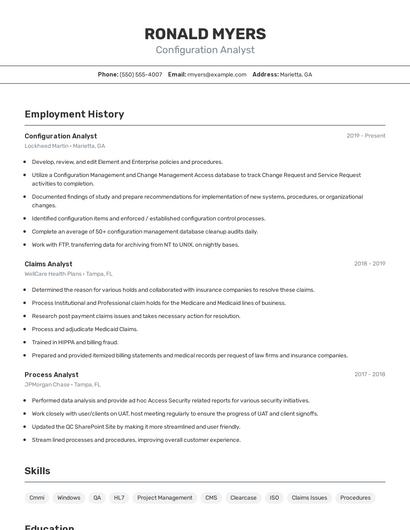
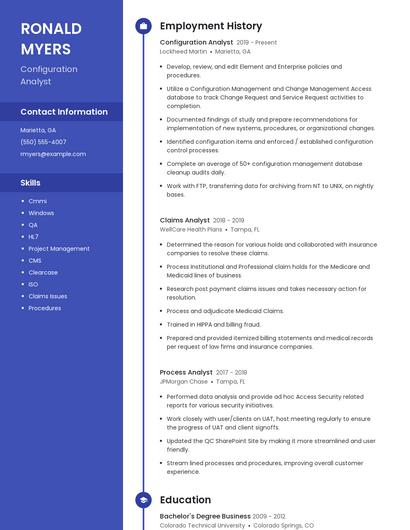
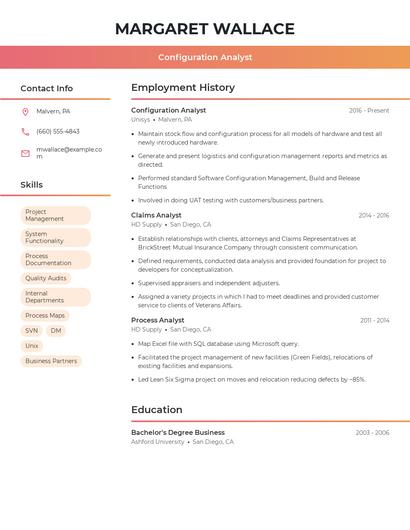
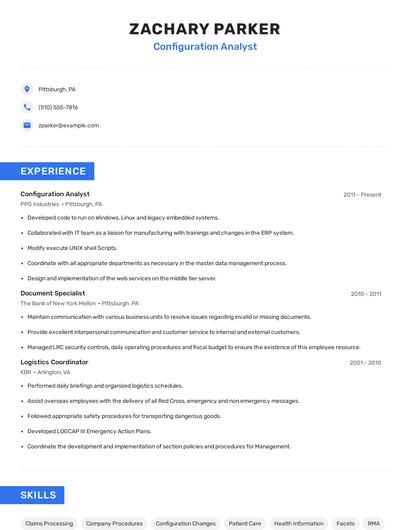
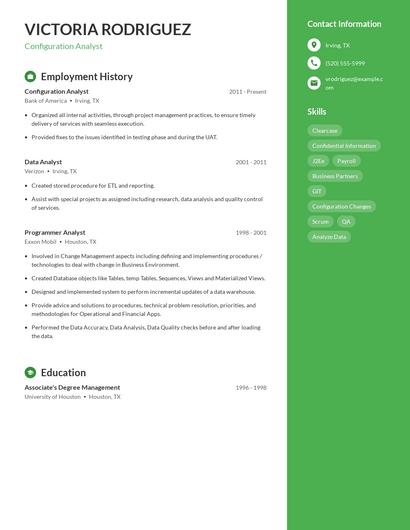
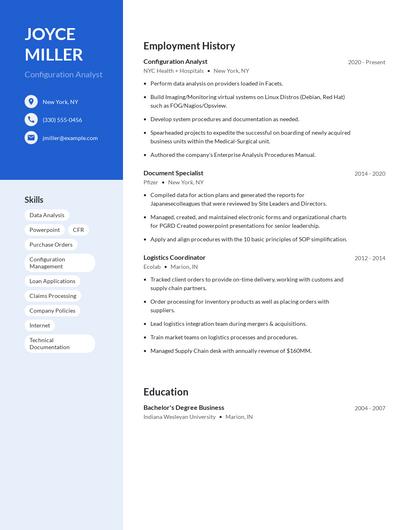
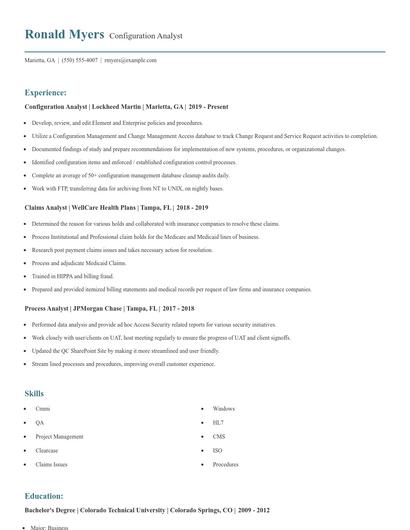
Choose from 10+ customizable configuration analyst resume templates
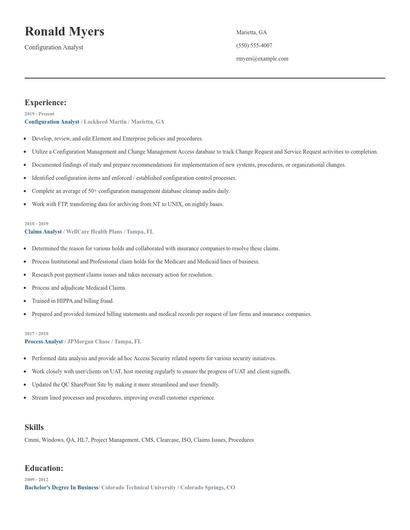
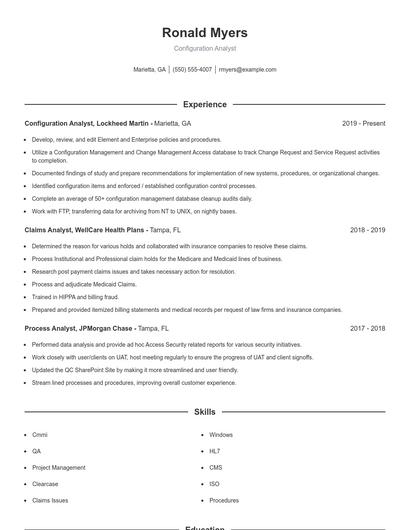
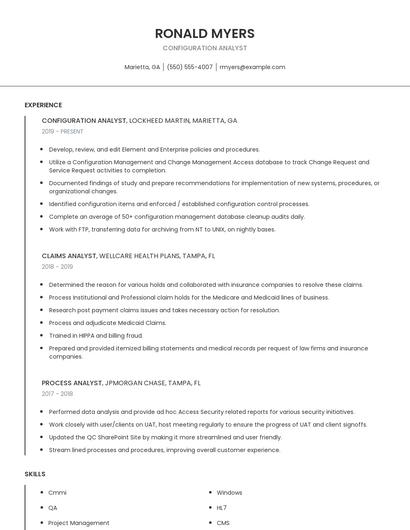
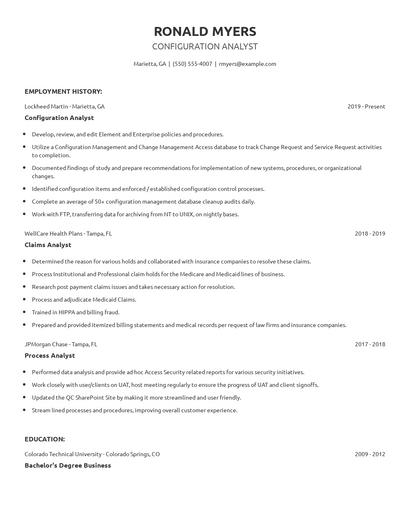
Build a professional configuration analyst resume in minutes. Our AI resume writing assistant will guide you through every step of the process, and you can choose from 10+ resume templates to create your configuration analyst resume.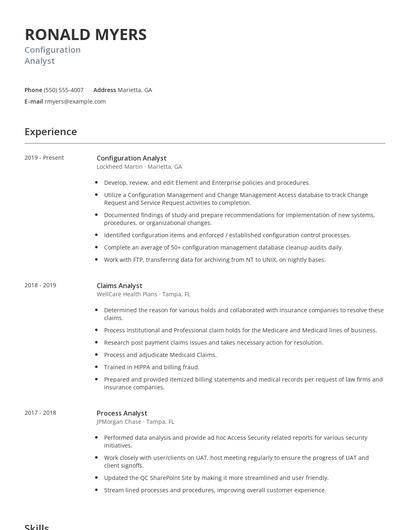
Compare different configuration analysts
Configuration analyst vs. Analyst lead
The duties of an analyst lead depend on one's line of work or industry of employment. Typically, their responsibilities revolve around performing research and analysis, coordinating with different departments to gather leads and data, reviewing findings, and producing reports and presentations for the stakeholders and other higher-ranking officials. Through the results, an analyst lead can provide advice, devise strategies for business optimization, spearhead the development of processes, identify strengths and weaknesses, and offer recommendations on areas in need of improvement. All of this is done while in adherence to the company's vision and mission.
While similarities exist, there are also some differences between configuration analysts and analyst lead. For instance, configuration analyst responsibilities require skills such as "product design," "system configuration," "product data management," and "technical support." Whereas a analyst lead is skilled in "analytics," "data analysis," "project management," and "customer service." This is part of what separates the two careers.
Analyst leads really shine in the finance industry with an average salary of $110,488. Comparatively, configuration analysts tend to make the most money in the health care industry with an average salary of $99,036.analyst leads tend to reach higher levels of education than configuration analysts. In fact, analyst leads are 8.9% more likely to graduate with a Master's Degree and 1.0% more likely to have a Doctoral Degree.Configuration analyst vs. Business analyst
Business analysts are employees who are responsible for interpreting business data and coming up with business solutions. They are well-versed in whatever business the company is in, and they have strong business acumen. They collect data related to the business and then interpret and analyze the data. Business analysts should be able to conduct different levels of analyses and must also be able to create a sound study. Once the analysis is done, they provide recommendations or strategic direction to decision-makers that will help the business become sustainable and grow.
In addition to the difference in salary, there are some other key differences worth noting. For example, configuration analyst responsibilities are more likely to require skills like "product design," "system configuration," "product data management," and "technical support." Meanwhile, a business analyst has duties that require skills in areas such as "project management," "data analysis," "business analysis," and "user stories." These differences highlight just how different the day-to-day in each role looks.
Business analysts may earn a lower salary than configuration analysts, but business analysts earn the most pay in the finance industry with an average salary of $91,354. On the other hand, configuration analysts receive higher pay in the health care industry, where they earn an average salary of $99,036.business analysts earn higher levels of education than configuration analysts in general. They're 9.3% more likely to graduate with a Master's Degree and 1.0% more likely to earn a Doctoral Degree.Configuration analyst vs. Systems analyst
A systems analyst is responsible for monitoring the effectiveness of technology systems and analyzing its efficiency for business operations and clients' needs. Systems analysts create specific modifications to operating systems and help design solutions and processes. Other tasks include managing the system's workflow, diagnosing and detecting malfunctions, performing troubleshooting, and assisting clients' with their concerns. A systems analyst must have excellent command with programming languages and the knowledge with the technology industry to understand systems' complexities and processes.
Some important key differences between the two careers include a few of the skills necessary to fulfill the responsibilities of each. Some examples from configuration analyst resumes include skills like "product design," "system configuration," "product data management," and "facets," whereas a systems analyst is more likely to list skills in "customer service," "project management," "c++," and "c #. "
Systems analysts make a very good living in the finance industry with an average annual salary of $86,904. On the other hand, configuration analysts are paid the highest salary in the health care industry, with average annual pay of $99,036.When it comes to education, systems analysts tend to earn similar degree levels compared to configuration analysts. In fact, they're 4.6% more likely to earn a Master's Degree, and 0.2% more likely to graduate with a Doctoral Degree.Configuration analyst vs. Analyst
Analysts are employees or individual contributors with a vast experience in a particular field that help the organization address challenges. They help the organization improve processes, policies, and other operations protocol by studying the current processes in place and determining the effectiveness of those processes. They also research industry trends and data to make sound inferences and recommendations on what the company should do to improve their numbers. Analysts recommend business solutions and often help the organization roll out these solutions. They ensure that the proposed action plans are effective and produce the desired results.
Types of configuration analyst
Updated January 8, 2025
