What does a content producer do?
The job of content producers is to write news stories, product descriptions, and blogs for various digital platforms, including websites, email marketing campaigns, and social media posts. These professionals typically create marketing materials, messaging, and other types of online copy that can be utilized to sell or promote products and services and enhance brand awareness. Additional duties that a content producer typically does include brainstorming and writing viral content and feature articles, completing tasks scheduled via a CRM, and copyediting editorial content.
Content producer responsibilities
Here are examples of responsibilities from real content producer resumes:
- Manage and create content for the site's Facebook page, while also expanding its audience.
- Produce social media stories using twitter, Facebook and Instagram.
- Create visually engaging social videos from podcast clips for Facebook & Instagram.
- Establish investigative WordPress news website.
- Produce videos, animation, and voice-over sessions.
- Co-Design and edit CSS coding for elaborate new online donation form.
- Publish videos to various digital platforms including, YouTube and in-house CMS.
- Set up and design company web sites in Drupal for computers and mobile devices.
- Ensure the design fit the capabilities of Drupal and the requirements of the client.
- Coordinate scripts with the other ABC platforms and the legal/standards department to ensure accuracy.
- Assign websites to content producers to drive web searches towards client approve content and improve SEO.
- Assist in proofreading and editing content, making sure that the websites are accurate and up-to-date.
- Create Facebook page for sports department and teach staff how to utilize it to promote their content.
- Design and write creative comics and animation projects for web, print, and online broadcast media.
- Update an expansive website using a proprietary software that offer special tools design to facilitate the manipulation of HTML.
Content producer skills and personality traits
We calculated that 7% of Content Producers are proficient in Video Content, Content Production, and Digital Content. They’re also known for soft skills such as Communication skills, Leadership skills, and Time-management skills.
We break down the percentage of Content Producers that have these skills listed on their resume here:
- Video Content, 7%
Produce creative online video content targeted for a defined demographic.
- Content Production, 5%
Worked closely with management, editorial staff and reporters on content production in a deadline-driven environment.
- Digital Content, 5%
Managed digital content hubs and social channel distribution.
- Instagram, 4%
Managed social media outlets including Facebook, Instagram, and Twitter.
- Facebook, 4%
Managed community outreach/customer support queries and social outreach on Twitter and Facebook.
- Content Creation, 4%
Collaborate with head of community to execute editorial social calendar and lead content creation efforts across multiple platforms.
Most content producers use their skills in "video content," "content production," and "digital content" to do their jobs. You can find more detail on essential content producer responsibilities here:
Communication skills. The most essential soft skill for a content producer to carry out their responsibilities is communication skills. This skill is important for the role because "producers and directors must convey information and ideas clearly in order to coordinate many people to finish a production on time and within budget." Additionally, a content producer resume shows how their duties depend on communication skills: "prioritize and manage the communication of breaking news stories for over 50 team pages in the teamstream mobile app. "
Leadership skills. Another soft skill that's essential for fulfilling content producer duties is leadership skills. The role rewards competence in this skill because "directors instruct actors and help them portray their characters in a believable manner." According to a content producer resume, here's how content producers can utilize leadership skills in their job responsibilities: "exemplified leadership by serving as a substitute assignment desk editor for weekend coverage. "
Creativity. content producer responsibilities often require "creativity." The duties that rely on this skill are shown by the fact that "because a script may be interpreted in different ways, directors must decide on their approach and on how to represent the script’s ideas for the production." This resume example shows what content producers do with creativity on a typical day: "gained experience in writing, editing, video production, hitting deadlines, creative collaboration, and marketing. "
The three companies that hire the most content producers are:
- Apple14 content producers jobs
- NBCUniversal13 content producers jobs
- Wpp Us Holdings Inc7 content producers jobs
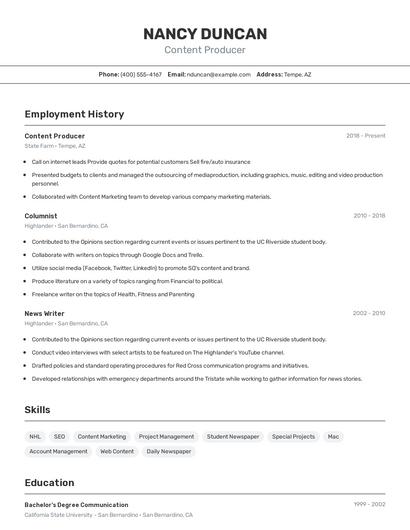
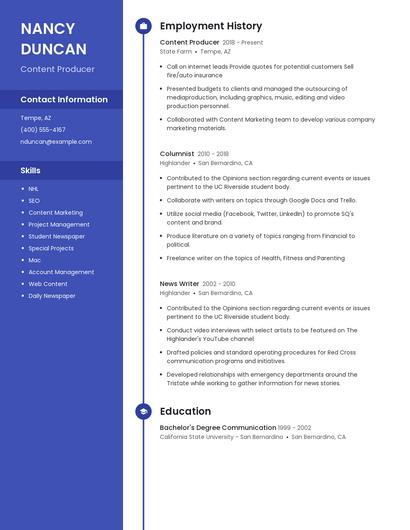
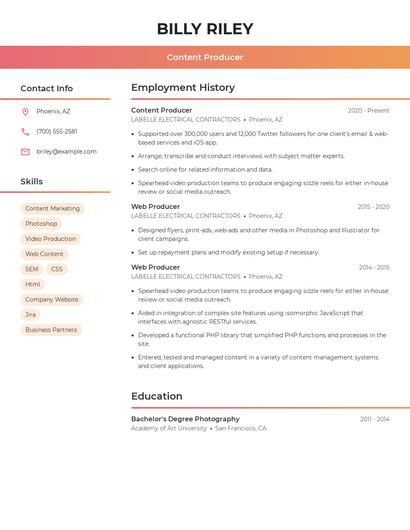
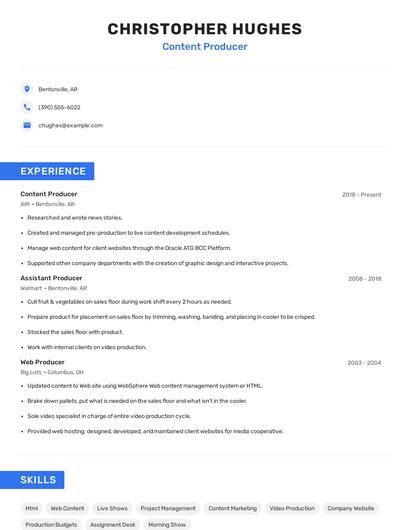
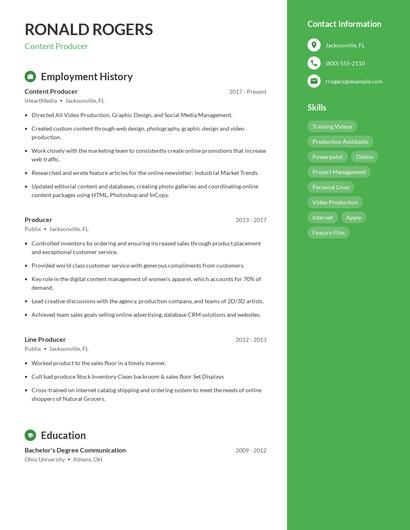
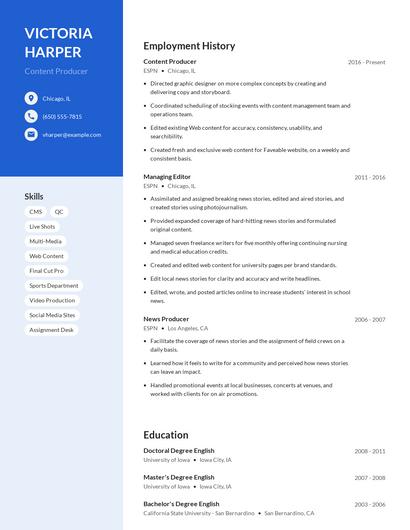
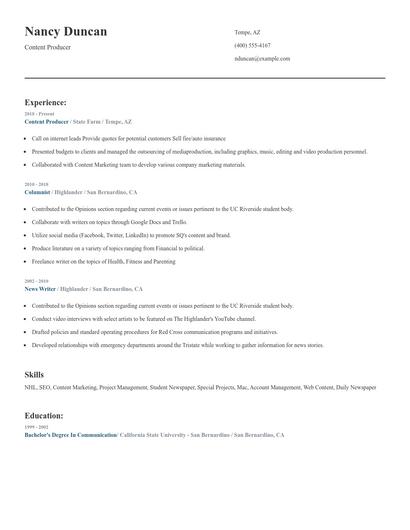
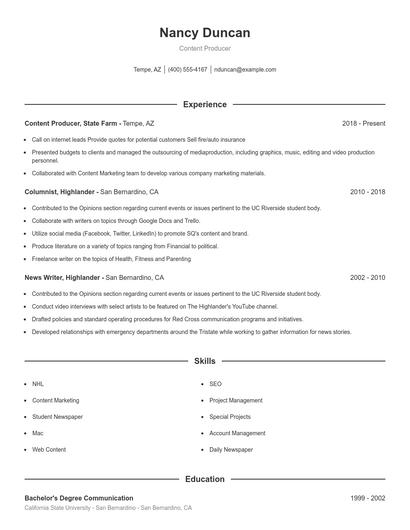
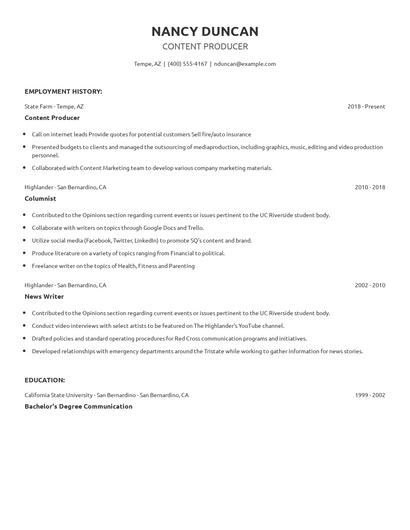
Choose from 10+ customizable content producer resume templates
Build a professional content producer resume in minutes. Our AI resume writing assistant will guide you through every step of the process, and you can choose from 10+ resume templates to create your content producer resume.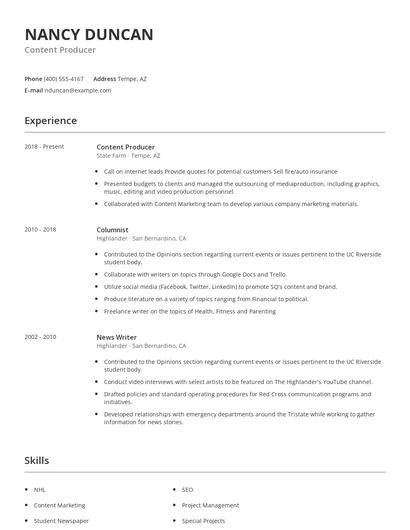


Compare different content producers
Content producer vs. Freelance videographer/editor
A freelance videographer/editor is responsible for processing and editing video contents, usually on a project basis. Freelance videographer/editors create their footage using their shooting equipment, utilize various design and editing software, and finish the project based on the clients' specifications and deliverables. They should also have a good grasp of digital marketing to produce impactful videos to the target audience. A freelance videographer/editor must be detail-oriented and have excellent communication skills to coordinate with the production team for content plans and perform adjustments as needed.
There are some key differences in the responsibilities of each position. For example, content producer responsibilities require skills like "content production," "digital content," "content creation," and "web content." Meanwhile a typical freelance videographer/editor has skills in areas such as "training videos," "video projects," "video shoots," and "audio equipment." This difference in skills reveals the differences in what each career does.
The education levels that freelance videographer/editors earn slightly differ from content producers. In particular, freelance videographer/editors are 5.8% less likely to graduate with a Master's Degree than a content producer. Additionally, they're 0.4% less likely to earn a Doctoral Degree.Content producer vs. Freelance video editor
A freelance video editor offers video editing services to individuals and businesses. Most freelance video editors manage their own time and work at their preferred places, some even working from home. Among their responsibilities include meeting with clients to identify their needs and preferences, negotiating contracts, gathering and editing clips, and completing projects within deadlines. There are also instances when they must shoot videos in adherence to the contract's terms. Moreover, a freelance video editor must establish positive relationships with clients to develop a strong client base.
In addition to the difference in salary, there are some other key differences worth noting. For example, content producer responsibilities are more likely to require skills like "content production," "digital content," "instagram," and "content creation." Meanwhile, a freelance video editor has duties that require skills in areas such as "training videos," "adobe premiere pro," "freelance video," and "color correction." These differences highlight just how different the day-to-day in each role looks.
Average education levels between the two professions vary. Freelance video editors tend to reach similar levels of education than content producers. In fact, they're 4.2% less likely to graduate with a Master's Degree and 0.4% less likely to earn a Doctoral Degree.What technology do you think will become more important and prevalent for content producers in the next 3-5 years?
Allison Harl Ph.D.
Associate Professor of English English Program Coordinator, Ferrum College
Content producer vs. Videographer
A videographer specializes in shooting and editing high-definition videos of different events, making them presentable to clients. They are primarily responsible for having their video equipment, coordinating with clients to learn any preferences or particular requests, capturing and recording from the best angle, and producing results quickly and accurately. Most of the time, a videographer may travel to different places, direct clients on what to do during filming, and edit any obstructions to produce an optimal result. Furthermore, it is essential to build rapport with clients to establish a client base and earn more projects.
There are many key differences between these two careers, including some of the skills required to perform responsibilities within each role. For example, a content producer is likely to be skilled in "content production," "digital content," "content creation," and "web content," while a typical videographer is skilled in "training videos," "audio equipment," "video projects," and "video equipment."
Videographers make a very good living in the education industry with an average annual salary of $41,551. On the other hand, content producers are paid the highest salary in the start-up industry, with average annual pay of $59,893.videographers typically earn lower educational levels compared to content producers. Specifically, they're 6.0% less likely to graduate with a Master's Degree, and 0.3% less likely to earn a Doctoral Degree.Content producer vs. Content specialist
A content specialist's role is to create strategies in developing captivating and engaging content to boost brand awareness and interest in a company. Their responsibilities revolve around conducting research and analysis of marketing conditions to identify new opportunities, keeping abreast of the latest trends, producing presentations and progress reports, and creating content through various mediums such as social media and print materials. Furthermore, it is essential to coordinate with managers and other content creators, all while adhering to the company's policies and standards.
Even though a few skill sets overlap between content producers and content specialists, there are some differences that are important to note. For one, a content producer might have more use for skills like "content production," "photography," "seo," and "video production." Meanwhile, some responsibilities of content specialists require skills like "customer service," "subject matter experts," "professional development," and "style guides. "
The health care industry tends to pay the highest salaries for content specialists, with average annual pay of $69,943. Comparatively, the highest content producer annual salary comes from the start-up industry.content specialists reach similar levels of education compared to content producers, in general. The difference is that they're 2.9% more likely to earn a Master's Degree, and 0.6% more likely to graduate with a Doctoral Degree.Types of content producer
Updated January 8, 2025
