What does a control accountant do?
A Control Accountant is in charge of managing a company's accounting records and spearheads the development of financial reports. Although the extent of their responsibilities depends on their place or industry of employment, it typically includes coordinating with different teams to gather and analyze data, conduct audits and risk analyses, monitor budgets and expenditures, review documents and other transactions and develop strategies to optimize operations. A Control Accountant leads and encourages staff to reach goals while implementing the company's policies and regulations.
Control accountant responsibilities
Here are examples of responsibilities from real control accountant resumes:
- Prepare internal financial reports for treasury manage accounts include in external compliance reports.
- Collect, analyze, interpret, and document information to support quarterly SOX reviews.
- Ensure proper accounting in compliance with GAAP, regulatory reporting requirements and joint ownership contracts.
- Identify variances between corporations, establish payable/receivable ledgers, and clear open variances in accordance with GAAP.
- Control regional account analysis, provide explanations and backup to SOX reporting department.
- Perform domestic and international roll forwards, quarterly schedules for goodwill, trademarks and acquisition activities utilizing Hyperion.
- Research professional publications and IRS code for unique business situations and maintain in-house wiki pages for standard operating procedures
Control accountant skills and personality traits
We calculated that 11% of Control Accountants are proficient in Reconciliations, General Ledger Accounts, and Payroll Taxes. They’re also known for soft skills such as Analytical skills, Communication skills, and Detail oriented.
We break down the percentage of Control Accountants that have these skills listed on their resume here:
- Reconciliations, 11%
Worked in Sacramento office to establish IBT controls environment and procedures for reconciliations related to conversion.
- General Ledger Accounts, 7%
Maintain payroll-related accounts for accuracy along with balancing of corporate salary/incentives general ledger accounts.
- Payroll Taxes, 6%
Processed weekly union payroll, all quarterly payroll taxes, and union benefits.
- Account Reconciliations, 5%
Prepare monthly balance sheet account reconciliations within the monthly closing cycle, providing excellent details and addressing any necessary corrections promptly.
- Accruals, 5%
Provided cost center auditing and monthly, quarterly, and year-end accruals for R&PD, advertising and patent departments.
- Internal Controls, 5%
Organized and administered a company-wide awareness program including classroom training to several hundred employees on internal controls and fraud awareness.
Common skills that a control accountant uses to do their job include "reconciliations," "general ledger accounts," and "payroll taxes." You can find details on the most important control accountant responsibilities below.
Communication skills. Many control accountant duties rely on communication skills. "accountants and auditors must be able to listen to and discuss facts and concerns from clients, managers, and other stakeholders," so a control accountant will need this skill often in their role. This resume example is just one of many ways control accountant responsibilities rely on communication skills: "reported to the corporate office of a communication and publishing company in the reporting and coordinating of divisional financial data. "
Detail oriented. Another skill that relates to the job responsibilities of control accountants is detail oriented. This skill is critical to many everyday control accountant duties, as "accountants and auditors must pay attention to detail when compiling and examining documents." This example from a resume shows how this skill is used: "provide detailed financial analysis reporting. "
Math skills. A big part of what control accountants do relies on "math skills." You can see how essential it is to control accountant responsibilities because "accountants and auditors must be able to analyze, compare, and interpret facts and figures." Here's an example of how this skill is used from a resume that represents typical control accountant tasks: "file quarterly bureau of labor statistics and sales & use tax reporting. "
Organizational skills. Another common skill required for control accountant responsibilities is "organizational skills." This skill comes up in the duties of control accountants all the time, as "strong organizational skills are important for accountants and auditors, who often work with a range of financial documents for a variety of clients." An excerpt from a real control accountant resume shows how this skill is central to what a control accountant does: "analyze internal and external accounting information to support organizational sox compliance. "
The three companies that hire the most control accountants are:
- Sodexo Management, Inc.3 control accountants jobs
- Florida Power and Light 2 control accountants jobs
- University of Massachusetts Amherst2 control accountants jobs
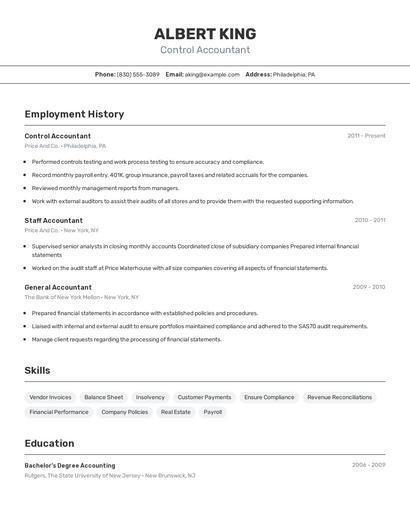
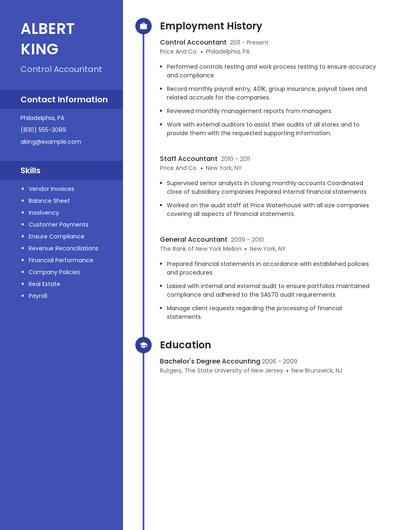
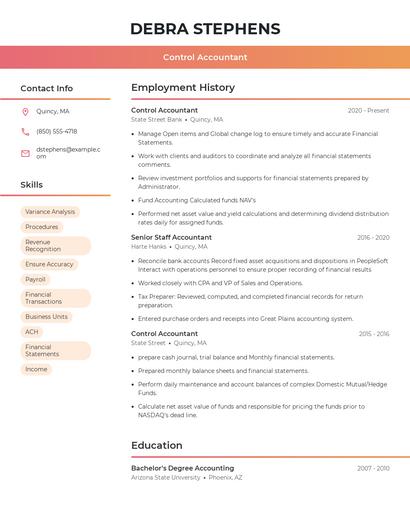
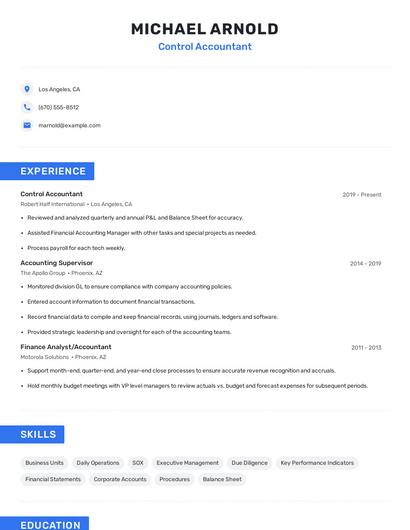
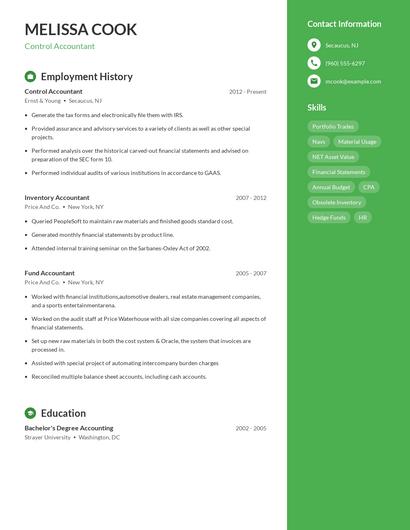
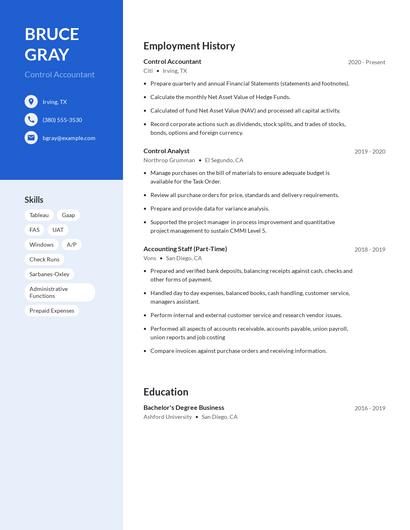
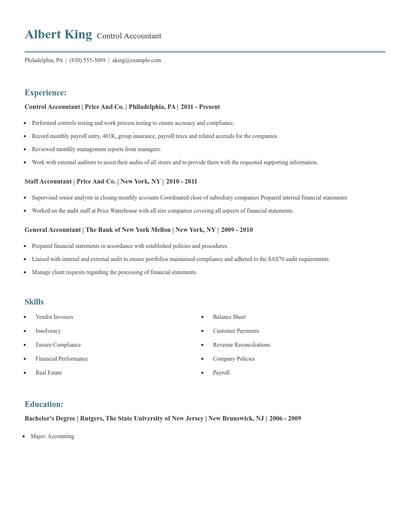
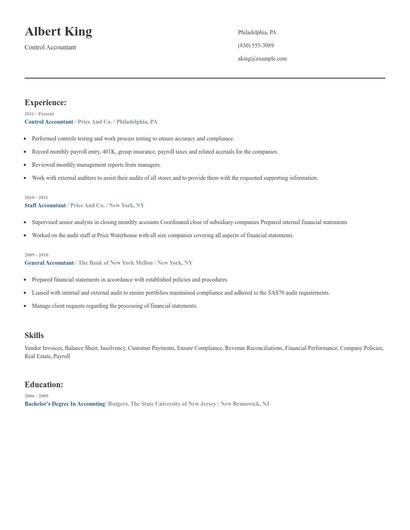
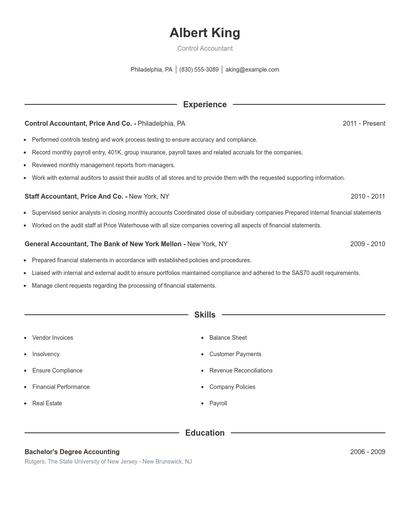
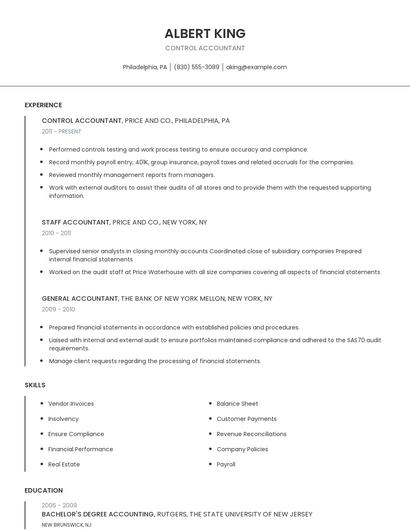
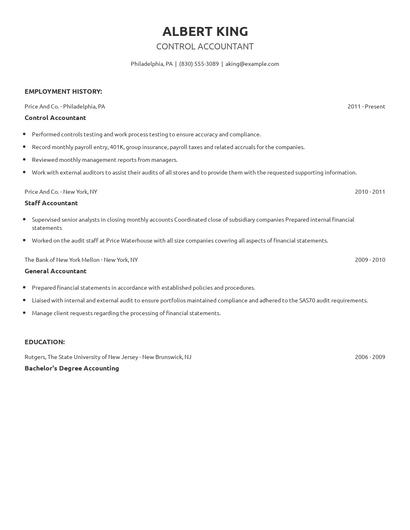
Choose from 10+ customizable control accountant resume templates
Build a professional control accountant resume in minutes. Our AI resume writing assistant will guide you through every step of the process, and you can choose from 10+ resume templates to create your control accountant resume.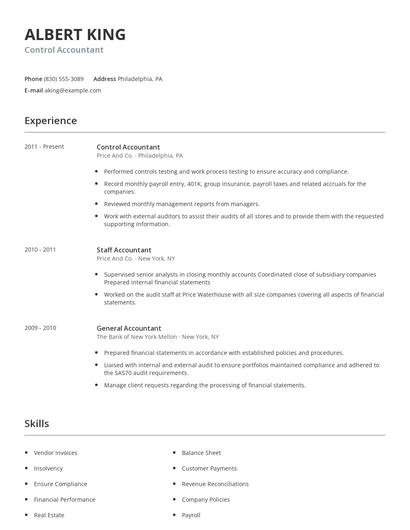
Compare different control accountants
Control accountant vs. Accounting manager/controller
An accounting manager/controller is responsible for spearheading and overseeing the daily operations in a company's accounting department. They monitor the company's budgets, including its costs and expenditures, and produce financial reports. It is also their duty to establish objectives and guidelines, manage accounting staff, monitor financial activities, review and assess financial statements, approve expenditures, and resolve issues promptly and efficiently. Furthermore, as an accounting manager/controller, it is essential to lead and encourage the workforce to reach goals, all while implementing the company's policies and regulations.
There are some key differences in the responsibilities of each position. For example, control accountant responsibilities require skills like "accruals," "income statement," "asset value," and "financial management." Meanwhile a typical accounting manager/controller has skills in areas such as "cash management," "journal entries," "oversight," and "sarbanes-oxley." This difference in skills reveals the differences in what each career does.
Accounting managers/controller really shine in the technology industry with an average salary of $89,839. Comparatively, control accountants tend to make the most money in the finance industry with an average salary of $85,616.The education levels that accounting managers/controller earn slightly differ from control accountants. In particular, accounting managers/controller are 3.2% more likely to graduate with a Master's Degree than a control accountant. Additionally, they're 0.1% less likely to earn a Doctoral Degree.Control accountant vs. Assistant controller
An assistant controller is an individual who supports and reports to the corporate controller about all the organization's accounting-related activities such as managerial accounting and financial activities. Assistant controllers are instrumental in maintaining the accountability of the organization's financial resources and protecting the assets of its investors. They delegate data entry tasks with junior accounting staff and coordinate financial audits with the vice president and chief financial officer (CFO). The minimum educational attainment of an assistant controller is to obtain a bachelor's degree in finance or accounting related field.
While some skills are similar in these professions, other skills aren't so similar. For example, resumes show us that control accountant responsibilities requires skills like "a/p," "income statement," "asset value," and "financial management." But an assistant controller might use other skills in their typical duties, such as, "close process," "strong analytical," "erp," and "cash management."
Assistant controllers earn a higher average salary than control accountants. But assistant controllers earn the highest pay in the finance industry, with an average salary of $99,888. Additionally, control accountants earn the highest salaries in the finance with average pay of $85,616 annually.In general, assistant controllers achieve similar levels of education than control accountants. They're 2.0% more likely to obtain a Master's Degree while being 0.1% less likely to earn a Doctoral Degree.What technology do you think will become more important and prevalent for control accountants in the next 3-5 years?
Terri Walsh
Professor/Program Manager, Accounting, Seminole State College of Florida
Control accountant vs. Accountant and office manager
An accountant/office manager is responsible for monitoring the organization's accounting records and financial reports, analyzing statistical information, and managing payroll processes. Accountant/office managers must have excellent knowledge of accounting disciplines and principles to perform accounting duties and train accounting staff of the accounting operations, overseeing account receivables, conducting bank reconciliations, and responding to the staff's inquiries and concerns. An accountant/office manager must have excellent communication and leadership skills, helping the management develop practical accounting and financial approach, maintaining the stability of the organization's cash management.
The required skills of the two careers differ considerably. For example, control accountants are more likely to have skills like "payroll taxes," "accruals," "internal controls," and "external auditors." But a accountant and office manager is more likely to have skills like "payroll tax returns," "customer service," "journal entries," and "purchase orders."
Accountant and office managers make a very good living in the real estate industry with an average annual salary of $59,443. On the other hand, control accountants are paid the highest salary in the finance industry, with average annual pay of $85,616.accountant and office managers typically earn similar educational levels compared to control accountants. Specifically, they're 3.5% less likely to graduate with a Master's Degree, and 0.1% less likely to earn a Doctoral Degree.Control accountant vs. Accountant/consultant
Accountants/consultants perform accounting tasks for organizations or companies. The accountants improve accounting practices and prepare financial statements at the end of every year. They analyze financial data and offer advice on regulatory compliance issues to the finance department. It is their job to make sure that the online system is secure. Most of the day, they organize invoices, prepare statements, and supervising systems. They should be equipped with analytical skills, industry knowledge, critical thinking, and interpersonal communication.
Types of control accountant
Updated January 8, 2025
