What does a course developer do?
A course developer specializes in developing and implementing course plans for educational programs. They are responsible for conducting industry research, conducting skills assessments to identify a company's training needs, creating plans and strategies, establishing timelines, developing programs, and securing supplies. Additionally, they must monitor the progress of a company's educational programs to make adjustments as needed.
Course developer responsibilities
Here are examples of responsibilities from real course developer resumes:
- Manage website content maintenance in WordPress CMS and produce copy that assist with SEO improvement.
- Lead the virtualization of military training exercises and provide periods of instruction using virtual simulations.
- Code course transcripts (XML).
- Provide server-side PHP with MySQL DBA for numerous projects.
- Create and edit HTML pages as necessary for course homepages.
- Assemble distinct course elements in course platform in CMS and HTML.
- Develop and execute training program for XML development in preparation for the IRS mandate transition.
- Note to be an expert in Authorware, which lead to a SME status among team.
- Specify requirements for product features and follow-up with developers and QA as the features move from testing to acceptance.
- Create SVG files from the illustrations to be integrate into HTML5 base portal for handoff to next step of the project.
- Develop oral and PowerPoint presentations for classroom instruction and briefings.
- Deliver numerous train-the-trainer courses domestically and internationally.
- Perform in the areas of curriculum design and implementation, ADDIE model instructional systems design, developing and competency mapping.
- Utilize web platforms, WordPress and Wix.
- Develop Facebook content strategies for FMCG brands, tailoring messages that resonate with diverse groups of audiences.
Course developer skills and personality traits
We calculated that 7% of Course Developers are proficient in Instructional Design, Course Content, and Course Materials. They’re also known for soft skills such as Instructional skills, Analytical skills, and Communication skills.
We break down the percentage of Course Developers that have these skills listed on their resume here:
- Instructional Design, 7%
Provided advice to higher-level managers regarding best practices, instructional design approaches, and project methodology to help improve internal processes.
- Course Content, 7%
Supported curriculum planning, lesson design servicing and course content tailoring based on customer and software upgrade requirements.
- Course Materials, 6%
Managed all aspects of course development projects, developing course materials and documentation in coordination with government clients.
- Training Materials, 6%
Designed and developed training materials for a new order processing system to be utilized by approximately 2,000 sales representatives.
- Subject Matter Experts, 6%
Worked with engineers and other subject matter experts while developing training documentation.
- ELearning, 4%
Implemented multiple evaluation strategies, including surveys, assessments and interviews for both eLearning and classroom courses.
Common skills that a course developer uses to do their job include "instructional design," "course content," and "course materials." You can find details on the most important course developer responsibilities below.
Instructional skills. One of the key soft skills for a course developer to have is instructional skills. You can see how this relates to what course developers do because "training and development specialists deliver employee training programs." Additionally, a course developer resume shows how course developers use instructional skills: "revise existing course content via course content software based on feedback from faculty, program managers, and instructional technologist. "
Analytical skills. Another soft skill that's essential for fulfilling course developer duties is analytical skills. The role rewards competence in this skill because "training and development specialists must evaluate training programs, methods, and materials and choose those that best fit each situation." According to a course developer resume, here's how course developers can utilize analytical skills in their job responsibilities: "developed and delivered online java programming component to over 100 data center certification candidates spanning duration of grant period. "
Communication skills. Another skill that relates to the job responsibilities of course developers is communication skills. This skill is critical to many everyday course developer duties, as "training and development specialists must convey information clearly and facilitate learning to diverse audiences." This example from a resume shows how this skill is used: "use oral and written communication skill to deliver course content, advise students and convey information to supervisor and administration. "
Creativity. course developer responsibilities often require "creativity." The duties that rely on this skill are shown by the fact that "specialists should be resourceful when developing training materials." This resume example shows what course developers do with creativity on a typical day: "developed creative and interactive training materials relative to interpretation services. "
The three companies that hire the most course developers are:
- Snowflake Computing44 course developers jobs
- Splunk16 course developers jobs
- MathWorks
14 course developers jobs
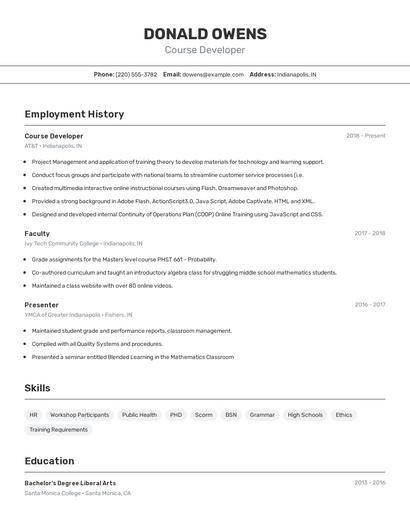
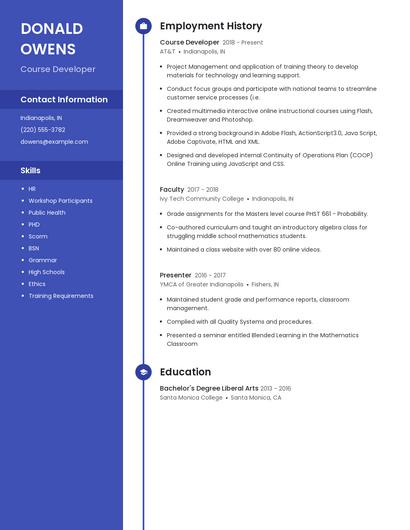
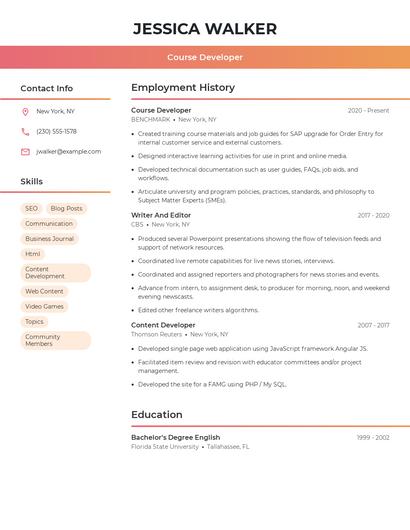
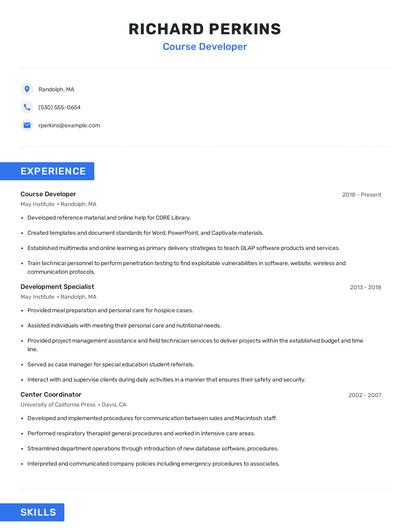
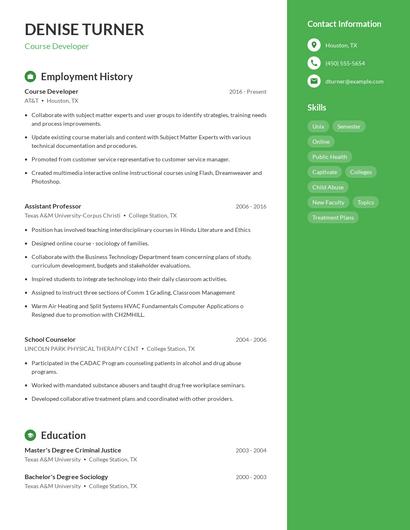
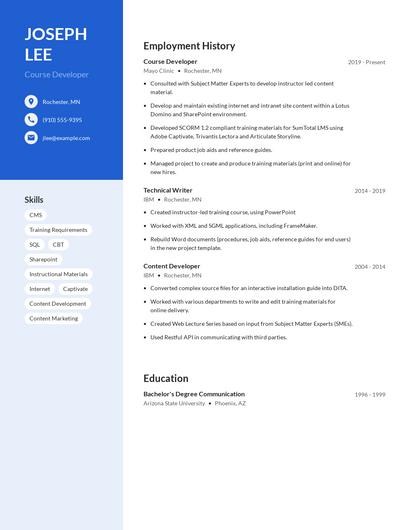
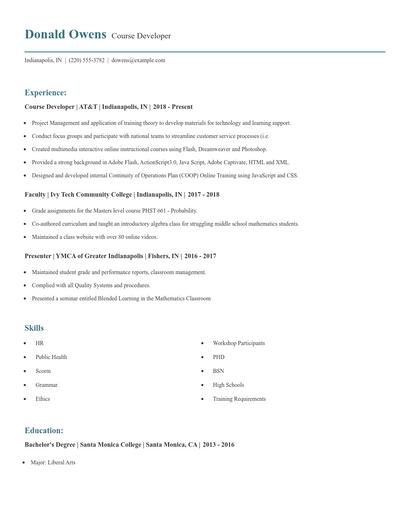
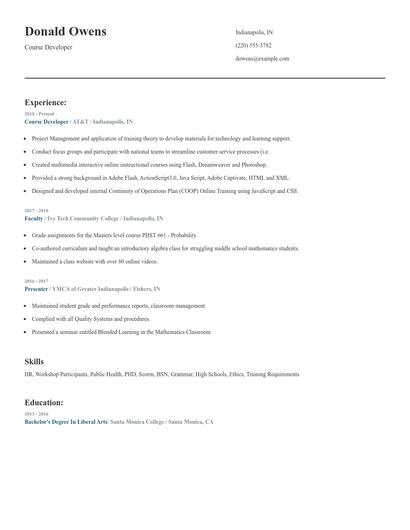
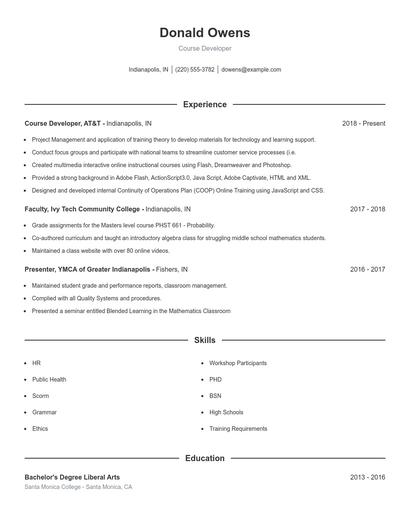
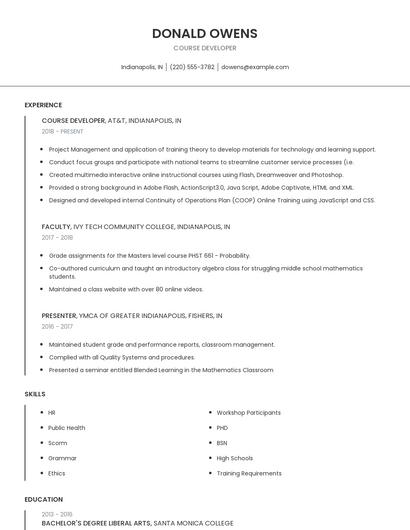
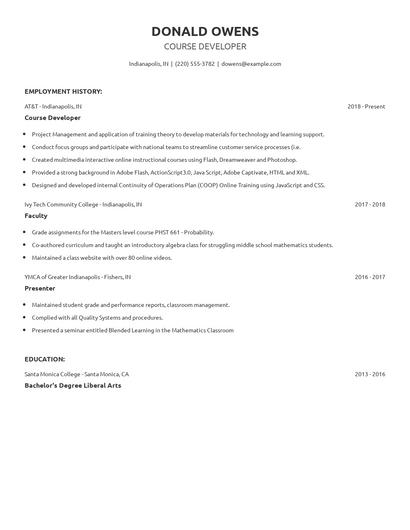
Choose from 10+ customizable course developer resume templates
Build a professional course developer resume in minutes. Our AI resume writing assistant will guide you through every step of the process, and you can choose from 10+ resume templates to create your course developer resume.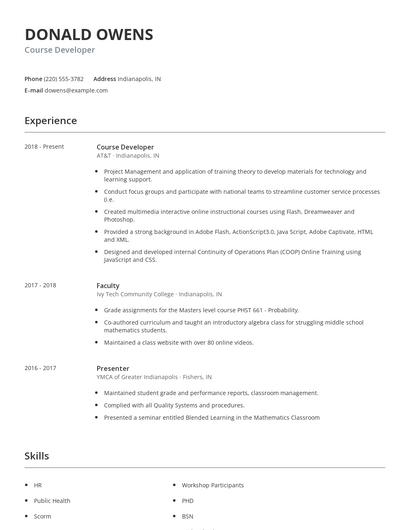
Compare different course developers
Course developer vs. Training facilitator
A training facilitator is responsible for managing the training sessions of employees in an organization, both for career advancement and process-related training. Training facilitators outline the training objectives, prepare the facility and resources, and ensure that all participants are present during the discussion. They also coordinate with the department heads for any progress updates and additional requirements for training purposes. A training facilitator must have excellent communication and organizational skills, especially in acting as a liaison between the management and the trainees for their inquiries, concerns, and feedback.
While similarities exist, there are also some differences between course developers and training facilitator. For instance, course developer responsibilities require skills such as "instructional design," "course design," "css," and "blackboard." Whereas a training facilitator is skilled in "training classes," "training curriculum," "customer service," and "presentation." This is part of what separates the two careers.
Training facilitators really shine in the health care industry with an average salary of $65,725. Comparatively, course developers tend to make the most money in the professional industry with an average salary of $116,312.training facilitators tend to reach similar levels of education than course developers. In fact, training facilitators are 2.6% less likely to graduate with a Master's Degree and 3.4% less likely to have a Doctoral Degree.Course developer vs. Training associate
A training associate specializes in devising training projects and programs according to the needs of employees. It is their duty to conduct skills assessment procedures, develop training structures, establish guidelines, and coordinate with the company's human resources department. They must also gather and analyze data to identify the strengths and weaknesses of company operations, perform research to determine and implement solutions to optimize operations. Above all, a training associate must enforce the company's policies and regulations, including its policies and regulations.
In addition to the difference in salary, there are some other key differences worth noting. For example, course developer responsibilities are more likely to require skills like "instructional design," "course content," "course materials," and "subject matter experts." Meanwhile, a training associate has duties that require skills in areas such as "food safety," "training classes," "hr," and "pos." These differences highlight just how different the day-to-day in each role looks.
Training associates earn a lower average salary than course developers. But training associates earn the highest pay in the hospitality industry, with an average salary of $50,254. Additionally, course developers earn the highest salaries in the professional with average pay of $116,312 annually.In general, training associates achieve lower levels of education than course developers. They're 16.0% less likely to obtain a Master's Degree while being 3.4% less likely to earn a Doctoral Degree.Course developer vs. Training assistant
A training assistant is an individual who is organizes training and organizational development programs for companies in the private or government sector. Training assistants are required to create training course schedules and timetables while providing written and visual training materials that are used by trainees. They use information systems or databases to enter data to create reports on the training statistics and assessment of the programs and instructors. Training assistants are also required to perform office clerical duties, such as organizing digital and paper files.
Some important key differences between the two careers include a few of the skills necessary to fulfill the responsibilities of each. Some examples from course developer resumes include skills like "instructional design," "course content," "subject matter experts," and "course design," whereas a training assistant is more likely to list skills in "strong work ethic," "work ethic," "punctuality," and "customer service. "
Training assistants earn the highest salary when working in the insurance industry, where they receive an average salary of $44,303. Comparatively, course developers have the highest earning potential in the professional industry, with an average salary of $116,312.training assistants typically earn lower educational levels compared to course developers. Specifically, they're 13.7% less likely to graduate with a Master's Degree, and 4.7% less likely to earn a Doctoral Degree.Course developer vs. Trainer lead
As a training lead, you are responsible for overseeing a company's employee training and development activities. You are also expected to perform various tasks that may include identifying training needs for the organization, supervising trainers' work, and developing effective employee training programs. Other duties and responsibilities may be conducting a readiness assessment, maintaining training information, and coordinating and reviewing the logistics of training materials. Also, you are expected to organize safety training and develop conflict resolution modules and diversity appreciation.
Types of course developer
Updated January 8, 2025
