What does a cutter operator do?
Cutter operator responsibilities
Here are examples of responsibilities from real cutter operator resumes:
- Use automate systems and RF units to pull, put away and load customer product, in addition to managing inventory
- Assist with other bindery operations in the department which include cutting, padding, collating, drilling and hole punching.
- Perform specialized production line and quality control duties in a professional production environment specializing in plastic extrusion.
- Inspect product for defects house keeping, AIB, preventive maintenance.
Cutter operator skills and personality traits
We calculated that 12% of Cutter Operators are proficient in Quality Checks, Pallets, and Math. They’re also known for soft skills such as Communication skills, Coordination, and Mechanical skills.
We break down the percentage of Cutter Operators that have these skills listed on their resume here:
- Quality Checks, 12%
Set up jobs on gate folders and was responsible for quality checks and troubleshooting machines.
- Pallets, 11%
Operated and programmed a Hydraulic cutter to cut down pallets of paper.
- Math, 10%
Produced and maintained accurate documentation for production reports using math and computer skills.
- Troubleshoot, 7%
Maintain, Repair, overhaul equipment and automobiles.. Troubleshoot equipment problems..
- Quality Standards, 7%
Achieved daily production goals while maintaining safety and quality standards.
- Pallet Jack, 7%
Used forklift or pallet jack to move skids of material to appropriate areas in the shop.
"quality checks," "pallets," and "math" are among the most common skills that cutter operators use at work. You can find even more cutter operator responsibilities below, including:
Communication skills. The most essential soft skill for a cutter operator to carry out their responsibilities is communication skills. This skill is important for the role because "material moving machine operators signal and direct workers to load and unload material." Additionally, a cutter operator resume shows how their duties depend on communication skills: "act as the first point of contact- performing central telecommunications functions for all hospital campuses using computer system and directories. "
Coordination. Another essential skill to perform cutter operator duties is coordination. Cutter operators responsibilities require that "material moving machine operators must have steady hands and feet to guide and control heavy machinery precisely." Cutter operators also use coordination in their role according to a real resume snippet: "operated production machinery utilized good communication skill to interact well with co-workers possess good hand-eye coordination ability to perform repetitive tasks"
Mechanical skills. Another skill that relates to the job responsibilities of cutter operators is mechanical skills. This skill is critical to many everyday cutter operator duties, as "material moving machine operators make minor adjustments to their machines and perform basic maintenance on them." This example from a resume shows how this skill is used: "performed manual and mechanical production functions necessary to operate the production equipment. "
Visual ability. cutter operator responsibilities often require "visual ability." The duties that rely on this skill are shown by the fact that "material moving machine operators must be able to see clearly where they are driving or what they are moving." This resume example shows what cutter operators do with visual ability on a typical day: "use calibers and visual inspection of products to insurequality of product being produced to iso standards and make adjustments as needed. "
The three companies that hire the most cutter operators are:
- Sheridan42 cutter operators jobs
- WestRock4 cutter operators jobs
- ABC Imaging3 cutter operators jobs
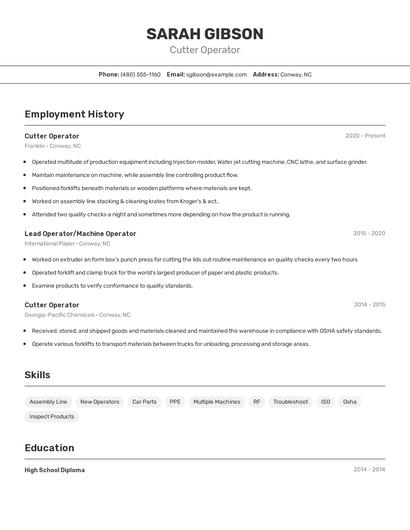
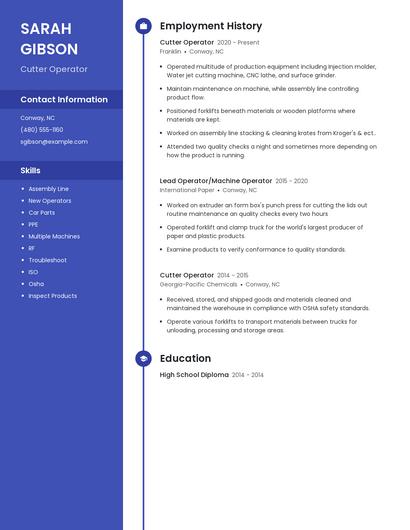
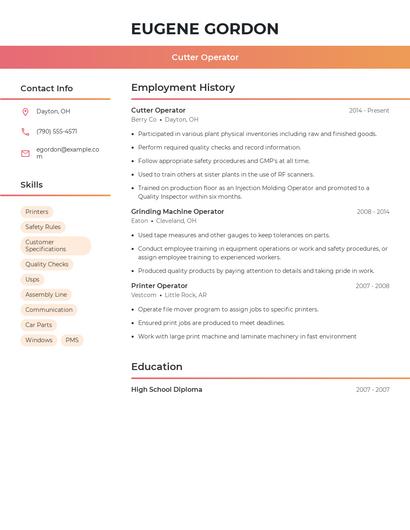
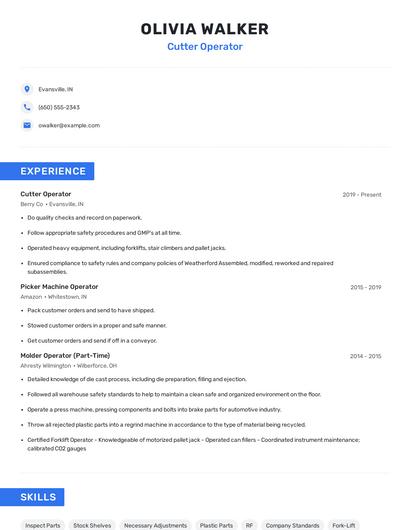
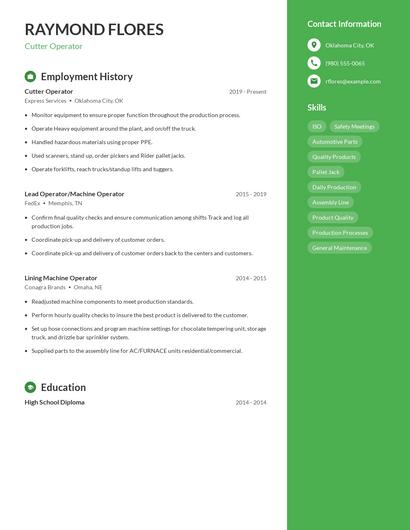
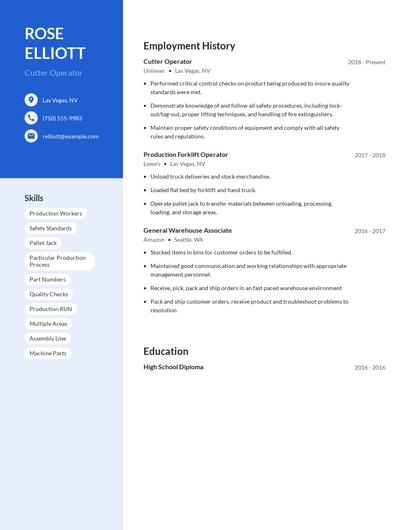
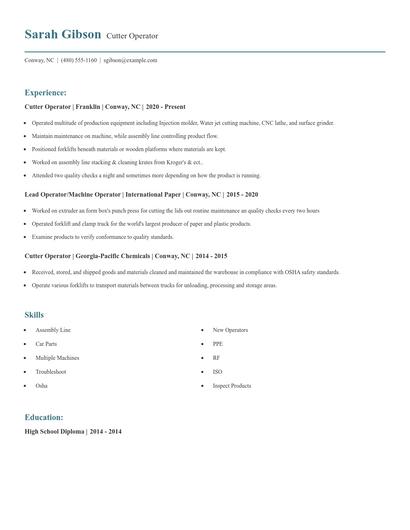
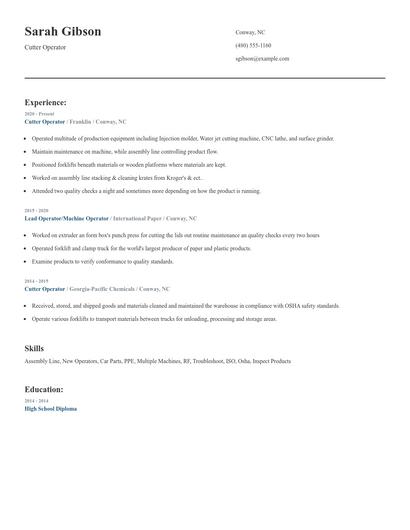
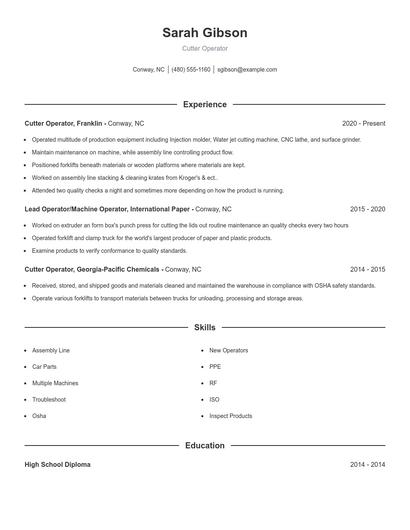
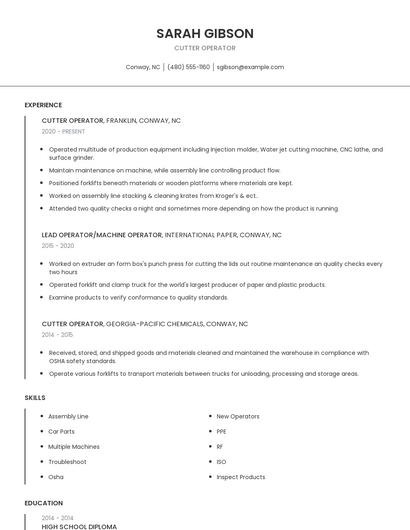
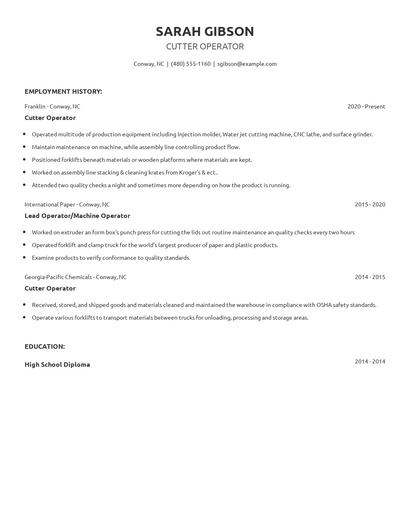
Choose from 10+ customizable cutter operator resume templates
Build a professional cutter operator resume in minutes. Our AI resume writing assistant will guide you through every step of the process, and you can choose from 10+ resume templates to create your cutter operator resume.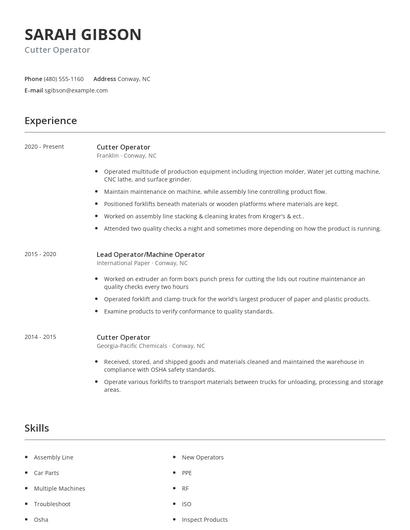
Compare different cutter operators
Cutter operator vs. Machine operator/forklift operator
A machine operator/forklift operator is responsible for operating industrial trucks to move merchandise around the warehouse facilities and other assigned areas. Machine operators/forklift operators also assist with inventory tasks by scanning orders and ensuring the correct merchandise for shipment. They manage the stability of the vehicles, ensuring its efficiency and optimization during operations, performing engine repairs for any inconsistencies to avoid delays on deliveries. A machine operator/forklift operator should strictly follow the safety protocols of the business, as well as have knowledge of the mechanical industry.
These skill sets are where the common ground ends though. The responsibilities of a cutter operator are more likely to require skills like "pallets," "math," "pallet jack," and "basic math." On the other hand, a job as a machine operator/forklift operator requires skills like "safety standards," "drive forklift," "load trucks," and "machine operation." As you can see, what employees do in each career varies considerably.
Machine operator/forklift operators really shine in the automotive industry with an average salary of $36,711. Comparatively, cutter operators tend to make the most money in the automotive industry with an average salary of $40,054.machine operator/forklift operators tend to reach similar levels of education than cutter operators. In fact, machine operator/forklift operators are 0.4% less likely to graduate with a Master's Degree and 0.1% more likely to have a Doctoral Degree.Cutter operator vs. Assembling machine operator
An assembling machine operator's role is to ensure the efficiency of assembly machines by setting or positioning the necessary components according to their sequence. Moreover, they must monitor the materials that the device produces, implement corrective measures if necessary, make sure that the machine is in good condition to maintain a safe working environment, and coordinate with the managers or supervisors should there be any issues. Furthermore, an assembling machine operator needs to adhere to the safety regulations and policies at all times.
In addition to the difference in salary, there are some other key differences worth noting. For example, cutter operator responsibilities are more likely to require skills like "quality checks," "pallets," "math," and "basic math." Meanwhile, an assembling machine operator has duties that require skills in areas such as "safety procedures," "machine operation," "quality control checks," and "press machine." These differences highlight just how different the day-to-day in each role looks.
Assembling machine operators earn a lower average salary than cutter operators. But assembling machine operators earn the highest pay in the automotive industry, with an average salary of $34,516. Additionally, cutter operators earn the highest salaries in the automotive with average pay of $40,054 annually.In general, assembling machine operators achieve similar levels of education than cutter operators. They're 0.3% less likely to obtain a Master's Degree while being 0.1% more likely to earn a Doctoral Degree.Cutter operator vs. Handle machine operator
A handle machine operator is responsible for operating production machines, conducting preventive maintenance, and ensuring optimal performance to prevent delays in orders or project deliverables. Handle machine operators analyze schematics and blueprints, inspect components for inconsistencies, replace defective parts, and upgrade systems as needed for higher operational efficiency. They also create resolution records for reference and manage maintenance standards to prevent downtimes. A handle machine operator must have excellent mechanical skills, especially on identifying machine problems and following specifications.
The required skills of the two careers differ considerably. For example, cutter operators are more likely to have skills like "quality checks," "pallets," "math," and "troubleshoot." But a handle machine operator is more likely to have skills like "forklifts," "cranes," "production lines," and "safety procedures."
Handle machine operators make a very good living in the manufacturing industry with an average annual salary of $34,314. On the other hand, cutter operators are paid the highest salary in the automotive industry, with average annual pay of $40,054.Most handle machine operators achieve a similar degree level compared to cutter operators. For example, they're 0.4% less likely to graduate with a Master's Degree, and 0.1% less likely to earn a Doctoral Degree.Cutter operator vs. Warehouse machine operator
Warehouse machine operators perform various tasks for their employers. These include setting up, operating, monitoring, and troubleshooting machinery, inspecting parts for specifications and any potential damage, and reading and interpreting diagrams and blueprints to position and secure the machines. They are expected to communicate with other team members and provide support for continuous production. Most employers are looking to hire someone with knowledge of production and safety procedures, previous experience as a machine operator, and analytical skills.
Even though a few skill sets overlap between cutter operators and warehouse machine operators, there are some differences that are important to note. For one, a cutter operator might have more use for skills like "quality checks," "pallets," "math," and "troubleshoot." Meanwhile, some responsibilities of warehouse machine operators require skills like "safety regulations," "electric pallet jack," "shipping receiving," and "load trucks. "
The manufacturing industry tends to pay the highest salaries for warehouse machine operators, with average annual pay of $36,642. Comparatively, the highest cutter operator annual salary comes from the automotive industry.In general, warehouse machine operators hold similar degree levels compared to cutter operators. Warehouse machine operators are 0.5% less likely to earn their Master's Degree and 0.1% more likely to graduate with a Doctoral Degree.Types of cutter operator
Updated January 8, 2025
