Explore jobs
Find specific jobs
Explore careers
Explore professions
Best companies
Explore companies
Job outlook for database analysts in the United States
Database analyst job growth summary. After extensive research, interviews, and analysis, Zippia's data science team found that:
The projected database analyst job growth rate is 9% from 2018-2028.
About 10,500 new jobs for database analysts are projected over the next decade.
Database analyst salaries have increased 12% for database analysts in the last 5 years.
There are over 130,528 database analysts currently employed in the United States.
There are 77,072 active database analyst job openings in the US.
The average database analyst salary is $85,660.
Are database analyst jobs in demand?
Database analyst job and salary trends over time
Database analyst jobs over time
Database analyst job growth rate over time
| Year | # of jobs | % of population |
|---|---|---|
| 2021 | 130,528 | 0.04% |
| 2020 | 50,794 | 0.02% |
| 2019 | 43,506 | 0.01% |
| 2018 | 50,088 | 0.02% |
| 2017 | 50,880 | 0.02% |
Average database analyst salary over time
Database analyst salary by year
| Year | Avg. salary | Hourly rate | % Change |
|---|---|---|---|
| 2026 | $85,660 | $41.18 | +3.4% |
| 2025 | $82,838 | $39.83 | +2.3% |
| 2024 | $80,962 | $38.92 | +3.5% |
| 2023 | $78,221 | $37.61 | +2.4% |
| 2022 | $76,360 | $36.71 | +4.0% |
Database analyst jobs by state
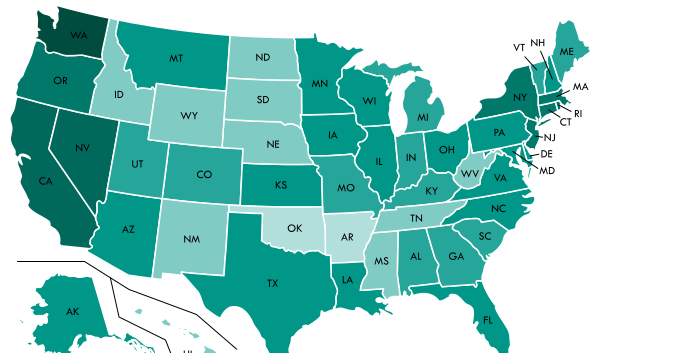
Most common states for database analysts
| Rank | State | Population | # of jobs | Employment/ 1000ppl |
|---|---|---|---|---|
| 1 | District of Columbia | 693,972 | 578 | 83% |
| 2 | Virginia | 8,470,020 | 1,712 | 20% |
| 3 | Maryland | 6,052,177 | 1,146 | 19% |
| 4 | Massachusetts | 6,859,819 | 1,176 | 17% |
| 5 | Delaware | 961,939 | 147 | 15% |
| 6 | Colorado | 5,607,154 | 701 | 13% |
| 7 | Rhode Island | 1,059,639 | 136 | 13% |
| 8 | Alaska | 739,795 | 97 | 13% |
| 9 | Minnesota | 5,576,606 | 684 | 12% |
| 10 | Oregon | 4,142,776 | 511 | 12% |
| 11 | Utah | 3,101,833 | 381 | 12% |
| 12 | Vermont | 623,657 | 77 | 12% |
| 13 | Illinois | 12,802,023 | 1,441 | 11% |
| 14 | North Carolina | 10,273,419 | 1,008 | 10% |
| 15 | New Jersey | 9,005,644 | 901 | 10% |
| 16 | Washington | 7,405,743 | 739 | 10% |
| 17 | Arizona | 7,016,270 | 707 | 10% |
| 18 | Connecticut | 3,588,184 | 347 | 10% |
| 19 | Kansas | 2,913,123 | 279 | 10% |
| 20 | Montana | 1,050,493 | 101 | 10% |
Most common cities for database analysts
| Rank | City | # of jobs | Employment/ 1000ppl | Avg. salary |
|---|---|---|---|---|
| 1 | Peabody | 3 | 6% | $86,290 |
| 2 | Annapolis | 2 | 5% | $79,746 |
| 3 | Bossier City | 3 | 4% | $82,235 |
| 4 | Albany | 2 | 3% | $77,528 |
| 5 | Huntsville | 4 | 2% | $79,009 |
| 6 | Little Rock | 4 | 2% | $66,132 |
| 7 | Salem | 3 | 2% | $85,934 |
| 8 | Washington | 6 | 1% | $80,984 |
| 9 | Atlanta | 4 | 1% | $78,346 |
| 10 | Sacramento | 3 | 1% | $104,119 |
| 11 | Tampa | 3 | 1% | $81,111 |
| 12 | Anchorage | 2 | 1% | $83,487 |
| 13 | Los Angeles | 4 | 0% | $92,645 |
| 14 | San Diego | 4 | 0% | $90,221 |
| 15 | Denver | 3 | 0% | $74,227 |
| 16 | Indianapolis | 3 | 0% | $74,603 |
| 17 | Baltimore | 2 | 0% | $79,743 |
Database Analyst job outlook: Expert opinions
Our panel of database analyst experts

UMass Lowell
Merrimack College
University of Cincinnati Clermont College
University of Washington
Widener University
Mississippi College
University of Southern Maine
Xavier University
Western Kentucky University
University of Missouri - Columbia
John Jay College of Criminal Justice of the City University of New York
University of California, Santa Cruz
Michael Ciuchta Ph.D.
Associate Professor, Program Coordinator, Masters of Science in EntrepreneurshipUMass Lowell
Department of Marketing, Entrepreneurship & Innovation
What general advice would you give to a Database Analyst?
Michael Ciuchta Ph.D.: Remember that your first job does not define your career. You may build a career around that first job or you may use it as a valuable learning experience to change careers at some point. Eventually, what we call our careers are only really seen in hindsight. They are part of a narrative we construct about ourselves. So, don't worry to much about whether you are on the 'right path'. The right path is the one you chose at the time given the constraints and alternatives before you. But make the most of every opportunity you can to learn more about yourself - what you like, what you don't like, and what you find fulfilling about your work.
What Database Analyst skills would you recommend for someone trying to advance their career?
Michael Ciuchta Ph.D.: Obviously we are seeing a tremendous increase in AI and other digital technologies. These will become a more crucial skill set for many careers going forward. But I wouldn't downplay the role of what are traditionally seen as soft skills like empathy, communications, and judgment. Not only can these distinguish you from robots but from your human competitors as well.
What will help Database Analysts increase their earning potential?
Michael Ciuchta Ph.D.: If all you want is the highest potential starting salary, then you should aim for careers that offer them. But that is a shortsighted way to view things. For example, many careers that have tournament-like pay structures (think entertainment) often have very low starting salaries but the so-called winners enjoy outsized financial gains. If you are thinking about a more traditional career, I think it's important to make sure you are more valuable to your employer than they are to you. This means you have to market yourself, both to your current employer as well as to potential ones. Of course, this approach may not be for everyone and maximizing your salary potential is only one thing you should be considering when assessing job and career opportunities.
What general advice would you give to a Database Analyst?
Yipeng Yang: Logic and critical thinking, mathematical modeling, computer programming, data analytics, and communication.
What Database Analyst skills would you recommend for someone trying to advance their career?
Yipeng Yang: Get to know clearly the job duties quickly. Make good connections with colleagues and listen to their advices.
What will help Database Analysts increase their earning potential?
Yipeng Yang: Enhance problem-solving ability. Keep learning and improving new skills in your field.
What general advice would you give to a Database Analyst?
Joseph Spivey: I’d start by becoming as knowledgeable as possible about the salaries of people in jobs you are interested in. Compare salaries for open positions; you may be able to use your knowledge as leverage to ask for more money. When you interview, ask not just about starting salary but about how raises and promotions are handled. I wish that I had learned some basic negotiation principles when I started my career. I’d recommend the book Getting to Yes: Negotiating Agreement Without Giving In.
What Database Analyst skills would you recommend for someone trying to advance their career?
Joseph Spivey: I think technology, especially artificial intelligence, provide increasingly important tools. Mathematics graduates will need to understand how to use technology in all kinds of new ways to improve their output and efficiency. Math graduates will need to be able to identify the best technological tools for a given task and critically interpret the output. As with most technological tools, people will be best served by using technology to augment, rather than replace, their efforts.
What will help Database Analysts increase their earning potential?
Joseph Spivey: My first piece of advice is to recognize that you have achieved something hard and worthwhile by completing a mathematics major. There are not many people on this planet who have the knowledge and skills that you have developed! By completing a math major, you have proven that you have excellent critical thinking and problem-solving skills, and these abilities and confidence in your abilities will pay off. I also think it’s worthwhile to identify a mentor early on who can help guide you to be successful.
Renee Robinson Ph.D.
Professor of CommunicationWhat will help Database Analysts increase their earning potential?
Renee Robinson Ph.D.: That would be awesome! We were hoping you could answer the following questions: 1. What general advice would you give to a graduate beginning their career in the field?
What will help Database Analysts increase their earning potential?
Marilyn Krogh: Have a strong undergraduate portfolio, do an internship before graduation, and be willing to 'go an extra mile' for your employer.
What general advice would you give to a Database Analyst?
Dr. Michael Zhang: In the coming years, turning data into insights and driving business innovation and success is the new compass.
What Database Analyst skills would you recommend for someone trying to advance their career?
Dr. Michael Zhang: Don’t worry about your job title. Regardless of what you do, prepare yourself with data and modeling skills and hands-on experience in applying knowledge for developing, evaluating, refining and implementing analytics solutions to your career.
What will help Database Analysts increase their earning potential?
Dr. Michael Zhang: All your study at University is a solid foundation of the bridge between theory and practice. Don’t be afraid of failure, be open-minded, keep learning and adapting to new challenges.
What Database Analyst skills would you recommend for someone trying to advance their career?
Adam Roth: I recommend that students start by identifying a specific skill in demand within your field, such as data analysis or social media marketing, and focus on developing expertise in that area. Research salary ranges and living costs in particular areas where you’re interested in working to ensure your compensation aligns with the local market. Always negotiate a salary and consider other aspects of the offer, such as funds for continuing education, technology and more. Continuing to network and establish demand for your services is essential; attend industry events, join professional associations, and engage with professionals in your field. Never miss an opportunity to reach out to and check in with your professional contacts. Pursue additional learning opportunities and education, such as certifications or advanced degrees, to provide a competitive advantage and increase your earning potential over time.
What will help Database Analysts increase their earning potential?
Bradley Andrew Ph.D.: Once you have your first job, ask about or determine the 20% of your supervisor’s job that they hate and start doing that for them. They will love you for it and it will quickly get you recognition. You’ll also be well on your way to learning your boss’s job. Continue doing this as you progress in your career (Kudos to Theo Epstein, former GM for the Red Sox, for this recommendation)
No matter the task you’re given, do it to the absolute best of your abilities. In the professional world, you may often be given menial tasks or tasks that you don’t believe are part of your job description. Doing those tasks to the absolute best of your ability leads to increased trust, recognition and responsibility and will put you “above class.” If asked, the coffee you bring should be the best your boss has ever had. You never know who’s watching.
Don’t expect credit and don’t ask for credit when things go right; give the credit to others.
What general advice would you give to a Database Analyst?
Melissa Zimdars: To remember that you're going to learn a lot on the job and that failure is part of the learning process. It's okay to ask questions and to not know things, but you must be willing to take feedback, adjust, and grow.
What will help Database Analysts increase their earning potential?
Melissa Zimdars: Recognize that your first career opportunity won't be your last. If the job you land after college does not have opportunities for growth or advancement, it's imperative that you keep an eye out for them elsewhere as you continue to gain experience in your field.
Fawen Zhang PhD
Professor of AudiologyUniversity of Cincinnati Clermont College
Communication Disorders Sciences And Services
What general advice would you give to a Database Analyst?
Fawen Zhang PhD: This is perfect! Thank you so much. We will be sure to feature your response in the article and send a draft over for your review before we promote it.
What Database Analyst skills would you recommend for someone trying to advance their career?
Fawen Zhang PhD: This is perfect! Thank you so much. We will be sure to feature your response in the article and send a draft over for your review before we promote it.
What will help Database Analysts increase their earning potential?
Fawen Zhang PhD: This is perfect! Thank you so much. We will be sure to feature your response in the article and send a draft over for your review before we promote it.
What general advice would you give to a Database Analyst?
Victor Menaldo: Learn, learn and learn some more. Adopt a growth mindset where you never stop learning. Gain economic literacy and financial literacy and historical literacy and statistical literacy. This will allow you to complement AI: ask it good questions, contextualize and evaluate its answers, and ask good follow up questions.
What Database Analyst skills would you recommend for someone trying to advance their career?
Victor Menaldo: Interacting with AI and knowing how to best exploit it to get the most out of it: increase productivity and value added in whatever field one is in.
What will help Database Analysts increase their earning potential?
Victor Menaldo: Develop oral communication skills that allow you to speak in an articulate manner and organize your thoughts to signal your competence, knowledge, work ethic, and willingness to keep learning and improving.
Tongyang Yang Ph.D.
Assistant Professor of Economics and Business AnalyticsWidener University
Business/Commerce
What Database Analyst skills would you recommend for someone trying to advance their career?
Tongyang Yang Ph.D.: The rise of AI has brought many opportunities for the professions like business analysts in terms of AI integration. Businesses will need analysts who can bridge the gap between AI and human needs and focus on more strategic areas like identifying ethical considerations of AI implementation, developing plans to mitigate AI bias, and designing human-AI collaboration workflows. For people who are interested in entering this profession, I would suggest adapting your skillset to include AI understanding, data storytelling, and strategic thinking to be well-positioned in the future.
What general advice would you give to a Database Analyst?
Taylor Poe Ph.D.: Remember to problem solve creatively just as you did in your coursework. The critical thinking and problem-solving skills you learned will be continually tested in whatever field you go into from your math degree. Also remember the benefits of collaborating with colleagues both in the field and in other disciplines.
What Database Analyst skills would you recommend for someone trying to advance their career?
Taylor Poe Ph.D.: Data analysis is certainly a growing field, and we cannot deny the benefits of having some programming skills. The ability to communicate and work with others will open doors to bigger projects.
What will help Database Analysts increase their earning potential?
Taylor Poe Ph.D.: Sell the strengths that set you apart and be willing to continue learning new skills and areas.
Tove Rasmussen
LecturerUniversity of Southern Maine
Specialized Sales, Merchandising And Marketing Operations
What general advice would you give to a Database Analyst?
Tove Rasmussen: Tove Rasmussen advises graduates beginning their career in the field to...
What Database Analyst skills would you recommend for someone trying to advance their career?
Tove Rasmussen: Tove Rasmussen believes that the skills that will become more important and prevalent in the field in the next 3-5 years are...
What will help Database Analysts increase their earning potential?
Dr. DAWN TOLONEN MBA: For the near future concentrate on three areas, soft skills, critical thinking, and artificial intelligence (AI). Your technical skills helped you land the job, but it’s your soft skills that lead to promotion.
Tim Scales
Director of Center for Entrepreneurship – Director Center for Economic Education and Senior Lecturer in Business and EconomicsWhat general advice would you give to a Database Analyst?
Tim Scales: I would advise a graduate beginning their career in the field to focus on building a strong network, continuously learning and adapting to new technologies and trends, and seeking mentorship from experienced professionals in the industry.
What Database Analyst skills would you recommend for someone trying to advance their career?
Tim Scales: To maximize salary potential when starting a career in the field, it's important to negotiate effectively, demonstrate value through performance, seek out opportunities for advancement and additional responsibilities, and continuously invest in improving skills and knowledge relevant to the industry.
What will help Database Analysts increase their earning potential?
Tim Scales: In the next 3-5 years, I believe skills such as data analysis, digital marketing, and adaptability to changing market conditions will become increasingly important and prevalent in the field.
What Database Analyst skills would you recommend for someone trying to advance their career?
Timothy Rich PhD: Think about the types of jobs that interest you and the skills necessary for those jobs early. So many students start thinking about post-graduation life spring their senior year, when it should be an incremental process much earlier. Another pieces of advice would be to talk to faculty and alum about your interests, find internship or research opportunities when possible, and try to figure out early your strengths and weaknesses. It's easy for students, especially high performing ones, to not fully consider what their weaknesses are. I encourage students to jot down what they see as their skills too and to share them with others. It helps them to identify what's a common skill versus something that might make them stick out.
What general advice would you give to a Database Analyst?
Matthew Sveum Ph.D.: I don’t think that there is a one-size-fits-all answer to this question. As I said above, building soft skills through internships, and also other experiences like study abroad, clubs, etc, is important to standing out in the workplace. Beyond that, it is important to pick a major that aligns with the career that the student wants, and to then network through internships, talking with guest speakers, etc. But it is also important to remember that the first job is just the starting point, and that promotions or job changes over time will improve their salary and title; they don’t need to jump in to the exact salary and title they eventually want.
Professor Shonna Trinch Ph.D.
ProfessorJohn Jay College of Criminal Justice of the City University of New York
Ethnic, Cultural Minority, Gender, And Group Studies
What general advice would you give to a Database Analyst?
Professor Shonna Trinch Ph.D.: Being able to negotiate a salary is also a skill that students need to learn and one that is rarely taught in college. Students need to be able to ask for more than they are offered, but also take jobs at entry levels, prove themselves and then ask for an increase in pay six months into the job after they have shown that they are doing the work and achieving their goals.
What general advice would you give to a Database Analyst?
Stephanie Lain Ph.D.: Look for a unionized job, preferably in a large institution where there is room for job growth. For students trained in linguistics, there are also often opportunities to work in tech, so this might be something to explore.
What Database Analyst skills would you recommend for someone trying to advance their career?
Stephanie Lain Ph.D.: I would advise graduates to be open to considering jobs in lots of different fields. The skills acquired through their major- such as problem-solving, critical thinking, and writing- are ones that transfer well to a variety of situations.