What does a direct care supervisor do?
Direct care supervisor responsibilities
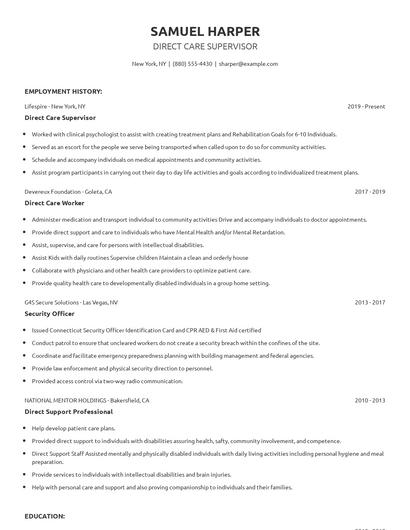
Here are examples of responsibilities from real direct care supervisor resumes:
- Keep coil tubing's frac tanks full of good filter water for duration of plug drill outs.
- Prepare files for file audits, as well as keeping the file up to Medicaid and DDS standards.
- Plug mill out and Frac assist.
- Certify in CPR and perform several XS.
- Rig in a junk catcher and sand trap.
- Conduct lessons and run daily activities of the program.
- Evaluate Medicare and Medicaid documents for accuracy, completeness, and billing purposes.
- Test that are ran are a ph and salinity test on the water.
- Provide OT evaluation, goal setting and ADL orient treatment to adult and geriatric population.
- Complete all ADL's and also assist with meal prep, light housekeeping and monitoring patient's needs and well being.
- Provide caring and companionship to elderly and developmentally disable consumers and provide primary resident care and assistance with daily living activities.
- Assist with obtaining community and/or Humana resources.
Direct care supervisor skills and personality traits
We calculated that 11% of Direct Care Supervisors are proficient in Mental Health, Substance Abuse, and CPR. They’re also known for soft skills such as Detail oriented, Integrity, and Interpersonal skills.
We break down the percentage of Direct Care Supervisors that have these skills listed on their resume here:
- Mental Health, 11%
Documented incident/accidents reports and mental health issues.
- Substance Abuse, 10%
Work in conjunction with the clinical team to manage residential groups such as substance abuse, relapse prevention, and DBT.
- CPR, 9%
Certified in CPR and performed several XS.
- Social Work, 8%
Work alongside with the psychologist, social worker and teachers to set goals for these individuals.
- Home Health, 7%
Maintain training needs and day to day managing of up to 125 home health nurses.
- Crisis Intervention, 5%
Utilize crisis interventions when there is an imminent safety threat, utilize authorized physical and/or mechanical restraint techniques.
Most direct care supervisors use their skills in "mental health," "substance abuse," and "cpr" to do their jobs. You can find more detail on essential direct care supervisor responsibilities here:
Detail oriented. One of the key soft skills for a direct care supervisor to have is detail oriented. You can see how this relates to what direct care supervisors do because "home health aides and personal care aides must adhere to specific rules and protocols and carefully follow instructions to help take care of clients." Additionally, a direct care supervisor resume shows how direct care supervisors use detail oriented: "provided ot evaluation, goal setting and adl oriented treatment to adult and geriatric population. "
Integrity. Another essential skill to perform direct care supervisor duties is integrity. Direct care supervisors responsibilities require that "home health aides and personal care aides should make clients feel comfortable when they tend to personal activities, such as helping a client bathe." Direct care supervisors also use integrity in their role according to a real resume snippet: "assisted individuals with supportive living activities and independent living skills while building relationships of trust and instilling confidence in clients. "
Interpersonal skills. This is an important skill for direct care supervisors to perform their duties. For an example of how direct care supervisor responsibilities depend on this skill, consider that "home health aides and personal care aides must work closely with clients." This excerpt from a resume also shows how vital it is to everyday roles and responsibilities of a direct care supervisor: "educated and modeled independent living, interpersonal relations and social skills. ".
Physical stamina. For certain direct care supervisor responsibilities to be completed, the job requires competence in "physical stamina." The day-to-day duties of a direct care supervisor rely on this skill, as "home health aides and personal care aides should be comfortable performing physical tasks." For example, this snippet was taken directly from a resume about how this skill applies to what direct care supervisors do: "direct patient care of individuals with mental and physical disabilities. "
The three companies that hire the most direct care supervisors are:
- Lifesteps14 direct care supervisors jobs
- Pathlight3 direct care supervisors jobs
- Indian Rivers Behavioral Health3 direct care supervisors jobs
Choose from 10+ customizable direct care supervisor resume templates
Build a professional direct care supervisor resume in minutes. Our AI resume writing assistant will guide you through every step of the process, and you can choose from 10+ resume templates to create your direct care supervisor resume.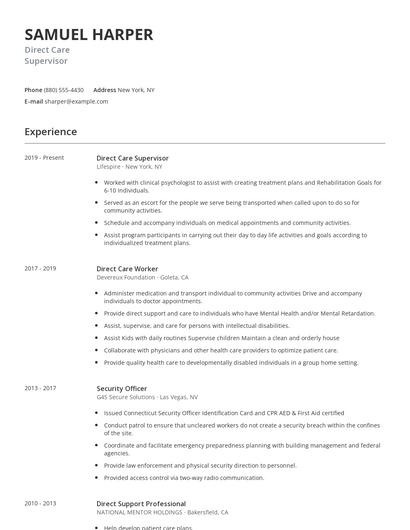
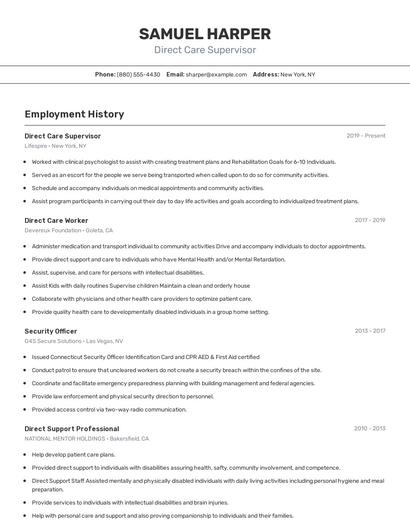


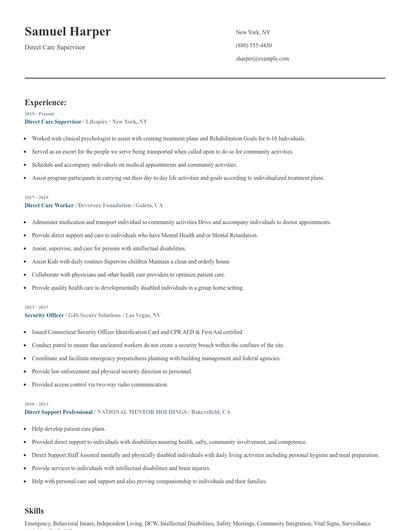

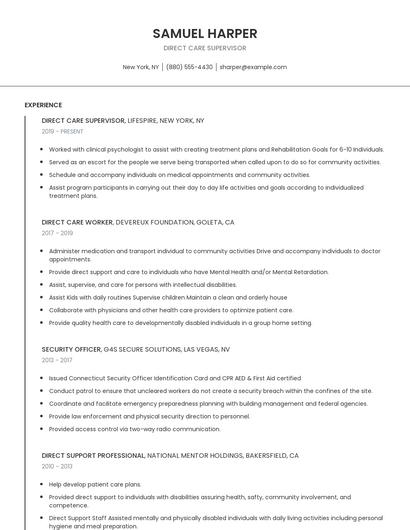
Compare different direct care supervisors
Direct care supervisor vs. Aide
Aides are personal employees of their clients who commonly have health issues that render them unable to do certain tasks. They help out their clients with activities they may need assistance in. They may do personal errands such as grocery shopping, cleaning, and cooking. They also provide care for their clients by helping them bathe, dress, brush their teeth, and other personal hygiene activities. Aides also help their clients walk, sit, and eat if their clients' motor functions are compromised. Aides are expected to be patient, caring, and trustworthy.
These skill sets are where the common ground ends though. The responsibilities of a direct care supervisor are more likely to require skills like "mental health," "substance abuse," "social work," and "community resources." On the other hand, a job as an aide requires skills like "patients," "compassion," "customer service," and "behavioral issues." As you can see, what employees do in each career varies considerably.
Aides earn the highest salaries when working in the health care industry, with an average yearly salary of $27,848. On the other hand, direct care supervisors are paid more in the construction industry with an average salary of $37,411.On average, aides reach similar levels of education than direct care supervisors. Aides are 2.1% less likely to earn a Master's Degree and 0.1% less likely to graduate with a Doctoral Degree.Direct care supervisor vs. Provider
Health care providers are health professionals and health organizations offering health care treatment and diagnosis services. These professionals play significant roles with patients through consultation, treatment, and advice. The health care they provide is of different variations. They even perform other procedures depending on the needs of the patients. Their responsibilities include comprehensive care and specialist work. Also, they help in duties, medication, and housekeeping. They transport clients to and from errands, activities, and appointments.
In addition to the difference in salary, there are some other key differences worth noting. For example, direct care supervisor responsibilities are more likely to require skills like "substance abuse," "home health," "crisis intervention," and "hr." Meanwhile, a provider has duties that require skills in areas such as "patients," "healthcare," "customer service," and "excellent interpersonal." These differences highlight just how different the day-to-day in each role looks.
Providers earn a higher average salary than direct care supervisors. But providers earn the highest pay in the health care industry, with an average salary of $55,214. Additionally, direct care supervisors earn the highest salaries in the construction with average pay of $37,411 annually.Average education levels between the two professions vary. Providers tend to reach similar levels of education than direct care supervisors. In fact, they're 0.0% less likely to graduate with a Master's Degree and 0.1% more likely to earn a Doctoral Degree.Direct care supervisor vs. Home manager
A home manager is responsible for a home's overall operation. Your duties typically include managing household schedules and calendars, planning and organizing events, and overseeing maintenance projects. In addition, you will be tasked to manage household bills and ensure good upkeep and maintenance of the house. Other duties include supervising other members of the household staff, ensuring the security and safety of the property at all times, and running errands, including shopping. You will also be responsible for managing the household inventory.
The required skills of the two careers differ considerably. For example, direct care supervisors are more likely to have skills like "substance abuse," "social work," "crisis intervention," and "incident reports." But a home manager is more likely to have skills like "patients," "cleanliness," "excellent organizational," and "direct supervision."
Home managers make a very good living in the manufacturing industry with an average annual salary of $82,414. On the other hand, direct care supervisors are paid the highest salary in the construction industry, with average annual pay of $37,411.When it comes to education, home managers tend to earn similar degree levels compared to direct care supervisors. In fact, they're 0.0% more likely to earn a Master's Degree, and 0.2% more likely to graduate with a Doctoral Degree.Direct care supervisor vs. Homemaker
Homemakers specialize in performing daily tasks related to cleanliness, organization, and other household routine activities such as cooking and laundry. Furthermore, a homemaker may also be responsible for looking after the care or welfare of children or the elderly. Among the duties may revolve around managing their schedules and assisting them in basic hygienic needs such as bathing, dressing, and feeding if necessary. A homemaker can also take charge of budgeting, often having to purchase groceries regularly and pay bills.
Types of direct care supervisor
Updated January 8, 2025
