What does a drilling fluids engineer do?
Together with a drilling rig engineer, a drilling fluids engineer helps with the pumping of fluids, testing liquids for unwanted particles. They also are involved in mixing fluids needed to drill oil or gas. Another task is providing reports for fluid properties acquired and giving recommendations. They keep a timely record of the performance of each staff member. If staffing is inadequate, they are also tasked to calculate funds for the drilling, allocating budget in both the procedures and miscellaneous expenses.
Drilling fluids engineer responsibilities
Here are examples of responsibilities from real drilling fluids engineer resumes:
- Manage Jenkins security by providing specific access to authorize developers/testers using project base matrix authorization strategy.
- Train on operations of OBM & WBM applications and products.
- General responsibilities in the field for analyzing WBM and OBM to drill horizontal wells.
- Develop a system to convey wireline tools on lateral open hole wells without pumping down.
- Work closely with field personnel to push performance, minimize NPT, and reduce cost / foot.
- Preform day to day operation and maintenance of wireline truck, crane and 5k and 10k pressure control equipment.
- Created/Implement rig site problem solutions.
- Supervise rig personnel during chemical additions and record parameters.
- Utilize proper procedures how to operate and troubleshoot under stressful situations.
- Expedite and simplify the quotation process for solar water heating systems by accurately representing solar water heating system performance through MATLAB models
- Load equipment for jobs.Ran Logging tools, perforating and set plugs.
- Transform usability designs into actionable development specifications and test plans for UI fundamentals, Java widgets and operator-specific cell phone applications.
Drilling fluids engineer skills and personality traits
We calculated that 15% of Drilling Fluids Engineers are proficient in Drilling Fluid, Fluid Systems, and Polymer. They’re also known for soft skills such as Analytical skills, Creativity, and Math skills.
We break down the percentage of Drilling Fluids Engineers that have these skills listed on their resume here:
- Drilling Fluid, 15%
Maintained the drilling fluid properties chemically and physically, supervised rig crews and ensured treatments were administered accurately and efficiently.
- Fluid Systems, 15%
Conduct physical and chemical tests on fluid systems to reinforce proper processes and remedy instabilities and issues in operations.
- Polymer, 8%
Worked the EXXON-Mobil project in CO. for two years with OBM and polymer mud.
- Logistics, 7%
Handled logistics through organization and coordinated chemical and fluid deliveries.
- CFD, 6%
Correlated CFD results to physical experiments through field-testing products.
- OBM, 4%
Worked with OBM and WBM on horizontal wells in the Permian Basin.
Common skills that a drilling fluids engineer uses to do their job include "drilling fluid," "fluid systems," and "polymer." You can find details on the most important drilling fluids engineer responsibilities below.
Analytical skills. To carry out their duties, the most important skill for a drilling fluids engineer to have is analytical skills. Their role and responsibilities require that "petroleum engineers must be able to compile and make sense of large amounts of technical information and data in order to ensure that facilities operate safely and effectively." Drilling fluids engineers often use analytical skills in their day-to-day job, as shown by this real resume: "collect fluid samples from oil or gas bearing formations and analyze sample to determine potential productivity of formation. "
Creativity. Another soft skill that's essential for fulfilling drilling fluids engineer duties is creativity. The role rewards competence in this skill because "because each new drill site is unique and therefore presents new challenges, petroleum engineers must be able to come up with creative designs to extract oil and gas." According to a drilling fluids engineer resume, here's how drilling fluids engineers can utilize creativity in their job responsibilities: "tabulate and prepare report every 24 hours for operator and field representative giving treatment recommendations, daily cost, and inventory. "
Math skills. This is an important skill for drilling fluids engineers to perform their duties. For an example of how drilling fluids engineer responsibilities depend on this skill, consider that "petroleum engineers use the principles of calculus and other advanced topics in math for analysis, design, and troubleshooting in their work." This excerpt from a resume also shows how vital it is to everyday roles and responsibilities of a drilling fluids engineer: "implemented simd math library and pool allocator for a basic game engine wrote shaders to implement phong shading and rendering in hlsl".
Problem-solving skills. A big part of what drilling fluids engineers do relies on "problem-solving skills." You can see how essential it is to drilling fluids engineer responsibilities because "identifying problems in drilling plans is critical for petroleum engineers because these problems can be costly." Here's an example of how this skill is used from a resume that represents typical drilling fluids engineer tasks: "determined cause of fluid, hole, or system problems and recommended the most effective and lowest cost solution. "
The three companies that hire the most drilling fluids engineers are:
- SpaceX11 drilling fluids engineers jobs
- Raytheon Technologies8 drilling fluids engineers jobs
- Applied Industrial Technologies4 drilling fluids engineers jobs
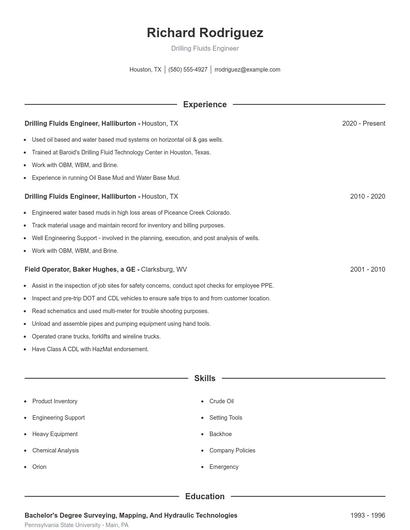
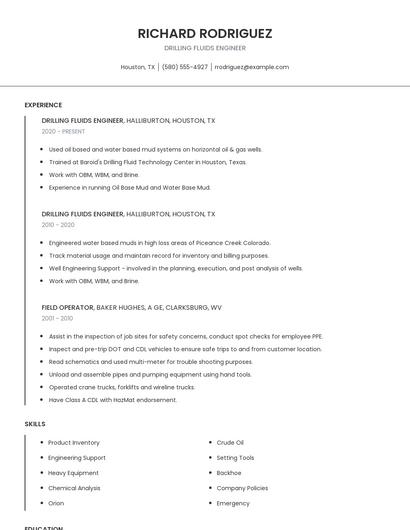
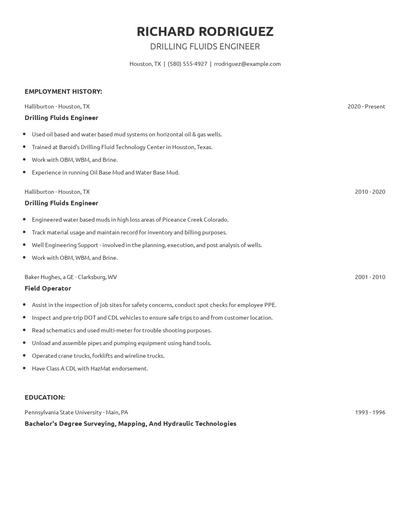
Choose from 10+ customizable drilling fluids engineer resume templates
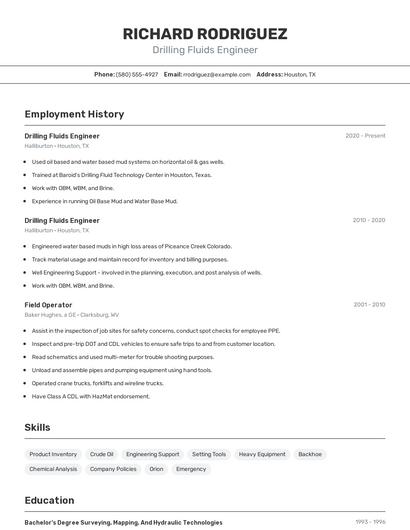
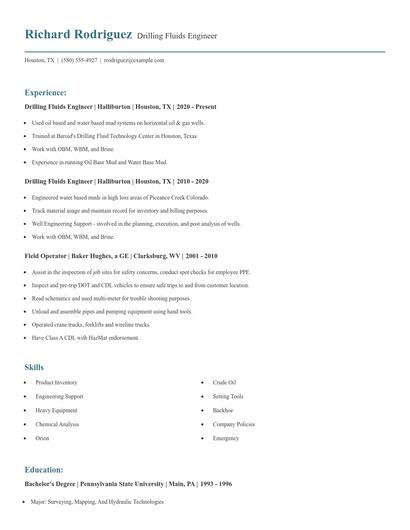
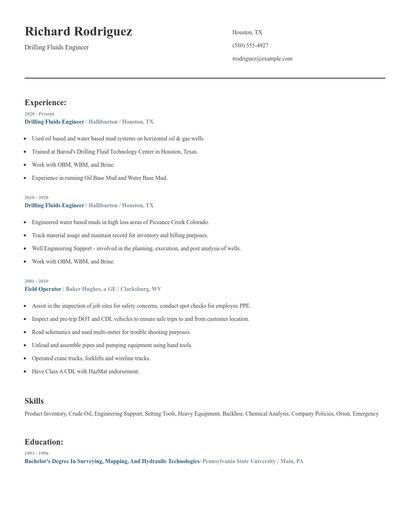
Build a professional drilling fluids engineer resume in minutes. Our AI resume writing assistant will guide you through every step of the process, and you can choose from 10+ resume templates to create your drilling fluids engineer resume.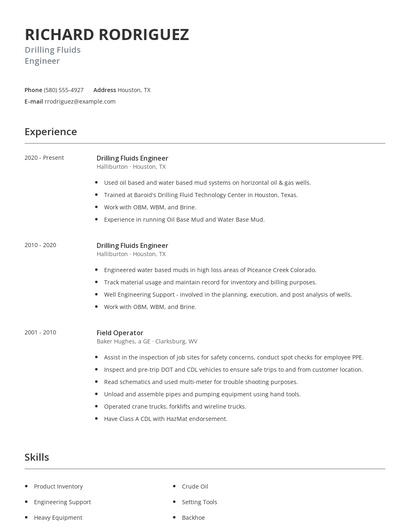


Compare different drilling fluids engineers
Drilling fluids engineer vs. Gas analyst
A gas analyst is faced with different responsibilities in the workplace. They are required to manage internal physical transactions with the gas management system. They may also be called upon to train new employees in GC-MS software and how to handle cylinders properly. Another duty of theirs is to analyze high-pressure cylinders of gas and check for purity using GC-MS. They may be in charge of monitoring some SCADA alarms and alerting field technicians to any problems.
There are some key differences in the responsibilities of each position. For example, drilling fluids engineer responsibilities require skills like "drilling fluid," "fluid systems," "polymer," and "logistics." Meanwhile a typical gas analyst has skills in areas such as "gas supply," "quantitative analysis," "sql," and "vba." This difference in skills reveals the differences in what each career does.
Gas analysts tend to make the most money working in the finance industry, where they earn an average salary of $90,153. In contrast, drilling fluids engineers make the biggest average salary, $104,653, in the energy industry.The education levels that gas analysts earn slightly differ from drilling fluids engineers. In particular, gas analysts are 1.7% more likely to graduate with a Master's Degree than a drilling fluids engineer. Additionally, they're 1.6% more likely to earn a Doctoral Degree.Drilling fluids engineer vs. Mud analysis supervisor
Engineers are highly trained professionals who determine the feasibility of various projects, usually related to the construction industry. They are considered experts in mathematics and science, two disciplines that they need to use in designing and coming up with plans for projects. They should also be well-versed in different construction or industrial materials, and they ensure that appropriate materials are used for the project. They also ensure that the projects meet the requirements of the groups that hired them. They create spaces that would both address the needs of the end-users and the industry standards. They also ensure that the projects they make would stand the test of time.
While some skills are similar in these professions, other skills aren't so similar. For example, resumes show us that drilling fluids engineer responsibilities requires skills like "drilling fluid," "fluid systems," "polymer," and "logistics." But a mud analysis supervisor might use other skills in their typical duties, such as, "autism," "executive leadership," "financial analyses," and "applied behavior analysis."
In general, mud analysis supervisors achieve higher levels of education than drilling fluids engineers. They're 11.0% more likely to obtain a Master's Degree while being 1.6% less likely to earn a Doctoral Degree.Drilling fluids engineer vs. Reservoir engineering consultant
The required skills of the two careers differ considerably. For example, drilling fluids engineers are more likely to have skills like "drilling fluid," "fluid systems," "polymer," and "logistics." But a reservoir engineering consultant is more likely to have skills like "eclipse," "field development," "economic analysis," and "pvt."
Most reservoir engineering consultants achieve a higher degree level compared to drilling fluids engineers. For example, they're 30.7% more likely to graduate with a Master's Degree, and 9.8% more likely to earn a Doctoral Degree.Drilling fluids engineer vs. Engineer
Types of drilling fluids engineer
Updated January 8, 2025
