What does an editorial director do?
An Editorial Director will plan, coordinate, and edit all written content for a publication or a website. As the Editorial Director, they are responsible for planning the company's vision for the publication, including its short- and long-term goals. They are also responsible for supervising other editors and developing the guidelines on the types of manuscripts they should seek. Other duties that Editorial Directors perform include planning the publication's contents, allocating work to editors-in-chief and editorial managers, and coordinating other departments' work as needed.
Editorial director responsibilities
Here are examples of responsibilities from real editorial director resumes:
- Lead triage of SEO issues.
- Manage messaging priorities, and press comments for YouTube, Google, and Guggenheim.
- Manage the reporting, video production, marketing, brand development and SEO of the brand s website and YouTube channel.
- Manage the implementation of large-scale editorial systems at commercial publishing, legal publishing, and in-plant publishing organizations.
- Manage research and editorial staff for production of print and on-line database-driven publications in the commercial real estate industry.
- Prepare site for forthcoming CMS upgrade and site redesign.
- Attend events in NYC as a representative of the company.
- Run SEO workshop sessions to increase the company's daily traffic.
- Promote website to build traffic through online marketing including Facebook ads and pay-per-click advertising.
- Write, edit, and proofread sales and marketing collateral and create content for social media.
- Play a hands-on role in reporting, writing, editing, proofreading, and selecting photographs for publication.
- Review and select manuscripts for print; proofread all material print to be publish; oversee daily operations.
- Supervise production and proofreading of typeset materials for company's clients (publishers, advertising agencies, design agencies).
- Serve as point person for editorial for the development and integration of a company-wide proprietary CMS system in agile development process.
- Work with best-selling personal finance author David Bach copywriting and editing for his transition to personal finance newsletters and online audiences.
Editorial director skills and personality traits
We calculated that 9% of Editorial Directors are proficient in Editorial Content, Web Content, and Editorial Strategy. They’re also known for soft skills such as Detail oriented, Good judgment, and Writing skills.
We break down the percentage of Editorial Directors that have these skills listed on their resume here:
- Editorial Content, 9%
Developed and implemented strategy for positioning, branding and enhancing the reputation of the university through digital editorial content.
- Web Content, 8%
Developed interactive web content based on contributions from Firefly users.
- Editorial Strategy, 6%
Created a viable editorial strategy to drive increased advertising support and specialized initiatives to bolster the organization's profitability.
- Content Strategy, 6%
Standardized content strategy throughout digital channels, developing consistent requirements and specifications for content management systems.
- Content Development, 5%
Budgeted and administered all content development costs and personnel.
- Project Management, 5%
Own prioritization and project management decisions for company-wide operations.
Common skills that an editorial director uses to do their job include "editorial content," "web content," and "editorial strategy." You can find details on the most important editorial director responsibilities below.
Detail oriented. To carry out their duties, the most important skill for an editorial director to have is detail oriented. Their role and responsibilities require that "editors must be meticulous to ensure that material is error free and matches the style of a publication." Editorial directors often use detail oriented in their day-to-day job, as shown by this real resume: "detailed fact checking, proofreading, article writing. "
Good judgment. Many editorial director duties rely on good judgment. "editors decide whether certain stories are ethical and whether there is enough evidence to publish them.," so an editorial director will need this skill often in their role. This resume example is just one of many ways editorial director responsibilities rely on good judgment: "budget - responsible for multiple budgets in the digital content department overseeing kcts 9 digital studios and what's good 206. "
Writing skills. This is an important skill for editorial directors to perform their duties. For an example of how editorial director responsibilities depend on this skill, consider that "editors ensure that all written content has correct grammar, punctuation, and syntax." This excerpt from a resume also shows how vital it is to everyday roles and responsibilities of an editorial director: "managed & trained writing staff in wordpress software, basic seo & content development".
Creativity. For certain editorial director responsibilities to be completed, the job requires competence in "creativity." The day-to-day duties of an editorial director rely on this skill, as "editors must be imaginative, curious, and knowledgeable in a broad range of topics." For example, this snippet was taken directly from a resume about how this skill applies to what editorial directors do: "cited by principals for possessing dual strengths in team leadership and creative content development. "
The three companies that hire the most editorial directors are:
- Southern Poverty Law Center5 editorial directors jobs
- HowStuffWorks3 editorial directors jobs
- Meredith Corporation2 editorial directors jobs
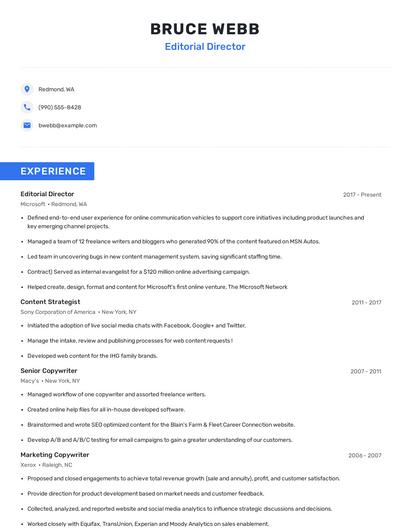
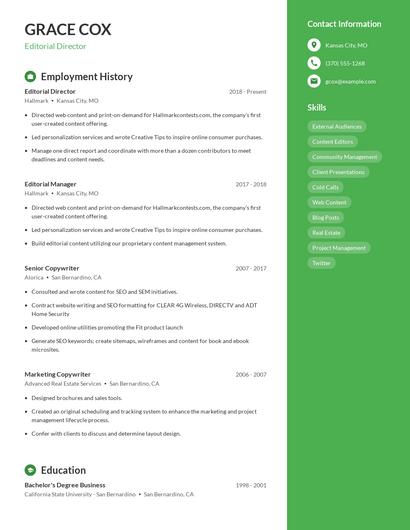
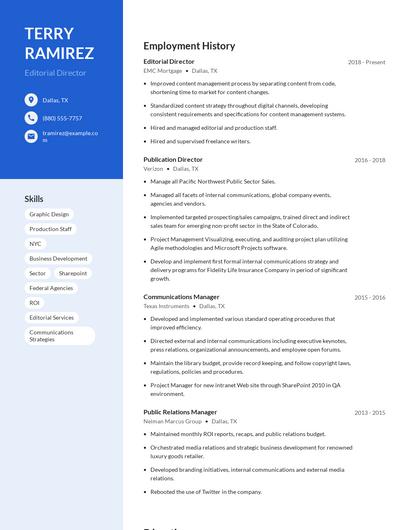
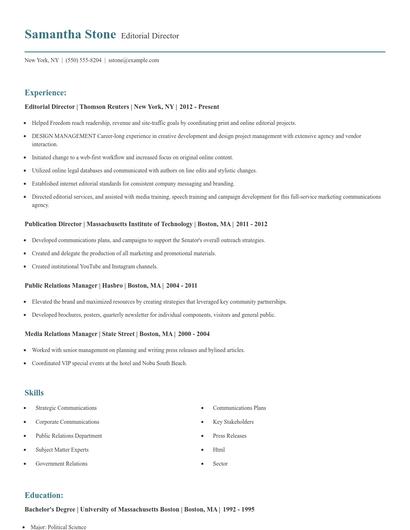
Choose from 10+ customizable editorial director resume templates
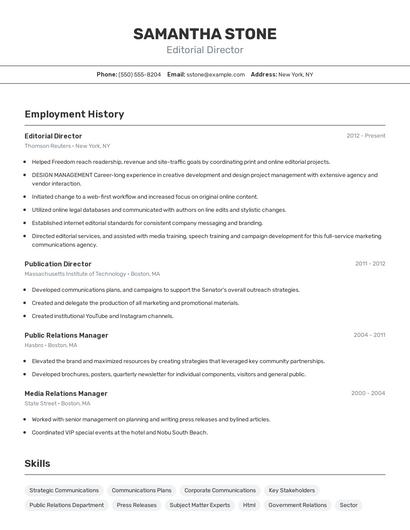
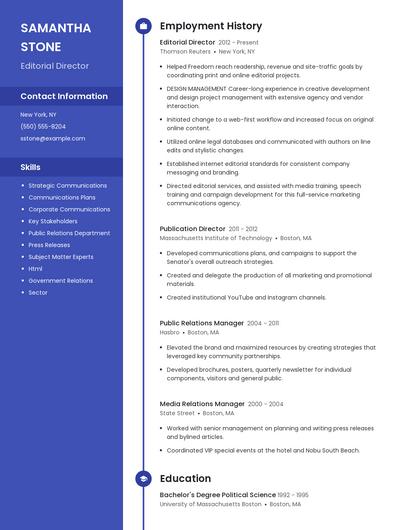
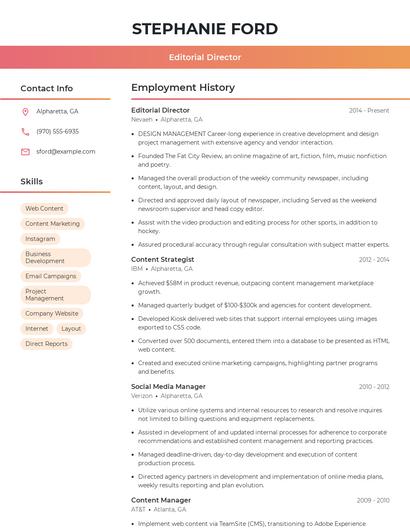
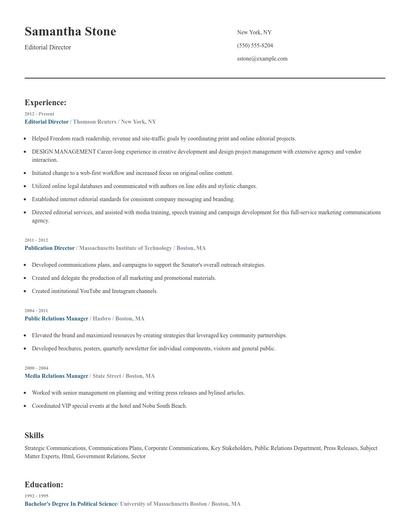
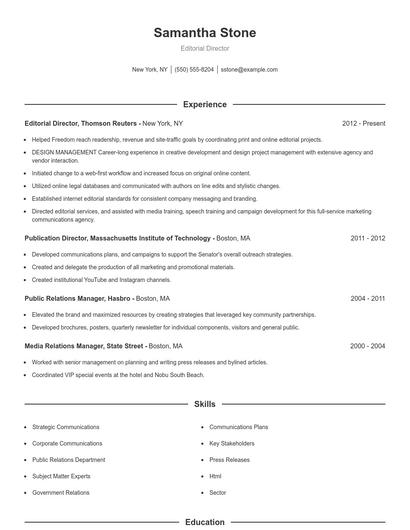
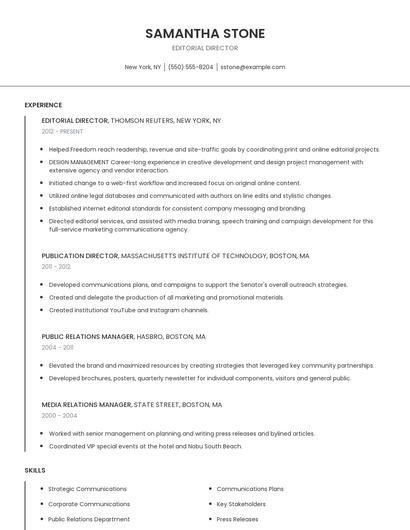
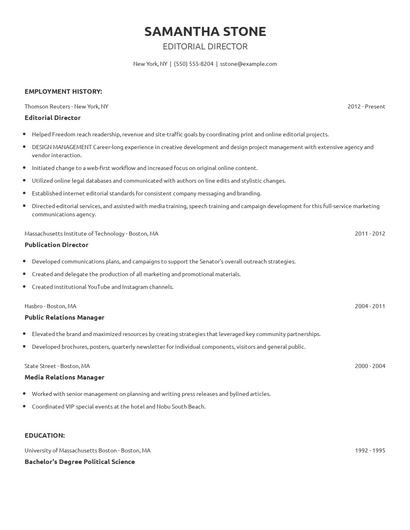
Build a professional editorial director resume in minutes. Our AI resume writing assistant will guide you through every step of the process, and you can choose from 10+ resume templates to create your editorial director resume.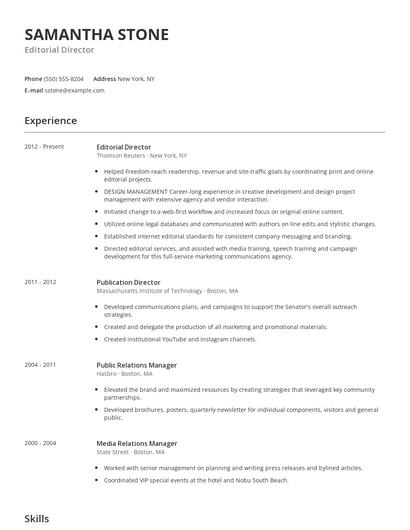
Compare different editorial directors
Editorial director vs. Publisher
A publisher manages the design, editing, and production process with the help of proofreaders, printers, and editors. Publishers make schedules for every stage of the process and work backward from the planned date for publication. They distribute promotional catalogs to libraries and booksellers. They set the commercial and editorial direction for businesses publishing newspapers, digital content, magazines, and books. It is their duty to make decisions on the markets that their firms will serve as well as the type of content that they will give to their audience.
There are some key differences in the responsibilities of each position. For example, editorial director responsibilities require skills like "editorial strategy," "content strategy," "project management," and "content creation." Meanwhile a typical publisher has skills in areas such as "customer satisfaction," "strategic thinking," "client facing," and "publishing industry." This difference in skills reveals the differences in what each career does.
Publishers earn the highest salaries when working in the telecommunication industry, with an average yearly salary of $69,908. On the other hand, editorial directors are paid more in the professional industry with an average salary of $100,162.The education levels that publishers earn slightly differ from editorial directors. In particular, publishers are 3.6% less likely to graduate with a Master's Degree than an editorial director. Additionally, they're 0.3% less likely to earn a Doctoral Degree.Editorial director vs. Senior copywriter
A Senior Copywriter is responsible for developing original written content. They generate immaculate copy for every brief.
In addition to the difference in salary, there are some other key differences worth noting. For example, editorial director responsibilities are more likely to require skills like "editorial content," "editorial strategy," "content creation," and "editorial calendar." Meanwhile, a senior copywriter has duties that require skills in areas such as "digital marketing," "healthcare," "seo," and "brainstorming." These differences highlight just how different the day-to-day in each role looks.
On average, senior copywriters earn a lower salary than editorial directors. Some industries support higher salaries in each profession. Interestingly enough, senior copywriters earn the most pay in the professional industry with an average salary of $98,856. Whereas editorial directors have higher pay in the professional industry, with an average salary of $100,162.Average education levels between the two professions vary. Senior copywriters tend to reach similar levels of education than editorial directors. In fact, they're 2.7% less likely to graduate with a Master's Degree and 0.3% less likely to earn a Doctoral Degree.Editorial director vs. Content writer
The job of content writers is to create the best possible written or visual content ranging from blog posts to press releases. They produce the content for various types of websites, including social networks, news aggregators, and e-commerce sites. The job of content writers is not limited to writing, but also ensuring that the content connects or is relevant to the website pages. They are expected to set the tone of the website and revise the content upon customers' or clients' requests. They are also responsible for assisting in the creation of style guides.
There are many key differences between these two careers, including some of the skills required to perform responsibilities within each role. For example, an editorial director is likely to be skilled in "editorial content," "editorial strategy," "project management," and "editorial standards," while a typical content writer is skilled in "digital marketing," "wordpress," "content writing," and "subject matter experts."
Content writers earn the highest salary when working in the finance industry, where they receive an average salary of $97,968. Comparatively, editorial directors have the highest earning potential in the professional industry, with an average salary of $100,162.When it comes to education, content writers tend to earn similar degree levels compared to editorial directors. In fact, they're 1.6% less likely to earn a Master's Degree, and 1.1% less likely to graduate with a Doctoral Degree.Editorial director vs. Senior writer
A senior writer is responsible for assisting junior writers in creating compositions and digital content according to business functions and client needs. A senior writer should have excellent communication skills, both written and oral, as well as extensive knowledge of composition structures and developing engaging pieces to attract the target audience and potential clients, driving resources for revenue and profits. They also coordinate with clients on any adjustments and instructions to support their goals and objectives.
Types of editorial director
Updated January 8, 2025
