What does an electrical controls engineer do?

An electrical controls engineer is responsible for monitoring the efficiency and optimal performance of the organization's electrical tools and equipment, usually in manufacturing and warehouse settings. Electrical controls engineers use their excellent analytical and statistical skills to analyze operational processes and suggest production improvement techniques maximize productivity and reduce service delays. They conduct preventive maintenance on the equipment and machinery, including network and system configuration, to increase efficiency and accuracy. An electrical controls engineer maintains operational reports, including equipment and machinery instructional manuals for reference.
Electrical controls engineer responsibilities
Here are examples of responsibilities from real electrical controls engineer resumes:
- Upgrade, troubleshoot and manage control systems for multiple businesses at the site location.
- Achieve low cost solution for professional tier radio with rug full color display and USB accessory interface.
- Introduce UL and NFPA codes and standards into electrical control panel designs.
- Design electrical controls and safety circuits for packaging machines, applying NEC codes, UL and CSA certification.
- Used a PID base code for precise iteration.
- Maintain and upgrade as necessary plant DCS Ethernet interface and assure its continue operation.
- Design and wire controls to NEC of machine new installation, modification, and relocation.
- Repair A/C for the hotel rooms, water pumps of the swimming pool, plumbing.
- Establish Ethernet communication between all the machines, up to and through the initial firewall setup.
- Determine plant area hazardous locations as required by NEC, API, ATEX, and other applicable codes.
- Set up hardware, design changes and debug logic for VFD implement on the flour type conveyor lines.
- Prepare power studies and design of electrical systems for new or upgrade facilities using ETAP and SKM modeling.
- Analyze equipment such as motors, transformers, load centers, and appliances to determine the origin and cause of damage
- Work across the organization to lead/support software development for various military applications for electrical, power electronics, HVAC, etc.
- Maintain and troubleshoot production automation equipment.
Electrical controls engineer skills and personality traits
We calculated that 12% of Electrical Controls Engineers are proficient in HMI, PLC, and Allen-Bradley. They’re also known for soft skills such as Concentration, Initiative, and Speaking skills.
We break down the percentage of Electrical Controls Engineers that have these skills listed on their resume here:
- HMI, 12%
Improved roll change operation by automating sequence and modifying PanelView HMI application.
- PLC, 11%
Designed and maintained electrical control systems using PLC based hardware and ladder logic software
- Allen-Bradley, 6%
Manufacture Company, Madison Height, MI * A PC based 6 axes CNC machine * Allen-Bradley Series-9 CNC machine.
- UL, 5%
Documented all changes with new control panel design in compliance with UL 508A and updated the reports accordingly.
- Hmi Programming, 4%
Project Management, Estimating, Purchasing, Panel Design, PLC & HMI Programming & Networking, Commissioning & Start Up.
- Project Management, 3%
Developed competencies and expertise in electrical design, project management and manufacturing processes.
"hmi," "plc," and "allen-bradley" are among the most common skills that electrical controls engineers use at work. You can find even more electrical controls engineer responsibilities below, including:
Concentration. One of the key soft skills for an electrical controls engineer to have is concentration. You can see how this relates to what electrical controls engineers do because "electrical and electronics engineers design and develop complex electrical systems and electronic components and products." Additionally, an electrical controls engineer resume shows how electrical controls engineers use concentration: "design, programming and installation of process control equipment for variety of customers with special concentration in the plastic compounding industry. "
Initiative. Many electrical controls engineer duties rely on initiative. "electrical and electronics engineers must apply their knowledge to new tasks in every project they undertake," so an electrical controls engineer will need this skill often in their role. This resume example is just one of many ways electrical controls engineer responsibilities rely on initiative: "managed manufacturing automation, continuous improvement, and lean cell initiatives for a 40,000 sq. "
Speaking skills. Another skill that relates to the job responsibilities of electrical controls engineers is speaking skills. This skill is critical to many everyday electrical controls engineer duties, as "electrical and electronics engineers work closely with other engineers and technicians." This example from a resume shows how this skill is used: "represented the company as sight manager to install system startups and debug processes. "
Math skills. For certain electrical controls engineer responsibilities to be completed, the job requires competence in "math skills." The day-to-day duties of an electrical controls engineer rely on this skill, as "electrical and electronics engineers must use the principles of calculus and other advanced math in order to analyze, design, and troubleshoot equipment." For example, this snippet was taken directly from a resume about how this skill applies to what electrical controls engineers do: "developed control system with simulink and mathworks xpc targetbox. "
Writing skills. A commonly-found skill in electrical controls engineer job descriptions, "writing skills" is essential to what electrical controls engineers do. Electrical controls engineer responsibilities rely on this skill because "electrical and electronics engineers develop technical publications related to equipment they develop, including maintenance manuals, operation manuals, parts lists, product proposals, and design methods documents." You can also see how electrical controls engineer duties rely on writing skills in this resume example: "worked as part of a team writing the plc code for new robotic work cells. "
The three companies that hire the most electrical controls engineers are:
- Black & Veatch26 electrical controls engineers jobs
- Health Care
22 electrical controls engineers jobs
- Honeywell21 electrical controls engineers jobs
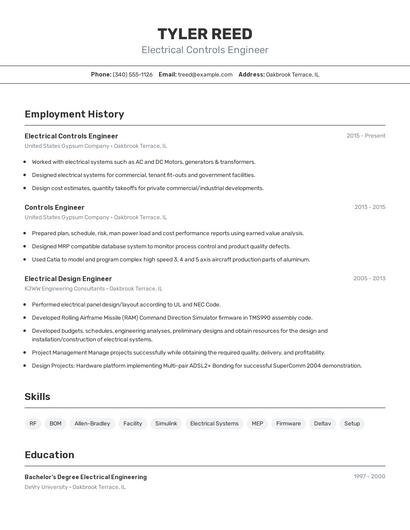
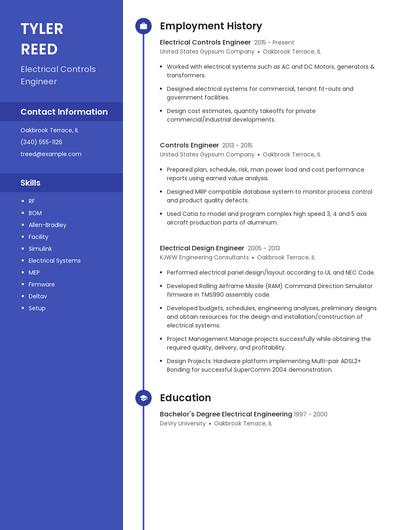
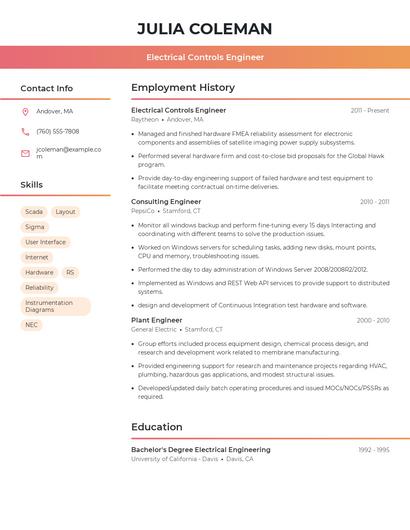
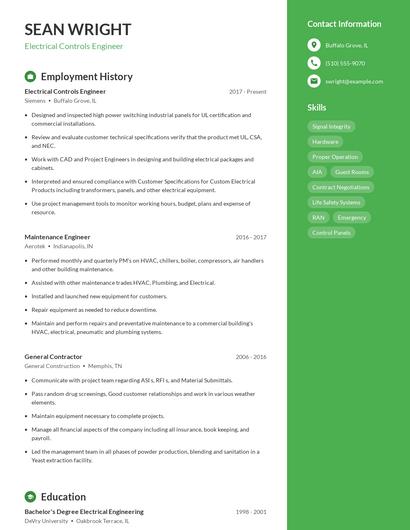
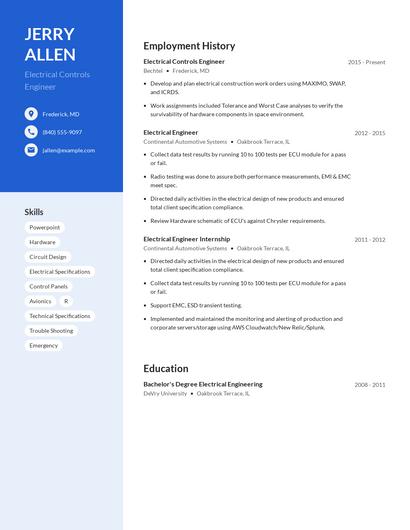
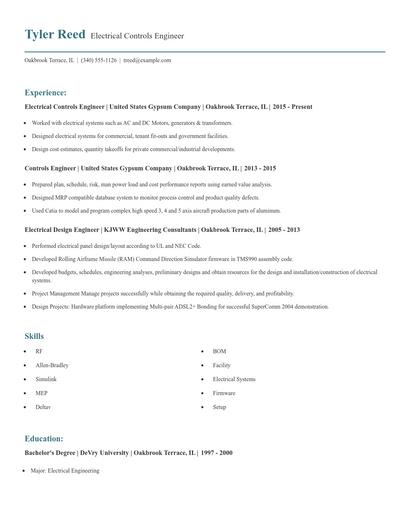
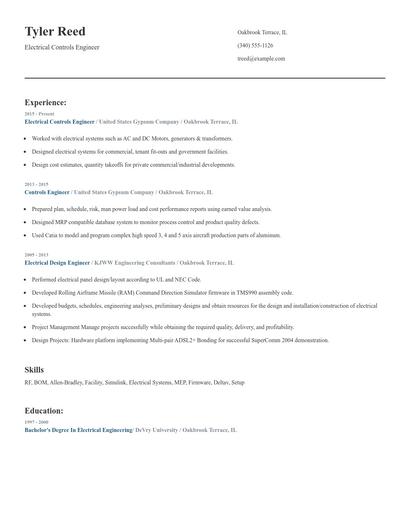
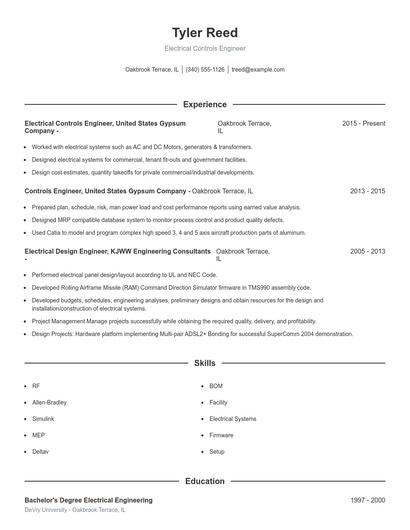
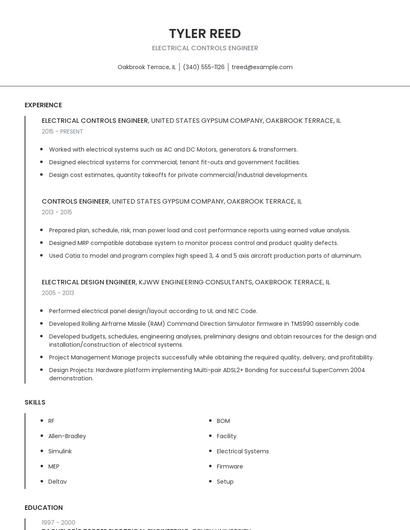
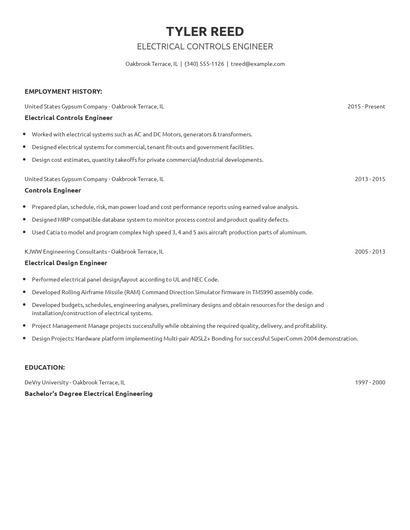
Choose from 10+ customizable electrical controls engineer resume templates
Build a professional electrical controls engineer resume in minutes. Our AI resume writing assistant will guide you through every step of the process, and you can choose from 10+ resume templates to create your electrical controls engineer resume.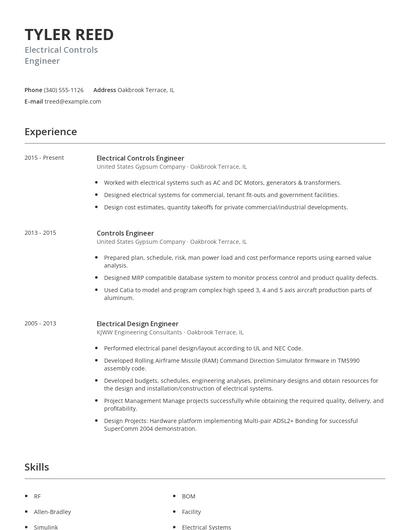

Compare different electrical controls engineers
Electrical controls engineer vs. Senior field engineer
A senior field engineer is in charge of overseeing and providing technical support on-site, helping operations run smoothly and efficiently. Among their responsibilities include performing installations and upgrades, performing research and analysis, managing staff, producing progress reports, and conducting inspections, ensuring compliance with state laws and regulations. They must also perform regular maintenance checks on equipment, performing corrective repairs and adjustments when necessary. Furthermore, as a senior field engineer, it is essential to lead and serve as a mentor to junior engineers while implementing the site's safety policies and regulations.
While similarities exist, there are also some differences between electrical controls engineers and senior field engineer. For instance, electrical controls engineer responsibilities require skills such as "hmi," "allen-bradley," "ul," and "hmi programming." Whereas a senior field engineer is skilled in "rf," "excellent interpersonal," "technical problems," and "test equipment." This is part of what separates the two careers.
Senior field engineers really shine in the energy industry with an average salary of $107,400. Comparatively, electrical controls engineers tend to make the most money in the automotive industry with an average salary of $91,443.On average, senior field engineers reach similar levels of education than electrical controls engineers. Senior field engineers are 3.0% less likely to earn a Master's Degree and 0.2% less likely to graduate with a Doctoral Degree.Electrical controls engineer vs. Engineer
Engineers are highly trained professionals who determine the feasibility of various projects, usually related to the construction industry. They are considered experts in mathematics and science, two disciplines that they need to use in designing and coming up with plans for projects. They should also be well-versed in different construction or industrial materials, and they ensure that appropriate materials are used for the project. They also ensure that the projects meet the requirements of the groups that hired them. They create spaces that would both address the needs of the end-users and the industry standards. They also ensure that the projects they make would stand the test of time.
Each career also uses different skills, according to real electrical controls engineer resumes. While electrical controls engineer responsibilities can utilize skills like "hmi," "allen-bradley," "ul," and "autocad electrical," engineers use skills like "python," "cloud," "c++," and "c #."
Engineers earn a higher average salary than electrical controls engineers. But engineers earn the highest pay in the automotive industry, with an average salary of $97,672. Additionally, electrical controls engineers earn the highest salaries in the automotive with average pay of $91,443 annually.engineers earn similar levels of education than electrical controls engineers in general. They're 2.0% more likely to graduate with a Master's Degree and 0.2% more likely to earn a Doctoral Degree.Electrical controls engineer vs. Junior engineer
A Junior Engineer helps design, build, or maintain engines, machines, or public works. They work under the supervision of an engineer.
There are many key differences between these two careers, including some of the skills required to perform responsibilities within each role. For example, an electrical controls engineer is likely to be skilled in "hmi," "allen-bradley," "ul," and "hmi programming," while a typical junior engineer is skilled in "control systems," "java," "c++," and "c #."
Junior engineers earn the best pay in the technology industry, where they command an average salary of $72,489. Electrical controls engineers earn the highest pay from the automotive industry, with an average salary of $91,443.junior engineers typically earn similar educational levels compared to electrical controls engineers. Specifically, they're 1.0% less likely to graduate with a Master's Degree, and 0.2% less likely to earn a Doctoral Degree.Electrical controls engineer vs. Field engineer
A field engineer's role will vary on the industry or line of work involved. However, the primary responsibility will mostly revolve around handling equipment and machinery, ensuring that they function effectively and safely. It is also the task of a field engineer to oversee the workflow and workforce, giving directions and recommendations when necessary. Furthermore, a field engineer must develop strategies and plans to improve the site's efficiency, produce progress reports, and coordinate with other workers.
Types of electrical controls engineer
Updated January 8, 2025
